


Executive Summary
Key Takeaways
Data integrity has evolved from separate governance, data quality and master data management practices into a coordinated discipline for establishing trusted enterprise data. Enterprises increasingly depend on accurate, complete and consistent data to accelerate analytics, BI and AI while meeting privacy and regulatory requirements. AI, GenAI and agentic AI are simultaneously increasing data governance demands and automating activities such as classification, quality assessment, lineage and sensitive-data identification.
Software Provider Summary
The ISG Buyers Guide™ for Data Integrity evaluates 26 software providers offering products that support data governance, data quality and master data management. The research ranked the top three overall as Salesforce, IBM and SAP. Actian, Alation, AWS, Collibra, Databricks, IBM, Microsoft, Pentaho, Precisely, Salesforce and SAP were rated Exemplary, with Ataccama and Syniti rated Innovative. Google Cloud and Oracle were rated as providers of Assurance, and Alibaba Cloud, Atlan, Cloud Software Group, Experian, Huawei Cloud, OvalEdge, Qlik, Quest, SAS, Snowflake and Tencent Cloud were rated providers of Merit. IBM, Actian and Salesforce were identified as Leaders for Data Governance, while Boomi, SAP and Oracle were identified as Leaders for Master Data Management.
Product Experience Insights
Product Experience, representing 80% of the evaluation, focuses on Capability (50%) and Platform (30%), including adaptability, manageability, reliability and usability. Salesforce, IBM and SAP were the Product Experience Leaders. Performance reflects requirements spanning metadata management, data lineage, data profiling and quality rules, data modeling and stewardship, and AI for governance, data quality and MDM.
Customer Experience Value
Customer Experience, representing 20% of the evaluation, focuses on validation and TCO/ROI. Oracle, AWS and IBM were the Customer Experience Leaders and best communicate commitment and dedication to customer needs. Providers with lower performance may lack sufficient information demonstrating customer success, customer commitment or TCO/ROI value.
Strategic Recommendations
Enterprises should evaluate data integrity platforms based on the ability to establish trusted, consistent data across operational, analytical and AI use cases. Assessment should prioritize governance and regulatory controls, data quality, metadata and lineage, MDM, data stewardship and automation. Organizations should also evaluate AI-enabled classification and quality management while ensuring GenAI and agentic AI initiatives incorporate privacy, sensitive-data controls, bias mitigation and appropriate governance.
The Findings
The software providers and products evaluated in this research offer product and customer experiences, but not every feature is equally valuable to every enterprise or is needed to support the relevant business processes and use cases. Moreover, having too many product capabilities may be a negative factor for an enterprise if it introduces unnecessary complexity. Nonetheless, you may decide that a more comprehensive set of capabilities is important and meets your enterprise’s requirements.
An effective customer relationship with a software provider is vital to the success of any investment. The overall customer experience and the full lifecycle of engagement play a key role in ensuring satisfaction and long-term success. Providers with dedicated customer 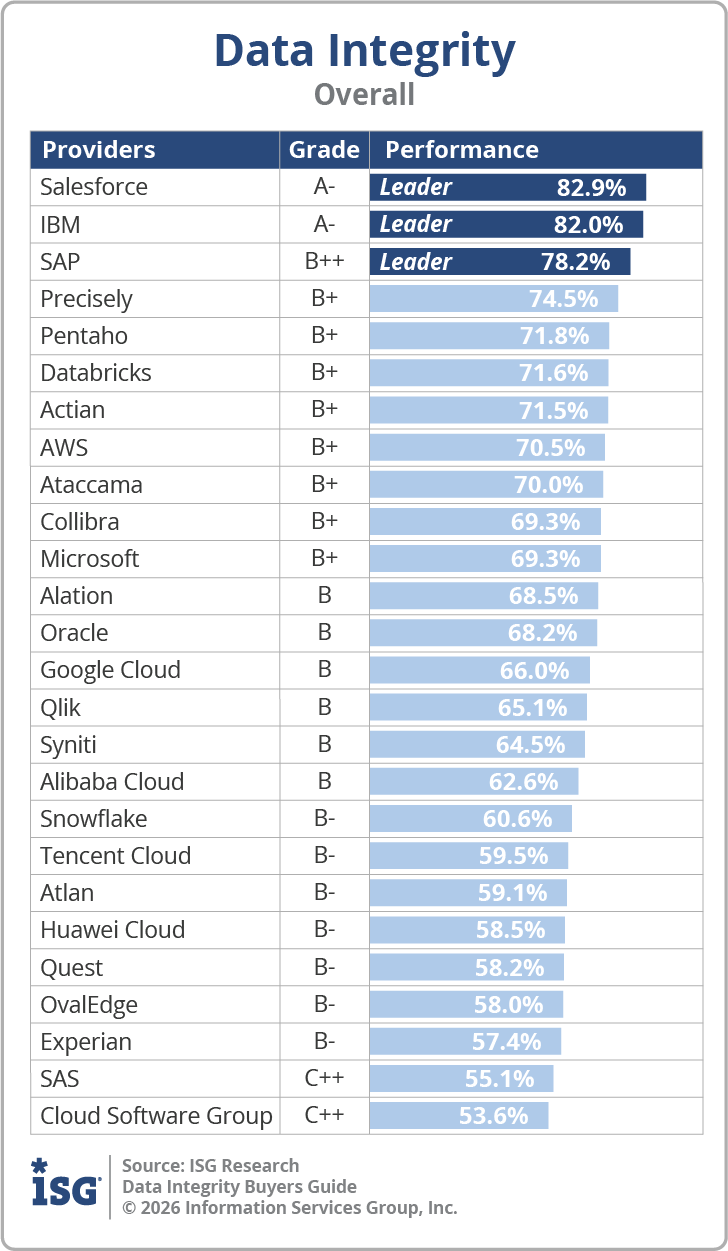 leadership, such as chief customer officers, tend to invest more deeply in these relationships and prioritize customer outcomes in line with TCO and ROI expectations. It is equally important that this commitment to customer success is evident throughout the provider’s website, the buying process and the customer journey.
Overall Scoring of Software Providers Across Categories
The research finds Salesforce atop the list, followed by IBM and SAP. Providers that place in the top three of a category earn the designation of Leader. IBM has done so in four categories, Salesforce and SAP in three, Oracle in two and AWS, Databricks and Microsoft in one category.
About the authors

Matt Aslett