


Executive Summary
Key Takeaways
Data quality and data observability have evolved into complementary disciplines for establishing and maintaining trust across increasingly complex data environments. Enterprises need to assess data accuracy, freshness and reliability while proactively monitoring pipelines to prevent issues from disrupting analytics and AI. Automation, machine learning, DataOps and growing generative and agentic AI requirements are increasing the importance of continuous data monitoring, error detection and remediation.
Software Provider Summary
The ISG Buyers Guide™ for Data Quality and Data Observability evaluates 13 software providers offering products supporting data quality and data observability. The research ranked the top three overall as Acceldata, Pentaho and Databricks. Acceldata, Actian, Collibra, Databricks, IBM, Pentaho and Qlik were rated Exemplary. Precisely and Salesforce were rated as providers of Assurance, and Ataccama, Quest, Snowflake and Tencent Cloud were rated providers of Merit. Acceldata, Actian and Pentaho were identified as Leaders for Data Quality, while Monte Carlo, Acceldata and Pentaho were identified as Leaders for Data Observability.
Product Experience Insights
Product Experience, representing 80% of the evaluation, focuses on Capability (50%) and Platform (30%), including adaptability, manageability, reliability and usability. Acceldata, Pentaho and Databricks were the Product Experience Leaders. Performance reflects differentiated requirements spanning data profiling, quality rules and insights, AI for data quality, and observability capabilities for detection, resolution and prevention.
Customer Experience Value
Customer Experience, representing 20% of the evaluation, focuses on validation and TCO/ROI. IBM, Collibra and Databricks were the Customer Experience Leaders and best communicate commitment and dedication to customer needs. Providers with lower performance may lack sufficient information demonstrating customer success, customer commitment or TCO/ROI value.
Strategic Recommendations
Enterprises should evaluate data quality and observability platforms based on the ability to establish trust in data while proactively identifying and preventing reliability issues. Assessment should prioritize automated error detection, root cause analysis, remediation workflows, data profiling and quality rules, pipeline monitoring, and AI-enabled automation. Organizations should align functionality with specific business needs while ensuring reliable, fresh and accurate data for analytics, generative AI and agentic AI initiatives.
The Findings
The software providers and products evaluated in this research offer product and customer experiences, but not every feature is equally valuable to every enterprise or is needed to support the relevant business processes and use cases. Moreover, having too many product capabilities may be a negative factor for an enterprise if it introduces unnecessary complexity. Nonetheless, you may decide that a more comprehensive set of capabilities is important and meets your enterprise’s requirements.
An effective customer relationship with a software provider is vital to the success of any investment. The overall customer experience and the full lifecycle of engagement play a key role in ensuring satisfaction and long-term success. Providers with dedicated customer leadership, such as chief customer officers, tend to invest more deeply in these relationships and prioritize customer outcomes in line with TCO and ROI expectations. It is equally important that this commitment to customer success is evident throughout the provider’s website, the buying process and the customer journey.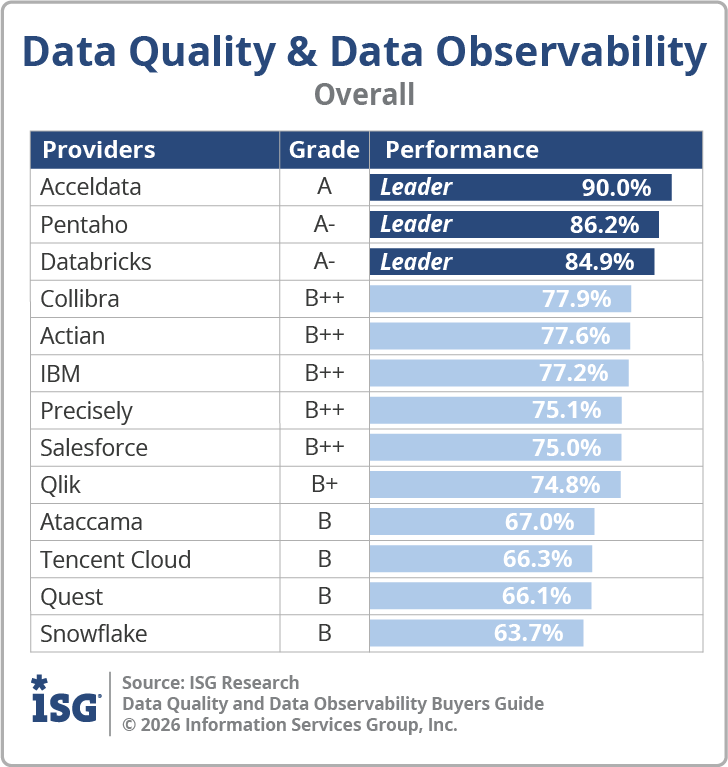
Overall Scoring of Software Providers Across Categories
The research finds Acceldata atop the list, followed by Pentaho and Databricks. Providers that place in the top three of a category earn the designation of Leader. Databricks has done so in five categories, Acceldata and Pentaho in four and Collibra and IBM in one category.
About the authors

Matt Aslett