

It’s clear that the contact center industry is experiencing a generational technological transformation. The effects of artificial intelligence (AI) and the automation it delivers have been extraordinary. But this isn’t the first time something like this has happened. People with long memories can recall the disruptive effects of CTI, for example, which enabled screen pops and integration of voice and data. Or the shift in routing from TDM to IP, enabling digital channels. Or the shift to the cloud, or to social media for service, and so forth.
Operational practices remained pretty stable during past transitions. Despite technology changes, the basic structure of contact centers remained recognizable to veterans: human agents in seats, supervisors walking around, ACDs at the heart of things. That started to change around the time of the pandemic, with accelerated normalization of remote agents. And then something sneakier started to happen. Contact centers began to be seen as strategic data hubs, valuable in new ways to their enterprises, not just as cost centers.
All of which is to say, contact center leadership has a new set of challenges ahead of it.
The downstream consequences of this current set of transformations on operations, employees, consumers and leadership are massive and unpredictable. In operations, we now have AI-powered virtual agents, intelligent routing and other tools to reduce call volumes handled by humans, lowering costs and smoothing demand spikes. This reshapes operational models from labor-centric to hybrid human+machine.
Employees’ roles are being redefined. When routine queries are increasingly automated, human agents can be reserved for high-complexity, emotional or escalated cases—shifting their role toward empathy, negotiation and problem-solving.
Consumers sometimes see experience improvements by way of faster service, 24/7 availability and more personalized interactions. Poor implementation of chatbots risks frustrating consumers so that they may still demand easy escalation to humans.
And leadership now must navigate rapidly shifting provider ecosystems (cloud, AI, analytics) while balancing cost pressures against strategic differentiation. AI is pushing contact centers into a new operational model where automation handles scale and humans handle depth. For leadership, success hinges on orchestrating this balance while managing talent, trust and technology adoption.
What’s happening is that there’s a shift in the core function of the center from pure interaction handling to something more like a collector of customer data, becoming the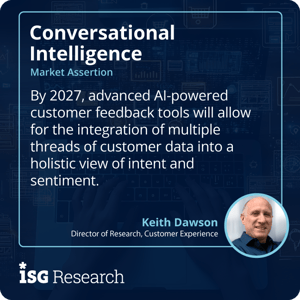 place where the organization orchestrates complex interactions. We predict that by 2027, advanced AI-powered customer feedback tools will allow for the integration of multiple threads of customer data into a holistic view of intent and sentiment.
This comes with a flattening of the hierarchy: traditional structures built around call queues, supervisors and tiered escalation shrink. Instead, teams organize around customer journeys, digital workflows and knowledge management. When that happens, centers align more closely with digital experience teams, IT and product management because the bulk of customer service relies on seamless applications and automated systems.
That allows metrics to shift from efficiency-based (e.g., AHT, calls per hour) to effectiveness and experience (FCR, CSAT/NPS by channel and digital containment rates). And there starts to be greater emphasis on cross-channel analytics to measure where customers drop out of digital flows or where human escalation is triggered. This is the beginning of professionalized journey management.
Thus, the contact center evolves from a volume-driven call factory into a strategic, digitally integrated engagement hub. The infrastructure shifts away from an interaction-handling focus to a broader tech stack focused on orchestration, outcomes and analysis. Infrastructure used to revolve around ACDs, IVRs and workforce management tools, all optimized for real-time call handling efficiency. But in the new AI and automation world, platforms focus on customer journey orchestration across channels. Routing is no longer about “which person answers the call,” but “what’s the best mix of automation, self-service, and human expertise at each touchpoint.”
Leadership needs to shift focus to a different set of important tools. I think the areas that need the most executive attention are knowledge management, data management, journey optimization and customer analytics.
Knowledge is a gimme. In a digital-first world, customers often start with self-service or AI-driven chat. Both require accurate, centralized knowledge to work reliably, so knowledge management becomes the content backbone that powers all channels—bots, agents, FAQs, proactive notifications. Without it, automation fails and human escalation skyrockets.
Orchestration platforms act as traffic controllers, ensuring that customers are guided toward the right next best action and that the organization is actively driving customers towards outcomes that are desirable for both parties.
When leadership considers what to purchase, people can move past thinking that the routing engine or the ACD has to be the foundational element of the tech stack. Instead, planning can focus on the component that makes the most sense in that particular context and build out from there, knowing that integrations are standard. They’re not forced into a contact center-shaped box anymore. For the first time, contact center execs must understand the customer journey end to end and not just at the service point. They need to think in terms of how service interacts with marketing automation, sales funnels, commerce platforms and loyalty programs.
Further, it’s necessary to grasp the enterprise customer experience (CX) tech stack, which is not just Contact Center as a Service (CCaaS), not just CRM, but extends past AI to journey orchestration, personalization engines and analytics platforms.
And organizations have to be able to take the insights derived from contact center activities and integrate them into enterprise dashboards and analysis—not just report on what is essentially a silo.
Another way to think about this is that the contact center has two roles to play in fostering better outcomes: first, the fundamental expertise in directly engaging with customers; and second, generating massive and valuable data for analysis and orchestration. The organizations that thrive will be those that leverage both roles together.
What you have at the end of the day is a role for contact center leadership in building complete business structures that manage customers more broadly. And, potentially, to finally realize the transition that we’ve used as a cliché for decades—from cost center to profit center—and ensure that the contact center is valued by the organization for its contributions, not just its activities.
I recommend leadership concentrate on building an outcome-focused plan for their contact centers. That plan should include a review of the available metrics for success in customer handling. And it should set out technology procurement goals that are in line with an enterprise focus on journey orchestration. That’s how leadership can ensure that they are working with the transition rather than against it.
Regards,
Keith Dawson
Fill out the form to continue reading.