

Play audio
As enterprises accelerate investments in agentic artificial intelligence (AI), advanced analytics and data-driven decision-making, the ability to provide trusted, governed and real-time access to distributed data has become increasingly important. Many enterprises continue to contend with fragmented data estates spanning cloud platforms, on-premises systems, software-as-a-service (SaaS) applications and modern data lakehouse environments. The challenge is no longer solely about storing data but about making it discoverable, consumable and trustworthy across a growing set of analytical and AI workloads.
This market shift has elevated logical data management and data virtualization from integration-centric solutions to strategic components of enterprise data architectures. Organizations are seeking approaches that 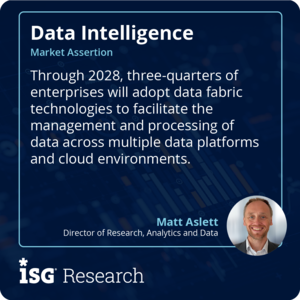
reduce data movement, simplify governance and support emerging AI use cases without introducing additional complexity. ISG asserts that through 2028, three-quarters of enterprises will adopt data fabric technologies to facilitate the management and processing of data across multiple data platforms and cloud environments. Against this backdrop, providers that can bridge data management, governance and AI enablement, such as Denodo, are increasingly well positioned to address evolving enterprise data requirements.
Denodo is a primary proponent of data virtualization and logical data management. The company has built its reputation around enabling enterprises to access, integrate and deliver data from disparate sources through a unified logical layer rather than relying exclusively on physical data consolidation approaches.
Over time, Denodo has expanded beyond data virtualization to encompass broader data management capabilities, including metadata management, governance, cloud integration, self-service data access and analytical enablement. Its customer base spans a range of industries, including financial services, telecommunications, healthcare, retail and the public sector, where complex and distributed data landscapes are common.
With Denodo Platform 9.5, the company continues its evolution from a data virtualization specialist to a broader data delivery and intelligence platform capable of supporting modern analytics and AI-driven initiatives.
The release of Denodo Platform 9.5 reflects a broader industry transition toward AI-ready data architectures. Across the market, enterprises are increasingly investing in retrieval-augmented generation (RAG), intelligent assistants, agent-based systems and machine learning (ML) workloads that require access to governed, high-quality enterprise data.
Denodo was rated as Innovative in ISG’s 2026 Buyers Guides for Data Products and Data Integration.
Denodo’s strategy is centered on strengthening the logical data layer as a foundation for these initiatives. Rather than competing directly with data lakehouse, warehouse or storage providers, Denodo continues to position itself as an abstraction and orchestration layer that connects, governs and delivers trusted data across heterogeneous environments.
This approach aligns with growing enterprise demand for architectural flexibility. Many organizations are reluctant to undertake large-scale data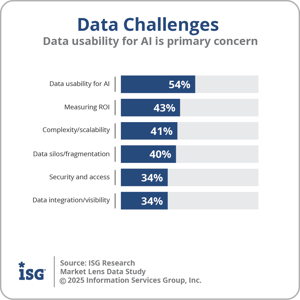 migration programs solely to support new AI initiatives. Two-fifths (40%) of participants in ISG’s Data and AI Market Lens Study also cited data silos and fragmentation as a key data challenge. By enabling data access closer to source systems while maintaining governance and consistency, Denodo seeks to reduce integration complexity and accelerate time to value.
Denodo Platform 9.5 builds upon the company’s established data virtualization foundation while introducing enhancements focused on usability, governance, performance and AI readiness.
At its core, the platform enables enterprises to connect to multiple data sources, create logical views of data assets and expose them to downstream consumers through a unified semantic layer. This architecture allows business users, analysts, developers and applications to access data without requiring extensive physical movement or replication.
The release places additional emphasis on supporting modern data consumption patterns. Enhancements across metadata management, governance, data discovery and AI-related capabilities indicate an effort to make enterprise data easier to locate, understand and utilize within advanced analytical and AI workflows.
From a deployment perspective, Denodo continues to support cloud, hybrid and multi-cloud environments, reflecting the reality that most enterprises operate across diverse infrastructure models. This flexibility remains an important differentiator in environments where data residency, compliance and operational requirements vary significantly.
The platform is particularly relevant for use cases involving data federation, enterprise analytics, self-service data access, data fabric initiatives, regulatory reporting and AI‑enabled knowledge retrieval.
Denodo Platform 9.5 is strategically relevant because it advances the convergence of logical data management, governance and AI enablement without requiring a major architectural shift. It strengthens Denodo’s role as a governed abstraction layer that can connect trusted data across distributed environments.
Customer interest will be driven by the need to reduce data silos and movement, support hybrid and multi-cloud architectures and make enterprise data accessible for analytics and AI. Provider competition will increasingly center on semantic capabilities, metadata intelligence, automated governance and AI ecosystem support—not connectivity alone.
Potential customers should consider Denodo as part of a modern data strategy if they need governed, flexible access to distributed data while minimizing migration cost, risk and operational complexity. Incumbent customers should find the release a practical upgrade for stronger AI and governance support.
Regards,
Mukesh Ranjan
Fill out the form to continue reading.