

Play audio
Data management and operations have always been potential facilitators of business insight, as well as potential barriers. Data management and operations tasks, including data governance, data integration and data quality, can improve trust in data and enable faster business decisions. These tasks are also traditionally highly complex and manual, providing the potential for badly managed data processes to become a delay or barrier to insight and innovation. Many data management and operations tasks are therefore good candidates for automation using artificial intelligence (AI), which can be used to streamline the execution of complex but repetitive and mundane tasks, accelerating human and agentic decision-making. ISG’s recently published 2026 Data Management and Operations Buyers Guides provide insight into the level of automation being delivered by software providers to expedite data management and operations tasks across a variety of product segments.
ISG’s 2025 State of Enterprise AI Adoption Report introduced a framework for categorizing AI adoption based on five autonomy levels, from AL0 (fully manual execution), through AL1 (AI suggests, human executes), AL2 (AI executes, human verifies) and AL3 (AI executes, human audits exceptions), to AL4 (fully autonomous execution with escalation fallback). The primary outcome of this framework is ISG Autonomy-Level Pricing™, which is designed to reflect the value delivered by AI-enabled service providers. However, it also provides a useful lens through which enterprises can assess the level of automation being delivered by software providers. As such, we incorporated the framework into the software product and provider assessments conducted as part of our recently published Buyers Guides.
I have written before about the importance of data management and operations to AI, and the potential for AI to improve data management and operations. The results of ISG’s recent AI Value Study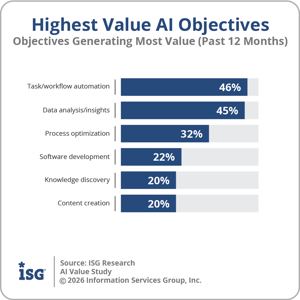 illustrate that data management and operations tasks can be both enablers and potential barriers to generating value from investments in AI. Almost one-half (45%) of participants stated that AI objectives related to data analysis and insights generation had delivered the most value for their organization in the last year, second only to task automation and workflow execution (46%). As an enabler of data analysis and insights generation, data management and operations software have the potential to facilitate the realization of value from AI through increased automation. The risk posed by a failure to take advantage of this opportunity is highlighted by more than three-quarters (78%) of participants in ISG’s AI Value Study citing data availability, quality and consistency as a barrier or limitation to realizing business value from AI.
Our 2026 Buyers Guides for Data Management and Operations assessed 68 providers and generated five reports addressing Data Management and Operations, Data Intelligence and Data Products, Data Quality and Data Observability, Data Integrity and Data Engineering. The five reports include a total of 16 Buyers Guide quadrants, including standalone assessments of individual product categories (such as data intelligence and data observability) as well as data governance, data integration, data orchestration, data pipelines and master data management.
While ISG’s Autonomy-Level Framework includes five autonomy levels, we added an additional level of granularity in our assessment in recognition of the fact that delivering automation is a work in progress for providers. This resulted in some products falling between two autonomy levels. For example, a product might primarily deliver AL2 autonomy with some features considered AL3. As such, we assessed providers on a nine-point scale with half measures (in this case, AL2.5).
The assessment illustrated a high degree of variation in the data management and operations sector. This variation was seen not only between different providers but also between different product categories. Across all categories, none of the 68 providers assessed were currently considered to be delivering AL4. Two providers were judged to be providing capabilities between AL3 and AL4, while five providers were judged to be delivering AL0. On average, the 68 providers had an autonomy level of 1.37, and in each category the average autonomy level was between AL1 and AL2.
The product category with the highest average autonomy level was data products (1.52), followed by data orchestration (1.46) and data observability (1.42). This is not surprising. Data products is a new and evolving category in which AI is a key enabler for data product classification and data product discovery, while automation of data pipelines and workflows is fundamental to data orchestration, and data observability relies on automated monitoring of data pipelines to identify anomalies and failures. Data products, data orchestration and data observability were the only product categories in which all providers were judged to offer some level of autonomy.
The product category with the lowest level of automation was data pipelines (1.19), followed by data governance (1.28). Although automation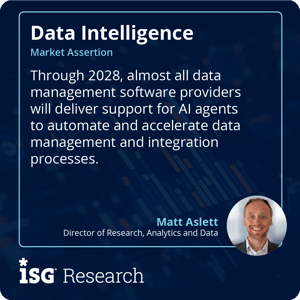 is being delivered by many providers to enhance data pipeline development and management, as well as data asset descriptions and data exploration in data governance, both categories are also populated by several established products with a heavy reliance on traditional manual processes. Two data governance providers currently offer AL0, while five data pipeline providers were rated AL0.
I assert that through 2028, almost all data management software providers will deliver support for AI agents to automate and accelerate data management and integration processes. The 2026 Data Management and Operations Buyers Guides illustrate that introduction of automation is not equally distributed, with some providers making faster progress than others. I recommend that enterprises evaluating products and providers in the data management and operations sector pay close attention to the breadth and depth of automation delivered by potential providers and use frameworks such as ISG’s Autonomy Levels as a lens through which to evaluate providers.
Regards,
Matt Aslett
Fill out the form to continue reading.