

Market momentum behind combined data and artificial intelligence (AI) platforms continues apace. The major data platform providers and hyperscalers continue to bring together previously separate data, analytics and AI products in combined platforms designed to reduce costs and complexity and accelerate AI initiatives. These platforms are now being positioned as the primary delivery engine for the many layers of context required to support agentic AI. Microsoft’s Fabric is a prime example. The product was initially designed to deliver a unified environment for analytic data processing and AI but expanded to address operational use cases in 2025. Recent announcements further those capabilities with context layer functionality to support the creation and governance of agentic applications.
Microsoft is a long-term provider of data processing, analytics and AI products, with a diverse portfolio that addresses databases, data integration, data management, data governance, business intelligence (BI), AI and machine learning (ML), delivered on-premises and via its Azure cloud service. The company continues to deliver standalone products that address each of these categories, but its unified data and analytics platform, Microsoft Fabric, is increasingly the focus for supporting operational, analytic and agentic workloads. The company claims more than 40,000 customers for Microsoft Fabric, which was initially introduced in May 2023 and delivers a single platform for data processing, data integration, data engineering, analytics and AI. The breadth of functionality available with Microsoft Fabric is illustrated by the product being assessed in ISG’s 2026 Buyers Guides for AI and Data Platforms, Real-Time Data and Data Management and Operations, while Microsoft Fabric’s Power BI functionality was also assessed in the 2026 ISG Buyers Guide for Analytics. At the recent FabCon + SQLCon Europe 2026 event in Barcelona, Spain, Microsoft announced new capabilities to support the creation and governance of agentic applications, as well as an update on semantic and ontology capabilities designed to deliver enterprise context to enable agentic AI.
I previously explained how traditional distinctions between different data, analytics and AI product categories are collapsing with the emergence of combined platforms such as Microsoft Fabric. With fewer individual products and consolidated licensing, combined AI and data platforms promise improved time to value via more efficient use of resources and improved utilization. In relation to the industry's current focus, combined AI and data platforms are also a natural fit for delivering a combination of runtime, data, knowledge and memory required to provide context for agentic AI. One of the key related announcements made at FabCon + SQLCon Europe 2026 was the ability for Microsoft Copilot users to take advantage of business context from Microsoft Fabric via the general availability of Fabric IQ in Copilot Chat and Cowork. As I previously discussed, Fabric IQ—which was announced in late 2025 and became generally available in June—is a unified data intelligence layer combining semantic modeling, ontology and knowledge graph capabilities to support agentic AI workloads. Fabric IQ essentially combines access to unified data in Microsoft OneLake with Power BI semantic models and operational intelligence ontologies. Although Fabric IQ Ontology continues to be in preview, Microsoft has enhanced its capabilities with the introduction of a new ontology agent designed to automate the creation of ontologies from semantic models. Facilitating the use of semantic models could help enterprises overcome core challenges faced by enterprises. More than one-half (52%) of participants in ISG’s Data and AI Study described semantic logic being tied up inside applications as a common disruption. The combination of Power BI semantic models, ontologies and Microsoft Planning capabilities, which were added to Fabric in March, has the potential to be a significant differentiator.
Another standout announcement was the introduction of agentic app creation in Power BI Desktop, enabling the use of natural language prompts to create, edit and publish applications from an existing semantic model, blurring the lines between traditional read-only analytics dashboards and read-write applications. The functionality is based on Fabric Apps, which was launched in June 2026 and enables developers to use the open-source Rayfin backend-as-a-service to create AI-powered business applications that are hosted on Fabric and integrated with its various data and analytics capabilities. Microsoft confirmed at FabCon + SQLCon Europe that it will be providing Power BI Pro and Premium customers with access to Fabric Apps and Fabric Database capabilities at no additional cost. Additionally, Microsoft also announced new Fabric Apps capabilities, including support for PostgreSQL alongside SQL Server and the ability to connect apps directly to Fabric warehouses, SQL databases, lakehouses and Power BI semantic models without duplicating data.
Underpinning the various data, analytics and AI services available on Microsoft Fabric is the Microsoft OneLake shared data lake layer for data storage, data management and data governance. Microsoft has enhanced the governance capabilities of OneLake since launch and announced the general availability of OneLake Catalog at FabCon + SQLCon Europe, along with the preview release of IQ sharing in OneLake to enable organizations to share governed data and business context across the enterprise, as well as with partners and customers. IQ sharing in OneLake initially enables the sharing of governed tables and files as well as Markdown agent instructions and resource data framework (RDF) ontologies, but native support for Fabric IQ ontologies and Power BI semantic models is on the roadmap. Microsoft also announced enhanced data discovery in Fabric via more granular search using the OneLake catalog search API as well as new OneLake catalog integration in Excel and enhanced integration between OneLake Catalog and Microsoft Foundry. The OneLake ecosystem has also been expanded with the addition of OneLake shortcuts for Salesforce Data 360, mirroring for Google BigQuery and Apache Iceberg-based catalog federation support for AWS Glue Data Catalog and Google Lakehouse runtime catalog.
The general availability of Fabric Databases was a significant announcement for Microsoft Fabric in 2025, providing transactional data platform capabilities that enable Fabric to support intelligent operational applications alongside analytics workloads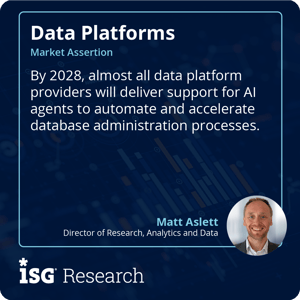 supported by Fabric Data Warehouse. The company also made some significant data platform-related announcements in Barcelona, including the general availability of Database Hub in Fabric, which is designed to provide a single interface for managing an enterprise’s entire estate of Microsoft databases, including Azure SQL, Azure Cosmos DB, Azure Database for PostgreSQL, SQL Server on Azure Arc, Azure Database for MySQL and Fabric Databases. Database Hub also provides access to new database agents designed to automate key elements of database administration, including performance monitoring. I assert that by 2028, almost all data platform providers will deliver support for AI agents to automate and accelerate database administration processes. Also now generally available is SQL Server on Azure Local, which enables enterprises to run Microsoft’s flagship database using Azure infrastructure in customer-owned data centers and edge environments, either connected to or disconnected from Azure cloud.
There are many more announcements that could be mentioned given the depth and breadth of the functionality available in Fabric. Examples include the preview release of a new data engineering agent built on the earlier acquisition of Osmos, new Copilot capabilities in Real-Time Intelligence to enable natural language creation of Real-Time Dashboards, and the general availability of Business Events in Real-Time Hub, enabling the definition of events at a business level. The fact that many of the new announcements relate to functionality that is in the preview stage indicates that Fabric as a product is in the process of evolving from an analytics platform towards a platform for the development and deployment of enterprise data, analytics and AI. I recommend that enterprises evaluating providers of data platforms for analytics, AI and operational workloads include Microsoft and Fabric within their assessments.
Regards,
Matt Aslett
About the author