

I have previously explained the critical importance of data to successful artificial intelligence (AI) initiatives, including generative and agentic AI. While enterprises have demonstrated the value of AI through small-scale initiatives, scaling these efforts has highlighted the need to coordinate AI and data programs more effectively. Providers that can address the full combination of AI and data requirements through integrated AI and data platforms are increasingly attractive as enterprises look to accelerate initiatives and reduce costs and complexity. Software providers have recognized this opportunity and are delivering platforms that combine AI and data capabilities. These providers are the focus of the recently completed 2026 AI and Data Platforms Buyers Guide.
To be AI-ready, data needs to be clean, well-organized and compliant with regulatory standards. Additionally, it needs to be aligned to the specific requirements of the use case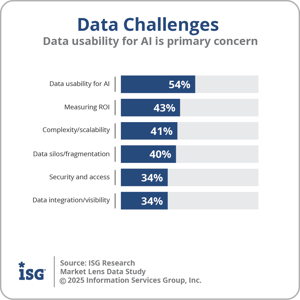 and its business objective. More than one-half (54%) of participants in ISG’s Market Lens Data and AI Program Study cite the usability of data for AI applications as a significant challenge. Delivering AI-ready data requires combining structured and unstructured sources, ensuring data trust and quality and validating relationships between entities so they can be consumed by applications and models.
Many providers have offered both AI platform and data platform capabilities for some time, but they have often addressed requirements with dedicated products. To mitigate cost and complexity, AI and data initiatives must be aligned. Enterprises cannot afford fragmented approaches that duplicate effort or slow deployment, particularly as competitive pressure increases. The increasing importance of intelligent, AI-driven applications is blurring the traditional boundaries between AI platforms and data platforms. Consumers and employees now expect applications that deliver personalized, contextually relevant recommendations in real time. Additionally, the explosion in the development of AI agents is increasing the requirements for automated data access and data processing, in conjunction with the execution of AI models. As a result, enterprises are re-evaluating platform architectures that were designed for separation rather than integration. In response to these requirements, most leading data platform providers have expanded their offerings to include AI capabilities, while many AI platform providers have expanded data persistence and processing capabilities. Whether approached from an AI-first or data-first perspective, success ultimately requires both.
The 2026 AI and Data Platforms Buyers Guide assessed 16 providers on their ability to address both AI platform and data platform requirements. The research considers whether providers deliver these capabilities through a single offering or a portfolio of integrated products or services. Providers focused exclusively on either AI platforms or data platforms are covered in separate Buyers Guide research. ISG’s Buyers Guide research assesses a combination of Product Experience and Customer Experience criteria. Providers that score highest in both Product Experience and Customer Experience are rated as Exemplary. The providers rated Exemplary in the 2026 AI and Data Platforms Buyers Guide are: AWS, Databricks, Google Cloud, IBM, Oracle, SAP and Teradata. The research finds Oracle atop the list of providers overall, followed by Databricks and AWS.
ISG’s 2026 AI and Data Platforms Buyers Guide assesses the ability of providers to address the full spectrum of AI platform and data platform requirements. ISG Research defines AI platforms as products that enable users to prepare, deploy and maintain AI models. Preparing models requires accessing and preparing data used in the modeling process, while training involves tools for data scientists to explore, compare and optimize models developed using different algorithms and parameters. Deploying and maintaining models requires governance and monitoring frameworks to ensure compliance with internal policies and regulatory requirements.
The AI model development process depends on extensive data preparation and feature engineering to produce accurate results, placing significant demands on underlying data platforms. The volumes of data required for effective AI models further increase infrastructure costs, making efficiency and coordination essential. Data platforms are defined by ISG Research as providing environments for organizing and managing the storage, processing, analysis and presentation of data across an enterprise. Data platforms play a critical role in supporting both operational applications that run the business and analytic applications that evaluate business performance. Supporting intelligent, AI-driven applications requires data platforms that can respond dynamically and support AI inferencing within operational workflows.
The convergence of AI and data platform functionality can reduce costs and complexity. These benefits need to be balanced with the risk of lock-in, however. I previously wrote about the importance of autonomy as a cornerstone of an effective sovereign AI and data strategy and the need for enterprises to make trade-offs between freedom and risk avoidance when evaluating AI and data platform providers. This need is heightened when selecting a single provider for both AI and data platform functionality. To maintain autonomy, enterprises must ensure that a combined AI and data platform supports a choice of deployment and consumption models, as well as the option to use different providers for data management, data operations, business intelligence (BI) and data science, as well as the option to choose machine learning (ML), deep learning and AI models from multiple providers. I assert that through 2028, one-third of enterprises will prioritize AI and data platform providers that enable the use of data management software from multiple providers to support a sovereign AI and data strategy.
As always, however, software products are only one aspect of delivering on the promise of AI. New approaches to people, processes and information are also required to deliver enterprise AI applications based on trusted data sources. To improve the value generated from AI and data initiatives, I recommend that enterprises evaluating AI and data platform products adopt processes and methodologies to assess the full spectrum of requirements that enable users to prepare, deploy and maintain AI models as well as organize and manage the storage, processing, analysis and presentation of data.
Regards,
Matt Aslett
Fill out the form to continue reading.