

Most technological innovations associated with the 1980s are now more likely to be found in a museum than a home or data center. Video cassette recorders, portable cassette players, compact discs, camcorders and fax machines have mostly been relegated to the trash heap. Mainframes and personal computers remain in use today but are largely unrecognizable from their 1980s counterparts in terms of both design and performance. One technological child of the 1980s that has not just survived but thrived is the PostgreSQL open-source database. PostgreSQL is arguably more popular than ever, with adoption having accelerated in recent years thanks to the launch of numerous PostgreSQL-based products and cloud-based managed services. Enterprises have a plethora of PostgreSQL options at their disposal, and different implementations can vary significantly in terms of the functionality and options available. Thus, enterprises need to evaluate the various options carefully.
PostgreSQL began life as a project at the University of California, Berkeley in 1986. Initially known as POSTGRES, it became PostgreSQL in 1996 following the addition of support for the Structured Query Language and the adoption of the PostgreSQL License. This is a permissive open-source license that provides developers with considerable freedom, including the use of the code within the development of proprietary software products. Thanks to its combination of mature functionality and a healthy support ecosystem, the PostgreSQL database has been widely adopted in the decades that have followed. It has been named the most popular database product by participants in the Stack Overflow Developer Survey for the past three years. One of the reasons PostgreSQL is attractive to developers is its versatility. It is an object-relational database but can be used to store and process a variety of data formats through either standard functionality or an assortment of extensions. PostgreSQL is designed to be extensible, and users can benefit from a broad catalogue of applications, tools, drivers, languages and extensions. In addition to enabling support for different data formats, this extensibility enables optional enhanced administrative functionality to address advanced performance, reliability, scalability and security, amongst other things. While PostgreSQL is most likely to be deployed for operational workloads used to run the business, it can also support analytic workloads used to analyze the business. The product’s permissive open-source license has led to PostgreSQL being used as the initial basis for the development of several proprietary products, such as the Netezza and Greenplum analytic data platforms, and numerous providers have utilized elements of the open-source codebase to deliver compatibility with PostgreSQL or develop cloud offerings that provide PostgreSQL as a managed service. One-third (33%) of the providers assessed in the 2026 ISG Data Platforms Buyers Guide offer a data platform product that is based on PostgreSQL. Given the versatility and extensibility of PostgreSQL, it is imperative that potential adopters assess the various options carefully to ensure they understand the level of compatibility provided, as well as the PostgreSQL version and range of extensions supported.
Perhaps the first factor that should be used to assess potential products is compatibility. Compatibility is not a binary concept but a spectrum. At one end of the spectrum is PostgreSQL wire compatibility, which enables a database to be used with drivers designed for PostgreSQL without code changes. While this is undoubtedly useful, it is a far cry from runtime compatibility, which delivers full support for PostgreSQL syntax, features and execution semantics to enable PostgreSQL applications and tools to run unchanged. Would-be adopters can be confident that PostgreSQL distributions and products offering PostgreSQL as a managed service will be runtime compatible. If a product is described as “PostgreSQL–compatible,” they should be careful to investigate the level of compatibility and test the offering extensively before considering migrating any workloads from an existing PostgreSQL database.
When evaluating PostgreSQL distributions and managed services, enterprises should also be aware of which versions of the open-source database are supported. The latest version of the database, PostgreSQL 18, was released in September 2025, but the PostgreSQL development community is currently also supporting the maintenance and enhancement of versions 14 to 17. The ISG Data Platforms Buyers Guide research illustrated that there can be significant differences in the versions supported by providers. Being cognizant of which versions (and therefore functionality) are supported should be an essential part of the evaluation process. The most widely supported versions are PostgreSQL 16 and 17 (both supported by 71% of providers included in the 2026 ISG Data Platforms Buyers Guide), followed by PostgreSQL 15 (65%), PostgreSQL 18 (59%) and PostgreSQL 14 (53%). Enterprises should also be aware that many cloud-managed service offerings enable users to deploy multiple versions of PostgreSQL. This will be an important factor if a potential user is looking to migrate workloads from a range of existing PostgreSQL databases. The broadest range of versions supported by providers assessed in the ISG Data Platforms Buyers Guide research is PostgreSQL 11 to 18.
In addition to evaluating the version of the PostgreSQL database itself, potential adopters should also assess which extensions are available. Some extensions are widely supported. 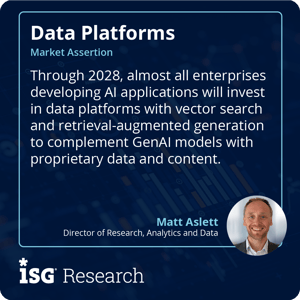 For example, 100% of the PostgreSQL-based products assessed as part of the 2026 ISG Data Platforms Buyers Guide graded A- or above for geospatial file formats, thanks to the ubiquity of the PostGIS extension. The postgres_fdw extension is also supported by all providers to enable access to data stored in external PostgreSQL servers. I assert that through 2028, almost all enterprises developing artificial intelligence (AI) applications will invest in data platforms with vector search and retrieval-augmented generation (RAG) to complement generative AI (GenAI) models with proprietary data and content. Enterprises looking to take advantage of the pgvector extension for vector similarity search should not assume that it will be available. It is currently supported by 86% of providers assessed. Enterprises requiring support for time-series workloads should also be cautious: the TimescaleDB extension has currently been adopted by only 57% of providers assessed in the 2026 ISG Data Platforms Buyers Guide. To complicate matters further, extension functionality will vary based on the version of the extension supported, while enterprises should also be aware that providers may not necessarily support the use of an extension for all supported PostgreSQL versions. For example, our research identified a provider that continues to support TimescaleDB for projects using Postgres 15 but has deprecated the extension for projects using PostgreSQL 17.
PostgreSQL is a mature and versatile database and is attractive to enterprises given its licensing flexibility and the breadth of provider support options. I recommend that enterprises evaluating data platform providers include PostgreSQL products in their assessments and pay close attention to the various factors listed above as well as the evolving requirements for operational data platforms I identified last year. Checking the fine print on feature and function availability should be part of the due diligence process for the adoption of any product but is especially important for PostgreSQL database providers given the variety of options available.
Regards,
Matt Aslett
Fill out the form to continue reading.