


Matt leads the software research and advisory for the Analytics and Data expertise at ISG Software Research, covering software that improves the utilization of information across business and IT. His focus areas of coverage include analytics, data intelligence, data operations, data platforms, and streaming and events. Matt’s specialization is in the operational and analytical use of data and use of AI where enterprises can modernize their approaches to accelerate the value realization of technology investments in support of hybrid and multi-cloud architecture. Matt has been an industry analyst for more than a decade and has pioneered the coverage of emerging data platforms including NoSQL and NewSQL databases, data lakes, and cloud-based data processing. He is a graduate of Bournemouth University.
narration area
Executive Summary
Key Takeaways – Data Platforms
Data platforms underpin the storage, processing and analysis of information that supports enterprise applications and digital interactions. Organizations rely on these platforms to manage operational workloads that run the business as well as analytic workloads used to evaluate performance and guide decisions. The expansion of cloud infrastructure, object storage and diverse data models has increased architectural diversity, resulting in enterprises deploying multiple platforms to support different workloads and application requirements.
Software Provider Summary
The ISG Buyers Guide™ for Data Platforms evaluates 23 software providers offering products supporting enterprise data storage, processing and analytics for operational and analytic workloads. The research ranked the top three overall leaders as Oracle, Databricks and AWS. Providers were classified using weighted performance in Product Experience and Customer Experience for ISG quadrant placement. AWS, Databricks, Google Cloud, IBM, InterSystems, Microsoft, Oracle, Progress Software and SAP were rated as Exemplary, with Alibaba Cloud, Cloudera and Snowflake rated as Innovative. Actian, Huawei Cloud and Salesforce were rated as Assurance; and Aiven, Broadcom, Couchbase, EDB, Neo4j, SingleStore, Tencent Cloud and VAST Data were rated as Merit.
Product Experience
Product Experience, representing 80% of the evaluation, focuses on Capability (50%) and Platform (30%), which includes adaptability, manageability, reliability and usability. Oracle, Databricks and InterSystems achieved the highest performance as Leaders in this category, supported by broad capabilities across data persistence, processing and artificial intelligence (AI) workloads and strong platform adaptability and governance for enterprise deployment. Leaders demonstrated enterprise-grade platform capabilities applicable across varied technical roles, operational contexts and analytic use cases.
Customer Experience Value
Customer Experience, representing 20% of the evaluation, focuses on validation and TCO/ROI. AWS, IBM and Oracle were the Leaders in this category, showing strong customer advocacy and clear investment in success outcomes. Providers with lower performance often lacked publicly available customer validation or failed to demonstrate structured ROI measurement and proactive lifecycle engagement.
Strategic Recommendations
Enterprises should evaluate data platforms based on their ability to support both operational and analytic workloads, particularly as AI-driven applications increasingly require real-time data processing and inference. Decision-makers should assess how well platforms integrate diverse data models, processing engines and governance capabilities across hybrid and cloud environments. Organizations should also consider operational factors such as deployment model, cost management and administrative overhead when evaluating managed cloud services versus self-managed platforms.
The Findings – Data Platforms
The software providers and products evaluated in this research offer product and customer experiences, but not every feature is equally valuable to every enterprise or is needed to support the relevant business processes and use cases. Moreover, having too many product capabilities may be a negative factor for an enterprise if it introduces unnecessary complexity. Nonetheless, you may decide that a more comprehensive set of capabilities is important and meets your enterprise’s requirements.
An effective customer relationship with a software provider is vital to the success of any investment. The overall customer experience and the full lifecycle of engagement play a key role in ensuring satisfaction and long-term success. Providers with dedicated customer leadership, such as chief customer officers, tend to invest more deeply in these relationships and prioritize customer outcomes in line with TCO and ROI expectations. It is equally important that this commitment to customer success is evident throughout the provider’s website, the buying process and the customer journey.
Overall Scoring of Software Providers Across Categories
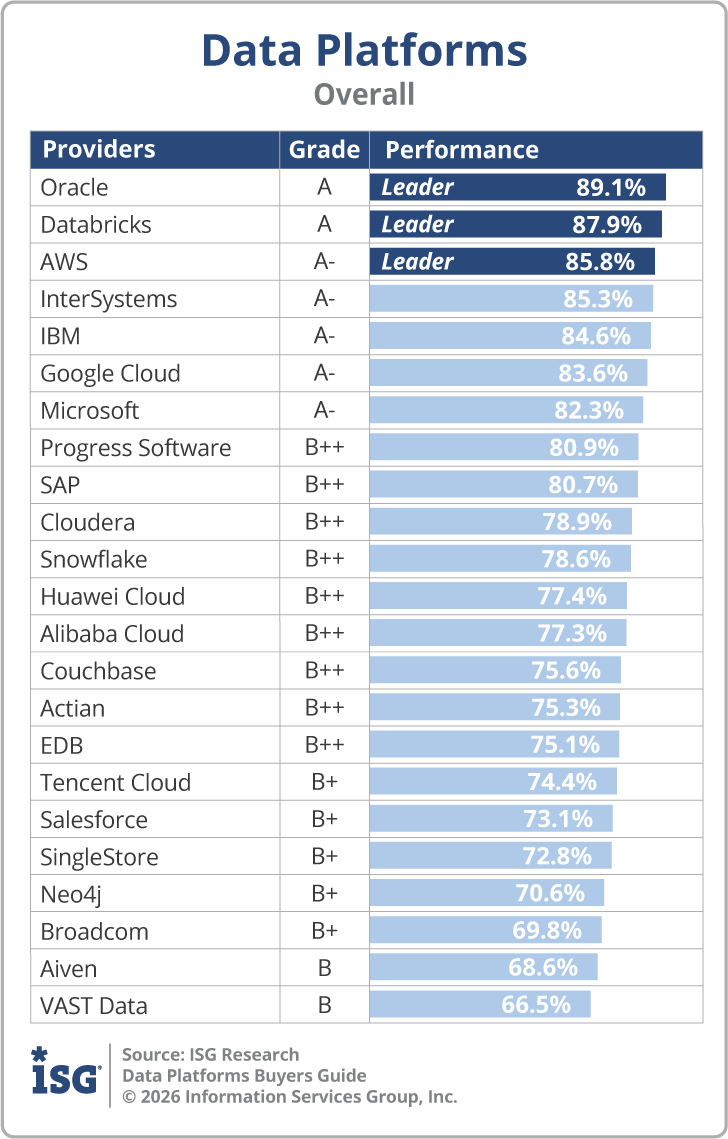 The research finds Oracle atop the list, followed by Databricks and AWS. Providers that place in the top three of a category earn the designation of Leader. Oracle has done so in five categories; Databricks in four; AWS in three; InterSystems in two; and IBM in one category.
The quadrant chart below presents ratings for Product Experience and Customer Experience on the x- and y-axes, respectively, to visually classify software providers. Those providers whose Product Experience has above-median weighted performance on the axis, in aggregate across the two product categories, place farther to the right. The performance and weighting for the Customer Experience category determine placement on the vertical axis. In short, software providers that place closer to the upper-right on this chart performed better than those closer to the lower-left.
The research categorizes and rates software providers into one of four categories: Assurance, Exemplary, Merit or Innovative. Placement represents the software providers’ weighted performance in meeting the requirements of product and customer experience.
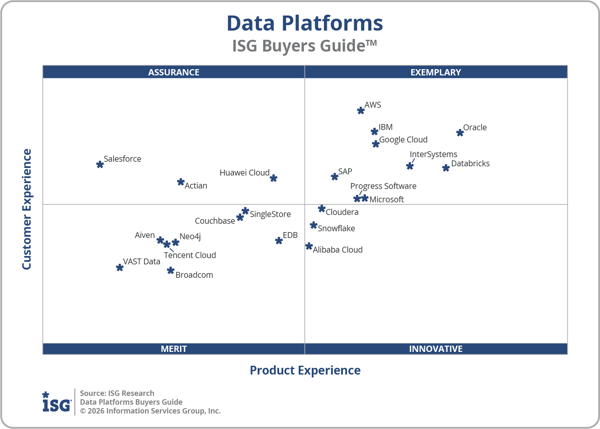
Exemplary: This rating (upper right) applies to those providers that performed above the median on Product and Customer Experience requirements. The providers rated Exemplary are: AWS, Databricks, Google Cloud, IBM, InterSystems, Microsoft, Oracle, Progress Software and SAP.
Innovative: This rating (lower right) applies to those that performed above median in Product Experience but not in Customer Experience. The providers rated Innovative are: Alibaba Cloud, Cloudera and Snowflake.
Assurance: This rating (upper left) applies to those that performed above median in Customer Experience but not in Product Experience. The providers rated Assurance are: Actian, Huawei Cloud and Salesforce.
Merit: This rating (lower left) applies to those that did not surpass the median in Customer or Product Experience. The providers rated Merit are: Aiven, Broadcom, Couchbase, EDB, Neo4j, SingleStore, Tencent Cloud and VAST Data.
We advise enterprises to use this research as a supplement to their own evaluations, recognizing that ratings or rankings do not solely represent a provider’s value nor indicate universal suitability of a set of products.
Key Takeaways – Analytic Data Platforms
Analytic data platforms enable enterprises to analyze accumulated data to support decision-making, business intelligence (BI), data science and artificial intelligence (AI) initiatives. These platforms provide the storage, management and processing capabilities required to evaluate performance and identify operational opportunities. As analytics increasingly supports real-time insights and AI-driven decision-making, enterprises require platforms that can scale diverse workloads while maintaining governance, reliability and cost efficiency.
Software Provider Summary
The ISG Buyers Guide™ for Analytic Data Platforms evaluates 30 software providers offering products supporting analytics, data science and AI workloads across enterprise data environments. The research ranked the top three overall leaders as Oracle, Databricks and Teradata. Providers were classified using weighted performance in Product Experience and Customer Experience for ISG quadrant placement. AWS, Cloudera, Databricks, Dremio, Google Cloud, IBM, InterSystems, Microsoft, Oracle, Progress Software, SAP and Teradata were rated as Exemplary, with Alibaba Cloud, ClickHouse and Snowflake rated as Innovative. Actian, Couchbase, Huawei Cloud and Salesforce were rated as Assurance; and Aiven, Broadcom, EDB, Incorta, KX, Neo4j, OpenText, SingleStore, Starburst, Tencent Cloud and VAST Data were rated as Merit.
Product Experience
Product Experience, representing 80% of the evaluation, focuses on Capability (50%) and Platform (30%), which includes adaptability, manageability, reliability and usability. Databricks, Oracle and Teradata achieved the highest performance as Leaders in this category, supported by broad analytic platform capabilities across data persistence, processing and analytics workloads and strong platform performance and governance for enterprise environments. Leaders demonstrated enterprise-grade platform capabilities applicable across diverse analytics, data science and AI contexts.
Customer Experience
Customer Experience, representing 20% of the evaluation, focuses on validation and TCO/ROI. AWS, IBM and Oracle were the Leaders in this category, showing strong customer advocacy and clear investment in success outcomes. Providers with lower performance often lacked publicly available customer validation or failed to demonstrate structured ROI measurement and proactive lifecycle engagement.
Strategic Recommendations
Enterprises should evaluate analytic data platforms based on their ability to support diverse analytics, data science and AI workloads at scale while maintaining governance and performance. Decision-makers should assess how well platforms integrate with broader data and AI ecosystems, including cloud infrastructure, object storage and open data formats. Organizations should also consider how platform architecture supports evolving requirements for real-time analytics, AI-driven insights and cost-efficient data processing.
The Findings – Analytic Data Platforms
The software providers and products evaluated in this research offer product and customer experiences, but not every feature is equally valuable to every enterprise or is needed to support the relevant business processes and use cases. Moreover, having too many product capabilities may be a negative factor for an enterprise if it introduces unnecessary complexity. Nonetheless, you may decide that a more comprehensive set of capabilities is important and meets your enterprise’s requirements.
An effective customer relationship with a software provider is vital to the success of any investment. The overall customer experience and the full lifecycle of engagement play a key role in ensuring satisfaction and long-term success. Providers with dedicated customer leadership, such as chief customer officers, tend to invest more deeply in these relationships and prioritize customer outcomes in line with TCO and ROI expectations. It is equally important that this commitment to customer success is evident throughout the provider’s website, the buying process and the customer journey.
Overall Scoring of Software Providers Across Categories
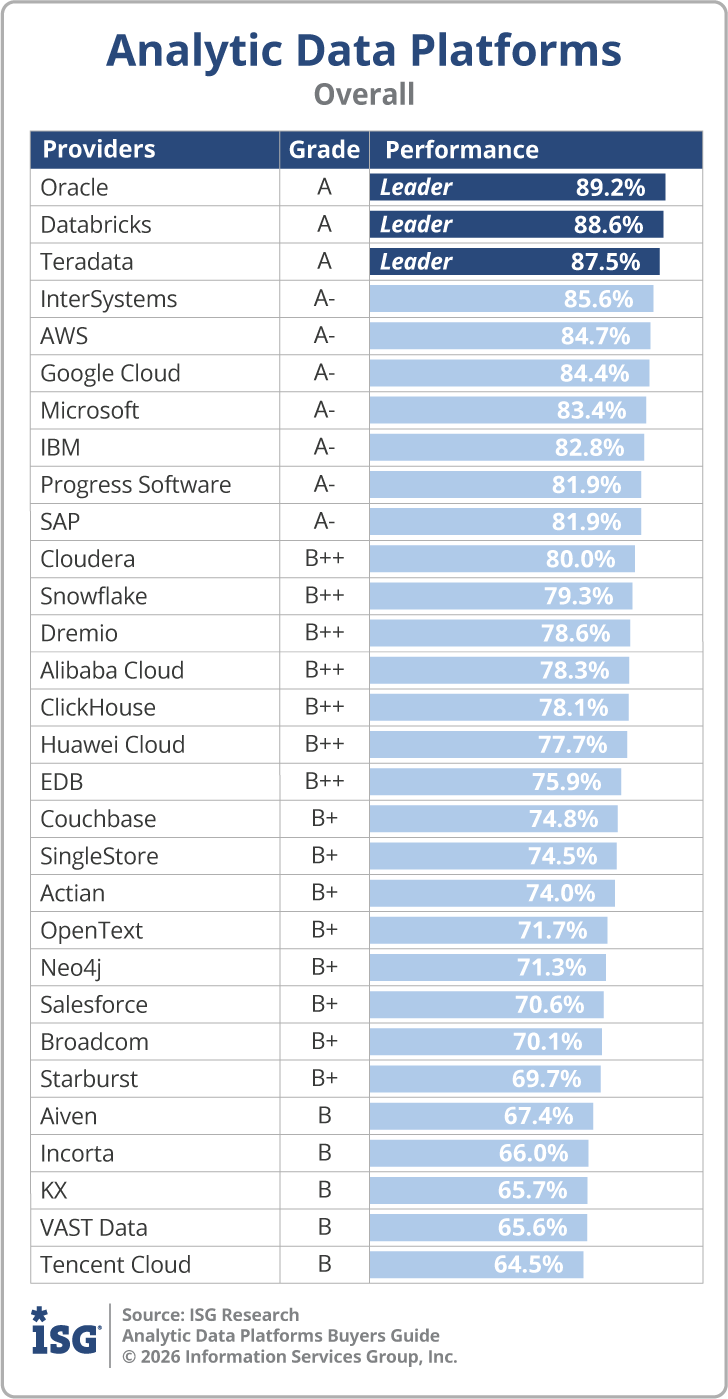 The research finds Oracle atop the list, followed by Databricks and Teradata. Providers that place in the top three of a category earn the designation of Leader. Oracle has done so in five categories; Databricks in four; Teradata in three; AWS in two; and IBM in one category.
The quadrant chart below presents ratings for Product Experience and Customer Experience on the x- and y-axes, respectively, to visually classify software providers. Those providers whose Product Experience has above-median weighted performance on the axis, in aggregate across the two product categories, place farther to the right. The performance and weighting for the Customer Experience category determine placement on the vertical axis. In short, software providers that place closer to the upper-right on this chart performed better than those closer to the lower-left.
The research categorizes and rates software providers into one of four categories: Assurance, Exemplary, Merit or Innovative. Placement represents the software providers’ weighted performance in meeting the requirements of product and customer experience.
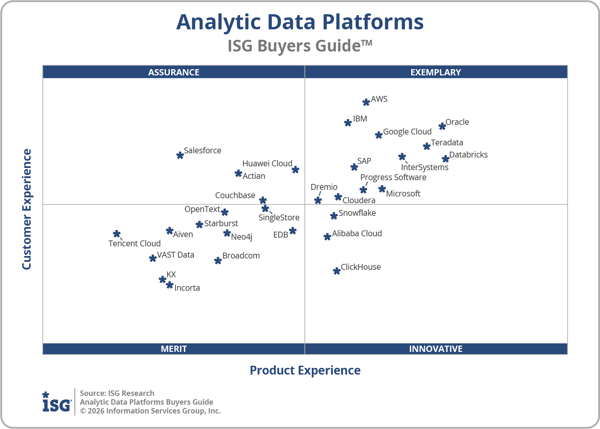
Exemplary: This rating (upper right) applies to those providers that performed above the median on Product and Customer Experience requirements. The providers rated Exemplary are: AWS, Cloudera, Databricks, Dremio, Google Cloud, IBM, InterSystems, Microsoft, Oracle, Progress Software, SAP and Teradata.
Innovative: This rating (lower right) applies to those that performed above median in Product Experience but not in Customer Experience. The providers rated Innovative are: Alibaba Cloud, ClickHouse and Snowflake.
Assurance: This rating (upper left) applies to those that performed above median in Customer Experience but not in Product Experience. The providers rated Assurance are: Actian, Couchbase, Huawei Cloud and Salesforce.
Merit: This rating (lower left) applies to those that did not surpass the median in Customer or Product Experience. The providers rated Merit are: Aiven, Broadcom, EDB, Incorta, KX, Neo4j, OpenText, SingleStore, Starburst, Tencent Cloud and VAST Data.
We advise enterprises to use this research as a supplement to their own evaluations, recognizing that ratings or rankings do not solely represent a provider’s value nor indicate universal suitability of a set of products.
Key Takeaways – Operational Data Platforms
Operational data platforms manage the storage and processing of data generated by enterprise applications that run the business, including finance, operations, sales and customer experience systems. These platforms support transactional workloads that require reliability, scalability and low-latency performance across operational environments. As intelligent applications incorporate artificial intelligence (AI)-driven recommendations, predictions and automation, operational data platforms must increasingly support real-time AI inferencing alongside transactional processing.
Software Provider Summary
The ISG Buyers Guide™ for Operational Data Platforms evaluates 28 software providers offering products supporting transactional data management for enterprise operational applications. The research ranked the top three overall leaders as Oracle, InterSystems and IBM. Providers were classified using weighted performance in Product Experience and Customer Experience for ISG quadrant placement. AWS, Cloudera, Databricks, Google Cloud, IBM, InterSystems, Microsoft, MongoDB, Oracle, Progress Software and SAP were rated as Exemplary, with Cockroach Labs, EDB and Yugabyte rated as Innovative. Actian, Huawei Cloud and Salesforce were rated as Assurance; and Aiven, Alibaba Cloud, Broadcom, Couchbase, Neo4j, Redis, SingleStore, Snowflake, Software AG, Tencent Cloud and VAST Data were rated as Merit.
Product Experience
Product Experience, representing 80% of the evaluation, focuses on Capability (50%) and Platform (30%), which includes adaptability, manageability, reliability and usability. Oracle, InterSystems and IBM achieved the highest performance as Leaders in this category, supported by broad operational data management capabilities across persistence and processing workloads and strong platform reliability and governance for enterprise deployments. Leaders demonstrated enterprise-grade platform capabilities applicable across diverse operational applications and enterprise usage contexts.
Customer Experience
Customer Experience, representing 20% of the evaluation, focuses on validation and TCO/ROI. AWS, IBM and Oracle were the Leaders in this category, showing strong customer advocacy and clear investment in success outcomes. Providers with lower performance often lacked publicly available customer validation or failed to demonstrate structured ROI measurement and proactive lifecycle engagement.
Strategic Recommendations
Enterprises should evaluate operational data platforms based on their ability to support high-performance transactional workloads while integrating AI-driven capabilities. Decision-makers should assess scalability, reliability and governance across hybrid and cloud environments. Platforms that support real-time AI inferencing alongside operational processing will be increasingly important.
The Findings – Operational Data Platforms
The software providers and products evaluated in this research offer product and customer experiences, but not every feature is equally valuable to every enterprise or is needed to support the relevant business processes and use cases. Moreover, having too many product capabilities may be a negative factor for an enterprise if it introduces unnecessary complexity. Nonetheless, you may decide that a more comprehensive set of capabilities is important and meets your enterprise’s requirements.
An effective customer relationship with a software provider is vital to the success of any investment. The overall customer experience and the full lifecycle of engagement play a key role in ensuring satisfaction and long-term success. Providers with dedicated customer leadership, such as chief customer officers, tend to invest more deeply in these relationships and prioritize customer outcomes in line with TCO and ROI expectations. It is equally important that this commitment to customer success is evident throughout the provider’s website, the buying process and the customer journey.
Overall Scoring of Software Providers Across Categories
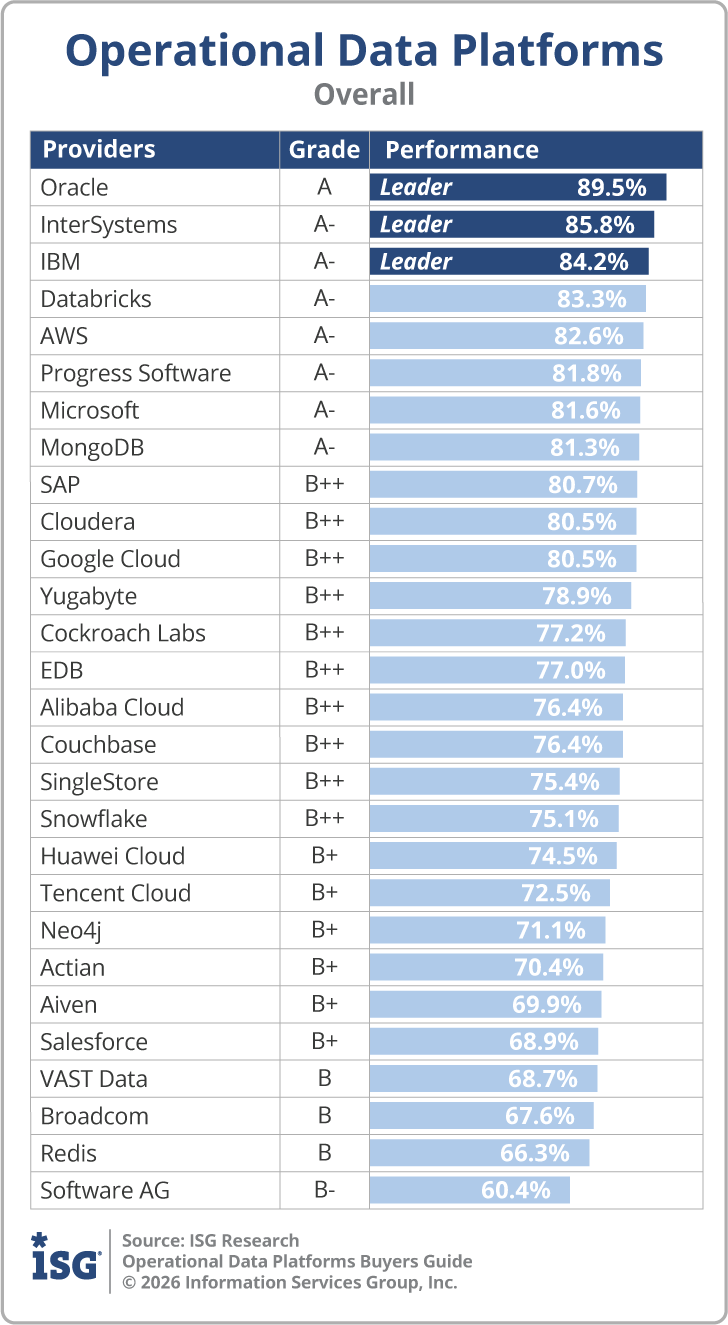 The research finds Oracle atop the list, followed by InterSystems and IBM. Providers that place in the top three of a category earn the designation of Leader. Oracle has done so in five categories; IBM and InterSystems in three; AWS in two; and Databricks and Progress Software in one category.
The quadrant chart below presents ratings for Product Experience and Customer Experience on the x- and y-axes, respectively, to visually classify software providers. Those providers whose Product Experience has above-median weighted performance on the axis, in aggregate across the two product categories, place farther to the right. The performance and weighting for the Customer Experience category determine placement on the vertical axis. In short, software providers that place closer to the upper-right on this chart performed better than those closer to the lower-left.
The research categorizes and rates software providers into one of four categories: Assurance, Exemplary, Merit or Innovative. Placement represents the software providers’ weighted performance in meeting the requirements of product and customer experience.
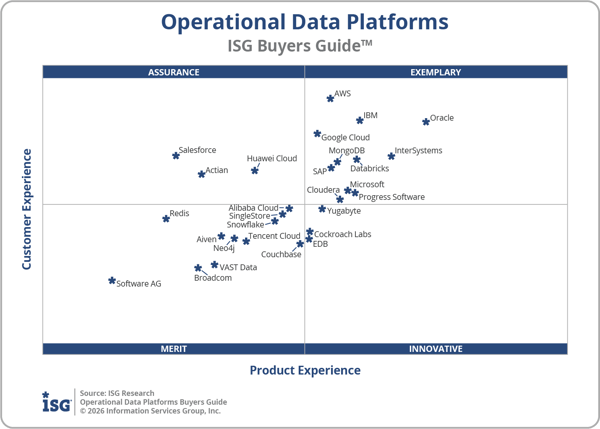
Exemplary: This rating (upper right) applies to those providers that performed above the median on Product and Customer Experience requirements. The providers rated Exemplary are: AWS, Cloudera, Databricks, Google Cloud, IBM, InterSystems, Microsoft, MongoDB, Oracle, Progress Software and SAP.
Innovative: This rating (lower right) applies to those that performed above median in Product Experience but not in Customer Experience. The providers rated Innovative are: Cockroach Labs, EDB and Yugabyte.
Assurance: This rating (upper left) applies to those that performed above median in Customer Experience but not in Product Experience. The providers rated Assurance are: Actian, Huawei Cloud and Salesforce.
Merit: This rating (lower left) applies to those that did not surpass the median in Customer or Product Experience. The providers rated Merit are: Aiven, Alibaba Cloud, Broadcom, Couchbase, Neo4j, Redis, SingleStore, Snowflake, Software AG, Tencent Cloud and VAST Data.
We advise enterprises to use this research as a supplement to their own evaluations, recognizing that ratings or rankings do not solely represent a provider’s value nor indicate universal suitability of a set of products.
Executive Summary
Key Takeaways – Data Platforms
Data platforms underpin the storage, processing and analysis of information that supports enterprise applications and digital interactions. Organizations rely on these platforms to manage operational workloads that run the business as well as analytic workloads used to evaluate performance and guide decisions. The expansion of cloud infrastructure, object storage and diverse data models has increased architectural diversity, resulting in enterprises deploying multiple platforms to support different workloads and application requirements.
Software Provider Summary
The ISG Buyers Guide™ for Data Platforms evaluates 23 software providers offering products supporting enterprise data storage, processing and analytics for operational and analytic workloads. The research ranked the top three overall leaders as Oracle, Databricks and AWS. Providers were classified using weighted performance in Product Experience and Customer Experience for ISG quadrant placement. AWS, Databricks, Google Cloud, IBM, InterSystems, Microsoft, Oracle, Progress Software and SAP were rated as Exemplary, with Alibaba Cloud, Cloudera and Snowflake rated as Innovative. Actian, Huawei Cloud and Salesforce were rated as Assurance; and Aiven, Broadcom, Couchbase, EDB, Neo4j, SingleStore, Tencent Cloud and VAST Data were rated as Merit.
Product Experience
Product Experience, representing 80% of the evaluation, focuses on Capability (50%) and Platform (30%), which includes adaptability, manageability, reliability and usability. Oracle, Databricks and InterSystems achieved the highest performance as Leaders in this category, supported by broad capabilities across data persistence, processing and artificial intelligence (AI) workloads and strong platform adaptability and governance for enterprise deployment. Leaders demonstrated enterprise-grade platform capabilities applicable across varied technical roles, operational contexts and analytic use cases.
Customer Experience Value
Customer Experience, representing 20% of the evaluation, focuses on validation and TCO/ROI. AWS, IBM and Oracle were the Leaders in this category, showing strong customer advocacy and clear investment in success outcomes. Providers with lower performance often lacked publicly available customer validation or failed to demonstrate structured ROI measurement and proactive lifecycle engagement.
Strategic Recommendations
Enterprises should evaluate data platforms based on their ability to support both operational and analytic workloads, particularly as AI-driven applications increasingly require real-time data processing and inference. Decision-makers should assess how well platforms integrate diverse data models, processing engines and governance capabilities across hybrid and cloud environments. Organizations should also consider operational factors such as deployment model, cost management and administrative overhead when evaluating managed cloud services versus self-managed platforms.
The Findings – Data Platforms
The software providers and products evaluated in this research offer product and customer experiences, but not every feature is equally valuable to every enterprise or is needed to support the relevant business processes and use cases. Moreover, having too many product capabilities may be a negative factor for an enterprise if it introduces unnecessary complexity. Nonetheless, you may decide that a more comprehensive set of capabilities is important and meets your enterprise’s requirements.
An effective customer relationship with a software provider is vital to the success of any investment. The overall customer experience and the full lifecycle of engagement play a key role in ensuring satisfaction and long-term success. Providers with dedicated customer leadership, such as chief customer officers, tend to invest more deeply in these relationships and prioritize customer outcomes in line with TCO and ROI expectations. It is equally important that this commitment to customer success is evident throughout the provider’s website, the buying process and the customer journey.
Overall Scoring of Software Providers Across Categories
The research finds Oracle atop the list, followed by Databricks and AWS. Providers that place in the top three of a category earn the designation of Leader. Oracle has done so in five categories; Databricks in four; AWS in three; InterSystems in two; and IBM in one category.
The quadrant chart below presents ratings for Product Experience and Customer Experience on the x- and y-axes, respectively, to visually classify software providers. Those providers whose Product Experience has above-median weighted performance on the axis, in aggregate across the two product categories, place farther to the right. The performance and weighting for the Customer Experience category determine placement on the vertical axis. In short, software providers that place closer to the upper-right on this chart performed better than those closer to the lower-left.
The research categorizes and rates software providers into one of four categories: Assurance, Exemplary, Merit or Innovative. Placement represents the software providers’ weighted performance in meeting the requirements of product and customer experience.
Exemplary: This rating (upper right) applies to those providers that performed above the median on Product and Customer Experience requirements. The providers rated Exemplary are: AWS, Databricks, Google Cloud, IBM, InterSystems, Microsoft, Oracle, Progress Software and SAP.
Innovative: This rating (lower right) applies to those that performed above median in Product Experience but not in Customer Experience. The providers rated Innovative are: Alibaba Cloud, Cloudera and Snowflake.
Assurance: This rating (upper left) applies to those that performed above median in Customer Experience but not in Product Experience. The providers rated Assurance are: Actian, Huawei Cloud and Salesforce.
Merit: This rating (lower left) applies to those that did not surpass the median in Customer or Product Experience. The providers rated Merit are: Aiven, Broadcom, Couchbase, EDB, Neo4j, SingleStore, Tencent Cloud and VAST Data.
We advise enterprises to use this research as a supplement to their own evaluations, recognizing that ratings or rankings do not solely represent a provider’s value nor indicate universal suitability of a set of products.
Key Takeaways – Analytic Data Platforms
Analytic data platforms enable enterprises to analyze accumulated data to support decision-making, business intelligence (BI), data science and artificial intelligence (AI) initiatives. These platforms provide the storage, management and processing capabilities required to evaluate performance and identify operational opportunities. As analytics increasingly supports real-time insights and AI-driven decision-making, enterprises require platforms that can scale diverse workloads while maintaining governance, reliability and cost efficiency.
Software Provider Summary
The ISG Buyers Guide™ for Analytic Data Platforms evaluates 30 software providers offering products supporting analytics, data science and AI workloads across enterprise data environments. The research ranked the top three overall leaders as Oracle, Databricks and Teradata. Providers were classified using weighted performance in Product Experience and Customer Experience for ISG quadrant placement. AWS, Cloudera, Databricks, Dremio, Google Cloud, IBM, InterSystems, Microsoft, Oracle, Progress Software, SAP and Teradata were rated as Exemplary, with Alibaba Cloud, ClickHouse and Snowflake rated as Innovative. Actian, Couchbase, Huawei Cloud and Salesforce were rated as Assurance; and Aiven, Broadcom, EDB, Incorta, KX, Neo4j, OpenText, SingleStore, Starburst, Tencent Cloud and VAST Data were rated as Merit.
Product Experience
Product Experience, representing 80% of the evaluation, focuses on Capability (50%) and Platform (30%), which includes adaptability, manageability, reliability and usability. Databricks, Oracle and Teradata achieved the highest performance as Leaders in this category, supported by broad analytic platform capabilities across data persistence, processing and analytics workloads and strong platform performance and governance for enterprise environments. Leaders demonstrated enterprise-grade platform capabilities applicable across diverse analytics, data science and AI contexts.
Customer Experience
Customer Experience, representing 20% of the evaluation, focuses on validation and TCO/ROI. AWS, IBM and Oracle were the Leaders in this category, showing strong customer advocacy and clear investment in success outcomes. Providers with lower performance often lacked publicly available customer validation or failed to demonstrate structured ROI measurement and proactive lifecycle engagement.
Strategic Recommendations
Enterprises should evaluate analytic data platforms based on their ability to support diverse analytics, data science and AI workloads at scale while maintaining governance and performance. Decision-makers should assess how well platforms integrate with broader data and AI ecosystems, including cloud infrastructure, object storage and open data formats. Organizations should also consider how platform architecture supports evolving requirements for real-time analytics, AI-driven insights and cost-efficient data processing.
The Findings – Analytic Data Platforms
The software providers and products evaluated in this research offer product and customer experiences, but not every feature is equally valuable to every enterprise or is needed to support the relevant business processes and use cases. Moreover, having too many product capabilities may be a negative factor for an enterprise if it introduces unnecessary complexity. Nonetheless, you may decide that a more comprehensive set of capabilities is important and meets your enterprise’s requirements.
An effective customer relationship with a software provider is vital to the success of any investment. The overall customer experience and the full lifecycle of engagement play a key role in ensuring satisfaction and long-term success. Providers with dedicated customer leadership, such as chief customer officers, tend to invest more deeply in these relationships and prioritize customer outcomes in line with TCO and ROI expectations. It is equally important that this commitment to customer success is evident throughout the provider’s website, the buying process and the customer journey.
Overall Scoring of Software Providers Across Categories
The research finds Oracle atop the list, followed by Databricks and Teradata. Providers that place in the top three of a category earn the designation of Leader. Oracle has done so in five categories; Databricks in four; Teradata in three; AWS in two; and IBM in one category.
The quadrant chart below presents ratings for Product Experience and Customer Experience on the x- and y-axes, respectively, to visually classify software providers. Those providers whose Product Experience has above-median weighted performance on the axis, in aggregate across the two product categories, place farther to the right. The performance and weighting for the Customer Experience category determine placement on the vertical axis. In short, software providers that place closer to the upper-right on this chart performed better than those closer to the lower-left.
The research categorizes and rates software providers into one of four categories: Assurance, Exemplary, Merit or Innovative. Placement represents the software providers’ weighted performance in meeting the requirements of product and customer experience.
Exemplary: This rating (upper right) applies to those providers that performed above the median on Product and Customer Experience requirements. The providers rated Exemplary are: AWS, Cloudera, Databricks, Dremio, Google Cloud, IBM, InterSystems, Microsoft, Oracle, Progress Software, SAP and Teradata.
Innovative: This rating (lower right) applies to those that performed above median in Product Experience but not in Customer Experience. The providers rated Innovative are: Alibaba Cloud, ClickHouse and Snowflake.
Assurance: This rating (upper left) applies to those that performed above median in Customer Experience but not in Product Experience. The providers rated Assurance are: Actian, Couchbase, Huawei Cloud and Salesforce.
Merit: This rating (lower left) applies to those that did not surpass the median in Customer or Product Experience. The providers rated Merit are: Aiven, Broadcom, EDB, Incorta, KX, Neo4j, OpenText, SingleStore, Starburst, Tencent Cloud and VAST Data.
We advise enterprises to use this research as a supplement to their own evaluations, recognizing that ratings or rankings do not solely represent a provider’s value nor indicate universal suitability of a set of products.
Key Takeaways – Operational Data Platforms
Operational data platforms manage the storage and processing of data generated by enterprise applications that run the business, including finance, operations, sales and customer experience systems. These platforms support transactional workloads that require reliability, scalability and low-latency performance across operational environments. As intelligent applications incorporate artificial intelligence (AI)-driven recommendations, predictions and automation, operational data platforms must increasingly support real-time AI inferencing alongside transactional processing.
Software Provider Summary
The ISG Buyers Guide™ for Operational Data Platforms evaluates 28 software providers offering products supporting transactional data management for enterprise operational applications. The research ranked the top three overall leaders as Oracle, InterSystems and IBM. Providers were classified using weighted performance in Product Experience and Customer Experience for ISG quadrant placement. AWS, Cloudera, Databricks, Google Cloud, IBM, InterSystems, Microsoft, MongoDB, Oracle, Progress Software and SAP were rated as Exemplary, with Cockroach Labs, EDB and Yugabyte rated as Innovative. Actian, Huawei Cloud and Salesforce were rated as Assurance; and Aiven, Alibaba Cloud, Broadcom, Couchbase, Neo4j, Redis, SingleStore, Snowflake, Software AG, Tencent Cloud and VAST Data were rated as Merit.
Product Experience
Product Experience, representing 80% of the evaluation, focuses on Capability (50%) and Platform (30%), which includes adaptability, manageability, reliability and usability. Oracle, InterSystems and IBM achieved the highest performance as Leaders in this category, supported by broad operational data management capabilities across persistence and processing workloads and strong platform reliability and governance for enterprise deployments. Leaders demonstrated enterprise-grade platform capabilities applicable across diverse operational applications and enterprise usage contexts.
Customer Experience
Customer Experience, representing 20% of the evaluation, focuses on validation and TCO/ROI. AWS, IBM and Oracle were the Leaders in this category, showing strong customer advocacy and clear investment in success outcomes. Providers with lower performance often lacked publicly available customer validation or failed to demonstrate structured ROI measurement and proactive lifecycle engagement.
Strategic Recommendations
Enterprises should evaluate operational data platforms based on their ability to support high-performance transactional workloads while integrating AI-driven capabilities. Decision-makers should assess scalability, reliability and governance across hybrid and cloud environments. Platforms that support real-time AI inferencing alongside operational processing will be increasingly important.
The Findings – Operational Data Platforms
The software providers and products evaluated in this research offer product and customer experiences, but not every feature is equally valuable to every enterprise or is needed to support the relevant business processes and use cases. Moreover, having too many product capabilities may be a negative factor for an enterprise if it introduces unnecessary complexity. Nonetheless, you may decide that a more comprehensive set of capabilities is important and meets your enterprise’s requirements.
An effective customer relationship with a software provider is vital to the success of any investment. The overall customer experience and the full lifecycle of engagement play a key role in ensuring satisfaction and long-term success. Providers with dedicated customer leadership, such as chief customer officers, tend to invest more deeply in these relationships and prioritize customer outcomes in line with TCO and ROI expectations. It is equally important that this commitment to customer success is evident throughout the provider’s website, the buying process and the customer journey.
Overall Scoring of Software Providers Across Categories
The research finds Oracle atop the list, followed by InterSystems and IBM. Providers that place in the top three of a category earn the designation of Leader. Oracle has done so in five categories; IBM and InterSystems in three; AWS in two; and Databricks and Progress Software in one category.
The quadrant chart below presents ratings for Product Experience and Customer Experience on the x- and y-axes, respectively, to visually classify software providers. Those providers whose Product Experience has above-median weighted performance on the axis, in aggregate across the two product categories, place farther to the right. The performance and weighting for the Customer Experience category determine placement on the vertical axis. In short, software providers that place closer to the upper-right on this chart performed better than those closer to the lower-left.
The research categorizes and rates software providers into one of four categories: Assurance, Exemplary, Merit or Innovative. Placement represents the software providers’ weighted performance in meeting the requirements of product and customer experience.
Exemplary: This rating (upper right) applies to those providers that performed above the median on Product and Customer Experience requirements. The providers rated Exemplary are: AWS, Cloudera, Databricks, Google Cloud, IBM, InterSystems, Microsoft, MongoDB, Oracle, Progress Software and SAP.
Innovative: This rating (lower right) applies to those that performed above median in Product Experience but not in Customer Experience. The providers rated Innovative are: Cockroach Labs, EDB and Yugabyte.
Assurance: This rating (upper left) applies to those that performed above median in Customer Experience but not in Product Experience. The providers rated Assurance are: Actian, Huawei Cloud and Salesforce.
Merit: This rating (lower left) applies to those that did not surpass the median in Customer or Product Experience. The providers rated Merit are: Aiven, Alibaba Cloud, Broadcom, Couchbase, Neo4j, Redis, SingleStore, Snowflake, Software AG, Tencent Cloud and VAST Data.
We advise enterprises to use this research as a supplement to their own evaluations, recognizing that ratings or rankings do not solely represent a provider’s value nor indicate universal suitability of a set of products.
Fill out the form to continue reading.