

To mitigate cost and complexity, artificial intelligence (AI) and data initiatives must be aligned. Enterprises cannot afford fragmented approaches that duplicate effort or slow deployment, particularly as competitive pressure increases. Many providers have offered both AI platform and data platform capabilities for some time, but they have often addressed requirements with dedicated products aimed at data scientists and data administrators, respectively. I recently stated that providers offering integrated AI and data platforms are increasingly attractive as enterprises look to accelerate AI initiatives and reduce costs and complexity. A prime example is Oracle, which has long offered functionality to address AI and data platform requirements and has brought them together in the form of its Oracle AI Data Platform.
Founded in 1977, Oracle was a dominant force in the early years of database management systems before expanding its focus through a combination of research and development and acquisitions to address applications and infrastructure, both on-premises and in the cloud. The company is now one of the largest technology providers on the planet, generating revenue of $57 billion in its fiscal year 2025 from a combination of cloud and on-premises infrastructure, as well as database, analytics, AI and application software. The depth and breadth of Oracle’s product portfolio and technology expertise is a key differentiation and resulted in Oracle products being assessed in more than 100 different ISG Buyers Guides in 2025. The company was rated Exemplary and a Leader in every category of every report for which it met the inclusion criteria as part of the 2026 AI and Data Platforms research, including AI Platforms, Data Platforms, AI and Data Platforms and Sovereign AI and Data. While the company continues to offer standalone software products to address capabilities for database management, analytics, AI and data science, it has also been leaning into its strength in depth with the release of products that bring together functionality in platform offerings designed to address the full breadth of requirements.
More than one-half (54%) of participants in ISG’s Market Lens Data and AI Program Study cite the usability of data for AI applications as a significant challenge. Announced at Oracle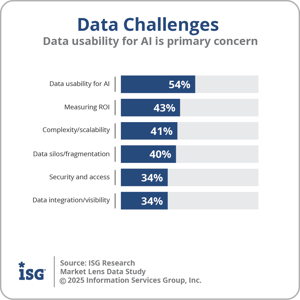 AI World in October last year, Oracle AI Data Platform combines multiple existing products from across Oracle’s portfolio, including Oracle Autonomous AI Lakehouse, Oracle Analytics Cloud, Oracle Cloud Infrastructure Generative AI Service and Oracle Cloud Infrastructure Object Storage. While each of these offerings is available for standalone consumption, Oracle AI Data Platform is designed to provide a single platform for Oracle customers to combine data persistence, governance, processing and analytics with the development, deployment and management of AI applications and agents. Oracle AI Data Platform enables the use of multiple AI models, frameworks and open-source processing engines, such as Apache Spark and Apache Flink. It also includes Oracle AI Data Platform Workbench, which provides a collaborative development environment for building, deploying and managing AI applications and is designed to complement Oracle AI Agent Studio, which is part of the Oracle Fusion Cloud Applications Suite and enables users to create, deploy, manage and orchestrate AI agents as well as customize Oracle-built agents delivered within Oracle Fusion Applications.
Oracle Autonomous AI Lakehouse was also launched in October 2025 and is an optimized version of Oracle Autonomous AI Database, delivering integration with the Apache Iceberg open table format as well as Oracle Autonomous AI Database Catalog to unify enterprise data and metadata from Iceberg-compatible platforms across an enterprise’s data estate and simplify data discovery and access. Oracle Autonomous AI Lakehouse also includes data engineering capabilities via Oracle Autonomous AI Database Data Studio, graph and spatial analytic functionality, Oracle Machine Learning functionality and support for storing, processing and retrieving vectors to facilitate similarity search and retrieval-augmented generation (RAG) use cases. In addition to offering vector capabilities within Oracle Autonomous AI Database, Oracle also recently introduced an early version of Oracle Autonomous AI Vector Database, a fully managed service aimed at developers and data scientists designed to make it easier to experiment with Oracle’s vector database capabilities without an upfront commitment to the full Oracle Autonomous AI Database product. As users move from experimentation and development into production at scale, they have the option to upgrade to Oracle Autonomous AI Database. I assert that through 2028, almost all enterprises developing AI applications will invest in data platforms with vector search and RAG to complement generative AI (GenAI) models with proprietary data and content.
Oracle also recently added Oracle AI Database Private Agent Factory to Oracle AI Database 26ai, providing an environment for the no-code development, deployment and orchestration of intelligent agents. Oracle AI Database Private Agent Factory is tightly integrated with the open source WayFlow runtime environment for the Agent Spec language for defining agentic systems, enabling database features to be consumed in agentic workflows. Oracle AI Database Private Agent Factory is designed to support sovereign AI and data requirements by providing a choice of deployment and consumption locations and delivers pre-built agents to support RAG, data administration and research. There is an increasing industry emphasis on the database as a memory layer for agentic applications. Much of this is achieved via existing data platform functionality for persisting and serving data, although agentic applications do place new demands on the database layer in terms of the combination of structured and unstructured data that requires hybrid vector search capabilities, as well as advanced semantic and knowledge graph capabilities. One of the drivers for the combination of AI and data platform functionality is that performance is improved when agentic memory is co-located with the data. Providers that can address the full combination of AI and data requirements through integrated AI and data platforms are increasingly attractive as enterprises look to accelerate initiatives and reduce costs and complexity. I recommend that enterprises evaluating AI and data platform products include Oracle AI Data Platform and its various complementary products within their assessments.
Regards,
Matt Aslett
Fill out the form to continue reading.