

IT service management (ITSM) is at an inflection point. For two decades, ITSM platforms have operated as structured systems of record and workflow orchestration layers, capturing tickets, routing tasks and enforcing process consistency. That model assumed humans were the primary actors and automation was deterministic, limited and rule-based. That assumption no longer holds.
Artificial intelligence (AI) is introducing a fundamentally different operating dynamic: systems that can interpret context, generate actions and adapt workflows in real time. The implication is not incremental improvement to ITSM, but a shift from passive workflow management to active, operational decision-making. In this model, the platform is no longer just tracking work. It is doing the work.
This creates a strategic fork for enterprise IT leaders.
One path is evolution: extending existing ITSM platforms with AI capabilities such as intelligent triage, automated resolution and predictive incident management. This approach preserves process integrity, governance structures and data models that enterprises have spent years building. It also aligns with risk-averse environments where auditability and control are non-negotiable.
The alternative path is disruption: AI agents operating across systems, interacting directly with infrastructure, applications and data without being mediated by traditional ITSM workflows. In this model, the “ticket” becomes obsolete. Work is initiated, executed and resolved autonomously, often outside the boundaries of the ITSM platform. The system of record risks becoming a lagging log rather than the control plane.
The tension between these paths centers on control versus speed. ISG Research asserts that by 2029, 60% of enterprise IT incidents will be resolved without ticket creation.
AI-native approaches promise faster resolution times, reduced operational overhead and the ability to handle previously unscalable workloads. But they also introduce new risks: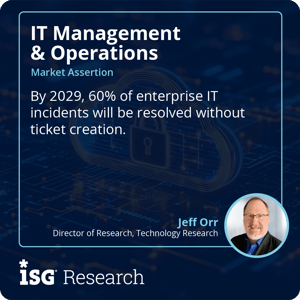 opaque decision-making, inconsistent execution and challenges in enforcing policy across distributed agents. Conversely, embedding AI into ITSM preserves governance but may constrain the full potential of autonomous operations.
A second tension is customization versus standardization.
Many enterprises have deeply customized their ITSM environments to reflect unique processes. These customizations now become liabilities. AI systems perform best with clean, standardized data and well-defined process boundaries. Excessive customization introduces ambiguity that reduces model effectiveness and increases the risk of unintended outcomes. As a result, organizations may need to unwind years of configuration to enable AI-driven operations.
A third dimension is ownership of workflow context.
AI systems derive value from understanding not just tasks, but the relationships between systems, users, policies and outcomes. The platform that owns this context becomes strategically central. If ITSM retains that role, it evolves into the operating system for enterprise workflows. If not, context shifts to AI orchestration layers, integration platforms or even data environments, displacing ITSM from its historical position.
For CIOs, the immediate priority is not choosing a winner but preparing for coexistence. This means defining where autonomous action is acceptable, establishing guardrails for AI-driven decisions and rethinking metrics that have traditionally defined IT operations success.
The end of passive ITSM does not mean the end of ITSM. It means its role is being renegotiated from a system of record to a system of action. The organizations that navigate this transition effectively will not simply automate workflows; they will redefine how work itself gets done.
Regards,
Jeff Orr
Fill out the form to continue reading.