

Digitally transforming finance operations has been a priority since 2020. Especially with the application of artificial intelligence in all its forms, software can streamline purchasing and the procure-to-pay (P2P) cycle, shorten process times, reduce unnecessary costs, provide greater visibility into cash flows, increase control and improve results. The application of AI will increasingly improve the productivity of the department, because professionals spend less time on mechanical, repetitive tasks. For all these reasons, ISG Research asserts that by 2028, only one-fourth of larger organizations will consistently manage procure-to-pay end-to-end, but those that do will outperform competitors.
Today, procure-to-pay systems are already beginning to embed AI, generative AI (GenAI) and agentic AI across the end-to-end process.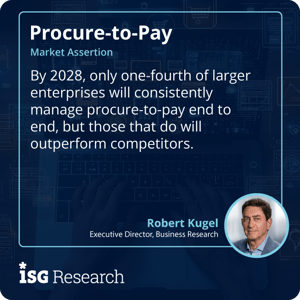 Although the capabilities examples mentioned below are not consistently available from each software provider, they represent the here and now of what’s feasible. It’s likely that every provider will feverishly copy its competitor’s offerings so that these will be table stakes within three years.
In the area of requisition and acquisition, natural-language assistants can turn free-text requests into structured requisitions, suggest categories and policies and route them for approval. Policy-aware guided buying recommends preferred suppliers, catalogs or frameworks, and flags policy issues in real time. These typically combine natural language processing (NLP) with machine learning and GenAI. In sourcing, GenAI helps draft request for proposal (RFP) and request for information (RFI) content, including questionnaires, scopes of work and evaluation criteria, which can be based on an enterprise’s templates and past events. Supplier-discovery tools can be used to suggest additional or alternative suppliers using category, specification and performance data, combining ML with GenAI search and summarization. Agentic sourcing capabilities can propose a request for quotations (RFQs), invite suppliers, collect bids and with a human in the loop, recommend a supplier.
For contracting- and order-related operations, some providers now offer contract analytics that can automatically extract clauses, renewal dates and risk markers, highlighting deviations from standard terms. GenAI offers summaries of documents such as long contracts, supplier assessments and questionnaires into concise risk and obligation overviews. I see these at this time as being serviceable but in a relatively primitive state. Moreover, the output will improve over time as systems “learn” in the context of the wording, functional requirements and outcomes specific to the enterprise using the software from its contracting activities.
In purchase orders (POs), providers use ML and predictive analytics to suggest reorders based on demand history, lead times and seasonality. Smart approval routing predicts optimal approvers to minimize delays while respecting policy and other constraints. AI assists with goods receipt and multi-way matching, aligning purchase orders, receipts and invoices and proposing resolutions to mismatches. Intelligent optical character recognition (OCR) is now nearly ubiquitous, capturing invoice data hands-free from multiple channels and formats. In a perfect example of the value of ML, the systems improve accuracy with feedback. ML-based agents also prevent errors by detecting duplicates and anomalous invoices in near real time and can block payment. Optimization models recommend early-payment discounts, payment timing and supplier prioritization.
P2P software also uses embedded AI for analytics, spend intelligence and exception handling. The software can classify and enrich spend data (especially through a more thorough extraction of invoice content) and detect miscoding. Providers offer agents to monitor exception queues, including blocked invoices and unmatched POs, and use the agents to attempt a first-line resolution or rerouting.
Software providers have been clear on the future direction in roadmap discussions. In addition to competitively filling in the missing capabilities mentioned, software providers most often add a short list of coming attractions. None of these appear to require major leaps in the application of AI technology, and all are almost certainly functional without major data and data architecture overhauls or major change-management efforts.
One of the most common roadmap features is broader and deeper use of copilots in managing P2P processes. Within two years, conversational copilots embedded across sourcing, supplier management, buying and contracts will be commonplace. These will support natural-language creation of requisitions and sourcing events, automated bid comparison and award recommendations, as well as concise supplier evaluation and risk summaries. Some will orchestrate multi-agent processes to manage sourcing rounds, adjust bid phases, validate service sheets and run compliance checks. With sufficient ongoing learning, agents will likely increasingly perform autonomous spend categorization and data-quality management.
Somewhat more speculative are the planned AI agents designed to coordinate sourcing and procurement decisions and workflows. This includes an end-to-end conversational P2P agent. The goal here is to have a single copilot that can take a user from a “I need…” statement through sourcing, contracting, ordering, receipt and invoice resolution, all the while respecting policy and constraints, retaining context and taking the right actions and data at each step. This is unlikely to be a fully or even largely autonomous agent, but one that confirms actions with the user that are either sufficiently consequential or where sufficient uncertainty exists about the right decision. Even with these limitations, there will be a positive impact on departmental productivity and quality.
Other examples of planned agents are those that will automatically compare complex supplier bids, ones that typically involve weighing initial price, total cost of ownership, environmental impact, performance and other risks and performance guarantees. Some will also simulate post-award scenarios and propose vendor recommendations. Others will help configure business rules by proposing approval flows, tolerance thresholds and categorization logic from data and policy descriptions. It’s likely that these will also have limitations and will benefit over the next few years from ongoing learning and design improvements.
Roadmaps from some providers include more sophisticated agents that go beyond flagging exceptions (such as price mismatches, missing receipts and duplicate invoices) but also check supporting documents, propose resolutions and fixes, assign responsibilities and handle notifications to process stakeholders. To further extend functionality, there will be an increasing availability of no-code tools that let procurement teams build copilots or agents on top of unified source-to-pay data, without specialist development skills.
Embedded AI in a purchasing application adds value by quickly improving the efficiency and effectiveness of an organization’s sourcing and procurement. Automated workflows streamline processes and enable departments to manage by exception. Greater productivity means the entire organization spends less time on routine requisitioning and ordering. Making policy compliance less burdensome can achieve cost savings by concentrating purchases from authorized vendors—especially those where volume purchase agreements are in force—and ensure that invoiced prices and discounts match what’s in the contract.
Software also enhances corporate effectiveness because the purchasing staff spends less time on routine work, leaving more time for them to act as a resource in support of the complex sourcing of materials and services. This shift can enhance the quality of the products and services the company offers. A dedicated system provides more thorough visibility into all direct and indirect spend by tracking cash commitments from purchase order approval. This also reduces risk because such visibility enables scrutiny of future cash commitments and identifies bad actors in the sourcing and procurement process.
AI will be a transformative technology for purchasing, as well as finance and accounting. But like all technology, it will not be a magic bullet that fixes an underperforming department. Only by methodically addressing any organizational and process issues that hamper the department’s performance can AI enable purchasing to achieve the full potential of technology. Another factor that must be included in any departmental AI initiative is ensuring that the data necessary for training the system is available on the software platform. Making purchasing departments AI-ready means addressing those business issues sufficiently before implementing software, or alternatively, addressing the people, process and data gaps as an explicit part of the project.
Investing in purchasing software can enhance the strategic value of the finance department, especially with the advent of AI and agents. It makes it possible for the department to redefine its role to serve as an enabler of better business outcomes. Digitizing purchasing with dedicated software supports this role while providing better control and visibility of corporate spending without needlessly encumbering the process. I recommend that chief financial officers, especially those who have a purchasing department reporting to them, focus on digitizing the sourcing and purchasing functions. They should be especially careful in provider selection at this stage of the evolution of the category and focus much of their attention on the providers’ ability to deliver on its development roadmap.
Regards,
Robert Kugel
Fill out the form to continue reading.