

A little over two years ago, I observed that the pendulum of fashion in the data management sector was swinging away from multiple best-of-breed tools and toward consolidated platforms. Enterprise software portfolios take time to evolve, but the trend toward consolidation has clearly been evident in the product strategies of large data management providers since then. Many providers have combined multiple previously separate products for data, analytics and artificial intelligence into unified offerings. A prime example is SAP’s Business Data Cloud, which combines data management, data integration, data federation, data governance and data catalog capabilities with analytics and AI functionality and an underlying data lakehouse architecture. SAP announced a series of updates to SAP BDC at its recent SAP TechEd event in Berlin, including the launch of a new data product development and management environment and the option to use Snowflake’s AI Data Cloud.
SAP was founded in 1972 and is a well-established provider of enterprise applications as  well as data platforms and analytics products and services. Headquartered in Walldorf, Germany, and providing products and services around the world, SAP is a trusted partner for thousands of customers across a range of industries and reported revenue of more than $39 billion in its most recent annual financial results. SAP offers a diverse range of software products that address business applications, business process management and transformation, artificial intelligence and analytics and data. All of these are underpinned by the SAP Business Technology Platform multi-cloud platform-as-a-service.
Given the diversity of its portfolio, SAP has been included in more than 50 ISG Buyers Guides published during 2025 at the time of writing. SAP was classified as Exemplary in the 2025 ISG Buyers Guides for AI Platforms, Data Platforms and Data Management, as well as Customer Experience Management, Supply Chain Planning and Workforce Management Suites, to name a few. In addition to SAP’s strength in each of these individual areas, the company can also argue that the breadth of capabilities provides a flywheel effect that gives it an advantage over other providers, thanks to its ownership of enterprise applications, which generate critical enterprise data that is incorporated into AI initiatives, which feed back into more intelligent enterprise applications.
While SAP applications are a primary source of enterprise data, the company’s data management products enable the management, governance and analysis of SAP and non-SAP data. Earlier this year, SAP consolidated its capabilities for analytics and data into a single offering with the launch of SAP BDC. As my colleague David Menninger explained at the time, SAP BDC is a data lakehouse-based platform designed to address analytics and AI, as well as data management, data integration, data federation, data cataloging and data governance. SAP BDC combines multiple existing SAP products, with SAP Datasphere addressing data governance, data integration, cataloging, semantic modeling and data warehousing; SAP Analytics Cloud addressing business intelligence and enterprise planning; SAP Business Warehouse enabling data warehouse transformation; and SAP AI Foundation providing the capabilities required for developing, deploying and managing AI initiatives. SAP BDC also includes SAP Databricks, delivering the core data science and machine learning capabilities of Databricks’ Data Intelligence Cloud (minus Databricks’ BI, data integration and workflow functionality).
In October, the company announced the availability of SAP Business Data Cloud Connect to provide real-time, zero-copy bi-directional sharing of data products between SAP BDC and Databricks Data Intelligence Cloud, along with a preview of the integration with Google Cloud. SAP had previously announced bi-directional replication and data federation with Google BigQuery. A key announcement at SAP’s TechEd developer conference in November was the addition of SAP Snowflake, providing SAP BDC users with the option to take advantage of Snowflake’s AI Data Cloud to store, process and analyze data. SAP also introduced SAP BDC Connect for Snowflake to provide zero-copy sharing between SAP BDC and external Snowflake environments.
Previously, SAP had also announced the addition of a variety of intelligent applications to SAP BDC at its SAP Sapphire conference in May, delivering pre-packaged data products with AI capabilities designed to accelerate and automate decision-making for key use-cases —initially finance intelligence, spend intelligence, supply chain intelligence and revenue intelligence. Enabling the development, consumption and sharing of data products was a primary design goal for SAP BDC.
In addition to delivering prepackaged SAP data products, another key announcement at TechEd was the preview of SAP Data Product Studio to enable enterprises to better create,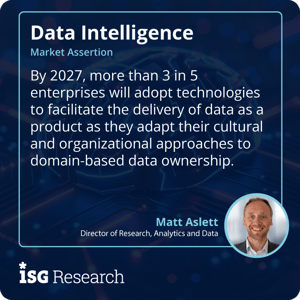 model and manage reusable data products with version control and lifecycle management. I assert that by 2027, more than 3 in 5 enterprises will adopt technologies to facilitate the delivery of data as a product as they adapt cultural and organizational approaches to domain-based data ownership.
In addition to the SAP BDC enhancements, TechEd also saw SAP announce updates for its SAP HANA Cloud database-as-a-service offering, including the ability to automatically generate knowledge graphs from SAP HANA Cloud metadata, support for Model Context Protocol, Tabular AI capabilities for forecasting, anomaly detection and predictive modeling that can be invoked as SQL functions. Also new is access to SAP’s new Relational Pretrained Transformer model (SAP-RPT-1), designed to deliver predictive AI on structured SAP data. SAP also previewed a new conversational vibe coding experience for Joule Studio, a capability of its SAP Build application development environment for developing and deploying custom Joule AI agents, along with Joule Studio’s forthcoming support for MCP and the Agent2Agent protocol. The company also announced an AI agent hub in its SAP LeanIX Application Portfolio Management product for agent discovery, management and governance.
There are advantages for enterprises in having a diverse portfolio of software product suppliers, not least the avoidance of becoming over-reliant on one provider. However, a myriad of providers and products can also lead to complexity, cost and confusion as enterprises need to commit time, effort and economic costs to integrating and maintaining multiple products. SAP BDC overcomes these challenges by providing users with a single, unified environment for data, analytics and AI, as well as facilitating integration with external data sources and applications. SAP BDC is also a work in progress. While the functionality is being combined, SAP still uses a myriad of product brands, which has the potential to cause confusion for the uninitiated trying to decipher how the various brands relate to each other and which of them are available standalone. Nevertheless, I recommend that enterprises considering providers for analytics, data and AI use cases consider the potential advantages of a unified approach and include SAP BDC in the evaluations.
Regards,
Matt Aslett
Fill out the form to continue reading.