

Artificial intelligence (AI) is not a feature you just turn on. It requires readiness work that many HR organizations still have not done.
That may sound blunt, but it reflects a reality that is getting lost in the current excitement around AI in HR. The market is moving quickly. Providers are rolling out copilots, assistants, recommendation engines and more advanced agentic capabilities across HCM, talent, learning, service delivery and workforce management. The innovation is real, and so is the pressure on HR leaders to keep pace. But speed in the market does not automatically equal readiness in the enterprise.
Many enterprises are still trying to activate AI on top of inconsistent processes, weak data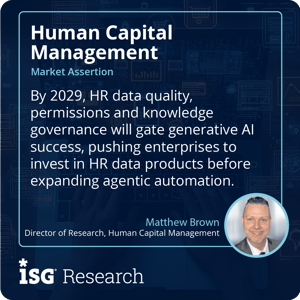 governance, incomplete records, outdated job structures, fragmented systems and unclear ownership. When that happens, AI does not create transformation. It creates confusion. In HR, that confusion quickly reaches the employee experience through inaccurate answers, weak recommendations, poor manager guidance, biased outcomes and declining trust in HR. That is why the conversation needs to move beyond AI enthusiasm and into AI readiness. By 2029, HR data quality, permissions and knowledge governance will gate generative AI (GenAI) success, pushing enterprises to invest in HR data products before expanding agentic automation.
The issue is not simply that HR has “bad data.” That phrase is too vague and, frankly, too easy. The more important question is whether HR has clarity on what data it needs to capture, why it matters and what decisions it is supposed to improve. HR has collected data for HR needs for years, but in many cases that data has not been governed, aligned or connected tightly enough to broader business outcomes. Data in HR strategies does not become more valuable just because an AI feature is layered on top of it. It becomes more consequential.
This is where the real risk starts to show. Incorrect or incomplete data can lead to decision support that is flawed from the start. Outdated policies included in knowledge models can generate answers that are no longer accurate. Bias-heavy job descriptions can distort recommendations and downstream talent decisions. Workforce models that were never adjusted for AI tuning can produce outputs that look credible but are not factually right in context. The result is not just lower value. It is a worse experience for employees and managers who are being asked to trust recommendations that may not deserve that trust.
That is also why governance matters so much, even though many enterprises still treat it like administrative overhead. Too often, governance is seen as bureaucracy, delegated entirely to IT, or documented once and never operationalized. In reality, governance is what makes AI usable. It is the discipline that helps define ownership, maintain data quality, control permissions, manage approved knowledge sources, monitor risk and connect outputs back to measurable business outcomes. Without that discipline, AI can scale weak assumptions much faster than HR can correct them.
HR cannot sit on the sidelines of this work. That may be uncomfortable for a function that has historically been centered more on people, policy and service than on data management and technology governance. HR people, historically, are not data people or technology people. They are people people. That is exactly why this readiness work does not come naturally across much of the field. But avoiding it is no longer an option. If HR wants AI to improve employee and manager experiences in a meaningful way, then HR has to lead the conversation around process audit, data governance and readiness, even if it does so in tight partnership with Finance and IT.
That partnership matters because this is not only a technology problem. It is an operating model problem. AI will expose whether the enterprise has discipline around how work gets done, how data is defined, who owns it and what level of confidence leaders should place in system-generated outputs. It will also expose whether HR is still relying on structures built for administration rather than for intelligence.
Legacy job architecture is a good example. Many organizations have job architecture that may still support compensation, compliance and reporting, but that alone will not move them forward if the goal is to connect work, skills, performance, learning and workforce decisions to business results. Some organizations do not have credible job architecture at all. Others have structures that are outdated or confuse a catalog of jobs with an architecture that can support modern talent decisions.
The same is true for skills data. Most enterprises still do not have skills data in a form that is strong enough to support the ambitions they attach to it. In many cases, what they have are fragments, approximations or disconnected efforts that are not grounded tightly enough in the actual work being done. That matters because work is done at the task level and supported by skills. Looking only at the job level is no longer sufficient if the objective is to improve performance, guide development and connect talent decisions to measurable business outcomes. Skills strategies became fashionable quickly. Data discipline has not kept up.
None of this means enterprises should stop exploring AI. It does mean they should be far more honest about where they are ready to move fast and where they are not. Lower-risk use cases may still offer practical value in the near term, but quick wins do not remove the need for readiness work. They should reinforce it. Enterprises that get real value from HR AI will not be the ones that rush to turn on every new capability. They will be the ones that take the time to examine process, audit data, enact governance, modernize (core HCM structures) and move forward on a stronger foundation.
What does good look like? Not perfection. Progress with discipline. It means common definitions, documented governance, accountable data owners, cleaner permissions, governed knowledge sources, process consistency, bias checks and a clearer link between HR data and business outcomes. It also means tighter coordination among HR, Finance and IT so that data, decisions and technology are moving in the same direction.
The market will keep pushing AI forward. Readiness work, however, will not disappear. It will evolve. That is the more useful way to think about what comes next. AI readiness is no longer a side project or a cleanup exercise that can wait until later. It is becoming part of modern HR transformation. HR does not need less ambition around AI. It needs more discipline underneath it.
Regards,
Matthew Brown
Fill out the form to continue reading.