

David manages the software research and advisory for IT and leads the expertise in AI at ISG Software Research. He oversees the team and expertise areas for software used by IT and for what is used by business. David leads the software research efforts in AI for IT and AI-infused software building on over three decades of experience in data and analytics. For decades, he has brought to market leading-edge analytics and data products in marketing and product leadership positions at Pivotal (a division of EMC), Vertica Systems, Oracle, Applix, InforSense, and IRI Software. David earned his MS in Business from Bentley University and a BS in Economics from the University of Pennsylvania.
narration area
Executive Summary
Buyers Guide Overview
ISG Research has conducted market research for over two decades across vertical industries, business applications, AI and IT. We have designed the ISG Buyers Guide™ to provide a balanced perspective of software providers and products that is rooted in an understanding of business and IT requirements. Utilization of our research methodology and decades of experience enables our Buyers Guide to be an effective method to assess and select software providers and products. The findings of this research provide a comprehensive approach to rating software providers and rank their ability to meet specific product and customer experience requirements.

ISG Research has designed the Buyers Guide to provide a balanced perspective of software providers and products that is rooted in an understanding of business and IT requirements.
The 2025 ISG Buyers Guides™ for Analytics, covering Analytics, Collaborative Analytics, Developer Analytics and Mobile Analytics, are the distillation of continuous market and product research. It is an assessment of how well software providers’ offerings address enterprises’ requirements for analytics software. The Value Index methodology is structured to support a request for information (RFI) for a request for proposal (RFP) process by incorporating all criteria needed to evaluate, select, utilize and maintain relationships with software providers. The ISG Buyers Guide evaluates customer experience and the product experience in its capability and platform.
The structure of the research reflects our understanding that the effective evaluation of software providers and products involves far more than just examining product features, potential revenue or customers generated from a provider’s marketing and sales efforts. It can ensure the best long-term relationship and value achieved from a resource and financial investment We believe it is important to take a comprehensive, research-based approach, since making the wrong choice of analytics software can raise the total cost of ownership, lower the return on investment and hamper an enterprise’s ability to reach its potential. In addition, this approach can reduce the project’s development and deployment time and eliminate the risk of relying on opinions or historical biases.
ISG Research believes that an objective review of existing and potential new software providers and products is a critical strategy for the adoption and implementation of analytics software. An enterprise’s review should include an analysis of both what is possible and what is relevant. We urge enterprises to do a thorough job of evaluating analytics software and offer these Buyers Guides as both the results of our in-depth analysis of these providers and as an evaluation methodology.
How To Use This Buyers Guide
Evaluating Software Providers: The Process
We recommend using the Buyers Guide to assess and evaluate new or existing software providers for your enterprise. The market research can be used as an evaluation framework to assess existing approaches and software providers or establish a formal request for information from providers on products and customer experience and will shorten the cycle time when creating an RFI. The steps listed below provide a process that can facilitate best possible outcomes in the most efficient manner.
- Define the business case and goals.
Define the mission and business case for investment and the expected outcomes from your organizational and technological efforts.
- Specify the business and IT needs.
Defining the business and IT requirements helps identify what specific capabilities are required with respect to people, processes, information and technology.
- Assess the required roles and responsibilities.
Identify the individuals required for success at every level of the enterprise from executives to frontline workers and determine the needs of each.
- Outline the project’s critical path.
What needs to be done, in what order and who will do it? This outline should make clear the prior dependencies at each step of the project plan.
- Ascertain the technology approach.
Determine the business and technology approach that most closely aligns to your enterprise’s requirements.
- Establish software provider evaluation criteria.
Utilize the product experience: capability and platform with support for adaptability, manageability, reliability and usability, and the customer experience in TCO/ROI and Validation.
- Evaluate and select the software provider and products properly.
Apply a weighting the evaluation categories in the evaluation criteria to reflect your enterprise’s priorities to determine the short list of software providers and products.
- Establish the business initiative team to start the project.
Identify who will lead the project and the members of the team needed to plan and execute it with timelines, priorities and resources.
Using the ISG Buyers Guide and process provides enterprises a clear, structured approach to making smarter software and business investment decisions. It ensures alignment between strategy, people, processes and technology while reducing risk, saving time and improving outcomes. The ISG approach promotes data-driven decision-making and collaboration, helping choose the right software providers for maximum value and return on investment.
Analytics
Analytics software continues to play an instrumental role in enabling an organization’s business units and IT teams to use data in both tactical and strategic ways, including the support of artificial intelligence (AI)-enabled processes. To accomplish this, organizations must provide technology that supports a variety of personas, enabling them to access data, generate and apply insights, communicate results and collaborate as needed. As analytics becomes more central to business performance, enterprises require platforms that scale insights across teams and make data-driven decision-making faster and more accessible.
Analytics has become more central to business performance as enterprises work to scale insights across teams.
ISG Research defines analytics software as the use of mathematics to create measurements and metrics that enable data to be evaluated in whatever form to provide insights and guide decision-making. It includes the collection and preparation of data needed in analyses, often one of the most time-consuming aspects of analytics. It also incorporates visualization and dissemination of information, such as dashboards, reports, emails or messages. Analytics ranges from simple ratios and percentages to forecasting, optimization and simulation. With the expansion of generative AI, analytics must also include narrative, AI-based insights.
Analytics as an advanced business tool dates back more than five decades. Reporting tools evolved from printed green-bar reports to banded reporting as personal computers and relational databases became widely adopted. Executive information systems developed in the 1970s, incorporating features such as dashboards, drill-down, pivot and conditional formatting, many of which remain central to today’s interactive analytics. Early analytics tools were limited by the volume of data that could be accessed and often relied on summarized information. As computing power increased, analytics systems expanded in interactivity and scale, enabling broader enterprise use.
Today’s business intelligence requirements extend well beyond query, reporting, analysis and publishing. Enterprises need tools for data sourcing and integration and for using analytics in planning, forecasting and performance assessment. They also require dashboards that support a wide range of visualizations. Analytics increasingly includes natural-language narratives supported by GenAI, with more providers offering multilingual capabilities. Collaboration features that allow users to share insights help reduce time to action and improve cross-functional alignment.
In today’s data-driven world, organizations must use analytics to understand and plan operations across every department and between business and IT domains. Analytics supports cost tracking, staffing plans, supplier performance, variance analysis and corrective action planning. It facilitates communication across teams, helping align efforts toward shared goals. Operating without analytics would be like flying a plane without an instrument panel. Artificial intelligence and machine learning extend analytics by classifying, predicting and recommending behaviors that improve operations. Enterprises require providers to use ML to analyze product-usage data, anticipate the next step in workflows and perform or recommend that action. GenAI enhances analytics products by recommending data preparation steps, suggesting visualizations and documenting processes.
Advanced analytics, which incorporates AI and ML, has become foundational in analytic workflows. Organizations using machine learning report competitive advantage, improved customer experiences, increased sales and faster responses to opportunities. Nearly two-thirds of organizations report using machine learning today, and three-quarters plan to increase use. The ultimate goal of analytics is to help organizations make and implement decisions that improve operations and financial outcomes. This set of capabilities has become known as decision intelligence. Decision intelligence includes analyzing historical performance, determining potential courses of action, evaluating alternatives and selecting the best path forward, with agentic AI coordinating activities that support implementation.
 Ideally, analytics processes can be conducted on a self-service basis. Self-service analytics remains a priority, and organizations that achieve it report greater satisfaction, particularly when business users can access insights without IT. To support self-service analytics, enterprises must also enable self-service data preparation. Preparing data remains the most time-consuming aspect of analytics, and many organizations hesitate to allow business users to work with unintegrated data. GenAI-based data preparation capabilities reduce the necessary involvement of IT and improve confidence in data quality. Semantic models further enhance self-service readiness, especially when combined with GenAI.
While AI and ML require specialized skills, providers have used elements of these technologies to deliver augmented intelligence capabilities such as automated insights and key-driver analysis with minimal input from business personnel. These capabilities, often delivered as narratives using GenAI, make insights more accessible across the workforce. ISG Software Research asserts that by 2027, almost all business intelligence software providers will include augmented intelligence based on GenAI to make analytics easier to use. Augmented intelligence shifts organizations from a pull model, where analysts create analyses on demand, to a push model where analyses are generated automatically. This improves consistency because automated analyses ensure common information is available to all users.
Analytics must also be accessible and timely. Nearly all providers now use GenAI to provide natural language processing that makes it easier for users to find information through search and understand analyses via narrative explanations. Analytics must be available to line-of-business personnel as they work, requiring mobile access to support a distributed workforce. Collaboration features are increasingly common. Providers now offer tools that enable users to comment on analyses, rate data sources and assign tasks that can be tracked to completion. Embedding analytics directly into operational applications allows line-of-business workers to access information without switching systems.
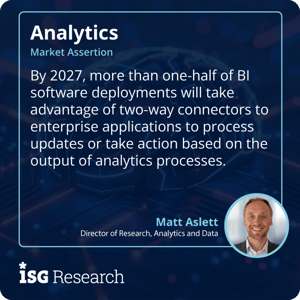 As providers expand application programming interfaces that support the full capabilities of products, many now offer prebuilt connections that deliver analytic outputs into operational systems. By 2027, more than one-half of BI software deployments will use two-way connectors to enterprise applications to process updates or take action based on analytic output. Analytics must also operate in real time. Organizations receive information from a rapidly growing number of devices and sources. Without the ability to analyze that information as it arrives, organizations risk missing opportunities to respond. Research shows that one-half of organizations consider it essential to process streaming data and event information in seconds or milliseconds.
As organizations expand analytic requirements, a transition to enterprise-class analytics becomes essential. Providers have responded with additional capabilities, some developed internally and others acquired from complementary software providers. Though the number of providers has expanded, few attempt to deliver the full spectrum of capabilities evaluated in this assessment. Most organizations will require more than one software provider to meet all analytic needs.
The 2025 ISG Buyers Guide™ for Analytics evaluates software providers and products in three key capability areas, including data, analytics and communication. Data capabilities evaluated include defining and managing data models, accessing, integrating and governing data and managing master data. Analytics evaluation criteria include data discovery using computers, browsers and mobile devices; query; visualization; presentation; calculation; and AI analytics, including predictive, generative and agentic capabilities. Providers are also evaluated for communication capabilities, including informing audiences of analytic results, delivering information via any device, supporting collaboration and automating action on analytic output through alerting and agents. This research assessed the following providers: Alibaba Cloud, AWS, Cloud Software Group, Databricks, Domo, Epicor, Google, IBM, Infor, insightsoftware, Microsoft, OpenText, Oracle, Qlik, Salesforce, SAP, SAS, Sisense, Strategy, ThoughtSpot and Zoho.
Key Takeaways
Analytics has become an enterprise-wide capability that supports data preparation, insight generation and communication across business and IT teams. As organizations expand the use of AI and machine learning, platforms must provide accessible, self-service experiences that scale across roles. Today’s requirements emphasize augmented intelligence, embedded workflows and collaboration to accelerate decision-making. These capabilities position analytics as a core driver of operational awareness and continuous performance improvement.
Software Provider Summary
The ISG Buyers Guide™ for Analytics evaluates 21 software providers that offer products supporting data modeling and access, analytic discovery and visualization, and communication capabilities that distribute insights and automate actions. The research ranked the top three overall leaders as Oracle, Domo and Databricks. Providers were classified using weighted performance in Product Experience and Customer Experience for ISG quadrant placement. AWS, Databricks, Domo, IBM, Microsoft, Oracle, Qlik, Salesforce and SAP were rated as Exemplary, with Google and Strategy rated as Innovative. Infor, ThoughtSpot and Zoho were rated as Assurance, and Alibaba Cloud, Cloud Software Group, Epicor, insightsoftware, OpenText, SAS and Sisense were rated as Merit.
Product Experience Insights
Product Experience, representing 80% of the evaluation, focuses on Capability (25%) and Platform (55%) which includes adaptability, manageability, reliability and usability. Oracle, Databricks and Domo achieved the highest performance as Leaders in this category, supported by Oracle’s breadth across enterprise analytics capabilities and Databricks’ and Domo’s strong platform performance in scalability and integration. Leaders demonstrated enterprise-grade platform capabilities across varied roles and contexts.
Customer Experience Value
Customer Experience, representing 20% of the evaluation, focuses on validation and TCO/ROI. Oracle, Domo, Salesforce and ThoughtSpot were the Leaders in this category showing strong customer advocacy and clear investment in success outcomes. Providers with lower performance often lacked publicly available customer validation or failed to demonstrate structured ROI measurement and proactive lifecycle engagement.
Strategic Recommendations
Enterprises should treat analytics as a strategic capability that unifies data access, insight generation and action across business and IT. Buyers should prioritize platforms that combine robust data integration with AI-driven augmentation to accelerate decision-making and reduce reliance on specialized roles. Providers that deliver intuitive experiences, governance-ready architectures and embedded collaboration will better support scalable analytics adoption. Aligning platform selection with enterprise data maturity and operational priorities will help organizations derive consistent value from analytics investments.
The Findings – Analytics
The software providers and products evaluated in the research provide product and customer experiences, but not everything offered is equally valuable to every enterprise or is needed to operate in business processes and use cases. Moreover, the existence of too many capabilities in products may be a negative factor for an enterprise if it introduces unnecessary complexity. Nonetheless, you may decide that a more comprehensive set of capabilities in the product is important, and where they match your enterprise’s requirements.
An effective customer relationship with a software provider is vital to the success of any investment. The overall customer experience and the full lifecycle of engagement play a key role in ensuring satisfaction and long-term success. Providers with dedicated customer leadership, such as chief customer officers, tend to invest more deeply in these relationships and prioritize customer outcomes to TCO and ROI expectations. It is equally important that this commitment to customer success is clearly demonstrated throughout the provider’s website, buying process and customer journey.
Overall Scoring of Software Providers Across Categories
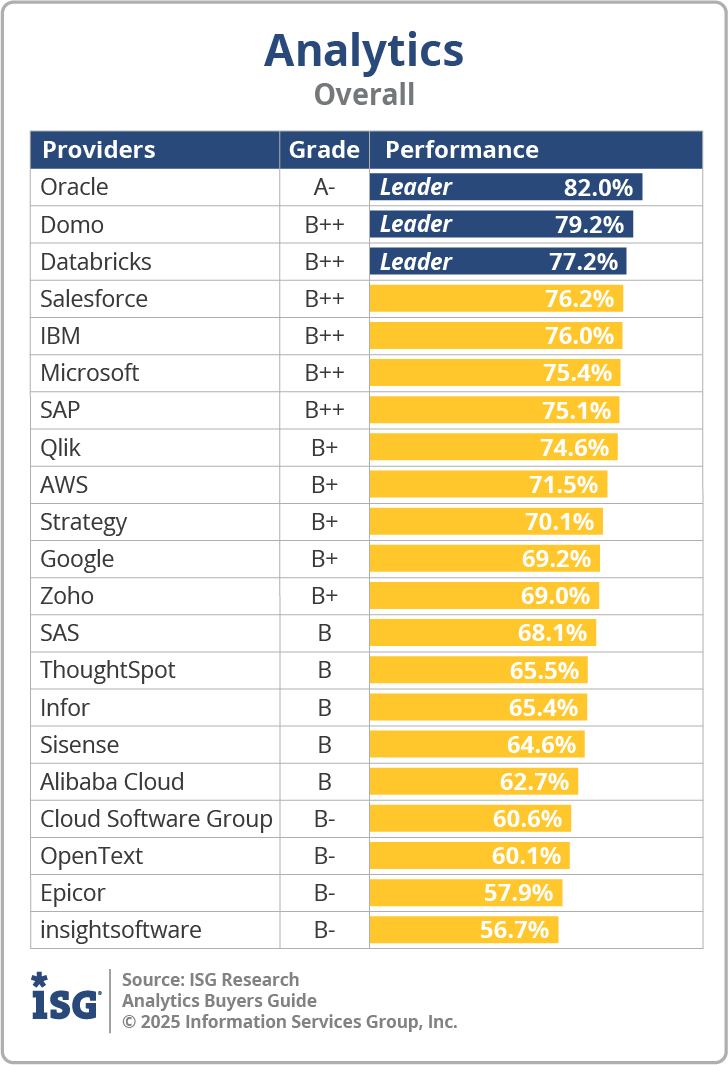 The research finds Oracle atop the list, followed by Domo and Databricks. Providers that place in the top three of a category earn the designation of Leader. Domo and Oracle have done so in five categories, Databricks in three and Salesforce, ThoughtSpot and Zoho in one category.
The overall representation of the research below places the rating of the Product Experience and Customer Experience on the x and y axes, respectively, to provide a visual representation and classification of the software providers. Those providers whose Product Experience have above median weighted performance to the axis in aggregate of the two product categories place farther to the right, while the performance and weighting for the Customer Experience category determines placement on the vertical axis. In short, software providers that place closer to the upper-right on this chart performed better than those closer to the lower-left.
The research categorizes and rates software providers into one of four categories: Assurance, Exemplary, Merit or Innovative. This representation of software providers’ weighted performance in meeting the requirements in product and customer experience.
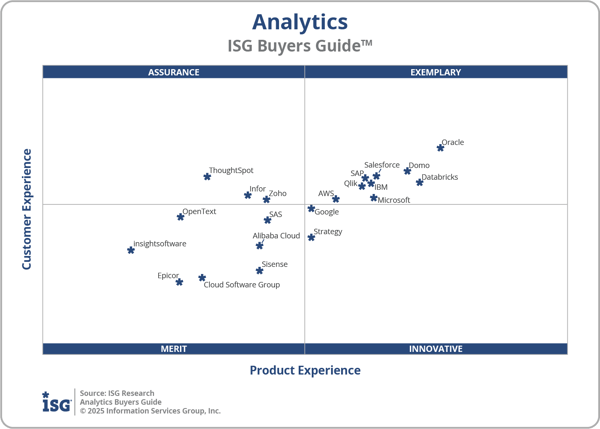
Exemplary: This rating (upper right) represents those that performed above median in Product and Customer Experience requirements. The providers rated Exemplary are: AWS, Databricks, Domo, IBM, Microsoft, Oracle, Qlik, Salesforce and SAP.
Innovative: This rating (lower right) represents those that performed above median in Product Experience but not in Customer Experience. The providers rated Innovative are: Google and Strategy.
Assurance: This rating (upper left) represents those that performed above median in Customer Experience but not in Product Experience. The providers rated Assurance are: Infor, ThoughtSpot and Zoho.
Merit: This rating (lower left) represents those that did not surpass the median in Customer or Product Experience. The providers rated Merit are: Alibaba Cloud, Cloud Software Group, Epicor, insightsoftware, OpenText, SAS and Sisense.
We advise enterprises to use this research as a supplement to their own evaluations, recognizing that ratings or rankings do not solely represent the value of a provider nor indicate universal suitability of a set of products.
Product Experience
 The process of researching products to address an enterprise’s needs should be comprehensive and evaluate specific capabilities and the underlying platform to the product experience. Our evaluation of the Product Experience examines the lifecycle of onboarding, configuration, operations, usage and maintenance. Too often, software providers are not evaluated for the entirety of the product; instead, they are evaluated on market execution and vision of the future.
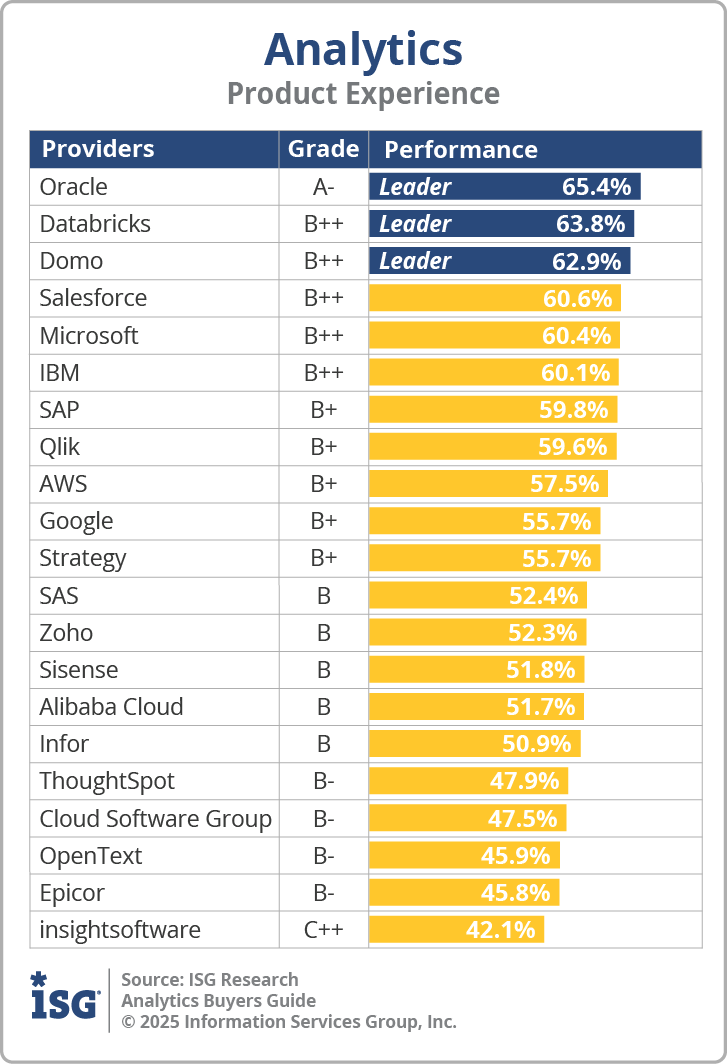
The research results in Product Experience are ranked at 80%, or four-fifths, using the underlying weighted performance. Importance was placed on the categories as follows: Capability (25%) and Platform (55%). Oracle, Databricks and Domo were designated Product Experience Leaders.
Customer Experience
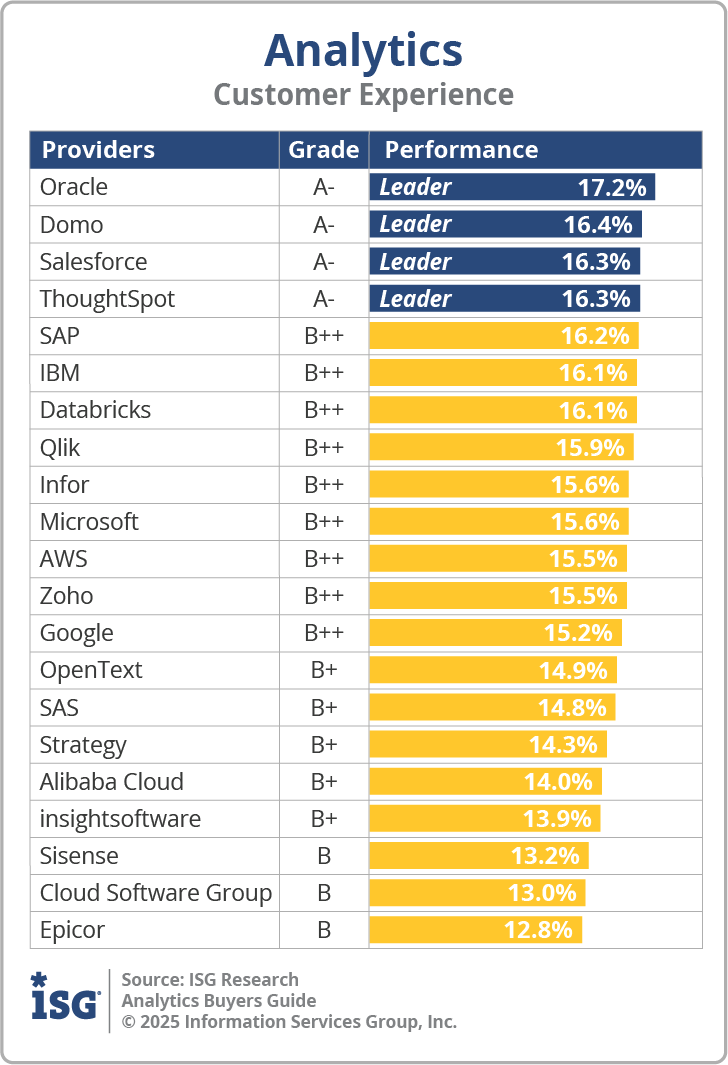 The importance of a customer relationship with a software provider is essential to the actual success of the products and technology. The evaluation of the Customer Experience and the entire lifecycle an enterprise has with its software provider is critical for ensuring satisfaction in working with that provider. The ISG Buyers Guide examines a software provider’s customer commitment, viability, customer success, sales and onboarding, product roadmap and services with partners and support. The customer experience category also investigates the TCO/ROI and how well a software provider demonstrates the product’s overall value, cost and benefits, including the tools and resources to evaluate these factors.
The research results in Customer Experience are ranked at 20%, or one-fifth of the 100% index, and represent the underlying provider validation and TCO/ROI requirements as they relate to the framework of commitment and value to the software provider-customer relationship.
The software providers that evaluated the highest in the Customer Experience category are Oracle, Domo, Salesforce and ThoughtSpot. These category leaders best communicate commitment and dedication to customer needs.
Software providers that did not perform well in this category were unable to provide or make sufficient information readily available to demonstrate success or articulate their commitment to customer experience. The use of a software provider requires continuous investment, so a holistic evaluation must include examination of how they support their customer experience.
Software Provider Inclusion – Analytics
For inclusion in the 2025 ISG Buyers Guide™ for Analytics, a software provider must be in good standing financially and ethically, have at least $150 million in annual or projected revenue verified using independent sources, sell products and provide support on at least two continents, and have at least 50 customers. The principal source of the relevant business unit’s revenue must be software-related, and there must have been at least one major software release in the past 12 months.
The product must be actively marketed as an analytics product and capable of accessing data from a variety of sources, modeling the data for analysis, analyzing the data using a variety of techniques, communicating the results in a variety of ways and supporting the analytics processes within an organization.
The research is designed to be independent of the specifics of software provider packaging and pricing. To represent the real-world environment in which businesses operate, we include providers that offer suites or packages of products that may include relevant individual modules or applications. If a software provider is actively marketing, selling and developing a product for the general market and it is reflected on the provider’s website that the product is within the scope of the research, that provider is automatically evaluated for inclusion.
All software providers that offer relevant products and meet the inclusion requirements were invited to participate in the evaluation process at no cost to them.
Software providers that meet our inclusion criteria but did not completely participate in our Buyers Guide were assessed solely on publicly available information. As this could have a significant impact on classification and ratings, we recommend additional scrutiny when evaluating those providers.
Products Evaluated
| Provider | Product Names | Version | Release Month/Year |
|---|---|---|---|
| Alibaba Cloud | Quick BI | 6.0 | October 2025 |
| AWS | Amazon Quick Suite | N/A | November 2025 |
| Cloud Software Group | Spotfire | 14.6 LTS | October 2025 |
| Databricks | Databricks Platform | N/A | November 2025 |
| Domo | Domo | N/A | November 2025 |
| Epicor | Grow | 15.0.0 | October 2025 |
| Looker | 25.20 | November 2025 | |
| IBM | IBM Cognos Analytics | 12.1.1 | October 2025 |
| Infor | Infor Birst | N/A | November 2025 |
| insightsoftware | Logi Symphony | N/A | November 2025 |
| Microsoft | Power BI | 2.148.1477.0 | November 2025 |
| OpenText | OpenText™ Analytics Cloud | N/A | November 2025 |
| Oracle | Oracle Analytics Cloud | N/A | November 2025 |
| Qlik | Qlik Cloud Analytics | N/A | November 2025 |
| Salesforce | Tableau | N/A | November 2025 |
| SAP | SAP Business Data Cloud | N/A | November 2025 |
| SAS | SAS Viya | 2025.11 | November 2025 |
| Sisense | Sisense Platform | N/A | November 2025 |
| Strategy | Strategy One Platform | N/A | November 2025 |
| ThoughtSpot | ThoughtSpot Embedded | 10.14.0.cl | November 2025 |
| Zoho | Zoho Analytics | N/A | October 2025 |
Collaborative Analytics
Analytics is the instrument panel for today’s enterprises, enabling every function to track performance, plan actions and coordinate decisions. Collaboration is now integral to these processes. Mobile access, enterprise collaboration platforms and GenAI-driven narratives are bringing more people into the discussion, accelerating time to insight and time to action.
Mobile access, enterprise collaboration platforms and GenAI-driven narratives are bringing more people into the discussion, accelerating time to insight and time to action.
ISG Research defines collaborative analytics as the sharing and communication of analytical outputs, including commenting, reviewing, approving and assigning tasks tied to insights. These must be combined with the underlying analytics that transform data into decisions. Collaborative analytics spans data preparation and modeling through visualization, narrative delivery and task tracking across devices.
Collaboration in conjunction with analytics has become much more commonplace. Two-thirds of organizations report using or planning to use collaboration with analytics. Enterprises need to publish and distribute analytics easily. Participants in analytics processes should be able to rate data sources and engage in threaded discussions about analyses. Decision-making involves assigning tasks and tracking them to completion, helping ensure that the value of analytics results in specific actions. A variety of personas are involved, and mobile capabilities are important to reach and engage all participants. We assert that by 2027, collaborative capabilities such as these will be standard in most BI platforms, shifting organizations from a pull model of manual analyses to a push model of proactive engagement.
The 2025 ISG Buyers Guide™ for Collaborative Analytics evaluates providers on support of collaboration about data-related issues, the ways analyses can be communicated, shared and discussed and how business strategy can be defined, tracked and communicated. This research assessed the following providers: Alibaba Cloud, AWS, Cloud Software Group, Databricks, Domo, Epicor, Google, IBM, Infor, insightsoftware, Microsoft, OpenText, Oracle, Qlik, Salesforce, SAP, SAS, Sisense, Strategy, ThoughtSpot and Zoho.
Key Takeaways
Collaborative analytics has become a core enterprise capability, enabling teams to share insights, coordinate decisions and translate analytical outputs into action. As organizations expand use of mobile access, enterprise collaboration tools and GenAI-driven narratives, analytics must support broader participation and faster engagement. Modern requirements emphasize seamless communication, structured task management and transparency across roles. These expectations position collaborative analytics as an essential mechanism for accelerating insight-to-action cycles and improving operational alignment.
Software Provider Summary
The ISG Buyers Guide™ for Collaborative Analytics evaluates 21 software providers that offer products supporting insight sharing, narrative delivery, and task-oriented collaboration across devices and workflows. The research ranked the top three overall leaders as Domo, Oracle and SAP. Providers were classified using weighted performance in Product Experience and Customer Experience for ISG quadrant placement. Domo, IBM, Microsoft, Oracle, Qlik, Salesforce, SAP, ThoughtSpot and Zoho were rated as Exemplary, with SAS and Strategy rated as Innovative. AWS, Databricks and Infor were rated as Assurance, and Alibaba Cloud, Cloud Software Group, Epicor, Google, insightsoftware, OpenText and Sisense were rated as Merit.
Product Experience Insights
Product Experience, representing 80% of the evaluation, focuses on Capability (50%) and Platform (30%) which includes adaptability, manageability, reliability and usability. Domo, Oracle and Zoho achieved the highest performance as Leaders in this category, supported by Domo and Zoho’s breadth of collaborative analytics capabilities and Oracle’s strong platform resilience across governance and scalability. Leaders demonstrated enterprise-grade platform capabilities across varied roles and contexts.
Customer Experience Value
Customer Experience, representing 20% of the evaluation, focuses on validation and TCO/ROI. Oracle, Domo, Salesforce and ThoughtSpot were the Leaders in this category, showing strong customer advocacy and clear investment in success outcomes. Providers with lower performance often lacked publicly available customer validation or failed to demonstrate structured ROI measurement and proactive lifecycle engagement.
Strategic Recommendations
Enterprises should treat collaborative analytics as a strategic investment that unifies insight sharing, workflow coordination and decision execution. Buyers should prioritize platforms that combine mobile engagement, structured task management and AI-assisted narratives to accelerate adoption and actionability. Providers delivering intuitive experiences, governance-ready architectures and seamless integration with enterprise collaboration tools will better support cross-functional alignment. Aligning platform selection with collaboration maturity and operational needs will help organizations increase the impact of analytics-driven decisions.
The Findings – Collaborative Analytics
The software providers and products evaluated in the research provide product and customer experiences, but not everything offered is equally valuable to every enterprise or is needed to operate in business processes and use cases. Moreover, the existence of too many capabilities in products may be a negative factor for an enterprise if it introduces unnecessary complexity. Nonetheless, you may decide that a more comprehensive set of capabilities in the product is important, and where they match your enterprise’s requirements.
An effective customer relationship with a software provider is vital to the success of any investment. The overall customer experience and the full lifecycle of engagement play a key role in ensuring satisfaction and long-term success. Providers with dedicated customer leadership, such as chief customer officers, tend to invest more deeply in these relationships and prioritize customer outcomes to TCO and ROI expectations. It is equally important that this commitment to customer success is clearly demonstrated throughout the provider’s website, buying process and customer journey.
Overall Scoring of Software Providers Across Categories
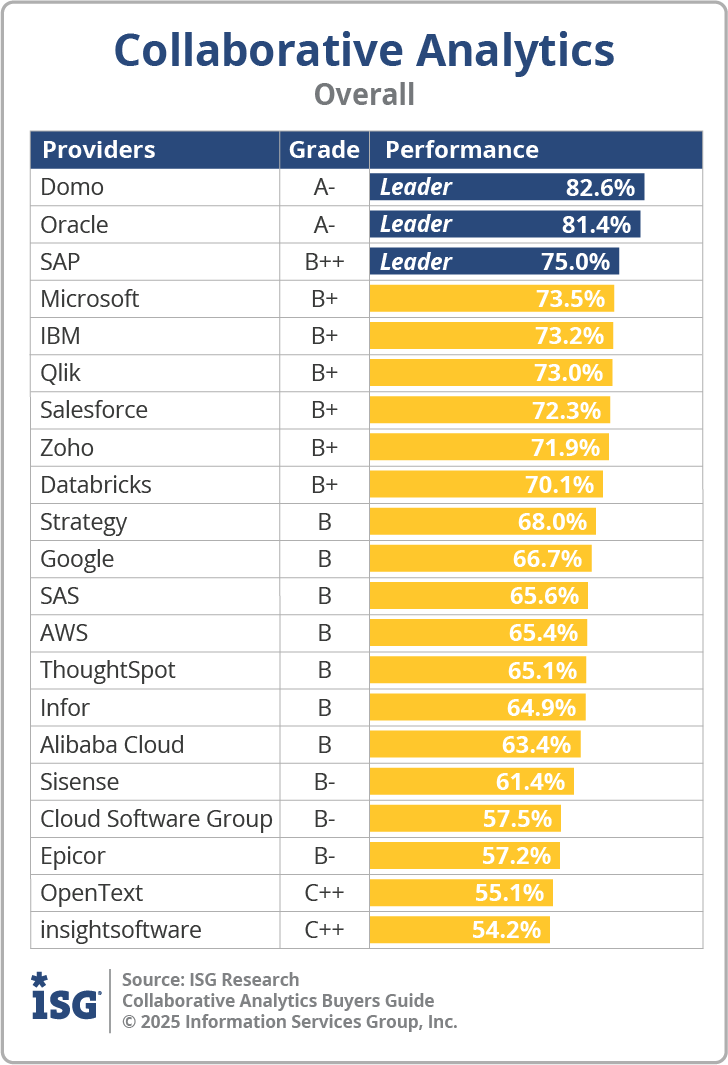 The research finds Domo atop the list, followed by Oracle and SAP. Providers that place in the top three of a category earn the designation of Leader. Domo and Oracle have done so in five categories, Zoho in two and Databricks, SAP, Salesforce and ThoughtSpot in one category.
The overall representation of the research below places the rating of the Product Experience and Customer Experience on the x and y axes, respectively, to provide a visual representation and classification of the software providers. Those providers whose Product Experience have above median weighted performance to the axis in aggregate of the two product categories place farther to the right, while the performance and weighting for the Customer Experience category determines placement on the vertical axis. In short, software providers that place closer to the upper-right on this chart performed better than those closer to the lower-left.
The research categorizes and rates software providers into one of four categories: Assurance, Exemplary, Merit or Innovative. This representation of software providers’ weighted performance in meeting the requirements in product and customer experience.
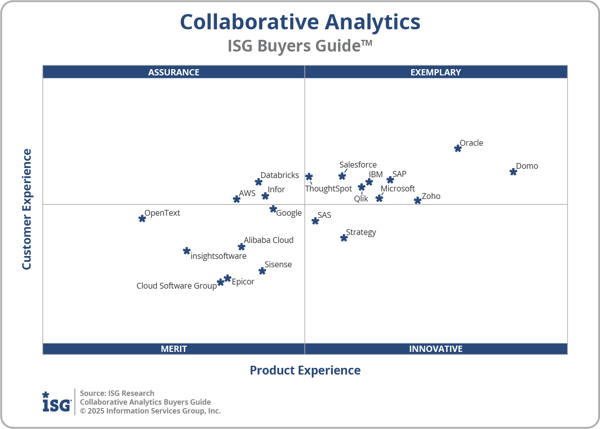
Exemplary: This rating (upper right) represents those that performed above median in Product and Customer Experience requirements. The providers rated Exemplary are: Domo, IBM, Microsoft, Oracle, Qlik, Salesforce, SAP, ThoughtSpot and Zoho.
Innovative: This rating (lower right) represents those that performed above median in Product Experience but not in Customer Experience. The providers rated Innovative are: SAS and Strategy.
Assurance: This rating (upper left) represents those that performed above median in Customer Experience but not in Product Experience. The providers rated Assurance are: AWS, Databricks and Infor.
Merit: This rating (lower left) represents those that did not surpass the median in Customer or Product Experience. The providers rated Merit are: Alibaba Cloud, Cloud Software Group, Epicor, Google, insightsoftware, OpenText and Sisense.
We advise enterprises to use this research as a supplement to their own evaluations, recognizing that ratings or rankings do not solely represent the value of a provider nor indicate universal suitability of a set of products.
Product Experience
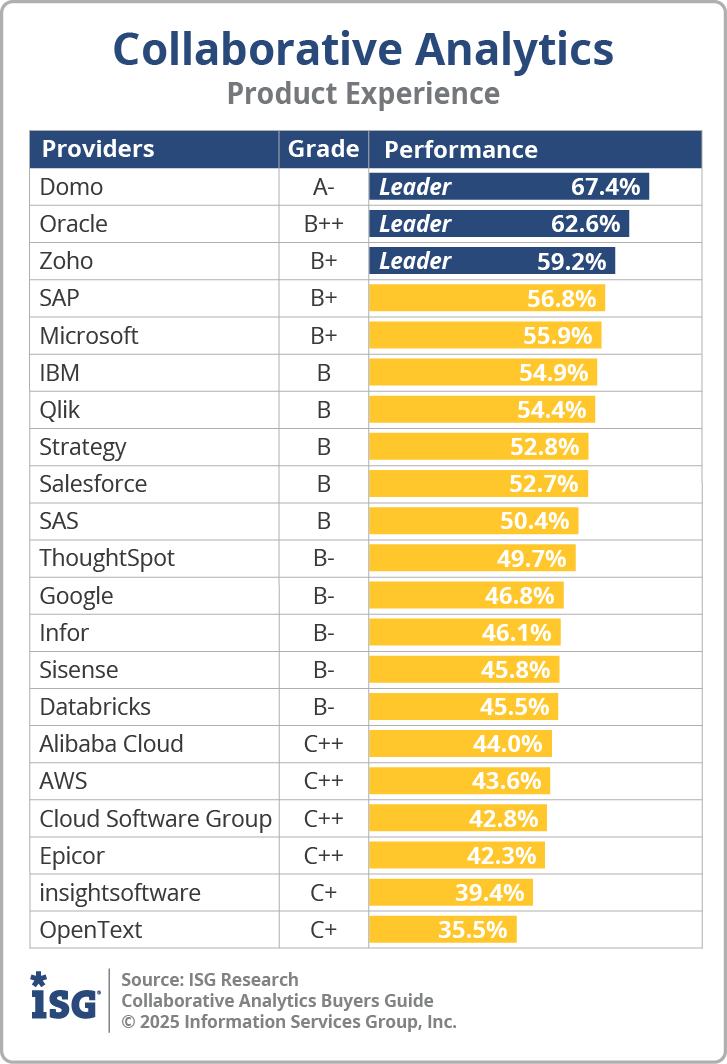 The process of researching products to address an enterprise’s needs should be comprehensive and evaluate specific capabilities and the underlying platform to the product experience. Our evaluation of the Product Experience examines the lifecycle of onboarding, configuration, operations, usage and maintenance. Too often, software providers are not evaluated for the entirety of the product; instead, they are evaluated on market execution and vision of the future.
The research results in Product Experience are ranked at 80%, or four-fifths, using the underlying weighted performance. Importance was placed on the categories as follows: Capability (50%) and Platform (30%). Domo, Oracle and Zoho were designated Product Experience Leaders.
Customer Experience
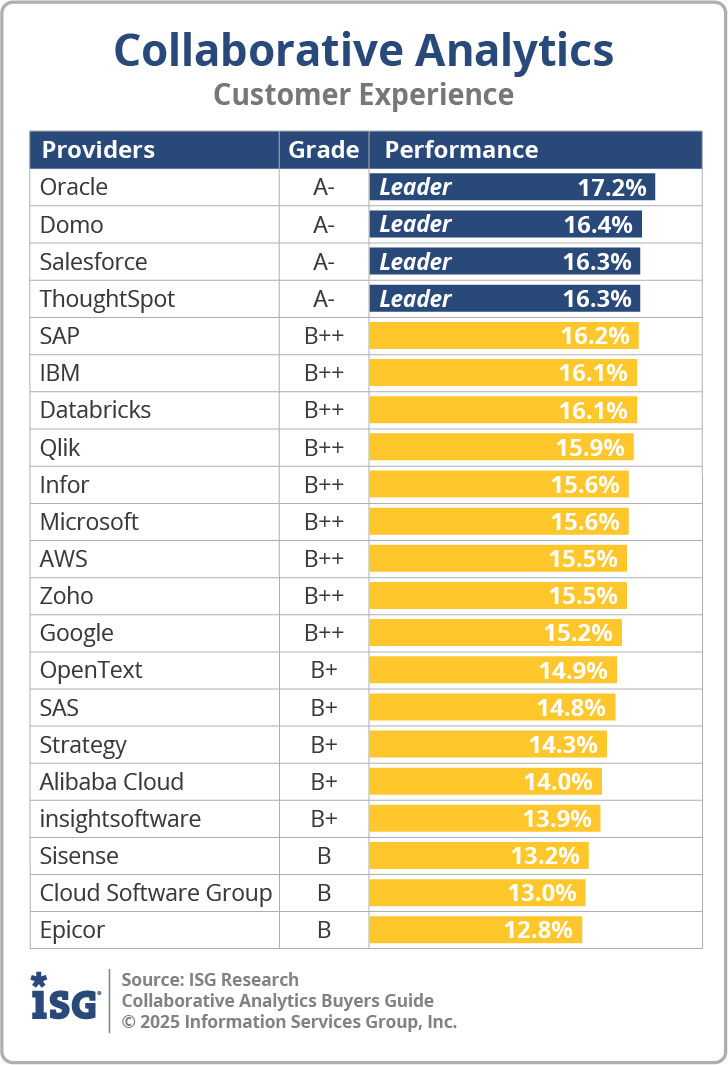 The importance of a customer relationship with a software provider is essential to the actual success of the products and technology. The evaluation of the Customer Experience and the entire lifecycle an enterprise has with its software provider is critical for ensuring satisfaction in working with that provider. The ISG Buyers Guide examines a software provider’s customer commitment, viability, customer success, sales and onboarding, product roadmap and services with partners and support. The customer experience category also investigates the TCO/ROI and how well a software provider demonstrates the product’s overall value, cost and benefits, including the tools and resources to evaluate these factors.
The research results in Customer Experience are ranked at 20%, or one-fifth of the 100% index, and represent the underlying provider validation and TCO/ROI requirements as they relate to the framework of commitment and value to the software provider-customer relationship.
The software providers that evaluated the highest in the Customer Experience category are Oracle, Domo, Salesforce and ThoughtSpot. These category leaders best communicate commitment and dedication to customer needs. While not a Leader, SAP was also found to meet a broad range of enterprise customer experience requirements.
Software providers that did not perform well in this category were unable to provide or make sufficient information readily available to demonstrate success or articulate their commitment to customer experience. The use of a software provider requires continuous investment, so a holistic evaluation must include examination of how they support their customer experience.
Software Provider Inclusion – Collaborative Analytics
For inclusion in the 2025 ISG Buyers Guide™ for Collaborative Analytics, a software provider must be in good standing financially and ethically, have at least $150 million in annual or projected revenue verified using independent sources, sell products and provide support on at least two continents, and have at least 50 customers. The principal source of the relevant business unit’s revenue must be software-related, and there must have been at least one major software release in the past 12 months.
The product must be actively marketed as an analytics product that includes collaborative capabilities to support analytics and decision-making processes with an enterprise including communicating the results of analyses and tracking the decisions and actions stemming from those analyses.
The research is designed to be independent of the specifics of software provider packaging and pricing. To represent the real-world environment in which businesses operate, we include providers that offer suites or packages of products that may include relevant individual modules or applications. If a software provider is actively marketing, selling and developing a product for the general market and it is reflected on the provider’s website that the product is within the scope of the research, that provider is automatically evaluated for inclusion.
All software providers that offer relevant products and meet the inclusion requirements were invited to participate in the evaluation process at no cost to them.
Software providers that meet our inclusion criteria but did not completely participate in our Buyers Guide were assessed solely on publicly available information. As this could have a significant impact on classification and ratings, we recommend additional scrutiny when evaluating those providers.
Products Evaluated
| Provider | Product Names | Version | Release Month/Year |
|---|---|---|---|
| Alibaba Cloud | Quick BI | 6.0 | October 2025 |
| AWS | Amazon Quick Suite | N/A | November 2025 |
| Cloud Software Group | Spotfire | 14.6 LTS | October 2025 |
| Databricks | Databricks Platform | N/A | November 2025 |
| Domo | Domo | N/A | November 2025 |
| Epicor | Grow | 15.0.0 | October 2025 |
| Looker | 25.20 | November 2025 | |
| IBM | IBM Cognos Analytics | 12.1.1 | October 2025 |
| Infor | Infor Birst | N/A | November 2025 |
| insightsoftware | Logi Symphony | N/A | November 2025 |
| Microsoft | Power BI | 2.148.1477.0 | November 2025 |
| OpenText | OpenText™ Analytics Cloud | N/A | November 2025 |
| Oracle | Oracle Analytics Cloud | N/A | November 2025 |
| Qlik | Qlik Cloud Analytics | N/A | November 2025 |
| Salesforce | Tableau | N/A | November 2025 |
| SAP | SAP Business Data Cloud | N/A | November 2025 |
| SAS | SAS Viya | 2025.11 | November 2025 |
| Sisense | Sisense Platform | N/A | November 2025 |
| Strategy | Strategy One Platform | N/A | November 2025 |
| ThoughtSpot | ThoughtSpot Embedded | 10.14.0.cl | November 2025 |
| Zoho | Zoho Analytics | N/A | October 2025 |
Developer Analytics
The processes and technology of analytics and business intelligence software continue to play an instrumental role in enabling an enterprise’s business units and IT teams to use data in both tactical and strategic ways. To accomplish this, organizations must provide technology that supports a variety of personas, enabling them to access data, generate and apply insights, communicate results and collaborate as needed. Analytics should also lead to action. Enterprises use operational applications where decisions resulting from analyses are implemented. Enabling developers to embed analytics directly into these systems makes it easier for line-of-business workers to access necessary information without switching tools, reducing the need for additional training.
ISG Research defines Developer Analytics as the ability to incorporate analytic applications, or portions thereof, into other business applications and processes with rich APIs and rebrandable analytic components.
Software providers must offer tools for defining data models and accessing data from applications and other data sources. These tools are often used by a different audience than typical analytics platforms. Application development teams, for example, create the framework that enables line-of-business personnel to perform analyses. The tools must also provide mechanisms to integrate both inputs to and outputs from analytical processes with other applications. ISG asserts that by 2027, more than one-half of BI software deployments will take advantage of two-way connectors to enterprise applications to process updates or take action based on the output of analytics processes. Developers also require programmatic access to management and administration functions to coordinate installation and maintenance of the system for business users.
The 2025 ISG Buyers Guide™ for Developer Analytics evaluates software providers and products in three key areas of data, analytics and communications, with emphasis on integration and customization. This research assessed the following providers: Alibaba Cloud, AWS, Cloud Software Group, Databricks, Domo, Epicor, Google, IBM, Infor, insightsoftware, Microsoft, OpenText, Oracle, Qlik, Salesforce, SAP, SAS, Sisense, Strategy, ThoughtSpot and Zoho.
Key Takeaways
Developer analytics enables enterprises to embed insights directly into operational systems, reducing friction for business users and supporting faster decision-making. As organizations expand use of APIs, connectors and customizable components, analytics must provide scalable integration and programmatic control for development teams. These capabilities position developer analytics as a key mechanism for unifying insight delivery with application workflows and improving operational responsiveness.
Software Provider Summary
The ISG Buyers Guide™ for Developer Analytics evaluates 21 software providers offering products supporting embedded analytics, data access frameworks and customizable communication components. The research ranked the top three overall leaders as Oracle, Domo and Databricks. Providers were classified using weighted performance in Product Experience and Customer Experience for ISG quadrant placement. Databricks, Domo, IBM, Microsoft, Oracle, Qlik, Salesforce and SAP were rated as Exemplary with SAS, Sisense and Strategy rated as Innovative. AWS, Infor, ThoughtSpot and Zoho were rated as Assurance; and Alibaba Cloud, Cloud Software Group, Epicor, Google, insightsoftware and OpenText were rated as Merit.
Product Experience Insights
Product Experience, representing 80% of the evaluation, focuses on Capability (40%) and Platform (40%) which includes adaptability, manageability, reliability and usability. Oracle, Domo and Databricks achieved the highest performance as Leaders in this category, supported by Oracle’s broad developer-focused capability set and Databricks’ and Domo’s strong platform integration and scalability. Leaders demonstrated enterprise-grade platform capabilities across varied roles and contexts.
Customer Experience Value
Customer Experience, representing 20% of the evaluation, focuses on validation and TCO/ROI. Oracle, Domo, Salesforce and ThoughtSpot were the Leaders in this category, showing strong customer advocacy and clear investment in success outcomes. Providers with lower performance often lacked publicly available customer validation or failed to demonstrate structured ROI measurement and proactive lifecycle engagement.
Strategic Recommendations
Enterprises should treat developer analytics as a strategic investment that unifies embedded insight delivery, workflow integration and decision execution. Buyers should prioritize platforms that combine robust APIs, two-way connectors and configurable components to extend analytics into operational applications. Providers that deliver intuitive developer tooling, secure and manageable architectures and flexible deployment models will better support scalable embedded analytics strategies. Aligning platform selection with application development priorities and enterprise data governance will help organizations accelerate insight-driven operations.
The Findings – Developer Analytics
The software providers and products evaluated in the research provide product and customer experiences, but not everything offered is equally valuable to every enterprise or is needed to operate in business processes and use cases. Moreover, the existence of too many capabilities in products may be a negative factor for an enterprise if it introduces unnecessary complexity. Nonetheless, you may decide that a more comprehensive set of capabilities in the product is important, and where they match your enterprise’s requirements.
An effective customer relationship with a software provider is vital to the success of any investment. The overall customer experience and the full lifecycle of engagement play a key role in ensuring satisfaction and long-term success. Providers with dedicated customer leadership, such as chief customer officers, tend to invest more deeply in these relationships and prioritize customer outcomes to TCO and ROI expectations. It is equally important that this commitment to customer success is clearly demonstrated throughout the provider’s website, buying process and customer journey.
Overall Scoring of Software Providers Across Categories
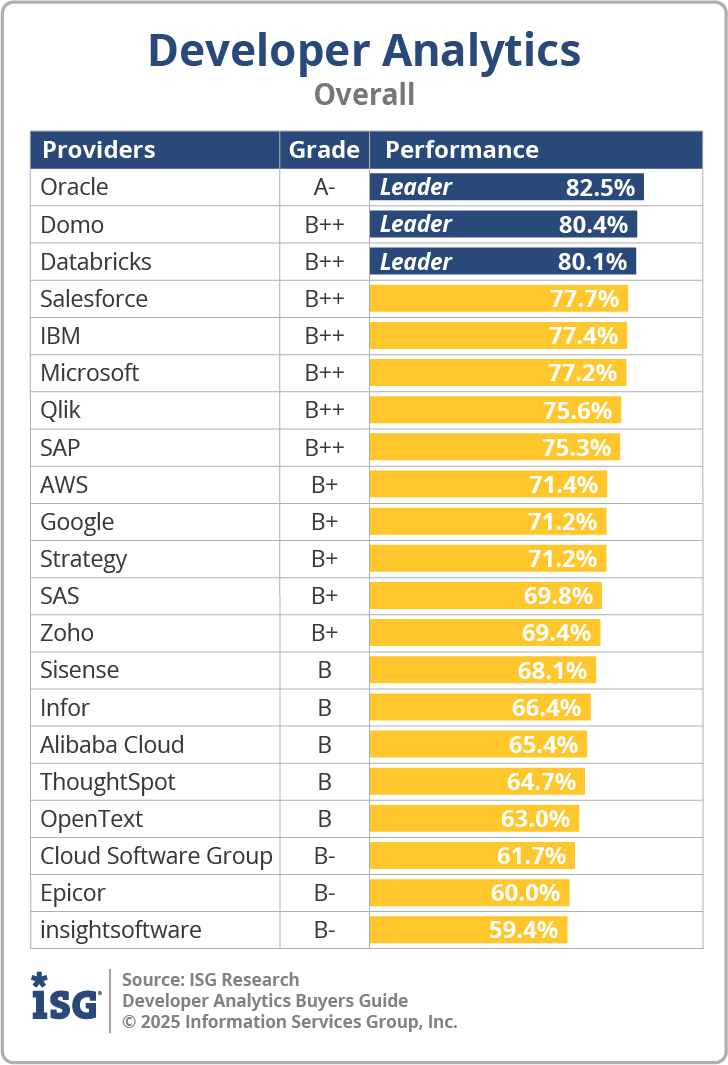 The research finds Oracle atop the list, followed by Domo and Databricks. Providers that place in the top three of a category earn the designation of Leader. Domo and Oracle have done so in five categories, Databricks in three and Microsoft, Salesforce and ThoughtSpot in one category.
The overall representation of the research below places the rating of the Product Experience and Customer Experience on the x and y axes, respectively, to provide a visual representation and classification of the software providers. Those providers whose Product Experience have above median weighted performance to the axis in aggregate of the two product categories place farther to the right, while the performance and weighting for the Customer Experience category determines placement on the vertical axis. In short, software providers that place closer to the upper-right on this chart performed better than those closer to the lower-left.
The research categorizes and rates software providers into one of four categories: Assurance, Exemplary, Merit or Innovative. This representation of software providers’ weighted performance in meeting the requirements in product and customer experience.
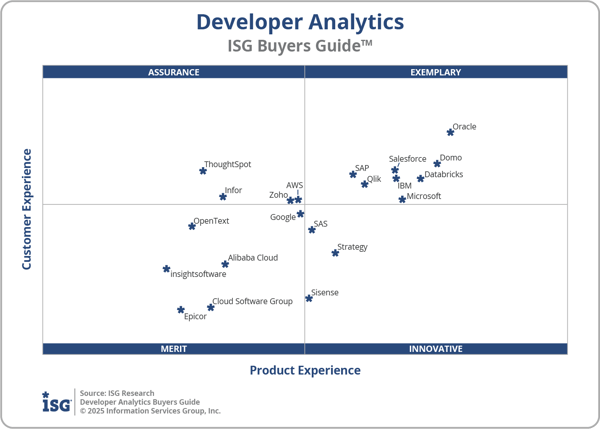
Exemplary: This rating (upper right) represents those that performed above median in Product and Customer Experience requirements. The providers rated Exemplary are: Databricks, Domo, IBM, Microsoft, Oracle, Qlik, Salesforce and SAP.
Innovative: This rating (lower right) represents those that performed above median in Product Experience but not in Customer Experience. The providers rated Innovative are: SAS, Sisense and Strategy.
Assurance: This rating (upper left) represents those that performed above median in Customer Experience but not in Product Experience. The providers rated Assurance are: AWS, Infor, ThoughtSpot and Zoho.
Merit: This rating (lower left) represents those that did not surpass the median in Customer or Product Experience. The providers rated Merit are: Alibaba Cloud, Cloud Software Group, Epicor, Google, insightsoftware and OpenText.
We advise enterprises to use this research as a supplement to their own evaluations, recognizing that ratings or rankings do not solely represent the value of a provider nor indicate universal suitability of a set of products.
Product Experience
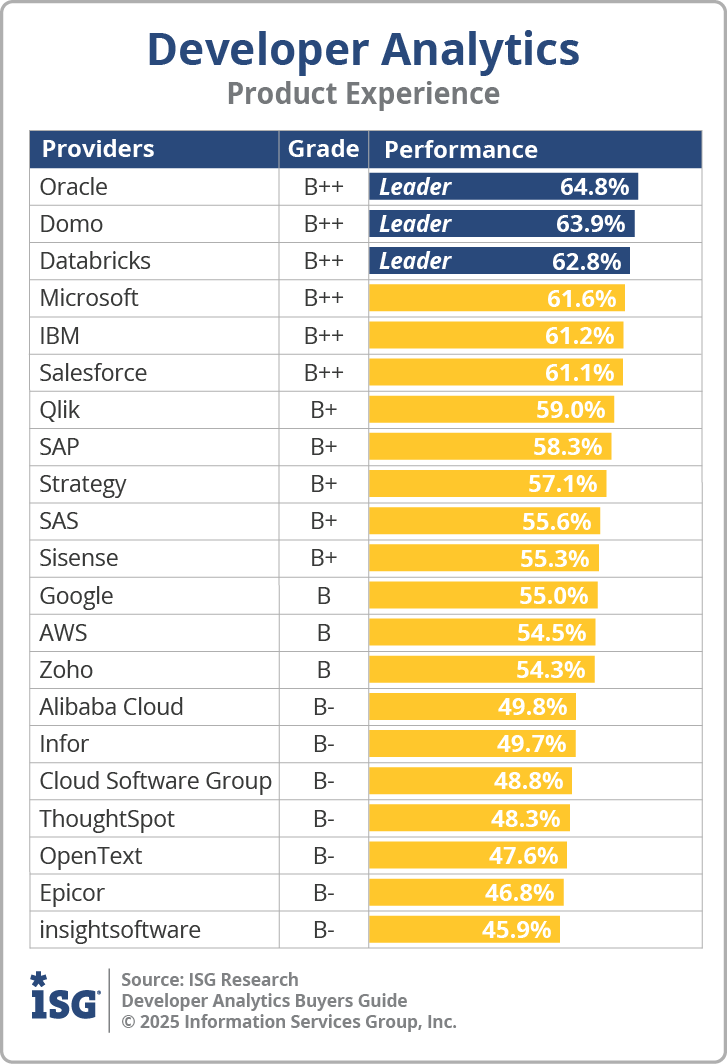 The process of researching products to address an enterprise’s needs should be comprehensive and evaluate specific capabilities and the underlying platform to the product experience. Our evaluation of the Product Experience examines the lifecycle of onboarding, configuration, operations, usage and maintenance. Too often, software providers are not evaluated for the entirety of the product; instead, they are evaluated on market execution and vision of the future.
The research results in Product Experience are ranked at 80%, or four-fifths, using the underlying weighted performance. Importance was placed on the categories as follows: Capability (40%) and Platform (40%). Oracle, Domo and Databricks were designated Product Experience Leaders.
Customer Experience
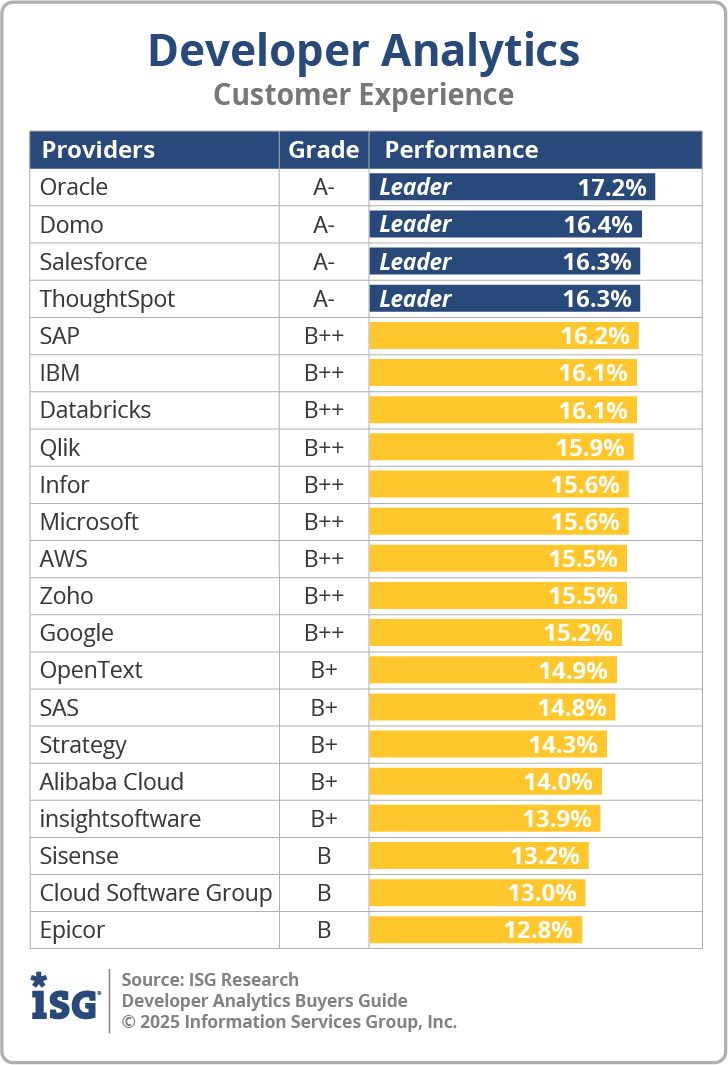 The importance of a customer relationship with a software provider is essential to the actual success of the products and technology. The evaluation of the Customer Experience and the entire lifecycle an enterprise has with its software provider is critical for ensuring satisfaction in working with that provider. The ISG Buyers Guide examines a software provider’s customer commitment, viability, customer success, sales and onboarding, product roadmap and services with partners and support. The customer experience category also investigates the TCO/ROI and how well a software provider demonstrates the product’s overall value, cost and benefits, including the tools and resources to evaluate these factors.
The research results in Customer Experience are ranked at 20%, or one-fifth of the 100% index, and represent the underlying provider validation and TCO/ROI requirements as they relate to the framework of commitment and value to the software provider-customer relationship.
The software providers that evaluated the highest in the Customer Experience category are Oracle, Domo, Salesforce and ThoughtSpot. These category leaders best communicate commitment and dedication to customer needs.
Software providers that did not perform well in this category were unable to provide or make sufficient information readily available to demonstrate success or articulate their commitment to customer experience. The use of a software provider requires continuous investment, so a holistic evaluation must include examination of how they support their customer experience.
Software Provider Inclusion – Developer Analytics
For inclusion in the 2025 ISG Buyers Guide™ for Developer Analytics, a software provider must be in good standing financially and ethically, have at least $150 million in annual or projected revenue verified using independent sources, sell products and provide support on at least two continents, and have at least 50 customers. The principal source of the relevant business unit’s revenue must be software-related, and there must have been at least one major software release in the past 12 months.
The product must be actively marketed as an analytics product that can be customized and embedded in other applications. It must be capable of accessing data from a variety of sources, modeling the data for analysis, analyzing the data using a variety of techniques, communicating the results in a variety of ways and supporting the data and analytics processes within an organization.
The research is designed to be independent of the specifics of software provider packaging and pricing. To represent the real-world environment in which businesses operate, we include providers that offer suites or packages of products that may include relevant individual modules or applications. If a software provider is actively marketing, selling and developing a product for the general market and it is reflected on the provider’s website that the product is within the scope of the research, that provider is automatically evaluated for inclusion.
All software providers that offer relevant products and meet the inclusion requirements were invited to participate in the evaluation process at no cost to them.
Software providers that meet our inclusion criteria but did not completely participate in our Buyers Guide were assessed solely on publicly available information. As this could have a significant impact on classification and ratings, we recommend additional scrutiny when evaluating those providers.
Products Evaluated
| Provider | Product Names | Version | Release Month/Year |
|---|---|---|---|
| Alibaba Cloud | Quick BI | 6.0 | October 2025 |
| AWS | Amazon Quick Suite | N/A | November 2025 |
| Cloud Software Group | Spotfire | 14.6 LTS | October 2025 |
| Databricks | Databricks Platform | N/A | November 2025 |
| Domo | Domo | N/A | November 2025 |
| Epicor | Grow | 15.0.0 | October 2025 |
| Looker | 25.20 | November 2025 | |
| IBM | IBM Cognos Analytics | 12.1.1 | October 2025 |
| Infor | Infor Birst | N/A | November 2025 |
| insightsoftware | Logi Symphony | N/A | November 2025 |
| Microsoft | Power BI | 2.148.1477.0 | November 2025 |
| OpenText | OpenText™ Analytics Cloud | N/A | November 2025 |
| Oracle | Oracle Analytics Cloud | N/A | November 2025 |
| Qlik | Qlik Cloud Analytics | N/A | November 2025 |
| Salesforce | Tableau | N/A | November 2025 |
| SAP | SAP Business Data Cloud | N/A | November 2025 |
| SAS | SAS Viya | 2025.11 | November 2025 |
| Sisense | Sisense Platform | N/A | November 2025 |
| Strategy | Strategy One Platform | N/A | November 2025 |
| ThoughtSpot | ThoughtSpot Embedded | 10.14.0.cl | November 2025 |
| Zoho | Zoho Analytics | N/A | October 2025 |
Mobile Analytics
Mobile analytics software plays an instrumental role in enabling an enterprise’s business units to use data in both tactical and strategic ways. Field personnel require mobile capabilities, but so do remote workers, traveling employees and office workers who spend significant time away from their desks. Mobile access not only makes analytics more accessible but can also further increase engagement by bringing more of the workforce into decision-making processes. Workers expect these capabilities, so organizations must choose analytics that can deliver.
Mobile access not only makes analytics more accessible but can also increase engagement.
ISG Research defines mobile analytics as the ability to view and interact with data and analytics on mobile devices, including phones, tablets and wearable devices, delivered via native or responsive web applications.
Software providers must make analytics available to line-of-business personnel as needed in their normal course of work. This requires rich mobile access to support a workforce seeking to conduct business in any location at any time. Providers differ in the approach to mobile design. Some take a design-once, deploy-anywhere approach, where every visualization is available on all devices. Others offer a mobile design view that allows teams to preview how devices will display information and design visualizations specifically for mobile screens. The former approach simplifies development and maintenance. The latter provides more control over limited screen real estate. Small form factors, especially smartphones, have pushed the boundaries of ease of use. Mobile devices also offer capabilities such as voice interaction, location information and cameras that can enhance analytics use cases. Mobile technology is critical for collaboration because it reaches deeply into the community of potential contributors. Mobile users can be notified that a topic requires their input or that new information is available.
Enterprises should evaluate mobile approaches that either design once and deploy anywhere or provide mobile-specific design views, ensuring effective use of limited screen space and consistent experiences across devices. Priorities include natural language access and responses, streamlined interactions suited to small screens and the use of mobile capabilities such as voice, location and cameras to enhance analytics workflows. Performance and timeliness matter: Providers should support streaming and event-driven updates and deliver responsive experiences on phones and tablets. Augmented intelligence and narratives can broaden adoption and shift analytics from a pull model to a push model for mobile workers.
The 2025 ISG Buyers Guide™ for Mobile Analytics evaluates software providers and products in the areas of data access, analytics, communications and IT support. This research assessed the following providers: Alibaba Cloud, AWS, Cloud Software Group, Databricks, Domo, Epicor, Google, IBM, Infor, insightsoftware, Microsoft, OpenText, Oracle, Qlik, Salesforce, SAP, SAS, Sisense, Strategy, ThoughtSpot and Zoho.
Key Takeaways
Mobile analytics has become essential for delivering insights to a distributed workforce, enabling teams to access information and act on analyses wherever work occurs. As organizations expand remote and field operations, analytics must provide streamlined mobile experiences that support varied personas and device types. Modern expectations emphasize natural-language access, responsive visualizations and the use of mobile capabilities such as voice, location and cameras to enhance workflows. These requirements position mobile analytics as a critical enabler of timely decisions and sustained engagement across the enterprise.
Software Provider Summary
The ISG Buyers Guide™ for Mobile Analytics evaluates 21 software providers that offer products supporting mobile data access, visualization, communication and IT support across devices. The research ranked the top three overall leaders as Domo, Oracle and Microsoft. Providers were classified using weighted performance in Product Experience and Customer Experience for ISG quadrant placement. Domo, IBM, Infor, Microsoft, Oracle, Qlik, Salesforce, SAP, ThoughtSpot and Zoho were rated as Exemplary, with Strategy rated as Innovative. AWS and Databricks were rated as Assurance, and Alibaba Cloud, Cloud Software Group, Epicor, Google, insightsoftware, OpenText, SAS and Sisense were rated as Merit.
Product Experience Insights
Product Experience, representing 80% of the evaluation, focuses on Capability (40%) and Platform (40%) which includes adaptability, manageability, reliability and usability. Domo, Microsoft and Oracle achieved the highest performance as Leaders in this category, supported by Domo’s breadth of mobile analytics capabilities and Microsoft’s and Oracle’s strong platform performance in reliability and scalability. Leaders demonstrated enterprise-grade platform capabilities across varied roles and contexts.
Customer Experience Value
Customer Experience, representing 20% of the evaluation, focuses on validation and TCO/ROI. Oracle, Domo, Salesforce and ThoughtSpot were the Leaders in this category showing strong customer advocacy and clear investment in success outcomes. Providers with lower performance often lacked publicly available customer validation or failed to demonstrate structured ROI measurement and proactive lifecycle engagement.
Strategic Recommendations
Enterprises should treat mobile analytics as a strategic investment that unifies insight delivery, collaboration and decision execution for a mobile-enabled workforce. Buyers should prioritize platforms that combine responsive design, natural-language interaction and mobile-native capabilities such as voice, location and camera integration. Providers that deliver resilient architectures, seamless data access and intuitive experiences will better support analytics adoption across roles and environments. Aligning platform selection with mobility requirements and operational workflows will help organizations accelerate real-time decision-making.
The Findings – Mobile Analytics
The software providers and products evaluated in the research provide product and customer experiences, but not everything offered is equally valuable to every enterprise or is needed to operate in business processes and use cases. Moreover, the existence of too many capabilities in products may be a negative factor for an enterprise if it introduces unnecessary complexity. Nonetheless, you may decide that a more comprehensive set of capabilities in the product is important, and where they match your enterprise’s requirements.
An effective customer relationship with a software provider is vital to the success of any investment. The overall customer experience and the full lifecycle of engagement play a key role in ensuring satisfaction and long-term success. Providers with dedicated customer leadership, such as chief customer officers, tend to invest more deeply in these relationships and prioritize customer outcomes to TCO and ROI expectations. It is equally important that this commitment to customer success is clearly demonstrated throughout the provider’s website, buying process and customer journey.
Overall Scoring of Software Providers Across Categories
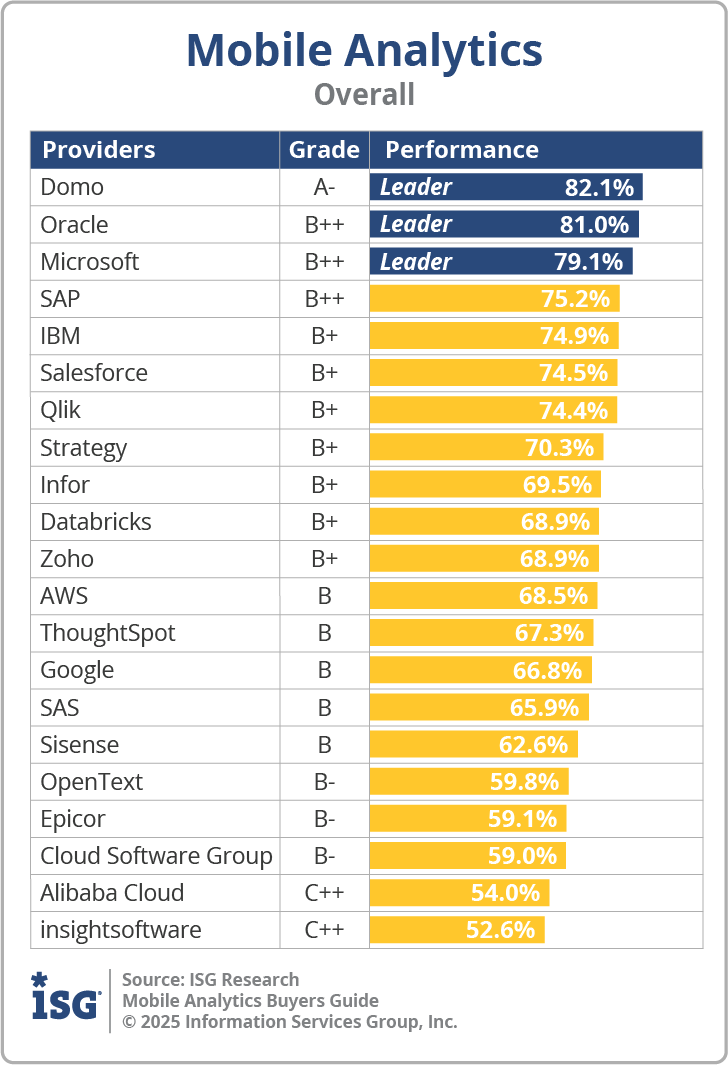 The research finds Domo atop the list, followed by Oracle and Microsoft. Providers that place in the top three of a category earn the designation of Leader. Domo and Oracle have done so in five categories; Microsoft in three and Databricks, Salesforce and ThoughtSpot in one category.
The overall representation of the research below places the rating of the Product Experience and Customer Experience on the x and y axes, respectively, to provide a visual representation and classification of the software providers. Those providers whose Product Experience have above median weighted performance to the axis in aggregate of the two product categories place farther to the right, while the performance and weighting for the Customer Experience category determines placement on the vertical axis. In short, software providers that place closer to the upper-right on this chart performed better than those closer to the lower-left.
The research categorizes and rates software providers into one of four categories: Assurance, Exemplary, Merit or Innovative. This representation of software providers’ weighted performance in meeting the requirements in product and customer experience.
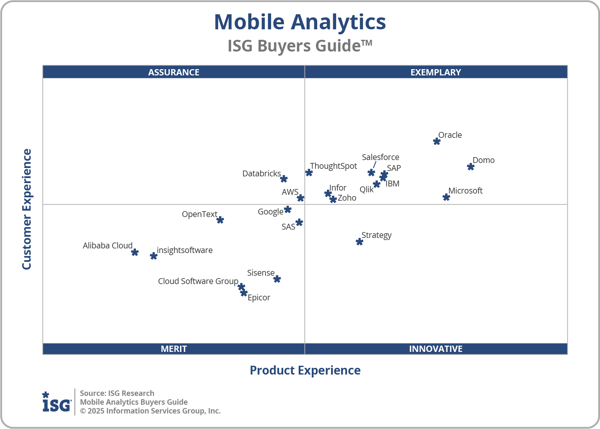
Exemplary: This rating (upper right) represents those that performed above median in Product and Customer Experience requirements. The providers rated Exemplary are: Domo, IBM, Infor, Microsoft, Oracle, Qlik, Salesforce, SAP, ThoughtSpot and Zoho.
Innovative: This rating (lower right) represents those that performed above median in Product Experience but not in Customer Experience. The provider rated Innovative is: Strategy.
Assurance: This rating (upper left) represents those that performed above median in Customer Experience but not in Product Experience. The providers rated Assurance are: AWS and Databricks.
Merit: This rating (lower left) represents those that did not surpass the median in Customer or Product Experience. The providers rated Merit are: Alibaba Cloud, Cloud Software Group, Epicor, Google, insightsoftware, OpenText, SAS and Sisense.
We advise enterprises to use this research as a supplement to their own evaluations, recognizing that ratings or rankings do not solely represent the value of a provider nor indicate universal suitability of a set of products.
Product Experience
 The process of researching products to address an enterprise’s needs should be comprehensive and evaluate specific capabilities and the underlying platform to the product experience. Our evaluation of the Product Experience examines the lifecycle of onboarding, configuration, operations, usage and maintenance. Too often, software providers are not evaluated for the entirety of the product; instead, they are evaluated on market execution and vision of the future.
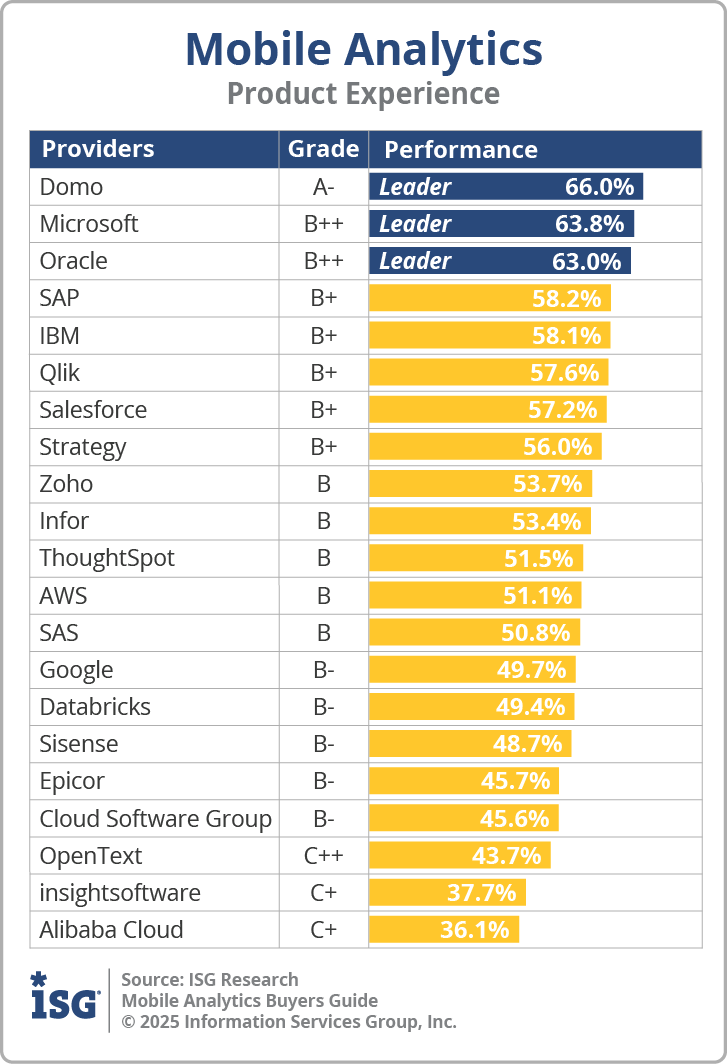
The research results in Product Experience are ranked at 80%, or four-fifths, using the underlying weighted performance. Importance was placed on the categories as follows: Capability (40%) and Platform (40%). Domo, Microsoft and Oracle were designated Product Experience Leaders.
Customer Experience
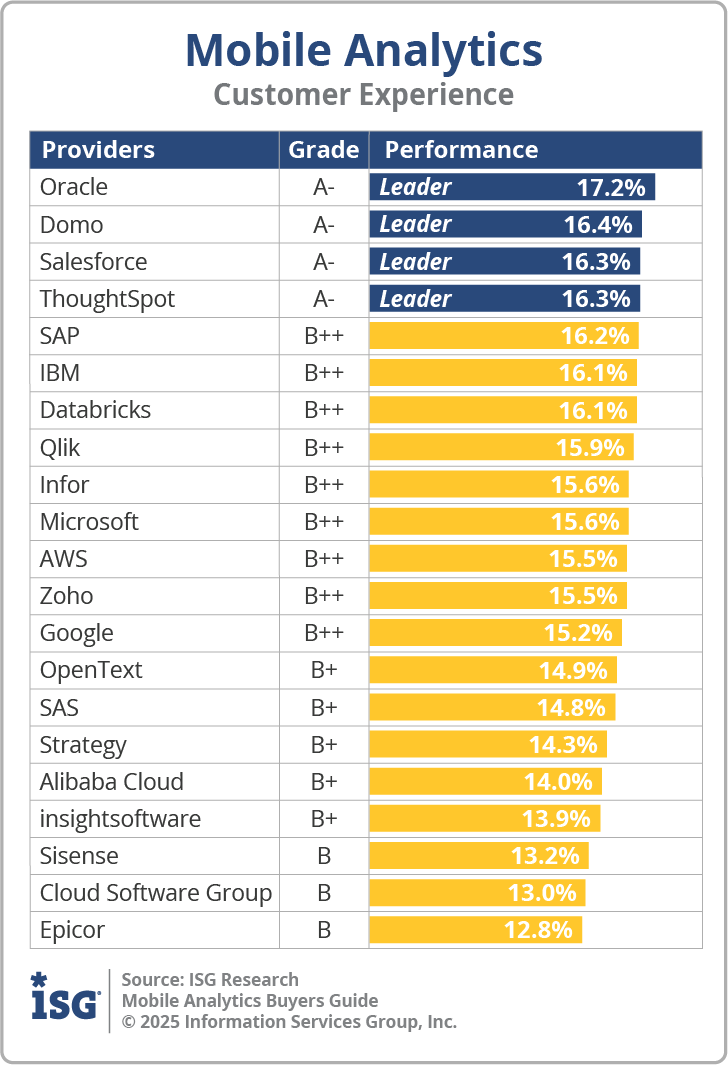 The importance of a customer relationship with a software provider is essential to the actual success of the products and technology. The evaluation of the Customer Experience and the entire lifecycle an enterprise has with its software provider is critical for ensuring satisfaction in working with that provider. The ISG Buyers Guide examines a software provider’s customer commitment, viability, customer success, sales and onboarding, product roadmap and services with partners and support. The customer experience category also investigates the TCO/ROI and how well a software provider demonstrates the product’s overall value, cost and benefits, including the tools and resources to evaluate these factors.
The research results in Customer Experience are ranked at 20%, or one-fifth of the 100% index, and represent the underlying provider validation and TCO/ROI requirements as they relate to the framework of commitment and value to the software provider-customer relationship.
The software providers that evaluated the highest in the Customer Experience category are Oracle, Domo, Salesforce and ThoughtSpot. These category leaders best communicate commitment and dedication to customer needs. While not a Leader, SAP was also found to meet a broad range of enterprise customer experience requirements.
Software providers that did not perform well in this category were unable to provide or make sufficient information readily available to demonstrate success or articulate their commitment to customer experience. The use of a software provider requires continuous investment, so a holistic evaluation must include examination of how they support their customer experience.
Software Provider Inclusion – Mobile Analytics
For inclusion in the 2025 ISG Buyers Guide™ for Mobile Analytics, a software provider must be in good standing financially and ethically, have at least $150 million in annual or projected revenue verified using independent sources, sell products and provide support on at least two continents, and have at least 50 customers. The principal source of the relevant business unit’s revenue must be software-related, and there must have been at least one major software release in the past 12 months.
The product must be actively marketed as an analytics product that supports mobile devices and is capable of accessing data from a variety of sources, analyzing the data using a variety of techniques, communicating the results in a variety of ways and supporting the data and analytics processes within an organization.
The research is designed to be independent of the specifics of software provider packaging and pricing. To represent the real-world environment in which businesses operate, we include providers that offer suites or packages of products that may include relevant individual modules or applications. If a software provider is actively marketing, selling and developing a product for the general market and it is reflected on the provider’s website that the product is within the scope of the research, that provider is automatically evaluated for inclusion.
All software providers that offer relevant products and meet the inclusion requirements were invited to participate in the evaluation process at no cost to them.
Software providers that meet our inclusion criteria but did not completely participate in our Buyers Guide were assessed solely on publicly available information. As this could have a significant impact on classification and ratings, we recommend additional scrutiny when evaluating those providers.
Products Evaluated
| Provider | Product Names | Version | Release Month/Year |
|---|---|---|---|
| Alibaba Cloud | Quick BI | 6.0 | October 2025 |
| AWS | Amazon Quick Suite | N/A | November 2025 |
| Cloud Software Group | Spotfire | 14.6 LTS | October 2025 |
| Databricks | Databricks Platform | N/A | November 2025 |
| Domo | Domo | N/A | November 2025 |
| Epicor | Grow | 15.0.0 | October 2025 |
| Looker | 25.2.0 | November 2025 | |
| IBM | IBM Cognos Analytics | 12.1.1 | October 2025 |
| Infor | Infor Birst | N/A | November 2025 |
| insightsoftware | Logi Symphony | N/A | November 2025 |
| Microsoft | Power BI | 2.148.1477.0 | November 2025 |
| OpenText | Analytics Cloud | N/A | November 2025 |
| Oracle | Oracle Analytics Cloud | N/A | November 2025 |
| Qlik | Qlik Cloud Analytics | N/A | November 2025 |
| Salesforce | Tableau | N/A | November 2025 |
| SAP | SAP Business Data Cloud | N/A | November 2025 |
| SAS | SAS Viya | 2025.11 | November 2025 |
| Sisense | Sisense Platform | N/A | November 2025 |
| Strategy | Strategy One Platform | N/A | November 2025 |
| ThoughtSpot | ThoughtSpot Cloud | 10.14.0.cl | November 2025 |
| Zoho | Zoho Analytics | NA | October 2025 |
Executive Summary
Buyers Guide Overview
ISG Research has conducted market research for over two decades across vertical industries, business applications, AI and IT. We have designed the ISG Buyers Guide™ to provide a balanced perspective of software providers and products that is rooted in an understanding of business and IT requirements. Utilization of our research methodology and decades of experience enables our Buyers Guide to be an effective method to assess and select software providers and products. The findings of this research provide a comprehensive approach to rating software providers and rank their ability to meet specific product and customer experience requirements.
ISG Research has designed the Buyers Guide to provide a balanced perspective of software providers and products that is rooted in an understanding of business and IT requirements.
The 2025 ISG Buyers Guides™ for Analytics, covering Analytics, Collaborative Analytics, Developer Analytics and Mobile Analytics, are the distillation of continuous market and product research. It is an assessment of how well software providers’ offerings address enterprises’ requirements for analytics software. The Value Index methodology is structured to support a request for information (RFI) for a request for proposal (RFP) process by incorporating all criteria needed to evaluate, select, utilize and maintain relationships with software providers. The ISG Buyers Guide evaluates customer experience and the product experience in its capability and platform.
The structure of the research reflects our understanding that the effective evaluation of software providers and products involves far more than just examining product features, potential revenue or customers generated from a provider’s marketing and sales efforts. It can ensure the best long-term relationship and value achieved from a resource and financial investment We believe it is important to take a comprehensive, research-based approach, since making the wrong choice of analytics software can raise the total cost of ownership, lower the return on investment and hamper an enterprise’s ability to reach its potential. In addition, this approach can reduce the project’s development and deployment time and eliminate the risk of relying on opinions or historical biases.
ISG Research believes that an objective review of existing and potential new software providers and products is a critical strategy for the adoption and implementation of analytics software. An enterprise’s review should include an analysis of both what is possible and what is relevant. We urge enterprises to do a thorough job of evaluating analytics software and offer these Buyers Guides as both the results of our in-depth analysis of these providers and as an evaluation methodology.
How To Use This Buyers Guide
Evaluating Software Providers: The Process
We recommend using the Buyers Guide to assess and evaluate new or existing software providers for your enterprise. The market research can be used as an evaluation framework to assess existing approaches and software providers or establish a formal request for information from providers on products and customer experience and will shorten the cycle time when creating an RFI. The steps listed below provide a process that can facilitate best possible outcomes in the most efficient manner.
- Define the business case and goals.
Define the mission and business case for investment and the expected outcomes from your organizational and technological efforts.
- Specify the business and IT needs.
Defining the business and IT requirements helps identify what specific capabilities are required with respect to people, processes, information and technology.
- Assess the required roles and responsibilities.
Identify the individuals required for success at every level of the enterprise from executives to frontline workers and determine the needs of each.
- Outline the project’s critical path.
What needs to be done, in what order and who will do it? This outline should make clear the prior dependencies at each step of the project plan.
- Ascertain the technology approach.
Determine the business and technology approach that most closely aligns to your enterprise’s requirements.
- Establish software provider evaluation criteria.
Utilize the product experience: capability and platform with support for adaptability, manageability, reliability and usability, and the customer experience in TCO/ROI and Validation.
- Evaluate and select the software provider and products properly.
Apply a weighting the evaluation categories in the evaluation criteria to reflect your enterprise’s priorities to determine the short list of software providers and products.
- Establish the business initiative team to start the project.
Identify who will lead the project and the members of the team needed to plan and execute it with timelines, priorities and resources.
Using the ISG Buyers Guide and process provides enterprises a clear, structured approach to making smarter software and business investment decisions. It ensures alignment between strategy, people, processes and technology while reducing risk, saving time and improving outcomes. The ISG approach promotes data-driven decision-making and collaboration, helping choose the right software providers for maximum value and return on investment.
Analytics
Analytics software continues to play an instrumental role in enabling an organization’s business units and IT teams to use data in both tactical and strategic ways, including the support of artificial intelligence (AI)-enabled processes. To accomplish this, organizations must provide technology that supports a variety of personas, enabling them to access data, generate and apply insights, communicate results and collaborate as needed. As analytics becomes more central to business performance, enterprises require platforms that scale insights across teams and make data-driven decision-making faster and more accessible.
Analytics has become more central to business performance as enterprises work to scale insights across teams.
ISG Research defines analytics software as the use of mathematics to create measurements and metrics that enable data to be evaluated in whatever form to provide insights and guide decision-making. It includes the collection and preparation of data needed in analyses, often one of the most time-consuming aspects of analytics. It also incorporates visualization and dissemination of information, such as dashboards, reports, emails or messages. Analytics ranges from simple ratios and percentages to forecasting, optimization and simulation. With the expansion of generative AI, analytics must also include narrative, AI-based insights.
Analytics as an advanced business tool dates back more than five decades. Reporting tools evolved from printed green-bar reports to banded reporting as personal computers and relational databases became widely adopted. Executive information systems developed in the 1970s, incorporating features such as dashboards, drill-down, pivot and conditional formatting, many of which remain central to today’s interactive analytics. Early analytics tools were limited by the volume of data that could be accessed and often relied on summarized information. As computing power increased, analytics systems expanded in interactivity and scale, enabling broader enterprise use.
Today’s business intelligence requirements extend well beyond query, reporting, analysis and publishing. Enterprises need tools for data sourcing and integration and for using analytics in planning, forecasting and performance assessment. They also require dashboards that support a wide range of visualizations. Analytics increasingly includes natural-language narratives supported by GenAI, with more providers offering multilingual capabilities. Collaboration features that allow users to share insights help reduce time to action and improve cross-functional alignment.
In today’s data-driven world, organizations must use analytics to understand and plan operations across every department and between business and IT domains. Analytics supports cost tracking, staffing plans, supplier performance, variance analysis and corrective action planning. It facilitates communication across teams, helping align efforts toward shared goals. Operating without analytics would be like flying a plane without an instrument panel. Artificial intelligence and machine learning extend analytics by classifying, predicting and recommending behaviors that improve operations. Enterprises require providers to use ML to analyze product-usage data, anticipate the next step in workflows and perform or recommend that action. GenAI enhances analytics products by recommending data preparation steps, suggesting visualizations and documenting processes.
Advanced analytics, which incorporates AI and ML, has become foundational in analytic workflows. Organizations using machine learning report competitive advantage, improved customer experiences, increased sales and faster responses to opportunities. Nearly two-thirds of organizations report using machine learning today, and three-quarters plan to increase use. The ultimate goal of analytics is to help organizations make and implement decisions that improve operations and financial outcomes. This set of capabilities has become known as decision intelligence. Decision intelligence includes analyzing historical performance, determining potential courses of action, evaluating alternatives and selecting the best path forward, with agentic AI coordinating activities that support implementation.
Ideally, analytics processes can be conducted on a self-service basis. Self-service analytics remains a priority, and organizations that achieve it report greater satisfaction, particularly when business users can access insights without IT. To support self-service analytics, enterprises must also enable self-service data preparation. Preparing data remains the most time-consuming aspect of analytics, and many organizations hesitate to allow business users to work with unintegrated data. GenAI-based data preparation capabilities reduce the necessary involvement of IT and improve confidence in data quality. Semantic models further enhance self-service readiness, especially when combined with GenAI.
While AI and ML require specialized skills, providers have used elements of these technologies to deliver augmented intelligence capabilities such as automated insights and key-driver analysis with minimal input from business personnel. These capabilities, often delivered as narratives using GenAI, make insights more accessible across the workforce. ISG Software Research asserts that by 2027, almost all business intelligence software providers will include augmented intelligence based on GenAI to make analytics easier to use. Augmented intelligence shifts organizations from a pull model, where analysts create analyses on demand, to a push model where analyses are generated automatically. This improves consistency because automated analyses ensure common information is available to all users.
Analytics must also be accessible and timely. Nearly all providers now use GenAI to provide natural language processing that makes it easier for users to find information through search and understand analyses via narrative explanations. Analytics must be available to line-of-business personnel as they work, requiring mobile access to support a distributed workforce. Collaboration features are increasingly common. Providers now offer tools that enable users to comment on analyses, rate data sources and assign tasks that can be tracked to completion. Embedding analytics directly into operational applications allows line-of-business workers to access information without switching systems.
As providers expand application programming interfaces that support the full capabilities of products, many now offer prebuilt connections that deliver analytic outputs into operational systems. By 2027, more than one-half of BI software deployments will use two-way connectors to enterprise applications to process updates or take action based on analytic output. Analytics must also operate in real time. Organizations receive information from a rapidly growing number of devices and sources. Without the ability to analyze that information as it arrives, organizations risk missing opportunities to respond. Research shows that one-half of organizations consider it essential to process streaming data and event information in seconds or milliseconds.
As organizations expand analytic requirements, a transition to enterprise-class analytics becomes essential. Providers have responded with additional capabilities, some developed internally and others acquired from complementary software providers. Though the number of providers has expanded, few attempt to deliver the full spectrum of capabilities evaluated in this assessment. Most organizations will require more than one software provider to meet all analytic needs.
The 2025 ISG Buyers Guide™ for Analytics evaluates software providers and products in three key capability areas, including data, analytics and communication. Data capabilities evaluated include defining and managing data models, accessing, integrating and governing data and managing master data. Analytics evaluation criteria include data discovery using computers, browsers and mobile devices; query; visualization; presentation; calculation; and AI analytics, including predictive, generative and agentic capabilities. Providers are also evaluated for communication capabilities, including informing audiences of analytic results, delivering information via any device, supporting collaboration and automating action on analytic output through alerting and agents. This research assessed the following providers: Alibaba Cloud, AWS, Cloud Software Group, Databricks, Domo, Epicor, Google, IBM, Infor, insightsoftware, Microsoft, OpenText, Oracle, Qlik, Salesforce, SAP, SAS, Sisense, Strategy, ThoughtSpot and Zoho.
Key Takeaways
Analytics has become an enterprise-wide capability that supports data preparation, insight generation and communication across business and IT teams. As organizations expand the use of AI and machine learning, platforms must provide accessible, self-service experiences that scale across roles. Today’s requirements emphasize augmented intelligence, embedded workflows and collaboration to accelerate decision-making. These capabilities position analytics as a core driver of operational awareness and continuous performance improvement.
Software Provider Summary
The ISG Buyers Guide™ for Analytics evaluates 21 software providers that offer products supporting data modeling and access, analytic discovery and visualization, and communication capabilities that distribute insights and automate actions. The research ranked the top three overall leaders as Oracle, Domo and Databricks. Providers were classified using weighted performance in Product Experience and Customer Experience for ISG quadrant placement. AWS, Databricks, Domo, IBM, Microsoft, Oracle, Qlik, Salesforce and SAP were rated as Exemplary, with Google and Strategy rated as Innovative. Infor, ThoughtSpot and Zoho were rated as Assurance, and Alibaba Cloud, Cloud Software Group, Epicor, insightsoftware, OpenText, SAS and Sisense were rated as Merit.
Product Experience Insights
Product Experience, representing 80% of the evaluation, focuses on Capability (25%) and Platform (55%) which includes adaptability, manageability, reliability and usability. Oracle, Databricks and Domo achieved the highest performance as Leaders in this category, supported by Oracle’s breadth across enterprise analytics capabilities and Databricks’ and Domo’s strong platform performance in scalability and integration. Leaders demonstrated enterprise-grade platform capabilities across varied roles and contexts.
Customer Experience Value
Customer Experience, representing 20% of the evaluation, focuses on validation and TCO/ROI. Oracle, Domo, Salesforce and ThoughtSpot were the Leaders in this category showing strong customer advocacy and clear investment in success outcomes. Providers with lower performance often lacked publicly available customer validation or failed to demonstrate structured ROI measurement and proactive lifecycle engagement.
Strategic Recommendations
Enterprises should treat analytics as a strategic capability that unifies data access, insight generation and action across business and IT. Buyers should prioritize platforms that combine robust data integration with AI-driven augmentation to accelerate decision-making and reduce reliance on specialized roles. Providers that deliver intuitive experiences, governance-ready architectures and embedded collaboration will better support scalable analytics adoption. Aligning platform selection with enterprise data maturity and operational priorities will help organizations derive consistent value from analytics investments.
The Findings – Analytics
The software providers and products evaluated in the research provide product and customer experiences, but not everything offered is equally valuable to every enterprise or is needed to operate in business processes and use cases. Moreover, the existence of too many capabilities in products may be a negative factor for an enterprise if it introduces unnecessary complexity. Nonetheless, you may decide that a more comprehensive set of capabilities in the product is important, and where they match your enterprise’s requirements.
An effective customer relationship with a software provider is vital to the success of any investment. The overall customer experience and the full lifecycle of engagement play a key role in ensuring satisfaction and long-term success. Providers with dedicated customer leadership, such as chief customer officers, tend to invest more deeply in these relationships and prioritize customer outcomes to TCO and ROI expectations. It is equally important that this commitment to customer success is clearly demonstrated throughout the provider’s website, buying process and customer journey.
Overall Scoring of Software Providers Across Categories
The research finds Oracle atop the list, followed by Domo and Databricks. Providers that place in the top three of a category earn the designation of Leader. Domo and Oracle have done so in five categories, Databricks in three and Salesforce, ThoughtSpot and Zoho in one category.
The overall representation of the research below places the rating of the Product Experience and Customer Experience on the x and y axes, respectively, to provide a visual representation and classification of the software providers. Those providers whose Product Experience have above median weighted performance to the axis in aggregate of the two product categories place farther to the right, while the performance and weighting for the Customer Experience category determines placement on the vertical axis. In short, software providers that place closer to the upper-right on this chart performed better than those closer to the lower-left.
The research categorizes and rates software providers into one of four categories: Assurance, Exemplary, Merit or Innovative. This representation of software providers’ weighted performance in meeting the requirements in product and customer experience.
Exemplary: This rating (upper right) represents those that performed above median in Product and Customer Experience requirements. The providers rated Exemplary are: AWS, Databricks, Domo, IBM, Microsoft, Oracle, Qlik, Salesforce and SAP.
Innovative: This rating (lower right) represents those that performed above median in Product Experience but not in Customer Experience. The providers rated Innovative are: Google and Strategy.
Assurance: This rating (upper left) represents those that performed above median in Customer Experience but not in Product Experience. The providers rated Assurance are: Infor, ThoughtSpot and Zoho.
Merit: This rating (lower left) represents those that did not surpass the median in Customer or Product Experience. The providers rated Merit are: Alibaba Cloud, Cloud Software Group, Epicor, insightsoftware, OpenText, SAS and Sisense.
We advise enterprises to use this research as a supplement to their own evaluations, recognizing that ratings or rankings do not solely represent the value of a provider nor indicate universal suitability of a set of products.
Product Experience
The process of researching products to address an enterprise’s needs should be comprehensive and evaluate specific capabilities and the underlying platform to the product experience. Our evaluation of the Product Experience examines the lifecycle of onboarding, configuration, operations, usage and maintenance. Too often, software providers are not evaluated for the entirety of the product; instead, they are evaluated on market execution and vision of the future.
The research results in Product Experience are ranked at 80%, or four-fifths, using the underlying weighted performance. Importance was placed on the categories as follows: Capability (25%) and Platform (55%). Oracle, Databricks and Domo were designated Product Experience Leaders.
Customer Experience
The importance of a customer relationship with a software provider is essential to the actual success of the products and technology. The evaluation of the Customer Experience and the entire lifecycle an enterprise has with its software provider is critical for ensuring satisfaction in working with that provider. The ISG Buyers Guide examines a software provider’s customer commitment, viability, customer success, sales and onboarding, product roadmap and services with partners and support. The customer experience category also investigates the TCO/ROI and how well a software provider demonstrates the product’s overall value, cost and benefits, including the tools and resources to evaluate these factors.
The research results in Customer Experience are ranked at 20%, or one-fifth of the 100% index, and represent the underlying provider validation and TCO/ROI requirements as they relate to the framework of commitment and value to the software provider-customer relationship.
The software providers that evaluated the highest in the Customer Experience category are Oracle, Domo, Salesforce and ThoughtSpot. These category leaders best communicate commitment and dedication to customer needs.
Software providers that did not perform well in this category were unable to provide or make sufficient information readily available to demonstrate success or articulate their commitment to customer experience. The use of a software provider requires continuous investment, so a holistic evaluation must include examination of how they support their customer experience.
Software Provider Inclusion – Analytics
For inclusion in the 2025 ISG Buyers Guide™ for Analytics, a software provider must be in good standing financially and ethically, have at least $150 million in annual or projected revenue verified using independent sources, sell products and provide support on at least two continents, and have at least 50 customers. The principal source of the relevant business unit’s revenue must be software-related, and there must have been at least one major software release in the past 12 months.
The product must be actively marketed as an analytics product and capable of accessing data from a variety of sources, modeling the data for analysis, analyzing the data using a variety of techniques, communicating the results in a variety of ways and supporting the analytics processes within an organization.
The research is designed to be independent of the specifics of software provider packaging and pricing. To represent the real-world environment in which businesses operate, we include providers that offer suites or packages of products that may include relevant individual modules or applications. If a software provider is actively marketing, selling and developing a product for the general market and it is reflected on the provider’s website that the product is within the scope of the research, that provider is automatically evaluated for inclusion.
All software providers that offer relevant products and meet the inclusion requirements were invited to participate in the evaluation process at no cost to them.
Software providers that meet our inclusion criteria but did not completely participate in our Buyers Guide were assessed solely on publicly available information. As this could have a significant impact on classification and ratings, we recommend additional scrutiny when evaluating those providers.
Products Evaluated
| Provider | Product Names | Version | Release Month/Year |
|---|---|---|---|
| Alibaba Cloud | Quick BI | 6.0 | October 2025 |
| AWS | Amazon Quick Suite | N/A | November 2025 |
| Cloud Software Group | Spotfire | 14.6 LTS | October 2025 |
| Databricks | Databricks Platform | N/A | November 2025 |
| Domo | Domo | N/A | November 2025 |
| Epicor | Grow | 15.0.0 | October 2025 |
| Looker | 25.20 | November 2025 | |
| IBM | IBM Cognos Analytics | 12.1.1 | October 2025 |
| Infor | Infor Birst | N/A | November 2025 |
| insightsoftware | Logi Symphony | N/A | November 2025 |
| Microsoft | Power BI | 2.148.1477.0 | November 2025 |
| OpenText | OpenText™ Analytics Cloud | N/A | November 2025 |
| Oracle | Oracle Analytics Cloud | N/A | November 2025 |
| Qlik | Qlik Cloud Analytics | N/A | November 2025 |
| Salesforce | Tableau | N/A | November 2025 |
| SAP | SAP Business Data Cloud | N/A | November 2025 |
| SAS | SAS Viya | 2025.11 | November 2025 |
| Sisense | Sisense Platform | N/A | November 2025 |
| Strategy | Strategy One Platform | N/A | November 2025 |
| ThoughtSpot | ThoughtSpot Embedded | 10.14.0.cl | November 2025 |
| Zoho | Zoho Analytics | N/A | October 2025 |
Collaborative Analytics
Analytics is the instrument panel for today’s enterprises, enabling every function to track performance, plan actions and coordinate decisions. Collaboration is now integral to these processes. Mobile access, enterprise collaboration platforms and GenAI-driven narratives are bringing more people into the discussion, accelerating time to insight and time to action.
Mobile access, enterprise collaboration platforms and GenAI-driven narratives are bringing more people into the discussion, accelerating time to insight and time to action.
ISG Research defines collaborative analytics as the sharing and communication of analytical outputs, including commenting, reviewing, approving and assigning tasks tied to insights. These must be combined with the underlying analytics that transform data into decisions. Collaborative analytics spans data preparation and modeling through visualization, narrative delivery and task tracking across devices.
Collaboration in conjunction with analytics has become much more commonplace. Two-thirds of organizations report using or planning to use collaboration with analytics. Enterprises need to publish and distribute analytics easily. Participants in analytics processes should be able to rate data sources and engage in threaded discussions about analyses. Decision-making involves assigning tasks and tracking them to completion, helping ensure that the value of analytics results in specific actions. A variety of personas are involved, and mobile capabilities are important to reach and engage all participants. We assert that by 2027, collaborative capabilities such as these will be standard in most BI platforms, shifting organizations from a pull model of manual analyses to a push model of proactive engagement.
The 2025 ISG Buyers Guide™ for Collaborative Analytics evaluates providers on support of collaboration about data-related issues, the ways analyses can be communicated, shared and discussed and how business strategy can be defined, tracked and communicated. This research assessed the following providers: Alibaba Cloud, AWS, Cloud Software Group, Databricks, Domo, Epicor, Google, IBM, Infor, insightsoftware, Microsoft, OpenText, Oracle, Qlik, Salesforce, SAP, SAS, Sisense, Strategy, ThoughtSpot and Zoho.
Key Takeaways
Collaborative analytics has become a core enterprise capability, enabling teams to share insights, coordinate decisions and translate analytical outputs into action. As organizations expand use of mobile access, enterprise collaboration tools and GenAI-driven narratives, analytics must support broader participation and faster engagement. Modern requirements emphasize seamless communication, structured task management and transparency across roles. These expectations position collaborative analytics as an essential mechanism for accelerating insight-to-action cycles and improving operational alignment.
Software Provider Summary
The ISG Buyers Guide™ for Collaborative Analytics evaluates 21 software providers that offer products supporting insight sharing, narrative delivery, and task-oriented collaboration across devices and workflows. The research ranked the top three overall leaders as Domo, Oracle and SAP. Providers were classified using weighted performance in Product Experience and Customer Experience for ISG quadrant placement. Domo, IBM, Microsoft, Oracle, Qlik, Salesforce, SAP, ThoughtSpot and Zoho were rated as Exemplary, with SAS and Strategy rated as Innovative. AWS, Databricks and Infor were rated as Assurance, and Alibaba Cloud, Cloud Software Group, Epicor, Google, insightsoftware, OpenText and Sisense were rated as Merit.
Product Experience Insights
Product Experience, representing 80% of the evaluation, focuses on Capability (50%) and Platform (30%) which includes adaptability, manageability, reliability and usability. Domo, Oracle and Zoho achieved the highest performance as Leaders in this category, supported by Domo and Zoho’s breadth of collaborative analytics capabilities and Oracle’s strong platform resilience across governance and scalability. Leaders demonstrated enterprise-grade platform capabilities across varied roles and contexts.
Customer Experience Value
Customer Experience, representing 20% of the evaluation, focuses on validation and TCO/ROI. Oracle, Domo, Salesforce and ThoughtSpot were the Leaders in this category, showing strong customer advocacy and clear investment in success outcomes. Providers with lower performance often lacked publicly available customer validation or failed to demonstrate structured ROI measurement and proactive lifecycle engagement.
Strategic Recommendations
Enterprises should treat collaborative analytics as a strategic investment that unifies insight sharing, workflow coordination and decision execution. Buyers should prioritize platforms that combine mobile engagement, structured task management and AI-assisted narratives to accelerate adoption and actionability. Providers delivering intuitive experiences, governance-ready architectures and seamless integration with enterprise collaboration tools will better support cross-functional alignment. Aligning platform selection with collaboration maturity and operational needs will help organizations increase the impact of analytics-driven decisions.
The Findings – Collaborative Analytics
The software providers and products evaluated in the research provide product and customer experiences, but not everything offered is equally valuable to every enterprise or is needed to operate in business processes and use cases. Moreover, the existence of too many capabilities in products may be a negative factor for an enterprise if it introduces unnecessary complexity. Nonetheless, you may decide that a more comprehensive set of capabilities in the product is important, and where they match your enterprise’s requirements.
An effective customer relationship with a software provider is vital to the success of any investment. The overall customer experience and the full lifecycle of engagement play a key role in ensuring satisfaction and long-term success. Providers with dedicated customer leadership, such as chief customer officers, tend to invest more deeply in these relationships and prioritize customer outcomes to TCO and ROI expectations. It is equally important that this commitment to customer success is clearly demonstrated throughout the provider’s website, buying process and customer journey.
Overall Scoring of Software Providers Across Categories
The research finds Domo atop the list, followed by Oracle and SAP. Providers that place in the top three of a category earn the designation of Leader. Domo and Oracle have done so in five categories, Zoho in two and Databricks, SAP, Salesforce and ThoughtSpot in one category.
The overall representation of the research below places the rating of the Product Experience and Customer Experience on the x and y axes, respectively, to provide a visual representation and classification of the software providers. Those providers whose Product Experience have above median weighted performance to the axis in aggregate of the two product categories place farther to the right, while the performance and weighting for the Customer Experience category determines placement on the vertical axis. In short, software providers that place closer to the upper-right on this chart performed better than those closer to the lower-left.
The research categorizes and rates software providers into one of four categories: Assurance, Exemplary, Merit or Innovative. This representation of software providers’ weighted performance in meeting the requirements in product and customer experience.
Exemplary: This rating (upper right) represents those that performed above median in Product and Customer Experience requirements. The providers rated Exemplary are: Domo, IBM, Microsoft, Oracle, Qlik, Salesforce, SAP, ThoughtSpot and Zoho.
Innovative: This rating (lower right) represents those that performed above median in Product Experience but not in Customer Experience. The providers rated Innovative are: SAS and Strategy.
Assurance: This rating (upper left) represents those that performed above median in Customer Experience but not in Product Experience. The providers rated Assurance are: AWS, Databricks and Infor.
Merit: This rating (lower left) represents those that did not surpass the median in Customer or Product Experience. The providers rated Merit are: Alibaba Cloud, Cloud Software Group, Epicor, Google, insightsoftware, OpenText and Sisense.
We advise enterprises to use this research as a supplement to their own evaluations, recognizing that ratings or rankings do not solely represent the value of a provider nor indicate universal suitability of a set of products.
Product Experience
The process of researching products to address an enterprise’s needs should be comprehensive and evaluate specific capabilities and the underlying platform to the product experience. Our evaluation of the Product Experience examines the lifecycle of onboarding, configuration, operations, usage and maintenance. Too often, software providers are not evaluated for the entirety of the product; instead, they are evaluated on market execution and vision of the future.
The research results in Product Experience are ranked at 80%, or four-fifths, using the underlying weighted performance. Importance was placed on the categories as follows: Capability (50%) and Platform (30%). Domo, Oracle and Zoho were designated Product Experience Leaders.
Customer Experience
The importance of a customer relationship with a software provider is essential to the actual success of the products and technology. The evaluation of the Customer Experience and the entire lifecycle an enterprise has with its software provider is critical for ensuring satisfaction in working with that provider. The ISG Buyers Guide examines a software provider’s customer commitment, viability, customer success, sales and onboarding, product roadmap and services with partners and support. The customer experience category also investigates the TCO/ROI and how well a software provider demonstrates the product’s overall value, cost and benefits, including the tools and resources to evaluate these factors.
The research results in Customer Experience are ranked at 20%, or one-fifth of the 100% index, and represent the underlying provider validation and TCO/ROI requirements as they relate to the framework of commitment and value to the software provider-customer relationship.
The software providers that evaluated the highest in the Customer Experience category are Oracle, Domo, Salesforce and ThoughtSpot. These category leaders best communicate commitment and dedication to customer needs. While not a Leader, SAP was also found to meet a broad range of enterprise customer experience requirements.
Software providers that did not perform well in this category were unable to provide or make sufficient information readily available to demonstrate success or articulate their commitment to customer experience. The use of a software provider requires continuous investment, so a holistic evaluation must include examination of how they support their customer experience.
Software Provider Inclusion – Collaborative Analytics
For inclusion in the 2025 ISG Buyers Guide™ for Collaborative Analytics, a software provider must be in good standing financially and ethically, have at least $150 million in annual or projected revenue verified using independent sources, sell products and provide support on at least two continents, and have at least 50 customers. The principal source of the relevant business unit’s revenue must be software-related, and there must have been at least one major software release in the past 12 months.
The product must be actively marketed as an analytics product that includes collaborative capabilities to support analytics and decision-making processes with an enterprise including communicating the results of analyses and tracking the decisions and actions stemming from those analyses.
The research is designed to be independent of the specifics of software provider packaging and pricing. To represent the real-world environment in which businesses operate, we include providers that offer suites or packages of products that may include relevant individual modules or applications. If a software provider is actively marketing, selling and developing a product for the general market and it is reflected on the provider’s website that the product is within the scope of the research, that provider is automatically evaluated for inclusion.
All software providers that offer relevant products and meet the inclusion requirements were invited to participate in the evaluation process at no cost to them.
Software providers that meet our inclusion criteria but did not completely participate in our Buyers Guide were assessed solely on publicly available information. As this could have a significant impact on classification and ratings, we recommend additional scrutiny when evaluating those providers.
Products Evaluated
| Provider | Product Names | Version | Release Month/Year |
|---|---|---|---|
| Alibaba Cloud | Quick BI | 6.0 | October 2025 |
| AWS | Amazon Quick Suite | N/A | November 2025 |
| Cloud Software Group | Spotfire | 14.6 LTS | October 2025 |
| Databricks | Databricks Platform | N/A | November 2025 |
| Domo | Domo | N/A | November 2025 |
| Epicor | Grow | 15.0.0 | October 2025 |
| Looker | 25.20 | November 2025 | |
| IBM | IBM Cognos Analytics | 12.1.1 | October 2025 |
| Infor | Infor Birst | N/A | November 2025 |
| insightsoftware | Logi Symphony | N/A | November 2025 |
| Microsoft | Power BI | 2.148.1477.0 | November 2025 |
| OpenText | OpenText™ Analytics Cloud | N/A | November 2025 |
| Oracle | Oracle Analytics Cloud | N/A | November 2025 |
| Qlik | Qlik Cloud Analytics | N/A | November 2025 |
| Salesforce | Tableau | N/A | November 2025 |
| SAP | SAP Business Data Cloud | N/A | November 2025 |
| SAS | SAS Viya | 2025.11 | November 2025 |
| Sisense | Sisense Platform | N/A | November 2025 |
| Strategy | Strategy One Platform | N/A | November 2025 |
| ThoughtSpot | ThoughtSpot Embedded | 10.14.0.cl | November 2025 |
| Zoho | Zoho Analytics | N/A | October 2025 |
Developer Analytics
The processes and technology of analytics and business intelligence software continue to play an instrumental role in enabling an enterprise’s business units and IT teams to use data in both tactical and strategic ways. To accomplish this, organizations must provide technology that supports a variety of personas, enabling them to access data, generate and apply insights, communicate results and collaborate as needed. Analytics should also lead to action. Enterprises use operational applications where decisions resulting from analyses are implemented. Enabling developers to embed analytics directly into these systems makes it easier for line-of-business workers to access necessary information without switching tools, reducing the need for additional training.
ISG Research defines Developer Analytics as the ability to incorporate analytic applications, or portions thereof, into other business applications and processes with rich APIs and rebrandable analytic components.
Software providers must offer tools for defining data models and accessing data from applications and other data sources. These tools are often used by a different audience than typical analytics platforms. Application development teams, for example, create the framework that enables line-of-business personnel to perform analyses. The tools must also provide mechanisms to integrate both inputs to and outputs from analytical processes with other applications. ISG asserts that by 2027, more than one-half of BI software deployments will take advantage of two-way connectors to enterprise applications to process updates or take action based on the output of analytics processes. Developers also require programmatic access to management and administration functions to coordinate installation and maintenance of the system for business users.
The 2025 ISG Buyers Guide™ for Developer Analytics evaluates software providers and products in three key areas of data, analytics and communications, with emphasis on integration and customization. This research assessed the following providers: Alibaba Cloud, AWS, Cloud Software Group, Databricks, Domo, Epicor, Google, IBM, Infor, insightsoftware, Microsoft, OpenText, Oracle, Qlik, Salesforce, SAP, SAS, Sisense, Strategy, ThoughtSpot and Zoho.
Key Takeaways
Developer analytics enables enterprises to embed insights directly into operational systems, reducing friction for business users and supporting faster decision-making. As organizations expand use of APIs, connectors and customizable components, analytics must provide scalable integration and programmatic control for development teams. These capabilities position developer analytics as a key mechanism for unifying insight delivery with application workflows and improving operational responsiveness.
Software Provider Summary
The ISG Buyers Guide™ for Developer Analytics evaluates 21 software providers offering products supporting embedded analytics, data access frameworks and customizable communication components. The research ranked the top three overall leaders as Oracle, Domo and Databricks. Providers were classified using weighted performance in Product Experience and Customer Experience for ISG quadrant placement. Databricks, Domo, IBM, Microsoft, Oracle, Qlik, Salesforce and SAP were rated as Exemplary with SAS, Sisense and Strategy rated as Innovative. AWS, Infor, ThoughtSpot and Zoho were rated as Assurance; and Alibaba Cloud, Cloud Software Group, Epicor, Google, insightsoftware and OpenText were rated as Merit.
Product Experience Insights
Product Experience, representing 80% of the evaluation, focuses on Capability (40%) and Platform (40%) which includes adaptability, manageability, reliability and usability. Oracle, Domo and Databricks achieved the highest performance as Leaders in this category, supported by Oracle’s broad developer-focused capability set and Databricks’ and Domo’s strong platform integration and scalability. Leaders demonstrated enterprise-grade platform capabilities across varied roles and contexts.
Customer Experience Value
Customer Experience, representing 20% of the evaluation, focuses on validation and TCO/ROI. Oracle, Domo, Salesforce and ThoughtSpot were the Leaders in this category, showing strong customer advocacy and clear investment in success outcomes. Providers with lower performance often lacked publicly available customer validation or failed to demonstrate structured ROI measurement and proactive lifecycle engagement.
Strategic Recommendations
Enterprises should treat developer analytics as a strategic investment that unifies embedded insight delivery, workflow integration and decision execution. Buyers should prioritize platforms that combine robust APIs, two-way connectors and configurable components to extend analytics into operational applications. Providers that deliver intuitive developer tooling, secure and manageable architectures and flexible deployment models will better support scalable embedded analytics strategies. Aligning platform selection with application development priorities and enterprise data governance will help organizations accelerate insight-driven operations.
The Findings – Developer Analytics
The software providers and products evaluated in the research provide product and customer experiences, but not everything offered is equally valuable to every enterprise or is needed to operate in business processes and use cases. Moreover, the existence of too many capabilities in products may be a negative factor for an enterprise if it introduces unnecessary complexity. Nonetheless, you may decide that a more comprehensive set of capabilities in the product is important, and where they match your enterprise’s requirements.
An effective customer relationship with a software provider is vital to the success of any investment. The overall customer experience and the full lifecycle of engagement play a key role in ensuring satisfaction and long-term success. Providers with dedicated customer leadership, such as chief customer officers, tend to invest more deeply in these relationships and prioritize customer outcomes to TCO and ROI expectations. It is equally important that this commitment to customer success is clearly demonstrated throughout the provider’s website, buying process and customer journey.
Overall Scoring of Software Providers Across Categories
The research finds Oracle atop the list, followed by Domo and Databricks. Providers that place in the top three of a category earn the designation of Leader. Domo and Oracle have done so in five categories, Databricks in three and Microsoft, Salesforce and ThoughtSpot in one category.
The overall representation of the research below places the rating of the Product Experience and Customer Experience on the x and y axes, respectively, to provide a visual representation and classification of the software providers. Those providers whose Product Experience have above median weighted performance to the axis in aggregate of the two product categories place farther to the right, while the performance and weighting for the Customer Experience category determines placement on the vertical axis. In short, software providers that place closer to the upper-right on this chart performed better than those closer to the lower-left.
The research categorizes and rates software providers into one of four categories: Assurance, Exemplary, Merit or Innovative. This representation of software providers’ weighted performance in meeting the requirements in product and customer experience.
Exemplary: This rating (upper right) represents those that performed above median in Product and Customer Experience requirements. The providers rated Exemplary are: Databricks, Domo, IBM, Microsoft, Oracle, Qlik, Salesforce and SAP.
Innovative: This rating (lower right) represents those that performed above median in Product Experience but not in Customer Experience. The providers rated Innovative are: SAS, Sisense and Strategy.
Assurance: This rating (upper left) represents those that performed above median in Customer Experience but not in Product Experience. The providers rated Assurance are: AWS, Infor, ThoughtSpot and Zoho.
Merit: This rating (lower left) represents those that did not surpass the median in Customer or Product Experience. The providers rated Merit are: Alibaba Cloud, Cloud Software Group, Epicor, Google, insightsoftware and OpenText.
We advise enterprises to use this research as a supplement to their own evaluations, recognizing that ratings or rankings do not solely represent the value of a provider nor indicate universal suitability of a set of products.
Product Experience
The process of researching products to address an enterprise’s needs should be comprehensive and evaluate specific capabilities and the underlying platform to the product experience. Our evaluation of the Product Experience examines the lifecycle of onboarding, configuration, operations, usage and maintenance. Too often, software providers are not evaluated for the entirety of the product; instead, they are evaluated on market execution and vision of the future.
The research results in Product Experience are ranked at 80%, or four-fifths, using the underlying weighted performance. Importance was placed on the categories as follows: Capability (40%) and Platform (40%). Oracle, Domo and Databricks were designated Product Experience Leaders.
Customer Experience
The importance of a customer relationship with a software provider is essential to the actual success of the products and technology. The evaluation of the Customer Experience and the entire lifecycle an enterprise has with its software provider is critical for ensuring satisfaction in working with that provider. The ISG Buyers Guide examines a software provider’s customer commitment, viability, customer success, sales and onboarding, product roadmap and services with partners and support. The customer experience category also investigates the TCO/ROI and how well a software provider demonstrates the product’s overall value, cost and benefits, including the tools and resources to evaluate these factors.
The research results in Customer Experience are ranked at 20%, or one-fifth of the 100% index, and represent the underlying provider validation and TCO/ROI requirements as they relate to the framework of commitment and value to the software provider-customer relationship.
The software providers that evaluated the highest in the Customer Experience category are Oracle, Domo, Salesforce and ThoughtSpot. These category leaders best communicate commitment and dedication to customer needs.
Software providers that did not perform well in this category were unable to provide or make sufficient information readily available to demonstrate success or articulate their commitment to customer experience. The use of a software provider requires continuous investment, so a holistic evaluation must include examination of how they support their customer experience.
Software Provider Inclusion – Developer Analytics
For inclusion in the 2025 ISG Buyers Guide™ for Developer Analytics, a software provider must be in good standing financially and ethically, have at least $150 million in annual or projected revenue verified using independent sources, sell products and provide support on at least two continents, and have at least 50 customers. The principal source of the relevant business unit’s revenue must be software-related, and there must have been at least one major software release in the past 12 months.
The product must be actively marketed as an analytics product that can be customized and embedded in other applications. It must be capable of accessing data from a variety of sources, modeling the data for analysis, analyzing the data using a variety of techniques, communicating the results in a variety of ways and supporting the data and analytics processes within an organization.
The research is designed to be independent of the specifics of software provider packaging and pricing. To represent the real-world environment in which businesses operate, we include providers that offer suites or packages of products that may include relevant individual modules or applications. If a software provider is actively marketing, selling and developing a product for the general market and it is reflected on the provider’s website that the product is within the scope of the research, that provider is automatically evaluated for inclusion.
All software providers that offer relevant products and meet the inclusion requirements were invited to participate in the evaluation process at no cost to them.
Software providers that meet our inclusion criteria but did not completely participate in our Buyers Guide were assessed solely on publicly available information. As this could have a significant impact on classification and ratings, we recommend additional scrutiny when evaluating those providers.
Products Evaluated
| Provider | Product Names | Version | Release Month/Year |
|---|---|---|---|
| Alibaba Cloud | Quick BI | 6.0 | October 2025 |
| AWS | Amazon Quick Suite | N/A | November 2025 |
| Cloud Software Group | Spotfire | 14.6 LTS | October 2025 |
| Databricks | Databricks Platform | N/A | November 2025 |
| Domo | Domo | N/A | November 2025 |
| Epicor | Grow | 15.0.0 | October 2025 |
| Looker | 25.20 | November 2025 | |
| IBM | IBM Cognos Analytics | 12.1.1 | October 2025 |
| Infor | Infor Birst | N/A | November 2025 |
| insightsoftware | Logi Symphony | N/A | November 2025 |
| Microsoft | Power BI | 2.148.1477.0 | November 2025 |
| OpenText | OpenText™ Analytics Cloud | N/A | November 2025 |
| Oracle | Oracle Analytics Cloud | N/A | November 2025 |
| Qlik | Qlik Cloud Analytics | N/A | November 2025 |
| Salesforce | Tableau | N/A | November 2025 |
| SAP | SAP Business Data Cloud | N/A | November 2025 |
| SAS | SAS Viya | 2025.11 | November 2025 |
| Sisense | Sisense Platform | N/A | November 2025 |
| Strategy | Strategy One Platform | N/A | November 2025 |
| ThoughtSpot | ThoughtSpot Embedded | 10.14.0.cl | November 2025 |
| Zoho | Zoho Analytics | N/A | October 2025 |
Mobile Analytics
Mobile analytics software plays an instrumental role in enabling an enterprise’s business units to use data in both tactical and strategic ways. Field personnel require mobile capabilities, but so do remote workers, traveling employees and office workers who spend significant time away from their desks. Mobile access not only makes analytics more accessible but can also further increase engagement by bringing more of the workforce into decision-making processes. Workers expect these capabilities, so organizations must choose analytics that can deliver.
Mobile access not only makes analytics more accessible but can also increase engagement.
ISG Research defines mobile analytics as the ability to view and interact with data and analytics on mobile devices, including phones, tablets and wearable devices, delivered via native or responsive web applications.
Software providers must make analytics available to line-of-business personnel as needed in their normal course of work. This requires rich mobile access to support a workforce seeking to conduct business in any location at any time. Providers differ in the approach to mobile design. Some take a design-once, deploy-anywhere approach, where every visualization is available on all devices. Others offer a mobile design view that allows teams to preview how devices will display information and design visualizations specifically for mobile screens. The former approach simplifies development and maintenance. The latter provides more control over limited screen real estate. Small form factors, especially smartphones, have pushed the boundaries of ease of use. Mobile devices also offer capabilities such as voice interaction, location information and cameras that can enhance analytics use cases. Mobile technology is critical for collaboration because it reaches deeply into the community of potential contributors. Mobile users can be notified that a topic requires their input or that new information is available.
Enterprises should evaluate mobile approaches that either design once and deploy anywhere or provide mobile-specific design views, ensuring effective use of limited screen space and consistent experiences across devices. Priorities include natural language access and responses, streamlined interactions suited to small screens and the use of mobile capabilities such as voice, location and cameras to enhance analytics workflows. Performance and timeliness matter: Providers should support streaming and event-driven updates and deliver responsive experiences on phones and tablets. Augmented intelligence and narratives can broaden adoption and shift analytics from a pull model to a push model for mobile workers.
The 2025 ISG Buyers Guide™ for Mobile Analytics evaluates software providers and products in the areas of data access, analytics, communications and IT support. This research assessed the following providers: Alibaba Cloud, AWS, Cloud Software Group, Databricks, Domo, Epicor, Google, IBM, Infor, insightsoftware, Microsoft, OpenText, Oracle, Qlik, Salesforce, SAP, SAS, Sisense, Strategy, ThoughtSpot and Zoho.
Key Takeaways
Mobile analytics has become essential for delivering insights to a distributed workforce, enabling teams to access information and act on analyses wherever work occurs. As organizations expand remote and field operations, analytics must provide streamlined mobile experiences that support varied personas and device types. Modern expectations emphasize natural-language access, responsive visualizations and the use of mobile capabilities such as voice, location and cameras to enhance workflows. These requirements position mobile analytics as a critical enabler of timely decisions and sustained engagement across the enterprise.
Software Provider Summary
The ISG Buyers Guide™ for Mobile Analytics evaluates 21 software providers that offer products supporting mobile data access, visualization, communication and IT support across devices. The research ranked the top three overall leaders as Domo, Oracle and Microsoft. Providers were classified using weighted performance in Product Experience and Customer Experience for ISG quadrant placement. Domo, IBM, Infor, Microsoft, Oracle, Qlik, Salesforce, SAP, ThoughtSpot and Zoho were rated as Exemplary, with Strategy rated as Innovative. AWS and Databricks were rated as Assurance, and Alibaba Cloud, Cloud Software Group, Epicor, Google, insightsoftware, OpenText, SAS and Sisense were rated as Merit.
Product Experience Insights
Product Experience, representing 80% of the evaluation, focuses on Capability (40%) and Platform (40%) which includes adaptability, manageability, reliability and usability. Domo, Microsoft and Oracle achieved the highest performance as Leaders in this category, supported by Domo’s breadth of mobile analytics capabilities and Microsoft’s and Oracle’s strong platform performance in reliability and scalability. Leaders demonstrated enterprise-grade platform capabilities across varied roles and contexts.
Customer Experience Value
Customer Experience, representing 20% of the evaluation, focuses on validation and TCO/ROI. Oracle, Domo, Salesforce and ThoughtSpot were the Leaders in this category showing strong customer advocacy and clear investment in success outcomes. Providers with lower performance often lacked publicly available customer validation or failed to demonstrate structured ROI measurement and proactive lifecycle engagement.
Strategic Recommendations
Enterprises should treat mobile analytics as a strategic investment that unifies insight delivery, collaboration and decision execution for a mobile-enabled workforce. Buyers should prioritize platforms that combine responsive design, natural-language interaction and mobile-native capabilities such as voice, location and camera integration. Providers that deliver resilient architectures, seamless data access and intuitive experiences will better support analytics adoption across roles and environments. Aligning platform selection with mobility requirements and operational workflows will help organizations accelerate real-time decision-making.
The Findings – Mobile Analytics
The software providers and products evaluated in the research provide product and customer experiences, but not everything offered is equally valuable to every enterprise or is needed to operate in business processes and use cases. Moreover, the existence of too many capabilities in products may be a negative factor for an enterprise if it introduces unnecessary complexity. Nonetheless, you may decide that a more comprehensive set of capabilities in the product is important, and where they match your enterprise’s requirements.
An effective customer relationship with a software provider is vital to the success of any investment. The overall customer experience and the full lifecycle of engagement play a key role in ensuring satisfaction and long-term success. Providers with dedicated customer leadership, such as chief customer officers, tend to invest more deeply in these relationships and prioritize customer outcomes to TCO and ROI expectations. It is equally important that this commitment to customer success is clearly demonstrated throughout the provider’s website, buying process and customer journey.
Overall Scoring of Software Providers Across Categories
The research finds Domo atop the list, followed by Oracle and Microsoft. Providers that place in the top three of a category earn the designation of Leader. Domo and Oracle have done so in five categories; Microsoft in three and Databricks, Salesforce and ThoughtSpot in one category.
The overall representation of the research below places the rating of the Product Experience and Customer Experience on the x and y axes, respectively, to provide a visual representation and classification of the software providers. Those providers whose Product Experience have above median weighted performance to the axis in aggregate of the two product categories place farther to the right, while the performance and weighting for the Customer Experience category determines placement on the vertical axis. In short, software providers that place closer to the upper-right on this chart performed better than those closer to the lower-left.
The research categorizes and rates software providers into one of four categories: Assurance, Exemplary, Merit or Innovative. This representation of software providers’ weighted performance in meeting the requirements in product and customer experience.
Exemplary: This rating (upper right) represents those that performed above median in Product and Customer Experience requirements. The providers rated Exemplary are: Domo, IBM, Infor, Microsoft, Oracle, Qlik, Salesforce, SAP, ThoughtSpot and Zoho.
Innovative: This rating (lower right) represents those that performed above median in Product Experience but not in Customer Experience. The provider rated Innovative is: Strategy.
Assurance: This rating (upper left) represents those that performed above median in Customer Experience but not in Product Experience. The providers rated Assurance are: AWS and Databricks.
Merit: This rating (lower left) represents those that did not surpass the median in Customer or Product Experience. The providers rated Merit are: Alibaba Cloud, Cloud Software Group, Epicor, Google, insightsoftware, OpenText, SAS and Sisense.
We advise enterprises to use this research as a supplement to their own evaluations, recognizing that ratings or rankings do not solely represent the value of a provider nor indicate universal suitability of a set of products.
Product Experience
The process of researching products to address an enterprise’s needs should be comprehensive and evaluate specific capabilities and the underlying platform to the product experience. Our evaluation of the Product Experience examines the lifecycle of onboarding, configuration, operations, usage and maintenance. Too often, software providers are not evaluated for the entirety of the product; instead, they are evaluated on market execution and vision of the future.
The research results in Product Experience are ranked at 80%, or four-fifths, using the underlying weighted performance. Importance was placed on the categories as follows: Capability (40%) and Platform (40%). Domo, Microsoft and Oracle were designated Product Experience Leaders.
Customer Experience
The importance of a customer relationship with a software provider is essential to the actual success of the products and technology. The evaluation of the Customer Experience and the entire lifecycle an enterprise has with its software provider is critical for ensuring satisfaction in working with that provider. The ISG Buyers Guide examines a software provider’s customer commitment, viability, customer success, sales and onboarding, product roadmap and services with partners and support. The customer experience category also investigates the TCO/ROI and how well a software provider demonstrates the product’s overall value, cost and benefits, including the tools and resources to evaluate these factors.
The research results in Customer Experience are ranked at 20%, or one-fifth of the 100% index, and represent the underlying provider validation and TCO/ROI requirements as they relate to the framework of commitment and value to the software provider-customer relationship.
The software providers that evaluated the highest in the Customer Experience category are Oracle, Domo, Salesforce and ThoughtSpot. These category leaders best communicate commitment and dedication to customer needs. While not a Leader, SAP was also found to meet a broad range of enterprise customer experience requirements.
Software providers that did not perform well in this category were unable to provide or make sufficient information readily available to demonstrate success or articulate their commitment to customer experience. The use of a software provider requires continuous investment, so a holistic evaluation must include examination of how they support their customer experience.
Software Provider Inclusion – Mobile Analytics
For inclusion in the 2025 ISG Buyers Guide™ for Mobile Analytics, a software provider must be in good standing financially and ethically, have at least $150 million in annual or projected revenue verified using independent sources, sell products and provide support on at least two continents, and have at least 50 customers. The principal source of the relevant business unit’s revenue must be software-related, and there must have been at least one major software release in the past 12 months.
The product must be actively marketed as an analytics product that supports mobile devices and is capable of accessing data from a variety of sources, analyzing the data using a variety of techniques, communicating the results in a variety of ways and supporting the data and analytics processes within an organization.
The research is designed to be independent of the specifics of software provider packaging and pricing. To represent the real-world environment in which businesses operate, we include providers that offer suites or packages of products that may include relevant individual modules or applications. If a software provider is actively marketing, selling and developing a product for the general market and it is reflected on the provider’s website that the product is within the scope of the research, that provider is automatically evaluated for inclusion.
All software providers that offer relevant products and meet the inclusion requirements were invited to participate in the evaluation process at no cost to them.
Software providers that meet our inclusion criteria but did not completely participate in our Buyers Guide were assessed solely on publicly available information. As this could have a significant impact on classification and ratings, we recommend additional scrutiny when evaluating those providers.
Products Evaluated
| Provider | Product Names | Version | Release Month/Year |
|---|---|---|---|
| Alibaba Cloud | Quick BI | 6.0 | October 2025 |
| AWS | Amazon Quick Suite | N/A | November 2025 |
| Cloud Software Group | Spotfire | 14.6 LTS | October 2025 |
| Databricks | Databricks Platform | N/A | November 2025 |
| Domo | Domo | N/A | November 2025 |
| Epicor | Grow | 15.0.0 | October 2025 |
| Looker | 25.2.0 | November 2025 | |
| IBM | IBM Cognos Analytics | 12.1.1 | October 2025 |
| Infor | Infor Birst | N/A | November 2025 |
| insightsoftware | Logi Symphony | N/A | November 2025 |
| Microsoft | Power BI | 2.148.1477.0 | November 2025 |
| OpenText | Analytics Cloud | N/A | November 2025 |
| Oracle | Oracle Analytics Cloud | N/A | November 2025 |
| Qlik | Qlik Cloud Analytics | N/A | November 2025 |
| Salesforce | Tableau | N/A | November 2025 |
| SAP | SAP Business Data Cloud | N/A | November 2025 |
| SAS | SAS Viya | 2025.11 | November 2025 |
| Sisense | Sisense Platform | N/A | November 2025 |
| Strategy | Strategy One Platform | N/A | November 2025 |
| ThoughtSpot | ThoughtSpot Cloud | 10.14.0.cl | November 2025 |
| Zoho | Zoho Analytics | NA | October 2025 |
Fill out the form to continue reading.