

David manages the software research and advisory for IT and leads the expertise in AI at ISG Software Research. He oversees the team and expertise areas for software used by IT and for what is used by business. David leads the software research efforts in AI for IT and AI-infused software building on over three decades of experience in data and analytics. For decades, he has brought to market leading-edge analytics and data products in marketing and product leadership positions at Pivotal (a division of EMC), Vertica Systems, Oracle, Applix, InforSense, and IRI Software. David earned his MS in Business from Bentley University and a BS in Economics from the University of Pennsylvania.
narration area
Executive Summary
Healthcare Analytics
The healthcare industry generates vast volumes of data spanning clinical, operational and financial domains. For decades, organizations have steadily advanced the use of analytics to improve patient care and streamline operations. This evolution has given rise to a diverse landscape of healthcare analytics software providers, including broad platform software providers and niche specialists, each offering tools to support a wide range of use cases, from clinical decision support to administrative optimization.
However, the unique nature of healthcare data, such as the need for longitudinal tracking, complex diagnostic coding systems, specific formats for electronic health records, such as FHIR and HL7 and strict privacy requirements, presents ongoing challenges. Notably, our research shows that 58 percent of healthcare organizations cite data usability as the most pressing data and AI concern, while 40 percent struggle with data integration. As artificial intelligence becomes increasingly embedded in analytics solutions, addressing these data issues remains critical to unlocking the full potential of healthcare analytics platforms.
Healthcare analytics also requires a higher standard of accuracy and accountability than most industries because insights often influence clinical decisions and patient outcomes. As AI capabilities expand, healthcare organizations must ensure that models are transparent, explainable, free from clinical or demographic bias and compliant with regional regulations such as HIPAA and GDPR. Interoperability with EHRs, alignment with healthcare data standards such as LOINC, SNOMED CT and ICD-10 and adherence to privacy and safety regulations are essential to building trust among clinicians, administrators and regulators.

Healthcare analytics software has evolved significantly alongside advances in computing, data storage and healthcare digitization.
ISG Research defines healthcare analytics as the use of analytics and AI to monitor and improve patient outcomes, healthcare operations and healthcare costs. It includes the use of mathematics to create measurements and metrics that enable healthcare data to be evaluated in any form, providing insights and guiding decision-making by healthcare providers and payers. It incorporates the collection and preparation of data needed in analyses, often one of the most time-consuming aspects of analytics. It also includes various forms for visualization and dissemination of information, such as dashboards, reports, emails or text messages. Analytics range from simple ratios and percentages to forecasting, optimization and simulation. With the explosion of generative AI, analytics must also include narrative, AI-based insights.
Healthcare analytics software has evolved significantly alongside advances in computing, data storage and healthcare digitization. In the 1960s and 1970s, basic statistical tools and hospital information systems laid the groundwork for early data use in healthcare. The widespread adoption of electronic health records in the 1990s and 2000s marked a major turning point, enabling more sophisticated data collection and analysis. This period saw the emergence of analytics and business intelligence tools tailored for healthcare providers, focusing on performance metrics, billing and patient outcomes. In the 2010s, the rise of big data technologies, machine learning and cloud computing fueled growth in predictive analytics, population health management and personalized medicine applications. Today, healthcare analytics software plays a crucial role in clinical decision support, operational efficiency, public health surveillance and value-based care initiatives, with AI-driven tools continuing to push the boundaries of what is possible.
Healthcare organizations require analytics platforms that are not only powerful but also easy to use and aligned with clinical and operational priorities. They need tools capable of ingesting and harmonizing diverse data sets, including clinical notes, imaging data, claims and genomic data, while preserving context and ensuring accuracy. Support for longitudinal analyses is critical to understanding outcomes over time, and the ability to work with structured and unstructured data is increasingly important. Payers also rely heavily on analytics to support risk adjustment, claims integrity, population health strategies and network performance. These use cases require robust enrichment, attribution and normalization capabilities, as well as dashboards that support actuarial, clinical and financial decision-making. GenAI-driven enhancements such as natural language query interfaces, AI-generated summaries and intelligent alerts are making analytics more accessible to clinicians and administrative users. However, these innovations must be underpinned by strong data governance, high data quality and robust integration capabilities to be effective in healthcare settings.
GenAI-driven enhancements are making analytics more accessible to clinicians and administrative users.
Successful healthcare analytics software must strike a balance between advanced analytical functionality and operational usability. Foundational capabilities include flexible data modeling, visual exploration, predictive analytics and the ability to embed AI and ML models. GenAI is adding further depth by streamlining data preparation, automating insight generation and improving documentation and explainability. Tools that offer AutoML allow non-specialist users to develop accurate forecasts or segment populations without deep coding skills. Increasingly, software must also support regulatory compliance, multilingual interaction and domain-specific customization. In a field as sensitive and high-stakes as healthcare, reliability, transparency and security are just as critical as analytical power.
This report is a specialized edition of the overall ISG Buyers Guide for Analytics, specifically evaluating software providers through the lens of healthcare needs, emphasizing clinical, operational, payer and workforce use cases. It applies many of the same foundational evaluation criteria used in the general analytics market, giving greater weight to capabilities such as interoperability with electronic health records, privacy safeguards, domain-specific models and support for healthcare data standards. This focus ensures that the report reflects the unique requirements and expectations of healthcare stakeholders.
Enterprises evaluating healthcare analytics providers should ensure that the platforms considered are not only capable of meeting current needs but are also evolving to support AI-driven capabilities, especially generative AI. By understanding the strengths and limitations of each provider’s offering, particularly in data usability, integration and AI maturity, healthcare organizations can make more informed decisions that will improve outcomes, increase operational efficiency and enhance long-term strategic value.
The 2025 ISG Buyers Guide™ Healthcare Analytics evaluated software providers and products in key areas of patient, payer, provider and workforce and the use of AI. It also includes capability requirements used in our overall Analytics Buyers Guide, spanning analytics-specific areas such as discover analytics, integrate analytics, predict analytics, act analytics, collaborate analytics, inform analytics, manage analytics, access data and data models. This research assessed the following providers: Arcadia, Databricks, Definitive Healthcare, Google, Health Catalyst, Infor, Innovaccer, Inovolan, InterSystems, IQVIA, MedeAnalytics, Merative, Microsoft, Millman MedInsight, NextGen Healthcare, Oracle, SAP, SAS, symplr and ZeOmega.
Buyers Guide Overview
ISG Research has conducted market research for over two decades across vertical industries, business applications, AI and IT. We have designed the ISG Buyers Guide™ to provide a balanced perspective of software providers and products that is rooted in an understanding of business and IT requirements. Utilization of our research methodology and decades of experience enables our Buyers Guide to be an effective method to assess and select software providers and products. The findings of this research provide a comprehensive approach to rating software providers and rank their ability to meet specific product and customer experience requirements.
ISG Research has designed the Buyers Guide to provide a balanced perspective of software providers and products that is rooted in an understanding of business and IT requirements.
The 2025 ISG Buyers Guide™ for Healthcare Analytics is the distillation of continuous market and product research. It is an assessment of how well software providers’ offerings address enterprises’ requirements for healthcare analytics software. The Value Index methodology is structured to support a request for information (RFI) for a request for proposal (RFP) process by incorporating all criteria needed to evaluate, select, utilize and maintain relationships with software providers. The ISG Buyers Guide evaluates customer experience and the product experience in its capability and platform.
The structure of the research reflects our understanding that the effective evaluation of software providers and products involves far more than just examining product features, potential revenue or customers generated from a provider’s marketing and sales efforts. It can ensure the best long-term relationship and value achieved from a resource and financial investment We believe it is important to take a comprehensive, research-based approach, since making the wrong choice of healthcare analytics software can raise the total cost of ownership, lower the return on investment and hamper an enterprise’s ability to reach its potential. In addition, this approach can reduce the project’s development and deployment time and eliminate the risk of relying on opinions or historical biases.
ISG Research believes that an objective review of existing and potential new software providers and products is a critical strategy for the adoption and implementation of healthcare analytics software. An enterprise’s review should include an analysis of both what is possible and what is relevant. We urge enterprises to do a thorough job of evaluating healthcare analytics software and offer this Buyers Guide as both the results of our in-depth analysis of these providers and as an evaluation methodology.
Key Takeaways
Healthcare analytics is advancing as organizations integrate clinical, operational and financial data with AI-enabled capabilities to improve decision-making. These tools must address persistent challenges in data usability, interoperability and privacy while supporting domain-specific standards and regulatory requirements. As AI becomes more embedded in workflows, platforms must balance advanced functionality with reliability, transparency and strong governance. This combination is essential for enabling clearer insights for clinicians, payers and administrative teams.
Software Provider Summary
The ISG Buyers Guide™ for Healthcare Analytics evaluates 20 software providers that offer products supporting analytics for clinical, operational, payer and workforce use cases. The research ranked the top three overall leaders as Oracle, Databricks and InterSystems. Providers were classified using weighted performance in Product Experience and Customer Experience for ISG quadrant placement. Infor, InterSystems, NextGen Healthcare and Oracle were rated as Exemplary, with Health Catalyst, Innovaccer, IQVIA, MedeAnalytics, Milliman MedInsight and SAS rated as Innovative. Databricks, Google, Inovalon, Microsoft, SAP and symplr were rated as Assurance, and Arcadia, Definitive Healthcare, Merative and ZeOmega were rated as Merit.
Product Experience Insights
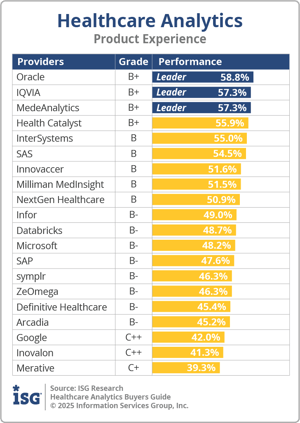
Product Experience, representing 80% of the evaluation, focuses on Capability (65%) and Platform (15%), including adaptability, manageability, reliability and usability. Oracle, IQVIA and MedeAnalytics achieved the highest performance as Leaders in this category, supported by breadth and depth across healthcare analytics capabilities and strong platform foundations that enable scalable performance, reliable operations and compliance-focused governance. Leaders demonstrated enterprise-grade platform capabilities across varied roles and contexts.
Customer Experience Value
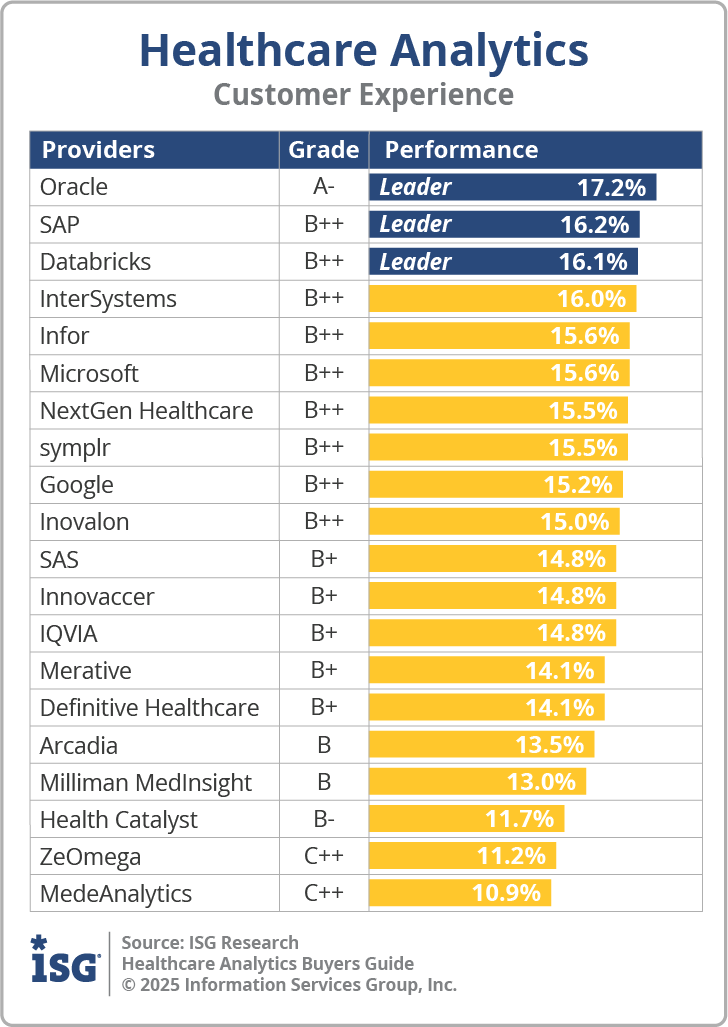
Customer Experience, representing 20% of the evaluation, focuses on validation and TCO/ROI. Oracle, SAP and Databricks were the Leaders in this category, showing strong customer advocacy and clear investment in success outcomes. Providers with lower performance often lacked publicly available customer validation or failed to demonstrate structured ROI measurement and proactive lifecycle engagement.
Strategic Recommendations
Enterprises should treat healthcare analytics as a strategic investment that unifies data governance, clinical usability, AI readiness and operational visibility. Buyers should prioritize providers that combine strong interoperability, robust privacy safeguards and clear value articulation. Platforms that streamline data preparation, support domain-specific modeling and ensure transparency in AI-driven insights will better align with clinical and payer priorities. Using these considerations, organizations can select providers that support long-term resilience, regulatory alignment and measurable performance improvement.
How To Use This Buyers Guide
Evaluating Software Providers: The Process
We recommend using the Buyers Guide to assess and evaluate new or existing software providers for your enterprise. The market research can be used as an evaluation framework to assess existing approaches and software providers or establish a formal request for information from providers on products and customer experience and will shorten the cycle time when creating an RFI. The steps listed below provide a process that can facilitate best possible outcomes in the most efficient manner.
- Define the business case and goals.
Define the mission and business case for investment and the expected outcomes from your organizational and technological efforts.
- Specify the business and IT needs.
Defining the business and IT requirements helps identify what specific capabilities are required with respect to people, processes, information and technology.
- Assess the required roles and responsibilities.
Identify the individuals required for success at every level of the enterprise from executives to frontline workers and determine the needs of each.
- Outline the project’s critical path.
What needs to be done, in what order and who will do it? This outline should make clear the prior dependencies at each step of the project plan.
- Ascertain the technology approach.
Determine the business and technology approach that most closely aligns to your enterprise’s requirements.
- Establish software provider evaluation criteria.
Utilize the product experience: capability and platform with support for adaptability, manageability, reliability and usability, and the customer experience in TCO/ROI and Validation.
- Evaluate and select the software provider and products properly.
Apply a weighting the evaluation categories in the evaluation criteria to reflect your enterprise’s priorities to determine the short list of software providers and products.
- Establish the business initiative team to start the project.
Identify who will lead the project and the members of the team needed to plan and execute it with timelines, priorities and resources.
Using the ISG Buyers Guide and process provides enterprises a clear, structured approach to making smarter software and business investment decisions. It ensures alignment between strategy, people, processes and technology while reducing risk, saving time and improving outcomes. The ISG approach promotes data-driven decision-making and collaboration, helping choose the right software providers for maximum value and return on investment.
The Findings
The software providers and products evaluated in the research provide product and customer experiences, but not everything offered is equally valuable to every enterprise or is needed to operate in business processes and use cases. Moreover, the existence of too many capabilities in products may be a negative factor for an enterprise if it introduces unnecessary complexity. Nonetheless, you may decide that a more comprehensive set of capabilities in the product is important, and where they match your enterprise’s requirements.
An effective customer relationship with a software provider is vital to the success of any investment. The overall customer experience and the full lifecycle of engagement play a key role in ensuring satisfaction and long-term success. Providers with dedicated customer leadership, such as chief customer officers, tend to invest more deeply in these relationships and prioritize customer outcomes to TCO and ROI expectations. It is equally important that this commitment to customer success is clearly demonstrated throughout the provider’s website, buying process and customer journey.
Overall Scoring of Software Providers Across Categories
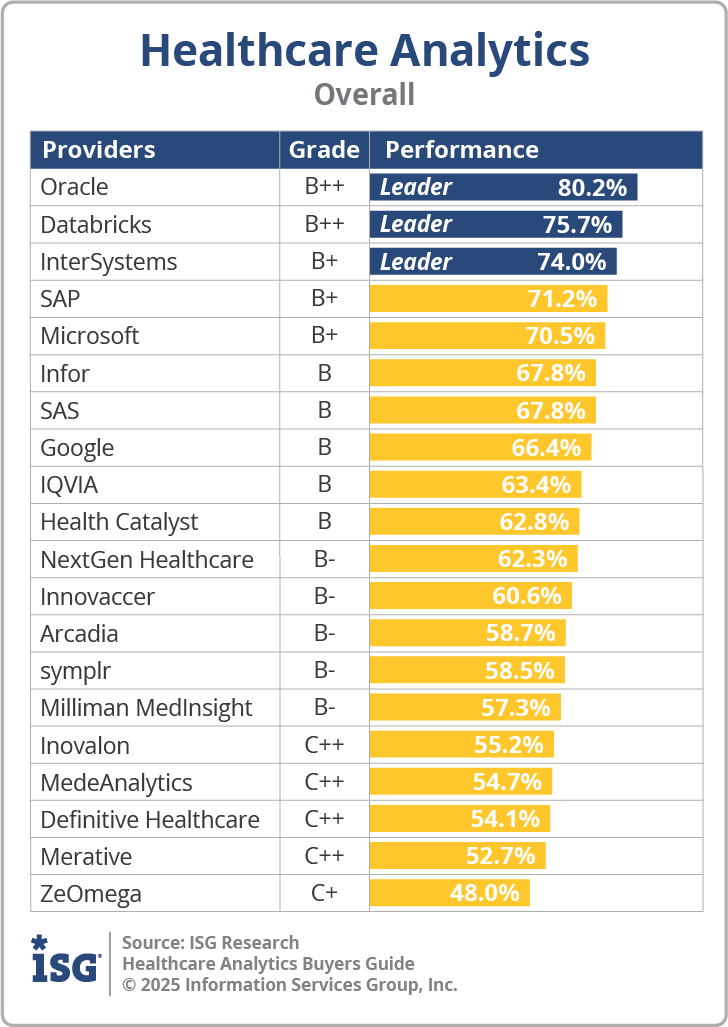 The research finds Oracle atop the list, followed by Databricks and InterSystems. Providers that place in the top three of a category earn the designation of Leader. Oracle has done so in four categories, Databricks in three, IQVIA, MedeAnalytics and SAP in two and Health Catalyst and InterSystems in one category.
The overall representation of the research below places the rating of the Product Experience and Customer Experience on the x and y axes, respectively, to provide a visual representation and classification of the software providers. Those providers whose Product Experience have above median weighted performance to the axis in aggregate of the two product categories place farther to the right, while the performance and weighting for the Customer Experience category determines placement on the vertical axis. In short, software providers that place closer to the upper-right on this chart performed better than those closer to the lower-left.
The research categorizes and rates software providers into one of four categories: Assurance, Exemplary, Merit or Innovative. This representation of software providers’ weighted performance in meeting the requirements in product and customer experience.
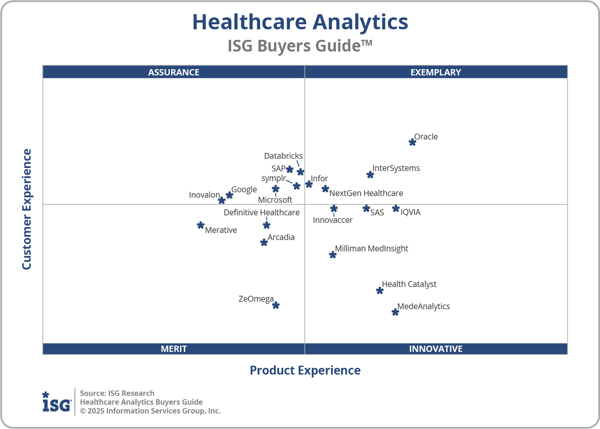
Exemplary: This rating (upper right) represents those that performed above median in Product and Customer Experience requirements. The providers rated Exemplary are: Infor, InterSystems, NextGen Healthcare and Oracle.
Innovative: This rating (lower right) represents those that performed above median in Product Experience but not in Customer Experience. The providers rated Innovative are: Health Catalyst, Innovaccer, IQVIA, MedeAnalytics, Milliman MedInsight and SAS.
Assurance: This rating (upper left) represents those that performed above median in Customer Experience but not in Product Experience. The providers rated Assurance are: Databricks, Google, Inovalon, Microsoft, SAP and symplr.
Merit: This rating (lower left) represents those that did not surpass the median in Customer or Product Experience. The providers rated Merit are: Arcadia, Definitive Healthcare, Merative and ZeOmega.
We advise enterprises to use this research as a supplement to their own evaluations, recognizing that ratings or rankings do not solely represent the value of a provider nor indicate universal suitability of a set of products.
Product Experience
The process of researching products to address an enterprise’s needs should be comprehensive and evaluate specific capabilities and the underlying platform to the product experience. Our evaluation of the Product Experience examines the lifecycle of onboarding, configuration, operations, usage and maintenance. Too often, software providers are not evaluated for the entirety of the product; instead, they are evaluated on market execution and vision of the future.
The research results in Product Experience are ranked at 80%, or four-fifths, using the underlying weighted performance. Importance was placed on the categories as follows: Capability (65%) and Platform (15%). Oracle, IQVIA and MedeAnalytics were designated Product Experience Leaders.
Customer Experience
 The importance of a customer relationship with a software provider is essential to the actual success of the products and technology. The evaluation of the Customer Experience and the entire lifecycle an enterprise has with its software provider is critical for ensuring satisfaction in working with that provider. The ISG Buyers Guide examines a software provider’s customer commitment, viability, customer success, sales and onboarding, product roadmap and services with partners and support. The customer experience category also investigates the TCO/ROI and how well a software provider demonstrates the product’s overall value, cost and benefits, including the tools and resources to evaluate these factors.
The research results in Customer Experience are ranked at 20%, or one-fifth of the 100% index, and represent the underlying provider validation and TCO/ROI requirements as they relate to the framework of commitment and value to the software provider-customer relationship.
The software providers that evaluated the highest in the Customer Experience category are Oracle, SAP and Databricks. These category leaders best communicate commitment and dedication to customer needs.
Software providers that did not perform well in this category were unable to provide or make sufficient information readily available to demonstrate success or articulate their commitment to customer experience. The use of a software provider requires continuous investment, so a holistic evaluation must include examination of how they support their customer experience.
Products Evaluated
| Provider | Product Names | Version | Release Month/Year |
|---|---|---|---|
| Arcadia | Arcadia Data Platform | N/A | November 2025 |
| Databricks | Databricks Platform | N/A | November 2025 |
| Definitive Healthcare | Definitive Healthcare Platform | N/A | November 2025 |
| Cloud Healthcare API Looker |
V1 25.20 |
November 2025 | |
| Health Catalyst | GoodData Cloud | N/A | November 2025 |
| Infor | Infor CloudSuite Healthcare Infor Birst | N/A | November 2025 |
| Innovaccer | Data Activation Platform | N/A | November 2025 |
| Inovalon | Inovalon One Platform | N/A | November 2025 |
| InterSystems | InterSystems IRIS for Health InterSystems IRIS | 2025.3 | November 2025 |
| IQVIA | IQVIA Connected Intelligence | N/A | November 2025 |
| MedeAnalytics | Integrated Analytics | N/A | November 2025 |
| Merative | Truven | N/A | November 2025 |
| Microsoft | Microsoft for Healthcare Power BI | N/A 2.148.1477.0 |
October 2025 November 2025 |
| Milliman MedInsight | Clinical Suite | N/A | November 2025 |
| NextGen Healthcare | NextGen Data Platform | N/A | November 2025 |
| Oracle | Oracle Health Oracle Analytics Cloud |
N/A | November 2025 |
| SAP |
SAP Connected Health Platform SAP Intelligent Clinical Supply Management SAP Business Data Cloud |
N/A | November 2025 |
| SAS | SAS Health Solutions SAS Viya |
2025.11 | November 2025 |
| symplr | symplr Operations Platform | N/A | November 2025 |
| ZeOmega | Jiva Platform | N/A | November 2025 |
Providers of Promise
We did not include software providers that, as a result of our research and analysis, did not satisfy the criteria for inclusion in this Buyers Guide. These are listed below as “Providers of Promise.”
| Provider | Product | Capability | Revenue | Customers |
|---|---|---|---|---|
| Azara Healthcare | Azara DVRS | Yes | No | Yes |
Executive Summary
Healthcare Analytics
The healthcare industry generates vast volumes of data spanning clinical, operational and financial domains. For decades, organizations have steadily advanced the use of analytics to improve patient care and streamline operations. This evolution has given rise to a diverse landscape of healthcare analytics software providers, including broad platform software providers and niche specialists, each offering tools to support a wide range of use cases, from clinical decision support to administrative optimization.
However, the unique nature of healthcare data, such as the need for longitudinal tracking, complex diagnostic coding systems, specific formats for electronic health records, such as FHIR and HL7 and strict privacy requirements, presents ongoing challenges. Notably, our research shows that 58 percent of healthcare organizations cite data usability as the most pressing data and AI concern, while 40 percent struggle with data integration. As artificial intelligence becomes increasingly embedded in analytics solutions, addressing these data issues remains critical to unlocking the full potential of healthcare analytics platforms.
Healthcare analytics also requires a higher standard of accuracy and accountability than most industries because insights often influence clinical decisions and patient outcomes. As AI capabilities expand, healthcare organizations must ensure that models are transparent, explainable, free from clinical or demographic bias and compliant with regional regulations such as HIPAA and GDPR. Interoperability with EHRs, alignment with healthcare data standards such as LOINC, SNOMED CT and ICD-10 and adherence to privacy and safety regulations are essential to building trust among clinicians, administrators and regulators.
Healthcare analytics software has evolved significantly alongside advances in computing, data storage and healthcare digitization.
ISG Research defines healthcare analytics as the use of analytics and AI to monitor and improve patient outcomes, healthcare operations and healthcare costs. It includes the use of mathematics to create measurements and metrics that enable healthcare data to be evaluated in any form, providing insights and guiding decision-making by healthcare providers and payers. It incorporates the collection and preparation of data needed in analyses, often one of the most time-consuming aspects of analytics. It also includes various forms for visualization and dissemination of information, such as dashboards, reports, emails or text messages. Analytics range from simple ratios and percentages to forecasting, optimization and simulation. With the explosion of generative AI, analytics must also include narrative, AI-based insights.
Healthcare analytics software has evolved significantly alongside advances in computing, data storage and healthcare digitization. In the 1960s and 1970s, basic statistical tools and hospital information systems laid the groundwork for early data use in healthcare. The widespread adoption of electronic health records in the 1990s and 2000s marked a major turning point, enabling more sophisticated data collection and analysis. This period saw the emergence of analytics and business intelligence tools tailored for healthcare providers, focusing on performance metrics, billing and patient outcomes. In the 2010s, the rise of big data technologies, machine learning and cloud computing fueled growth in predictive analytics, population health management and personalized medicine applications. Today, healthcare analytics software plays a crucial role in clinical decision support, operational efficiency, public health surveillance and value-based care initiatives, with AI-driven tools continuing to push the boundaries of what is possible.
Healthcare organizations require analytics platforms that are not only powerful but also easy to use and aligned with clinical and operational priorities. They need tools capable of ingesting and harmonizing diverse data sets, including clinical notes, imaging data, claims and genomic data, while preserving context and ensuring accuracy. Support for longitudinal analyses is critical to understanding outcomes over time, and the ability to work with structured and unstructured data is increasingly important. Payers also rely heavily on analytics to support risk adjustment, claims integrity, population health strategies and network performance. These use cases require robust enrichment, attribution and normalization capabilities, as well as dashboards that support actuarial, clinical and financial decision-making. GenAI-driven enhancements such as natural language query interfaces, AI-generated summaries and intelligent alerts are making analytics more accessible to clinicians and administrative users. However, these innovations must be underpinned by strong data governance, high data quality and robust integration capabilities to be effective in healthcare settings.
GenAI-driven enhancements are making analytics more accessible to clinicians and administrative users.
Successful healthcare analytics software must strike a balance between advanced analytical functionality and operational usability. Foundational capabilities include flexible data modeling, visual exploration, predictive analytics and the ability to embed AI and ML models. GenAI is adding further depth by streamlining data preparation, automating insight generation and improving documentation and explainability. Tools that offer AutoML allow non-specialist users to develop accurate forecasts or segment populations without deep coding skills. Increasingly, software must also support regulatory compliance, multilingual interaction and domain-specific customization. In a field as sensitive and high-stakes as healthcare, reliability, transparency and security are just as critical as analytical power.
This report is a specialized edition of the overall ISG Buyers Guide for Analytics, specifically evaluating software providers through the lens of healthcare needs, emphasizing clinical, operational, payer and workforce use cases. It applies many of the same foundational evaluation criteria used in the general analytics market, giving greater weight to capabilities such as interoperability with electronic health records, privacy safeguards, domain-specific models and support for healthcare data standards. This focus ensures that the report reflects the unique requirements and expectations of healthcare stakeholders.
Enterprises evaluating healthcare analytics providers should ensure that the platforms considered are not only capable of meeting current needs but are also evolving to support AI-driven capabilities, especially generative AI. By understanding the strengths and limitations of each provider’s offering, particularly in data usability, integration and AI maturity, healthcare organizations can make more informed decisions that will improve outcomes, increase operational efficiency and enhance long-term strategic value.
The 2025 ISG Buyers Guide™ Healthcare Analytics evaluated software providers and products in key areas of patient, payer, provider and workforce and the use of AI. It also includes capability requirements used in our overall Analytics Buyers Guide, spanning analytics-specific areas such as discover analytics, integrate analytics, predict analytics, act analytics, collaborate analytics, inform analytics, manage analytics, access data and data models. This research assessed the following providers: Arcadia, Databricks, Definitive Healthcare, Google, Health Catalyst, Infor, Innovaccer, Inovolan, InterSystems, IQVIA, MedeAnalytics, Merative, Microsoft, Millman MedInsight, NextGen Healthcare, Oracle, SAP, SAS, symplr and ZeOmega.
Buyers Guide Overview
ISG Research has conducted market research for over two decades across vertical industries, business applications, AI and IT. We have designed the ISG Buyers Guide™ to provide a balanced perspective of software providers and products that is rooted in an understanding of business and IT requirements. Utilization of our research methodology and decades of experience enables our Buyers Guide to be an effective method to assess and select software providers and products. The findings of this research provide a comprehensive approach to rating software providers and rank their ability to meet specific product and customer experience requirements.
ISG Research has designed the Buyers Guide to provide a balanced perspective of software providers and products that is rooted in an understanding of business and IT requirements.
The 2025 ISG Buyers Guide™ for Healthcare Analytics is the distillation of continuous market and product research. It is an assessment of how well software providers’ offerings address enterprises’ requirements for healthcare analytics software. The Value Index methodology is structured to support a request for information (RFI) for a request for proposal (RFP) process by incorporating all criteria needed to evaluate, select, utilize and maintain relationships with software providers. The ISG Buyers Guide evaluates customer experience and the product experience in its capability and platform.
The structure of the research reflects our understanding that the effective evaluation of software providers and products involves far more than just examining product features, potential revenue or customers generated from a provider’s marketing and sales efforts. It can ensure the best long-term relationship and value achieved from a resource and financial investment We believe it is important to take a comprehensive, research-based approach, since making the wrong choice of healthcare analytics software can raise the total cost of ownership, lower the return on investment and hamper an enterprise’s ability to reach its potential. In addition, this approach can reduce the project’s development and deployment time and eliminate the risk of relying on opinions or historical biases.
ISG Research believes that an objective review of existing and potential new software providers and products is a critical strategy for the adoption and implementation of healthcare analytics software. An enterprise’s review should include an analysis of both what is possible and what is relevant. We urge enterprises to do a thorough job of evaluating healthcare analytics software and offer this Buyers Guide as both the results of our in-depth analysis of these providers and as an evaluation methodology.
Key Takeaways
Healthcare analytics is advancing as organizations integrate clinical, operational and financial data with AI-enabled capabilities to improve decision-making. These tools must address persistent challenges in data usability, interoperability and privacy while supporting domain-specific standards and regulatory requirements. As AI becomes more embedded in workflows, platforms must balance advanced functionality with reliability, transparency and strong governance. This combination is essential for enabling clearer insights for clinicians, payers and administrative teams.
Software Provider Summary
The ISG Buyers Guide™ for Healthcare Analytics evaluates 20 software providers that offer products supporting analytics for clinical, operational, payer and workforce use cases. The research ranked the top three overall leaders as Oracle, Databricks and InterSystems. Providers were classified using weighted performance in Product Experience and Customer Experience for ISG quadrant placement. Infor, InterSystems, NextGen Healthcare and Oracle were rated as Exemplary, with Health Catalyst, Innovaccer, IQVIA, MedeAnalytics, Milliman MedInsight and SAS rated as Innovative. Databricks, Google, Inovalon, Microsoft, SAP and symplr were rated as Assurance, and Arcadia, Definitive Healthcare, Merative and ZeOmega were rated as Merit.
Product Experience Insights
Product Experience, representing 80% of the evaluation, focuses on Capability (65%) and Platform (15%), including adaptability, manageability, reliability and usability. Oracle, IQVIA and MedeAnalytics achieved the highest performance as Leaders in this category, supported by breadth and depth across healthcare analytics capabilities and strong platform foundations that enable scalable performance, reliable operations and compliance-focused governance. Leaders demonstrated enterprise-grade platform capabilities across varied roles and contexts.
Customer Experience Value
Customer Experience, representing 20% of the evaluation, focuses on validation and TCO/ROI. Oracle, SAP and Databricks were the Leaders in this category, showing strong customer advocacy and clear investment in success outcomes. Providers with lower performance often lacked publicly available customer validation or failed to demonstrate structured ROI measurement and proactive lifecycle engagement.
Strategic Recommendations
Enterprises should treat healthcare analytics as a strategic investment that unifies data governance, clinical usability, AI readiness and operational visibility. Buyers should prioritize providers that combine strong interoperability, robust privacy safeguards and clear value articulation. Platforms that streamline data preparation, support domain-specific modeling and ensure transparency in AI-driven insights will better align with clinical and payer priorities. Using these considerations, organizations can select providers that support long-term resilience, regulatory alignment and measurable performance improvement.
How To Use This Buyers Guide
Evaluating Software Providers: The Process
We recommend using the Buyers Guide to assess and evaluate new or existing software providers for your enterprise. The market research can be used as an evaluation framework to assess existing approaches and software providers or establish a formal request for information from providers on products and customer experience and will shorten the cycle time when creating an RFI. The steps listed below provide a process that can facilitate best possible outcomes in the most efficient manner.
- Define the business case and goals.
Define the mission and business case for investment and the expected outcomes from your organizational and technological efforts.
- Specify the business and IT needs.
Defining the business and IT requirements helps identify what specific capabilities are required with respect to people, processes, information and technology.
- Assess the required roles and responsibilities.
Identify the individuals required for success at every level of the enterprise from executives to frontline workers and determine the needs of each.
- Outline the project’s critical path.
What needs to be done, in what order and who will do it? This outline should make clear the prior dependencies at each step of the project plan.
- Ascertain the technology approach.
Determine the business and technology approach that most closely aligns to your enterprise’s requirements.
- Establish software provider evaluation criteria.
Utilize the product experience: capability and platform with support for adaptability, manageability, reliability and usability, and the customer experience in TCO/ROI and Validation.
- Evaluate and select the software provider and products properly.
Apply a weighting the evaluation categories in the evaluation criteria to reflect your enterprise’s priorities to determine the short list of software providers and products.
- Establish the business initiative team to start the project.
Identify who will lead the project and the members of the team needed to plan and execute it with timelines, priorities and resources.
Using the ISG Buyers Guide and process provides enterprises a clear, structured approach to making smarter software and business investment decisions. It ensures alignment between strategy, people, processes and technology while reducing risk, saving time and improving outcomes. The ISG approach promotes data-driven decision-making and collaboration, helping choose the right software providers for maximum value and return on investment.
The Findings
The software providers and products evaluated in the research provide product and customer experiences, but not everything offered is equally valuable to every enterprise or is needed to operate in business processes and use cases. Moreover, the existence of too many capabilities in products may be a negative factor for an enterprise if it introduces unnecessary complexity. Nonetheless, you may decide that a more comprehensive set of capabilities in the product is important, and where they match your enterprise’s requirements.
An effective customer relationship with a software provider is vital to the success of any investment. The overall customer experience and the full lifecycle of engagement play a key role in ensuring satisfaction and long-term success. Providers with dedicated customer leadership, such as chief customer officers, tend to invest more deeply in these relationships and prioritize customer outcomes to TCO and ROI expectations. It is equally important that this commitment to customer success is clearly demonstrated throughout the provider’s website, buying process and customer journey.
Overall Scoring of Software Providers Across Categories
The research finds Oracle atop the list, followed by Databricks and InterSystems. Providers that place in the top three of a category earn the designation of Leader. Oracle has done so in four categories, Databricks in three, IQVIA, MedeAnalytics and SAP in two and Health Catalyst and InterSystems in one category.
The overall representation of the research below places the rating of the Product Experience and Customer Experience on the x and y axes, respectively, to provide a visual representation and classification of the software providers. Those providers whose Product Experience have above median weighted performance to the axis in aggregate of the two product categories place farther to the right, while the performance and weighting for the Customer Experience category determines placement on the vertical axis. In short, software providers that place closer to the upper-right on this chart performed better than those closer to the lower-left.
The research categorizes and rates software providers into one of four categories: Assurance, Exemplary, Merit or Innovative. This representation of software providers’ weighted performance in meeting the requirements in product and customer experience.
Exemplary: This rating (upper right) represents those that performed above median in Product and Customer Experience requirements. The providers rated Exemplary are: Infor, InterSystems, NextGen Healthcare and Oracle.
Innovative: This rating (lower right) represents those that performed above median in Product Experience but not in Customer Experience. The providers rated Innovative are: Health Catalyst, Innovaccer, IQVIA, MedeAnalytics, Milliman MedInsight and SAS.
Assurance: This rating (upper left) represents those that performed above median in Customer Experience but not in Product Experience. The providers rated Assurance are: Databricks, Google, Inovalon, Microsoft, SAP and symplr.
Merit: This rating (lower left) represents those that did not surpass the median in Customer or Product Experience. The providers rated Merit are: Arcadia, Definitive Healthcare, Merative and ZeOmega.
We advise enterprises to use this research as a supplement to their own evaluations, recognizing that ratings or rankings do not solely represent the value of a provider nor indicate universal suitability of a set of products.
Product Experience
The process of researching products to address an enterprise’s needs should be comprehensive and evaluate specific capabilities and the underlying platform to the product experience. Our evaluation of the Product Experience examines the lifecycle of onboarding, configuration, operations, usage and maintenance. Too often, software providers are not evaluated for the entirety of the product; instead, they are evaluated on market execution and vision of the future.
The research results in Product Experience are ranked at 80%, or four-fifths, using the underlying weighted performance. Importance was placed on the categories as follows: Capability (65%) and Platform (15%). Oracle, IQVIA and MedeAnalytics were designated Product Experience Leaders.
Customer Experience
The importance of a customer relationship with a software provider is essential to the actual success of the products and technology. The evaluation of the Customer Experience and the entire lifecycle an enterprise has with its software provider is critical for ensuring satisfaction in working with that provider. The ISG Buyers Guide examines a software provider’s customer commitment, viability, customer success, sales and onboarding, product roadmap and services with partners and support. The customer experience category also investigates the TCO/ROI and how well a software provider demonstrates the product’s overall value, cost and benefits, including the tools and resources to evaluate these factors.
The research results in Customer Experience are ranked at 20%, or one-fifth of the 100% index, and represent the underlying provider validation and TCO/ROI requirements as they relate to the framework of commitment and value to the software provider-customer relationship.
The software providers that evaluated the highest in the Customer Experience category are Oracle, SAP and Databricks. These category leaders best communicate commitment and dedication to customer needs.
Software providers that did not perform well in this category were unable to provide or make sufficient information readily available to demonstrate success or articulate their commitment to customer experience. The use of a software provider requires continuous investment, so a holistic evaluation must include examination of how they support their customer experience.
Products Evaluated
| Provider | Product Names | Version | Release Month/Year |
|---|---|---|---|
| Arcadia | Arcadia Data Platform | N/A | November 2025 |
| Databricks | Databricks Platform | N/A | November 2025 |
| Definitive Healthcare | Definitive Healthcare Platform | N/A | November 2025 |
| Cloud Healthcare API Looker |
V1 25.20 |
November 2025 | |
| Health Catalyst | GoodData Cloud | N/A | November 2025 |
| Infor | Infor CloudSuite Healthcare Infor Birst | N/A | November 2025 |
| Innovaccer | Data Activation Platform | N/A | November 2025 |
| Inovalon | Inovalon One Platform | N/A | November 2025 |
| InterSystems | InterSystems IRIS for Health InterSystems IRIS | 2025.3 | November 2025 |
| IQVIA | IQVIA Connected Intelligence | N/A | November 2025 |
| MedeAnalytics | Integrated Analytics | N/A | November 2025 |
| Merative | Truven | N/A | November 2025 |
| Microsoft | Microsoft for Healthcare Power BI | N/A 2.148.1477.0 |
October 2025 November 2025 |
| Milliman MedInsight | Clinical Suite | N/A | November 2025 |
| NextGen Healthcare | NextGen Data Platform | N/A | November 2025 |
| Oracle | Oracle Health Oracle Analytics Cloud |
N/A | November 2025 |
| SAP |
SAP Connected Health Platform SAP Intelligent Clinical Supply Management SAP Business Data Cloud |
N/A | November 2025 |
| SAS | SAS Health Solutions SAS Viya |
2025.11 | November 2025 |
| symplr | symplr Operations Platform | N/A | November 2025 |
| ZeOmega | Jiva Platform | N/A | November 2025 |
Providers of Promise
We did not include software providers that, as a result of our research and analysis, did not satisfy the criteria for inclusion in this Buyers Guide. These are listed below as “Providers of Promise.”
| Provider | Product | Capability | Revenue | Customers |
|---|---|---|---|---|
| Azara Healthcare | Azara DVRS | Yes | No | Yes |
Fill out the form to continue reading.