Executive Summary
The rise of generative and agentic artificial intelligence (AI) has accelerated enterprise investment in technologies that support the development and operation of AI systems. As organizations move beyond experimentation, attention is shifting to platforms that support the full lifecycle of model development, deployment and governance. Enterprises increasingly require AI platforms that enable scalable, operational use of AI across diverse business processes.
Software Provider Summary
The ISG Buyers Guide™ for AI Platforms evaluates 28 software providers offering products supporting the preparation, training, deployment and governance of AI models across enterprise environments. The research ranked the top three overall leaders as Oracle, Databricks and IBM. Providers were classified using weighted performance in Product Experience and Customer Experience for ISG quadrant placement. AWS, Databricks, Dataiku, Google Cloud, IBM, Microsoft, Oracle, SAP and Teradata were rated as Exemplary, with Alibaba Cloud, DataRobot, MathWorks, Snowflake and Tencent Cloud rated as Innovative. Alteryx, Cloudera, Domo, Huawei Cloud and Salesforce were rated as Assurance; and Altair, Anaconda, C3 AI, EdgeVerve, NVIDIA, Palantir, Red Hat, SAS and Weights & Biases were rated as Merit.
Product Experience
Product Experience, representing 80% of the evaluation, focuses on Capability (50%) and Platform (30%), which includes adaptability, manageability, reliability and usability. Oracle, Databricks and IBM achieved the highest performance as Leaders in this category, supported by comprehensive AI lifecycle capabilities spanning model development, deployment and governance and scalable platform architectures that support integration, security and enterprise operations. Leaders demonstrated enterprise-grade platform capabilities across varied roles and operational contexts.
Customer Experience
Customer Experience, representing 20% of the evaluation, focuses on validation and TCO/ROI. AWS, IBM and Oracle were the Leaders in this category, showing strong customer advocacy and clear investment in success outcomes. Providers with lower performance often lacked publicly available customer validation or failed to demonstrate structured ROI measurement and proactive lifecycle engagement.
Strategic Recommendations
Enterprises should prioritize AI platforms that support the full lifecycle of model development, deployment and governance across predictive, generative and agentic AI workloads. Platform evaluations should assess how effectively providers integrate automation, usability and collaboration across data science, engineering and operations teams. Organizations should also consider scalability, governance and cost management capabilities to ensure AI initiatives can expand beyond isolated experiments. Establishing consistent MLOps and governance practices is essential to maintaining accuracy, compliance and operational reliability over time.
The software providers and products evaluated in this research offer product and customer experiences, but not every feature is equally valuable to every enterprise or is needed to support the relevant business processes and use cases. Moreover, having too many product capabilities may be a negative factor for an enterprise if it introduces unnecessary complexity. Nonetheless, you may decide that a more comprehensive set of capabilities is important and meets your enterprise’s requirements.
An effective customer relationship with a software provider is vital to the success of any investment. The overall customer experience and the full lifecycle of engagement play a key role in ensuring satisfaction and long-term success. Providers with dedicated customer leadership, such as chief customer officers, tend to invest more deeply in these relationships and prioritize customer outcomes in line with TCO and ROI expectations. It is equally important that this commitment to customer success is evident throughout the provider’s website, the buying process and the customer journey.
Overall Scoring of Software Providers Across Categories
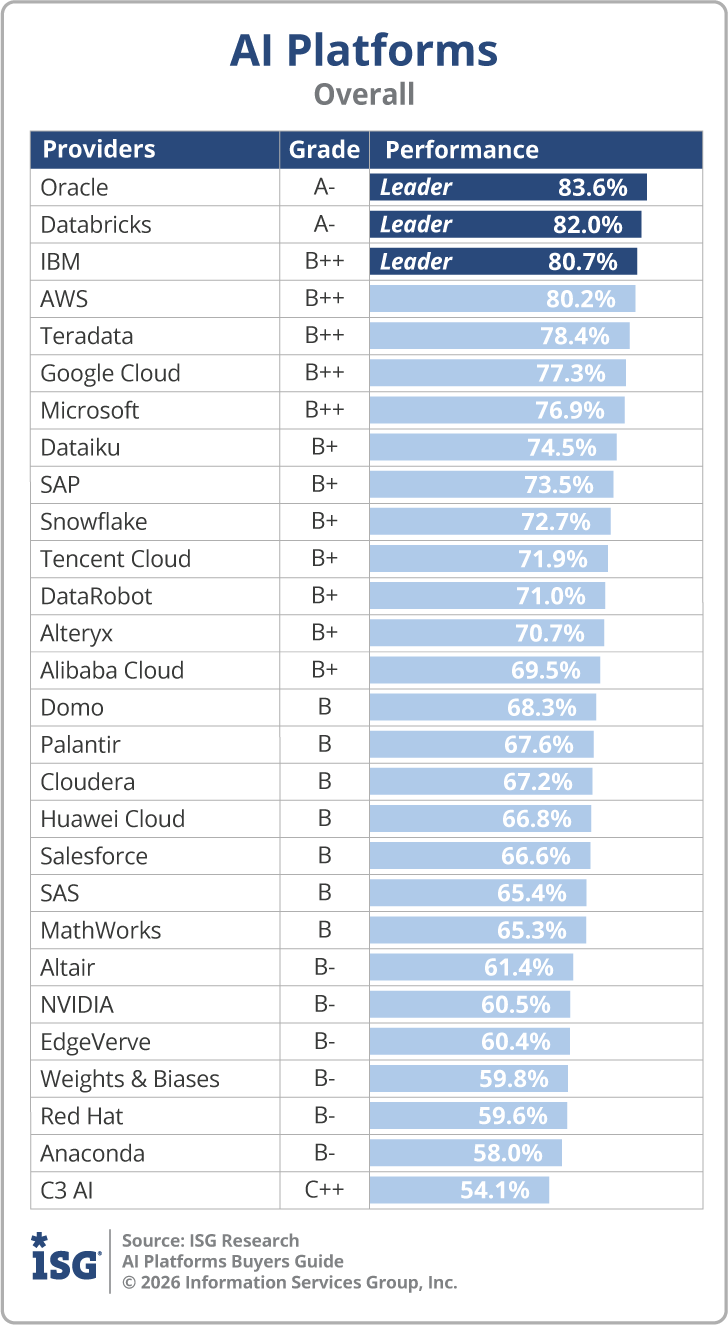 The research finds Oracle atop the list, followed by Databricks and IBM. Providers that place in the top three of a category earn the designation of Leader. Oracle has done so in five categories; IBM in four; Databricks in three; AWS in two; and Dataiku in one category.
The quadrant chart below presents ratings for Product Experience and Customer Experience on the x- and y-axes, respectively, to visually classify software providers. Those providers whose Product Experience has above-median weighted performance on the axis, in aggregate across the two product categories, place farther to the right. The performance and weighting for the Customer Experience category determine placement on the vertical axis. In short, software providers that place closer to the upper-right on this chart performed better than those closer to the lower-left.
The research categorizes and rates software providers into one of four categories: Assurance, Exemplary, Merit or Innovative. Placement represents the software providers’ weighted performance in meeting the requirements of product and customer experience.
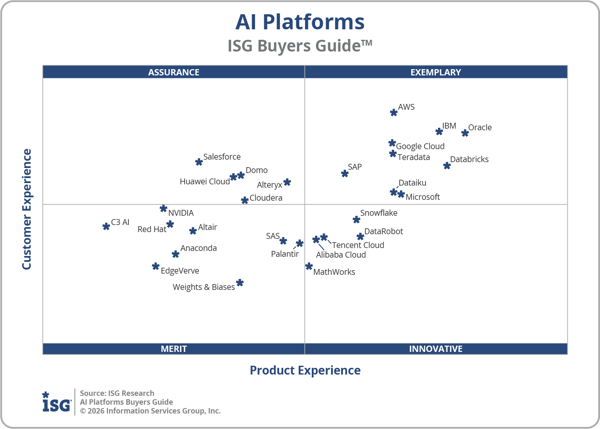
Exemplary: This rating (upper right) applies to those providers that performed above the median on Product and Customer Experience requirements. The providers rated Exemplary are: AWS, Databricks, Dataiku, Google Cloud, IBM, Microsoft, Oracle, SAP and Teradata.
Innovative: This rating (lower right) applies to those that performed above median in Product Experience but not in Customer Experience. The providers rated Innovative are: Alibaba Cloud, DataRobot, MathWorks, Snowflake and Tencent Cloud.
Assurance: This rating (upper left) applies to those that performed above median in Customer Experience but not in Product Experience. The providers rated Assurance are: Alteryx, Cloudera, Domo, Huawei Cloud and Salesforce.
Merit: This rating (lower left) applies to those that did not surpass the median in Customer or Product Experience. The providers rated Merit are: Altair, Anaconda, C3 AI, EdgeVerve, NVIDIA, Palantir, Red Hat, SAS and Weights & Biases.
We advise enterprises to use this research as a supplement to their own evaluations, recognizing that ratings or rankings do not solely represent a provider’s value nor indicate universal suitability of a set of products.
Key Takeaways – Agentic and Generative AI
Generative and agentic AI are expanding enterprise expectations for artificial intelligence (AI) from analysis to automated execution of tasks. Organizations are increasingly embedding these capabilities into operational workflows to improve speed, consistency and scalability. This shift is driving demand for platforms that support the development, deployment and governance of AI-driven systems.
Software Provider Summary
The ISG Buyers Guide™ for Agentic and Generative AI evaluates 33 software providers offering products supporting generative AI (GenAI), AI agents and lifecycle management of AI systems across enterprise environments. The research ranked the top three overall leaders as Oracle, AWS and IBM. Providers were classified using weighted performance in Product Experience and Customer Experience for ISG quadrant placement. AWS, Databricks, Dataiku, Google Cloud, IBM, Microsoft, Oracle, Salesforce, ServiceNow, Teradata and UiPath were rated as Exemplary, with Alibaba Cloud, DataRobot, OpenAI, Palantir, Snowflake and Tencent Cloud rated as Innovative. Boomi, Cloudera, Domo, Huawei Cloud, NVIDIA and SAP were rated as Assurance; and Altair, Anthropic, Automation Anywhere, C3 AI, Cohere, Couchbase, EDB, EdgeVerve, Fractal and Weights & Biases were rated as Merit.
Product Experience
Product Experience, representing 80% of the evaluation, focuses on Capability (55%) and Platform (25%), which includes adaptability, manageability, reliability and usability. Oracle, IBM and Microsoft achieved the highest performance as Leaders in this category, supported by comprehensive capabilities for developing and governing generative and agentic AI systems and scalable platforms that support integration, security and operational deployment. Leaders demonstrated enterprise-grade platform capabilities across varied roles and operational contexts.
Customer Experience
Customer Experience, representing 20% of the evaluation, focuses on validation and TCO/ROI. AWS, IBM and Oracle were the Leaders in this category, showing strong customer advocacy and clear investment in success outcomes. Providers with lower performance often lacked publicly available customer validation or failed to demonstrate structured ROI measurement and proactive lifecycle engagement.
Strategic Recommendations
Enterprises should evaluate generative and agentic AI platforms based on their ability to support the full lifecycle of AI development, deployment and governance. Platform selection should prioritize capabilities for managing AI agents, integrating AI into operational workflows and maintaining oversight of autonomous systems. Organizations should also assess how effectively providers support model monitoring, cost control and compliance as AI systems scale. Establishing strong governance and operational frameworks is essential to ensuring reliable and responsible AI-driven automation.
The Findings – Agentic and Generative AI
The software providers and products evaluated in this research offer product and customer experiences, but not every feature is equally valuable to every enterprise or is needed to support the relevant business processes and use cases. Moreover, having too many product capabilities may be a negative factor for an enterprise if it introduces unnecessary complexity. Nonetheless, you may decide that a more comprehensive set of capabilities is important and meets your enterprise’s requirements.
An effective customer relationship with a software provider is vital to the success of any investment. The overall customer experience and the full lifecycle of engagement play a key role in ensuring satisfaction and long-term success. Providers with dedicated customer leadership, such as chief customer officers, tend to invest more deeply in these relationships and prioritize customer outcomes in line with TCO and ROI expectations. It is equally important that this commitment to customer success is evident throughout the provider’s website, the buying process and the customer journey.
Overall Scoring of Software Providers Across Categories
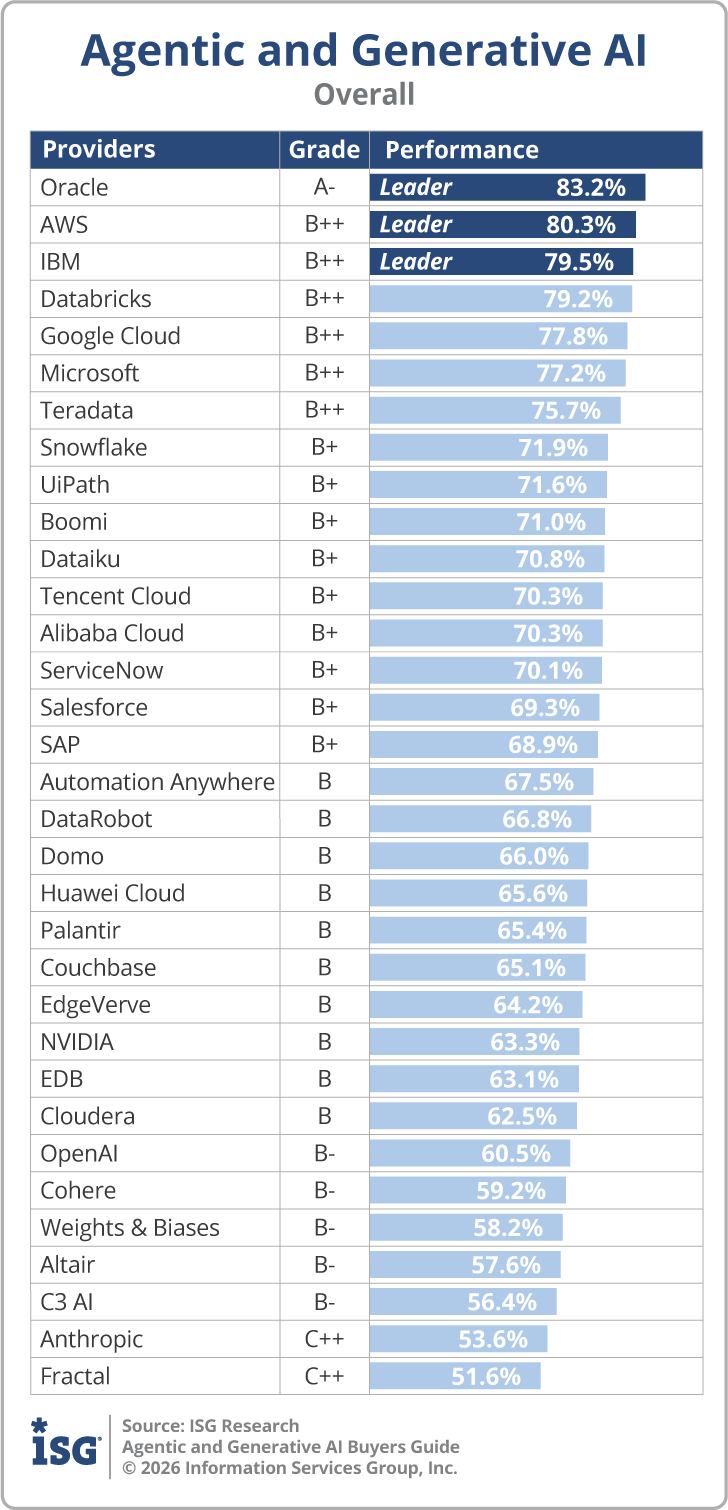 The research finds Oracle atop the list, followed by AWS and IBM. Providers that place in the top three of a category earn the designation of Leader. Oracle has done so in five categories; IBM in four; AWS in three; and Databricks, Google Cloud and Microsoft in one category.
The quadrant chart below presents ratings for Product Experience and Customer Experience on the x- and y-axes, respectively, to visually classify software providers. Those providers whose Product Experience has above-median weighted performance on the axis, in aggregate across the two product categories, place farther to the right. The performance and weighting for the Customer Experience category determine placement on the vertical axis. In short, software providers that place closer to the upper-right on this chart performed better than those closer to the lower-left.
The research categorizes and rates software providers into one of four categories: Assurance, Exemplary, Merit or Innovative. Placement represents the software providers’ weighted performance in meeting the requirements of product and customer experience.
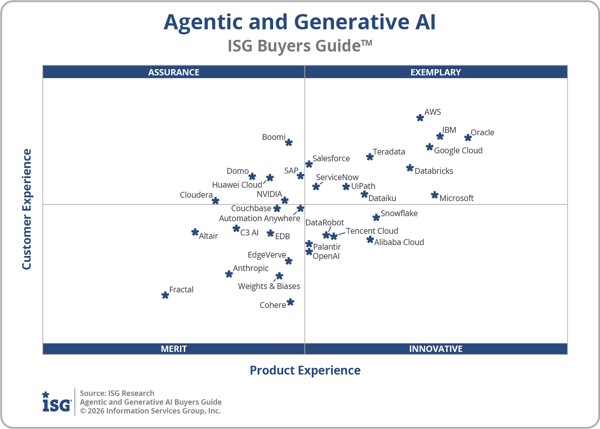
Exemplary: This rating (upper right) applies to those providers that performed above the median on Product and Customer Experience requirements. The providers rated Exemplary are: AWS, Databricks, Dataiku, Google Cloud, IBM, Microsoft, Oracle, Salesforce, ServiceNow, Teradata and UiPath.
Innovative: This rating (lower right) applies to those that performed above median in Product Experience but not in Customer Experience. The providers rated Innovative are: Alibaba Cloud, DataRobot, OpenAI, Palantir, Snowflake and Tencent Cloud.
Assurance: This rating (upper left) applies to those that performed above median in Customer Experience but not in Product Experience. The providers rated Assurance are: Boomi, Cloudera, Domo, Huawei Cloud, NVIDIA and SAP.
Merit: This rating (lower left) applies to those that did not surpass the median in Customer or Product Experience. The providers rated Merit are: Altair, Anthropic, Automation Anywhere, C3 AI, Cohere, Couchbase, EDB, EdgeVerve, Fractal and Weights & Biases.
We advise enterprises to use this research as a supplement to their own evaluations, recognizing that ratings or rankings do not solely represent a provider’s value nor indicate universal suitability of a set of products.
Key Takeaways – AI Governance and Operations
The rapid adoption of generative and agentic AI has increased enterprise attention to governance and operational oversight of AI systems. As AI applications become embedded in business processes, organizations must manage risks related to accuracy, compliance and unintended outcomes. This shift is driving demand for platforms that support monitoring, lifecycle management and governance across AI models, applications and agents.
Software Provider Summary
The ISG Buyers Guide™ for AI Governance and Operations evaluates 32 software providers offering products supporting the governance, deployment and lifecycle management of AI models, applications and agents across enterprise environments. The research ranked the top three overall leaders as Oracle, IBM and Databricks. Providers were classified using weighted performance in Product Experience and Customer Experience for ISG quadrant placement. AWS, Cloudera, Databricks, Dataiku, Google Cloud, IBM, Microsoft, Oracle, SAP and Teradata were rated as Exemplary, with Alibaba Cloud, DataRobot, MathWorks, SAS, Snowflake and Tencent Cloud rated as Innovative. Alteryx, Boomi, Couchbase, Domo, Huawei Cloud, NVIDIA and Salesforce were rated as Assurance; and Altair, Anaconda, C3 AI, EDB, EdgeVerve, Fractal, Palantir, Red Hat and Weights and Biases were rated as Merit.
Product Experience
Product Experience, representing 80% of the evaluation, focuses on Capability (55%) and Platform (25%), which includes adaptability, manageability, reliability and usability. IBM, Databricks and Oracle achieved the highest performance as Leaders in this category, supported by comprehensive capabilities for AI governance, monitoring and lifecycle management and scalable platform architectures that support integration, security and enterprise operations. Leaders demonstrated enterprise-grade platform capabilities across varied roles and operational contexts.
Customer Experience
Customer Experience, representing 20% of the evaluation, focuses on validation and TCO/ROI. AWS, IBM and Oracle were the Leaders in this category, showing strong customer advocacy and clear investment in success outcomes. Providers with lower performance often lacked publicly available customer validation or failed to demonstrate structured ROI measurement and proactive lifecycle engagement.
Strategic Recommendations
Enterprises should prioritize platforms that provide monitoring, governance and lifecycle management for AI models, applications and agents. Evaluations should assess capabilities for policy enforcement, auditability and operational oversight as AI systems scale. Strong governance frameworks are essential to balance innovation with risk management and regulatory compliance.
The Findings – AI Governance and Operations
The software providers and products evaluated in this research offer product and customer experiences, but not every feature is equally valuable to every enterprise or is needed to support the relevant business processes and use cases. Moreover, having too many product capabilities may be a negative factor for an enterprise if it introduces unnecessary complexity. Nonetheless, you may decide that a more comprehensive set of capabilities is important and meets your enterprise’s requirements.
An effective customer relationship with a software provider is vital to the success of any investment. The overall customer experience and the full lifecycle of engagement play a key role in ensuring satisfaction and long-term success. Providers with dedicated customer leadership, such as chief customer officers, tend to invest more deeply in these relationships and prioritize customer outcomes in line with TCO and ROI expectations. It is equally important that this commitment to customer success is evident throughout the provider’s website, the buying process and the customer journey.
Overall Scoring of Software Providers Across Categories
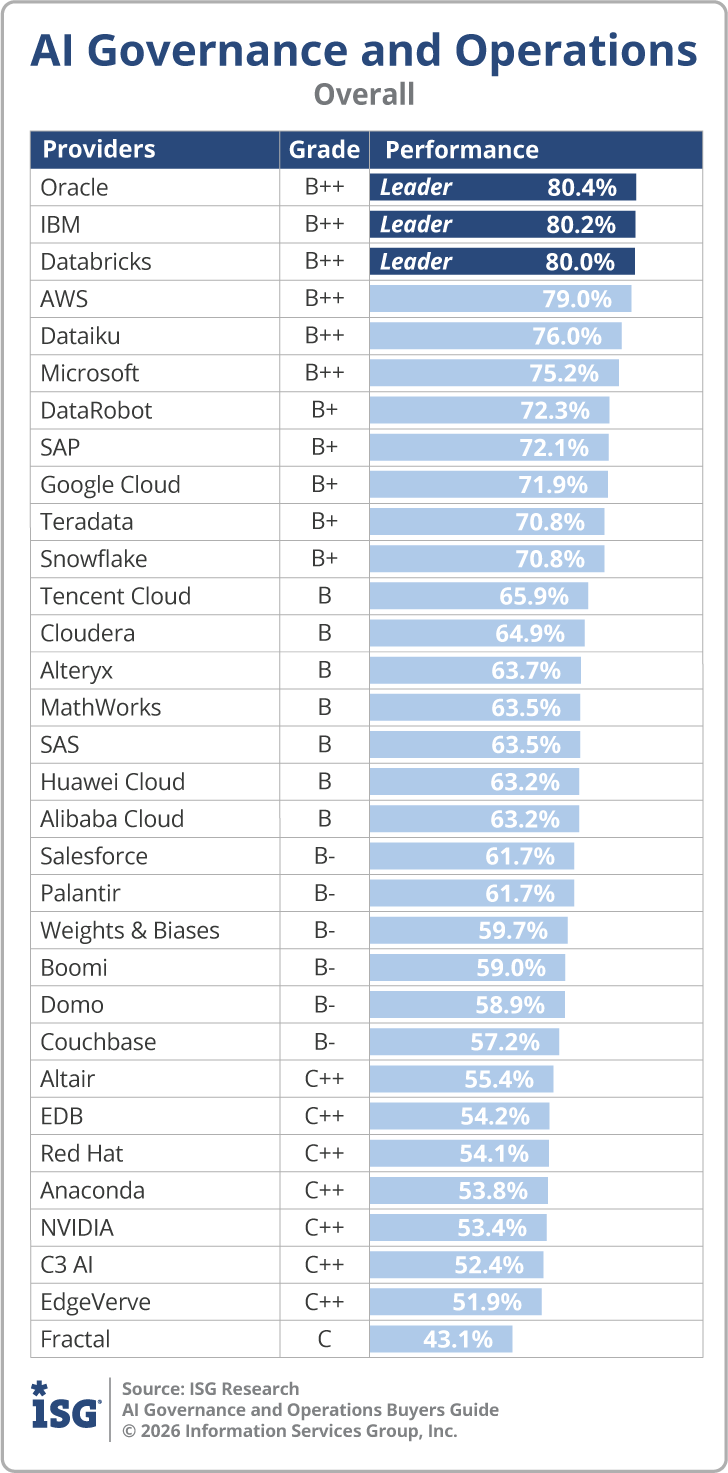 The research finds Oracle atop the list, followed by IBM and Databricks. Providers that place in the top three of a category earn the designation of Leader. Oracle has done so in five categories; IBM in four; Databricks in three; AWS in two; and Dataiku in one category.
The quadrant chart below presents ratings for Product Experience and Customer Experience on the x- and y-axes, respectively, to visually classify software providers. Those providers whose Product Experience has above-median weighted performance on the axis, in aggregate across the two product categories, place farther to the right. The performance and weighting for the Customer Experience category determine placement on the vertical axis. In short, software providers that place closer to the upper-right on this chart performed better than those closer to the lower-left.
The research categorizes and rates software providers into one of four categories: Assurance, Exemplary, Merit or Innovative. Placement represents the software providers’ weighted performance in meeting the requirements of product and customer experience.
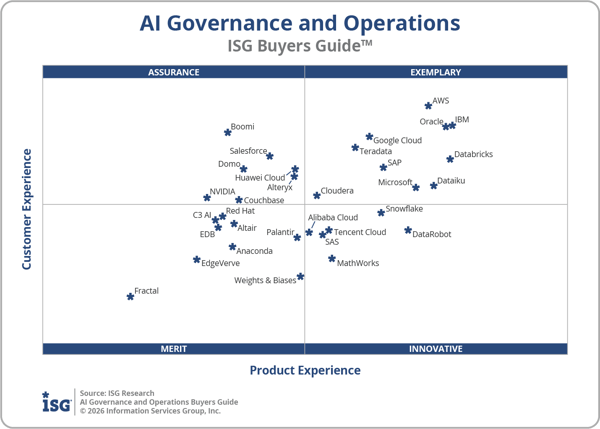
Exemplary: This rating (upper right) applies to those providers that performed above the median on Product and Customer Experience requirements. The providers rated Exemplary are: AWS, Cloudera, Databricks, Dataiku, Google Cloud, IBM, Microsoft, Oracle, SAP and Teradata.
Innovative: This rating (lower right) applies to those that performed above median in Product Experience but not in Customer Experience. The providers rated Innovative are: Alibaba Cloud, DataRobot, MathWorks, SAS, Snowflake and Tencent Cloud.
Assurance: This rating (upper left) applies to those that performed above median in Customer Experience but not in Product Experience. The providers rated Assurance are: Alteryx, Boomi, Couchbase, Domo, Huawei Cloud, NVIDIA and Salesforce.
Merit: This rating (lower left) applies to those that did not surpass the median in Customer or Product Experience. The providers rated Merit are: Altair, Anaconda, C3 AI, EDB, EdgeVerve, Fractal, Palantir, Red Hat and Weights and Biases.
We advise enterprises to use this research as a supplement to their own evaluations, recognizing that ratings or rankings do not solely represent a provider’s value nor indicate universal suitability of a set of products.