

Keith leads the Customer Experience (CX) expertise at ISG Software Research, covering applications and technology that facilitate engagement to optimize customer-facing processes across marketing, sales and Customer Relationship Management (CRM). His focus areas of coverage include agent management, contact center, customer experience management, field service, intelligent self-service and voice of the customer. Keith’s specialization is in natural language and speech tools with intelligent virtual assistants, multichannel routing and journey management, and a wide array of customer analytics. Keith’s experience spans over two decades as an industry analyst and as the editorial director of Call Center Magazine. There he pioneered coverage of cloud-based contact centers, speech recognition and processing, and the shift from voice to multichannel communications. He is a graduate of Amherst College.
narration area
Executive Summary
Buyers Guide Overview
ISG Research has conducted market research for over two decades across vertical industries, business applications, AI and IT. We have designed the ISG Buyers Guide™ to provide a balanced perspective of software providers and products that is rooted in an understanding of business and IT requirements. Utilization of our research methodology and decades of experience enables our Buyers Guide to be an effective method to assess and select software providers and products. The findings of this research provide a comprehensive approach to rating software providers and rank their ability to meet specific product and customer experience requirements.

ISG Research has designed the Buyers Guide to provide a balanced perspective of software providers and products that is rooted in an understanding of business and IT requirements.
The 2026 ISG Buyers Guides™ for Field Service Management, covering Field Service Management, Field Service Customer Engagement and Field Service Proactive Maintenance, are the distillation of continuous market and product research. It is an assessment of how well software providers’ offerings address enterprises’ requirements for field service management software. The Value Index methodology is structured to support a request for information (RFI) for a request for proposal (RFP) process by incorporating all criteria needed to evaluate, select, utilize and maintain relationships with software providers. The ISG Buyers Guide evaluates customer experience and the product experience in its capability and platform.
The structure of the research reflects our understanding that the effective evaluation of software providers and products involves far more than just examining product features, potential revenue or customers generated from a provider’s marketing and sales efforts. It can ensure the best long-term relationship and value achieved from a resource and financial investment We believe it is important to take a comprehensive, research-based approach, since making the wrong choice of field service management software can raise the total cost of ownership, lower the return on investment and hamper an enterprise’s ability to reach its potential. In addition, this approach can reduce the project’s development and deployment time and eliminate the risk of relying on opinions or historical biases.
ISG Research believes that an objective review of existing and potential new software providers and products is a critical strategy for the adoption and implementation of field service management software. An enterprise’s review should include an analysis of both what is possible and what is relevant. We urge enterprises to do a thorough job of evaluating field service management software and offer these Buyers Guides as both the results of our in-depth analysis of these providers and as an evaluation methodology.
How To Use This Buyers Guide
Evaluating Software Providers: The Process
We recommend using the Buyers Guide to assess and evaluate new or existing software providers for your enterprise. The market research can be used as an evaluation framework to assess existing approaches and software providers or establish a formal request for information from providers on products and customer experience and will shorten the cycle time when creating an RFI. The steps listed below provide a process that can facilitate best possible outcomes in the most efficient manner.
- Define the business case and goals.
Define the mission and business case for investment and the expected outcomes from your organizational and technological efforts. - Specify the business and IT needs.
Defining the business and IT requirements helps identify what specific capabilities are required with respect to people, processes, information and technology. - Assess the required roles and responsibilities.
Identify the individuals required for success at every level of the enterprise from executives to frontline workers and determine the needs of each. - Outline the project’s critical path.
What needs to be done, in what order and who will do it? This outline should make clear the prior dependencies at each step of the project plan. - Ascertain the technology approach.
Determine the business and technology approach that most closely aligns to your enterprise’s requirements. - Establish software provider evaluation criteria.
Utilize the product experience: capability and platform with support for adaptability, manageability, reliability and usability, and the customer experience in TCO/ROI and Validation. - Evaluate and select the software provider and products properly.
Apply a weighting the evaluation categories in the evaluation criteria to reflect your enterprise’s priorities to determine the short list of software providers and products. - Establish the business initiative team to start the project.
Identify who will lead the project and the members of the team needed to plan and execute it with timelines, priorities and resources.
Using the ISG Buyers Guide and process provides enterprises a clear, structured approach to making smarter software and business investment decisions. It ensures alignment between strategy, people, processes and technology while reducing risk, saving time, and improving outcomes. The ISG approach promotes data-driven decision-making and collaboration, helping choose the right software providers for maximum value and return on investment.
Field Service Management
Field service delivery is one of the most complex and highly orchestrated functions of an enterprise’s customer-facing activities. It can also be one of the most expensive and difficult to automate. Sending a worker or technician to a customer’s site represents an investment of time, materials and labor that goes well beyond what it costs to respond to a customer by phone. When the customer is a business, and the object being serviced is a highly advanced piece of machinery or critical infrastructure, the stakes for that interaction go far beyond customer satisfaction or NPS scores.
The market for field service software has been fragmented by function—tools for fleet management over here, technician communications over there—and is now consolidating into broad-based platforms that integrate multiple activities. The broader the platform, the easier it is to track and organize field service processes for maximum efficiency.
Change in this market is accelerating, due in part to advances in AI but also because the field service environment itself has grown more complex. Workforce dynamics are shifting, assets are becoming more sophisticated and customer expectations for speed, uptime and transparency continue to rise. In response, enterprises are increasingly focused on gaining end-to-end visibility across the service lifecycle, from work-order creation and technician scheduling through service execution and incident closeout. Greater emphasis is placed on workforce optimization, including skills-based scheduling and the ability to adapt in real time to disruptions.
Workforce dynamics are shifting, assets are becoming more sophisticated and customer expectations for speed, uptime and transparency continue to rise.
ISG Research defines field service management (FSM) as the practice of delivering technical customer support at the customer’s site, as opposed to relying solely on remote communication channels such as phone or chat. To implement that practice, FSM software is defined as a digital platform that coordinates and optimizes all activities required to deploy, manage and support field technicians. This typically includes capabilities for scheduling and dispatching, work-order management, mobile workforce enablement, asset and inventory tracking, customer communication and real-time data capture. Together, these capabilities ensure that technicians have the right information, parts and tools to complete service tasks efficiently and consistently.
AI has proven particularly effective in two areas of field service delivery: optimizing technician dispatch and travel time, and coordinating the use of technical knowledge by both customers and technicians. These advances alone would have delivered meaningful improvements. But field service operations are also benefiting from the way broad-based enterprise software platforms now support a more comprehensive digitalization of service processes. By connecting knowledge, scheduling, skills, measurement, asset tracking and financial performance under one software roof, organizations gain clearer insight into the true cost of service. They can react faster in real time, prioritize incidents more effectively and maintain more consistent communication with customers throughout the service lifecycle.
The nature of the service experience for business customers differs significantly from that of consumers. Costs differ, as do expectations, particularly when service levels are governed by contractual SLAs. These differences influence how service organizations prioritize response times, technician skills and parts availability, and whether platforms emphasize customer communication, asset visibility or strict service-level enforcement.
The platformization of field service software is also enabling a more predictive approach to service delivery. When organizations can anticipate maintenance needs, scheduling visits becomes more efficient, or service can be resolved without requiring an on-site visit. These capabilities are driven largely by advances in AI. In practice, this shifts field service from reactive break/fix models toward planned, data-driven interventions that reduce downtime, improve asset utilization and lower the overall cost of service delivery. For many organizations, this shift is helping balance preventive maintenance with customer disruption, improving uptime while lowering the total cost of service operations.
FSM software and practices have progressed rapidly from digitized versions of paper-based work orders to advanced platforms that unify scheduling, work order management and knowledge access. The widespread adoption of smartphones and reliable mobile broadband enabled real-time technician connectivity, GPS-based routing and faster data capture.
 More recently, IoT, AI and machine learning have reshaped the category by enabling remote monitoring, predictive maintenance, automated workflows and intelligent technician assignment. These capabilities have moved FSM from reactive issue resolution toward more proactive service delivery models that improve uptime and customer experience. Today’s FSM platforms support data-driven decision-making, higher workforce productivity and, in some cases, help transform field service from a cost center into a strategic source of differentiation.
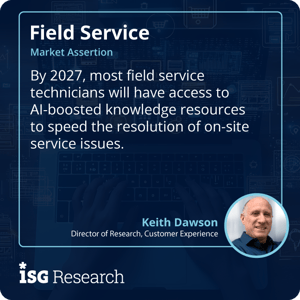
Knowledge management is one example of how enterprises are using FSM platforms to connect functions that were previously managed in isolation. When a single platform coordinates documentation across contact centers, customer portals and internal service teams, centralization becomes both practical and valuable. ISG asserts that by 2027, most field service technicians will have access to AI-boosted knowledge resources to accelerate on-site issue resolution. By 2028, two-thirds of enterprises will use AI to coordinate and optimize scheduling, dispatch and workflow management for field service teams.
Mobility remains central to field service operations. FSM platforms focus on controlling scheduling and communicating updates to all parties involved. Mobile applications provide technicians with access to technical documentation, product catalogs, customer histories and SLA information, while customers benefit from improved communication and, in some cases, media sharing or remote assistance. This mobile-first approach reduces administrative overhead, shortens service cycles and ensures that technicians can make informed decisions at the point of service.
FSM capabilities center on scheduling and dispatch optimization, mobile workforce enablement, work order lifecycle management, asset and inventory tracking, knowledge delivery, analytics and integration with the broader enterprise environment.
FSM capabilities center on scheduling and dispatch optimization, mobile workforce enablement and work order lifecycle management.
Enterprises should approach FSM adoption as a structured transformation rather than a single system deployment. Successful programs often begin with phased rollouts by region or asset class. Alignment across service, IT, operations and finance is essential to ensure shared accountability for outcomes such as SLA performance, cost control and asset uptime.
FSM success is measured through metrics that reflect both efficiency and effectiveness, including first-time fix rate, mean time to repair, truck roll reduction, SLA compliance, technician utilization and inventory performance. Together, these measures provide a fact-based view of FSM value and support continuous improvement.
Enterprises evaluating FSM providers should look beyond core scheduling and dispatch to assess integration depth, AI maturity, security and governance practices and alignment with long-term operational strategies. Any selected platform should be able to scale and deliver measurable improvements in operational efficiency and customer experience.
The 2026 ISG Buyers Guide™ for Field Service Management evaluates software providers in key areas, including mobile workforce management, scheduling and dispatch optimization, work-order and asset management and related capabilities. This research evaluates the following software providers: Comarch, CSG, Epicor, IBM, IFS, Infor, Microsoft, Odoo, Oracle, Oracle NetSuite, OverIT, PTC, Salesforce, SAP, ServiceNow, ServiceTitan, Simpro and Syncron.
Key Takeaways
Field service management is evolving into a platform-centric discipline as enterprises seek tighter coordination across scheduling, execution and customer engagement. Rising asset complexity, shifting workforce dynamics and higher expectations for uptime are increasing the operational and financial stakes of on-site service delivery. Organizations are prioritizing end-to-end visibility across the service lifecycle to balance cost control with service reliability. As a result, FSM platforms are increasingly positioned as foundational systems for operational resilience rather than point solutions for dispatch.
Software Provider Summary
The ISG Buyers Guide™ for Field Service Management evaluates 18 software providers offering products that support end-to-end coordination of field service operations. The research ranked the top three overall leaders as Salesforce, ServiceNow and IFS. Providers were classified using weighted performance in Product Experience and Customer Experience for ISG quadrant placement. IBM, IFS, Oracle, Salesforce, SAP and ServiceNow were rated as Exemplary, with Comarch, Microsoft and PTC rated as Innovative. CSG, Infor and Oracle NetSuite were rated as Assurance, and Epicor, Odoo, OverIT, ServiceTitan, Simpro and Syncron were rated as Merit.
Product Experience Insights
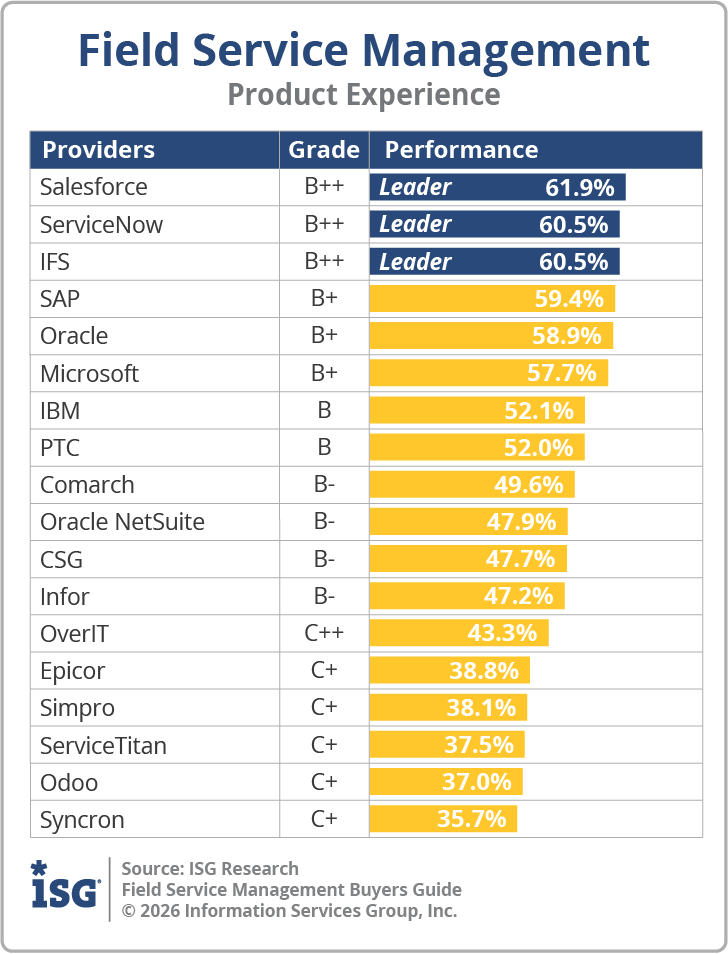
Product Experience, representing 80% of the evaluation, focuses on Capability (30%) and Platform (50%), which includes adaptability, manageability, reliability and usability. Salesforce, ServiceNow and IFS achieved the highest performance as Leaders in this category, supported by strengths in scheduling and dispatch optimization and enterprise-grade platform adaptability and manageability. Leaders demonstrated enterprise-grade platform capabilities across varied roles and contexts.
Customer Experience Value
Customer Experience, representing 20% of the evaluation, focuses on validation and TCO/ROI. ServiceNow, Salesforce and Oracle were the Leaders in this category, showing strong customer advocacy and clear investment in success outcomes. Providers with lower performance often lacked publicly available customer validation or failed to demonstrate structured ROI measurement and proactive lifecycle engagement.
Strategic Recommendations
Enterprises should approach field service management as a coordinated transformation that aligns service operations, IT and financial accountability. Buyers should prioritize platforms that integrate deeply with the broader enterprise environment while embedding AI to improve scheduling efficiency and service predictability. Strong governance, scalable mobility and measurable service outcomes should be treated as core requirements rather than incremental enhancements. This approach enables organizations to improve uptime and cost control while sustaining consistent service experiences at scale.
The Findings – Field Service Management
The software providers and products evaluated in the research provide product and customer experiences, but not everything offered is equally valuable to every enterprise or is needed to operate in business processes and use cases. Moreover, the existence of too many capabilities in products may be a negative factor for an enterprise if it introduces unnecessary complexity. Nonetheless, you may decide that a more comprehensive set of capabilities in the product is important, and where they match your enterprise’s requirements.
An effective customer relationship with a software provider is vital to the success of any investment. The overall customer experience and the full lifecycle of engagement play a key role in ensuring satisfaction and long-term success. Providers with dedicated customer leadership, such as chief customer officers, tend to invest more deeply in these relationships and prioritize customer outcomes to TCO and ROI expectations. It is equally important that this commitment to customer success is clearly demonstrated throughout the provider’s website, buying process and customer journey.
Overall Scoring of Software Providers Across Categories
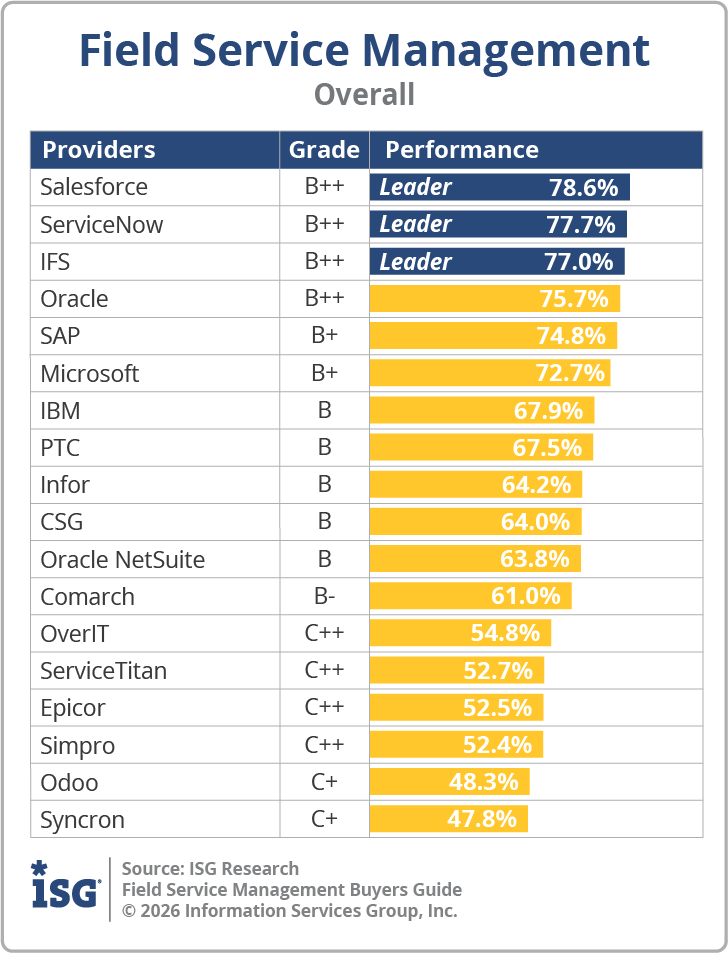 The research finds Salesforce atop the list, followed by ServiceNow and IFS. Providers that place in the top three of a category earn the designation of Leader. IFS, Salesforce and ServiceNow have done so in five categories and Oracle in one category.
The overall representation of the research below places the rating of the Product Experience and Customer Experience on the x and y axes, respectively, to provide a visual representation and classification of the software providers. Those providers whose Product Experience have above median weighted performance to the axis in aggregate of the two product categories place farther to the right, while the performance and weighting for the Customer Experience category determines placement on the vertical axis. In short, software providers that place closer to the upper-right on this chart performed better than those closer to the lower-left.
The research categorizes and rates software providers into one of four categories: Assurance, Exemplary, Merit or Innovative. This representation of software providers’ weighted performance in meeting the requirements in product and customer experience.
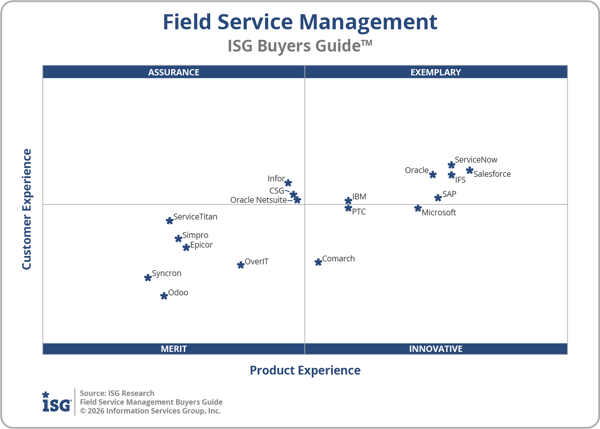
Exemplary: This rating (upper right) represents those that performed above median in Product and Customer Experience requirements. The providers rated Exemplary are: IBM, IFS, Oracle, Salesforce, SAP and ServiceNow.
Innovative: This rating (lower right) represents those that performed above median in Product Experience but not in Customer Experience. The providers rated Innovative are: Comarch, Microsoft and PTC.
Assurance: This rating (upper left) represents those that performed above median in Customer Experience but not in Product Experience. The providers rated Assurance are: CSG, Infor and Oracle NetSuite.
Merit: This rating (lower left) represents those that did not surpass the median in Customer or Product Experience. The providers rated Merit are: Epicor, Odoo, OverIT, ServiceTitan, Simpro and Syncron.
We advise enterprises to use this research as a supplement to their own evaluations, recognizing that ratings or rankings do not solely represent the value of a provider nor indicate universal suitability of a set of products.
Product Experience
 The process of researching products to address an enterprise’s needs should be comprehensive and evaluate specific capabilities and the underlying platform to the product experience. Our evaluation of the Product Experience examines the lifecycle of onboarding, configuration, operations, usage and maintenance. Too often, software providers are not evaluated for the entirety of the product; instead, they are evaluated on market execution and vision of the future.
The research results in Product Experience are ranked at 80%, or four-fifths, using the underlying weighted performance. Importance was placed on the categories as follows: Capability (30%) and Platform (50%). Salesforce, ServiceNow and IFS were designated Product Experience Leaders.
Customer Experience
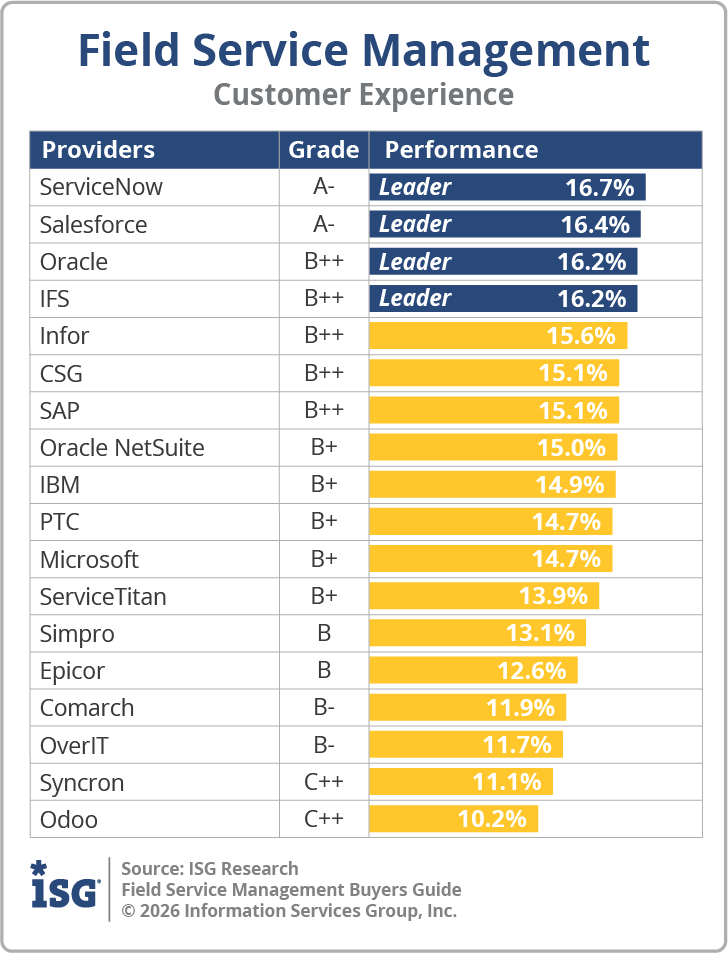 The importance of a customer relationship with a software provider is essential to the actual success of the products and technology. The evaluation of the Customer Experience and the entire lifecycle an enterprise has with its software provider is critical for ensuring satisfaction in working with that provider. The ISG Buyers Guide examines a software provider’s customer commitment, viability, customer success, sales and onboarding, product roadmap and services with partners and support. The customer experience category also investigates the TCO/ROI and how well a software provider demonstrates the product’s overall value, cost and benefits, including the tools and resources to evaluate these factors.
The research results in Customer Experience are ranked at 20%, or one-fifth of the 100% index, and represent the underlying provider validation and TCO/ROI requirements as they relate to the framework of commitment and value to the software provider-customer relationship.
The software providers that evaluated the highest in the Customer Experience category are ServiceNow, Salesforce, Oracle and IFS. These category leaders best communicate commitment and dedication to customer needs.
Software providers that did not perform well in this category were unable to provide or make sufficient information readily available to demonstrate success or articulate their commitment to customer experience. The use of a software provider requires continuous investment, so a holistic evaluation must include examination of how they support their customer experience.
Software Provider Inclusion – Field Service Management
For inclusion in the 2026 ISG Buyers Guide™ for Field Service Management, a software provider must be in good standing financially and ethically, have at least $50 million in annual or projected revenue verified using independent sources, sell products and provide support on at least two continents and have at least 25 customers. The principal source of the relevant business unit’s revenue must be software-related, and there must have been at least one major software release in the past 12 months.
Products evaluated must include support for mobile applications used by technicians in the field, mobile workforce management, scheduling and dispatch optimization, and work order and asset management. Products should support customer engagement and experience functions, automation and AI, data and analytics, knowledge management tools and proactive service delivery.
The research is designed to be independent of the specifics of software provider packaging and pricing. To represent the real-world environment in which businesses operate, we include providers that offer suites or packages of products that may include relevant individual modules or applications. If a software provider is actively marketing, selling and developing a product for the general market and it is reflected on the provider’s website that the product is within the scope of the research, that provider is automatically evaluated for inclusion.
All software providers that offer relevant products and meet the inclusion requirements were invited to participate in the evaluation process at no cost to them.
Software providers that meet our inclusion criteria but did not completely participate in our Buyers Guide were assessed solely on publicly available information. As this could have a significant impact on classification and ratings, we recommend additional scrutiny when evaluating those providers.
Products Evaluated
| Provider | Product Names | Version | Release Month/Year |
|---|---|---|---|
| Comarch | Comarch FSM | N/A | Oct-25 |
| CSG | CSG Field Service Management | N/A | Oct-25 |
| Epicor | Epicor Field Service Management | N/A | Oct-25 |
| IBM | IBM Maximo Field Service Management | IBM Maximo Application Suite 9.2 | Sep-25 |
| IFS | IFS Cloud—Field Service Management | IFS Cloud 25R2 | Oct-25 |
| Infor | Infor Cloudsuite Field Service | N/A | Oct-25 |
| Microsoft | Dynamics 365 Field Service | 8.8.139.398 | Oct-25 |
| Odoo | Odoo Field Service | Odoo 19 | Sep-25 |
| Oracle | Oracle Fusion Field Service | 25C | Oct-25 |
| Oracle NetSuite | NetSuite Field Service Management | FSM SuiteApp 2025.10.1 (EA) | Oct-25 |
| OverIT | Nextgen FSM | NextGen Platform 2025 Wave Three | Sep-25 |
| PTC | ServiceMax | ServiceMax Core 25.1 (25R1) | Jun-25 |
| Salesforce | Salesforce Field Service | Winter ’26 | Oct-25 |
| SAP | Field Service Management | SAP FSM 2508 | Aug-25 |
| ServiceNow | Field Service Management | Zurich | Oct-25 |
| ServiceTitan | ServiceTitan | Fall 2025 (ST‑75) | Sep-25 |
| Simpro | Simpro Premium | Simpro Premium 25.4.2 | Oct-25 |
| Syncron | Syncron SLM Platform | N/A | Oct-25 |
Field Service Customer Engagement
Field service customer engagement systems are customer-centric tools that enhance the on-site service experience. These platforms prioritize proactive communication, real-time updates and remote engagement and integrate tightly with core field service management (FSM) software, while remaining distinct from workforce and asset management tools.
Service interactions are often the most visible and emotionally charged touchpoints between an enterprise and its customers. Missed appointments, late arrivals and limited communication can have a disproportionate impact on trust, renewal decisions and brand perception, particularly in asset-intensive and contract-driven environments. Because these interactions occur under time pressure and operational stress, the quality of communication often outweighs the technical outcome in shaping customer perception and long-term loyalty.
Service interactions are the most visible touchpoints between an enterprise and its customers.
ISG Research defines field service customer engagement as tools that facilitate communication between businesses and customers across the field service lifecycle, from service request through on-site execution and follow-up, with a focus on transparency and timely information. Customer engagement within FSM is shifting toward proactive, digitally mediated interaction. AI-assisted communication personalizes updates, explains delays or next steps and adjusts engagement based on customer context and priority. In practice, this allows service organizations to set expectations earlier, reduce uncertainty during service events and intervene before communication gaps translate into dissatisfaction or escalations.
Enterprises need engagement-oriented FSM software that makes service predictable and easy to navigate from the customer’s perspective, combining accurate arrival windows, real-time technician ETAs, access to SLA status and service history, two-way messaging, automated notifications and structured post-visit feedback within core FSM workflows. Together, these capabilities reduce inbound status inquiries, improve first-time resolution and help service organizations manage customer expectations more consistently at scale. When evaluating providers, enterprises should prioritize deep integration with FSM workflows, a high-quality customer-facing experience, support for remote engagement scenarios and the ability to scale consistently across regions and service lines.
The 2026 ISG Buyers Guide™ for Field Service Customer Engagement evaluates software providers in key areas, including customer portals, automated notifications, two-way messaging, remote engagement and feedback workflows. This research evaluates the following providers: Comarch, CSG, Epicor, IBM, IFS, Infor, Microsoft, Odoo, Oracle, Oracle NetSuite, OverIT, PTC, Salesforce, SAP, ServiceNow, ServiceTitan, Simpro and Syncron.
Key Takeaways
Field service customer engagement is becoming a distinct but tightly integrated layer within broader field service platforms as enterprises focus on improving service transparency and predictability. Communication quality during on-site service events increasingly shapes customer trust, renewal decisions and brand perception, particularly in contract-driven environments. Organizations are prioritizing proactive, digitally mediated engagement to reduce uncertainty and manage expectations across the service lifecycle. As a result, customer engagement capabilities are emerging as a critical enabler of consistent service outcomes rather than a secondary interface layer.
Software Provider Summary
The ISG Buyers Guide™ for Field Service Customer Engagement evaluates 18 software providers offering products that support customer-facing communication and interaction across the field service lifecycle. The research ranked the top three overall leaders as Salesforce, ServiceNow and IFS. Providers were classified using weighted performance in Product Experience and Customer Experience for ISG quadrant placement. CSG, IFS, Oracle, Salesforce, SAP and ServiceNow were rated as Exemplary, with Comarch, Microsoft and PTC rated as Innovative. IBM, Infor and Oracle NetSuite were rated as Assurance, and Epicor, Odoo, OverIT, ServiceTitan, Simpro and Syncron were rated as Merit.
Product Experience Insights
Product Experience, representing 80% of the evaluation, focuses on Capability (50%) and Platform (30%), which includes adaptability, manageability, reliability and usability. Salesforce, IFS and SAP achieved the highest performance as Leaders in this category, supported by strengths in customer-facing communication workflows and broad enterprise-grade capability coverage. Leaders demonstrated enterprise-grade platform capabilities across varied roles and contexts.
Customer Experience Value
Customer Experience, representing 20% of the evaluation, focuses on validation and TCO/ROI. ServiceNow, Salesforce, Oracle and IFS were the Leaders in this category, showing strong customer advocacy and clear investment in success outcomes. Providers with lower performance often lacked publicly available customer validation or failed to demonstrate structured ROI measurement and proactive lifecycle engagement.
Strategic Recommendations
Enterprises should treat field service customer engagement as a core component of service delivery rather than an add-on to operational systems. Buyers should prioritize platforms that integrate directly into FSM workflows while supporting proactive, real-time communication at scale. Consistent governance, intuitive customer experiences and measurable service impact should be evaluated together to avoid fragmented engagement models. This approach enables service organizations to improve trust and predictability without increasing operational complexity.
The Findings – Field Service Customer Engagement
The software providers and products evaluated in the research provide product and customer experiences, but not everything offered is equally valuable to every enterprise or is needed to operate in business processes and use cases. Moreover, the existence of too many capabilities in products may be a negative factor for an enterprise if it introduces unnecessary complexity. Nonetheless, you may decide that a more comprehensive set of capabilities in the product is important, and where they match your enterprise’s requirements.
An effective customer relationship with a software provider is vital to the success of any investment. The overall customer experience and the full lifecycle of engagement play a key role in ensuring satisfaction and long-term success. Providers with dedicated customer leadership, such as chief customer officers, tend to invest more deeply in these relationships and prioritize customer outcomes to TCO and ROI expectations. It is equally important that this commitment to customer success is clearly demonstrated throughout the provider’s website, buying process and customer journey.
Overall Scoring of Software Providers Across Categories
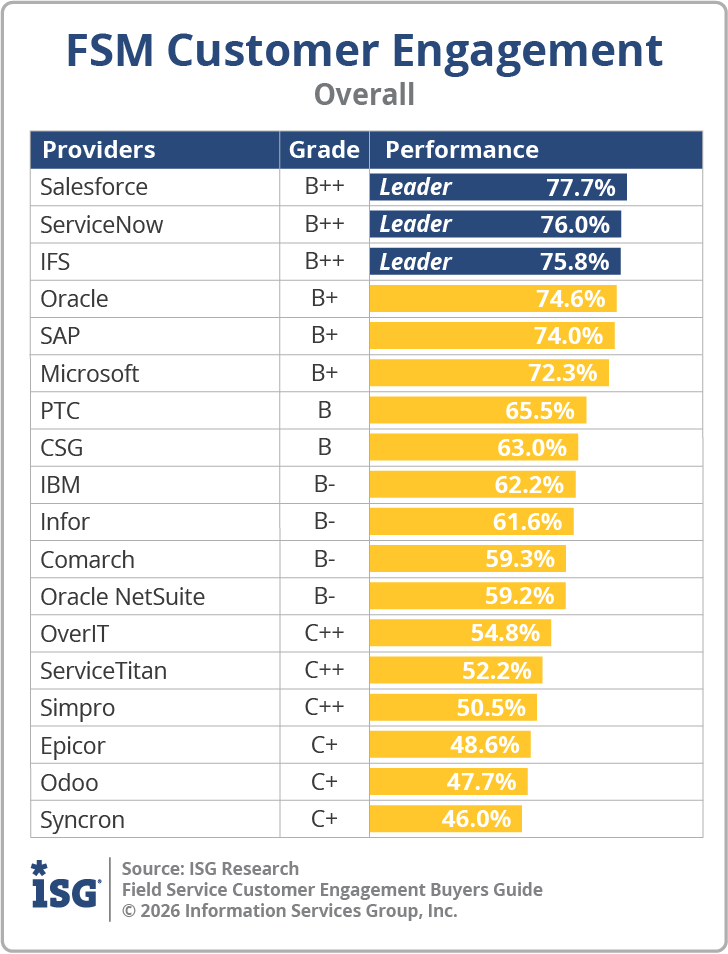 The research finds Salesforce atop the list, followed by ServiceNow and IFS. Providers that place in the top three of a category earn the designation of Leader. IFS and Salesforce have done so in five categories, ServiceNow in three, SAP in two and Oracle in one category.
The overall representation of the research below places the rating of the Product Experience and Customer Experience on the x and y axes, respectively, to provide a visual representation and classification of the software providers. Those providers whose Product Experience have above median weighted performance to the axis in aggregate of the two product categories place farther to the right, while the performance and weighting for the Customer Experience category determines placement on the vertical axis. In short, software providers that place closer to the upper-right on this chart performed better than those closer to the lower-left.
The research categorizes and rates software providers into one of four categories: Assurance, Exemplary, Merit or Innovative. This representation of software providers’ weighted performance in meeting the requirements in product and customer experience.
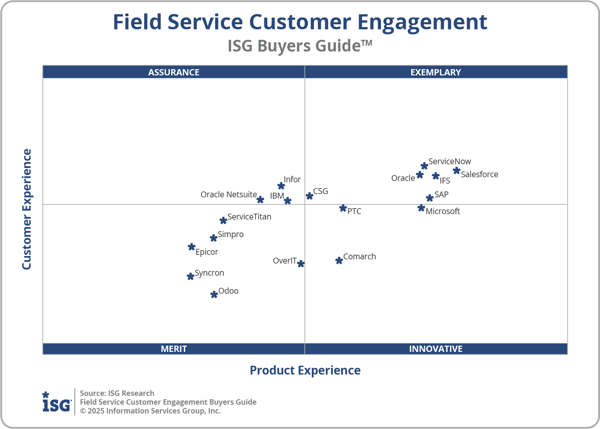
Exemplary: This rating (upper right) represents those that performed above median in Product and Customer Experience requirements. The providers rated Exemplary are CSG, IFS, Oracle, Salesforce, SAP and ServiceNow.
Innovative: This rating (lower right) represents those that performed above median in Product Experience but not in Customer Experience. The providers rated Innovative are: Comarch, Microsoft and PTC.
Assurance: This rating (upper left) represents those that performed above median in Customer Experience but not in Product Experience. The providers rated Assurance are: IBM, Infor and Oracle NetSuite.
Merit: This rating (lower left) represents those that did not surpass the median in Customer or Product Experience. The providers rated Merit are: Epicor, Odoo, OverIT, ServiceTitan, Simpro and Syncron.
We advise enterprises to use this research as a supplement to their own evaluations, recognizing that ratings or rankings do not solely represent the value of a provider nor indicate universal suitability of a set of products.
Product Experience
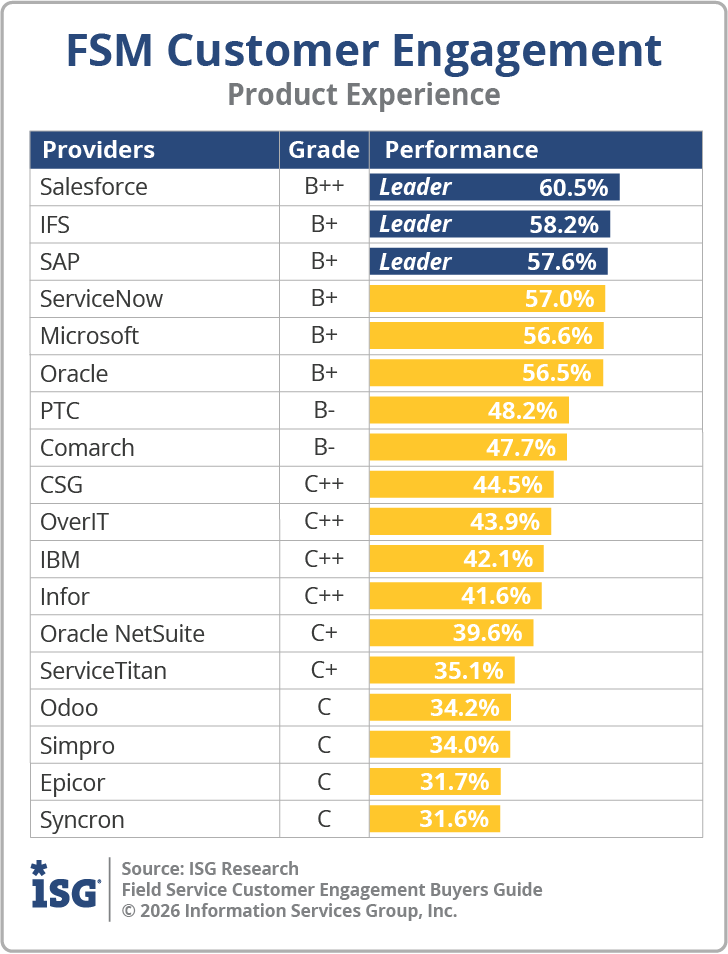 The process of researching products to address an enterprise’s needs should be comprehensive and evaluate specific capabilities and the underlying platform to the product experience. Our evaluation of the Product Experience examines the lifecycle of onboarding, configuration, operations, usage and maintenance. Too often, software providers are not evaluated for the entirety of the product; instead, they are evaluated on market execution and vision of the future.
The research results in Product Experience are ranked at 80%, or four-fifths, using the underlying weighted performance. Importance was placed on the categories as follows: Capability (50%) and Platform (30%). Salesforce, IFS and SAP were designated Product Experience Leaders.
Customer Experience
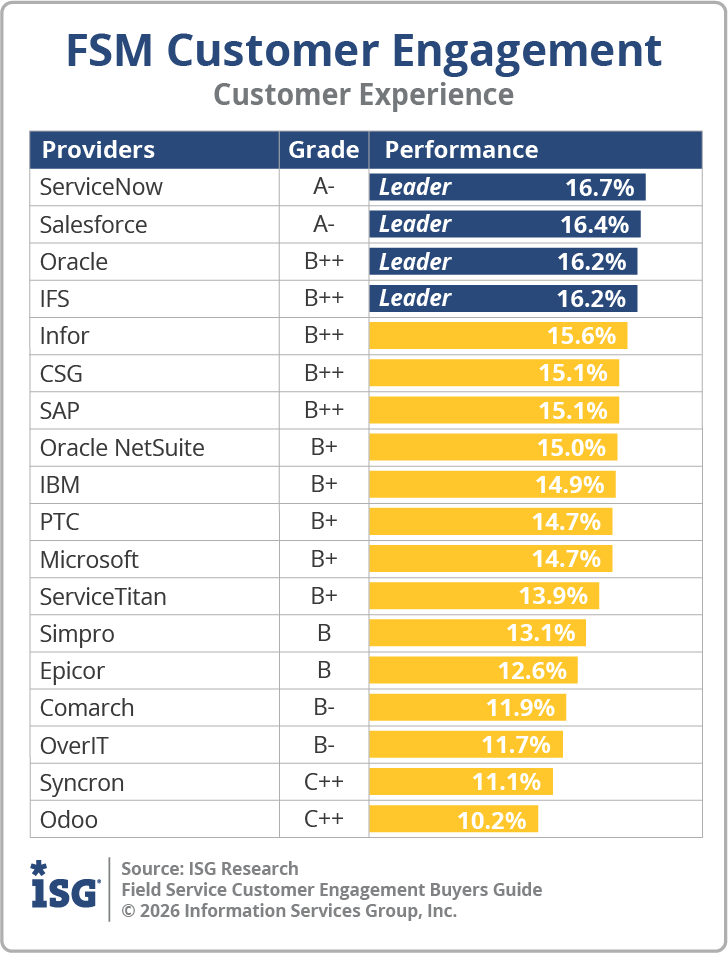 The importance of a customer relationship with a software provider is essential to the actual success of the products and technology. The evaluation of the Customer Experience and the entire lifecycle an enterprise has with its software provider is critical for ensuring satisfaction in working with that provider. The ISG Buyers Guide examines a software provider’s customer commitment, viability, customer success, sales and onboarding, product roadmap and services with partners and support. The customer experience category also investigates the TCO/ROI and how well a software provider demonstrates the product’s overall value, cost and benefits, including the tools and resources to evaluate these factors.
The research results in Customer Experience are ranked at 20%, or one-fifth of the 100% index, and represent the underlying provider validation and TCO/ROI requirements as they relate to the framework of commitment and value to the software provider-customer relationship.
The software providers that evaluated the highest in the Customer Experience category are ServiceNow, Salesforce, Oracle and IFS. These category leaders best communicate commitment and dedication to customer needs.
Software providers that did not perform well in this category were unable to provide or make sufficient information readily available to demonstrate success or articulate their commitment to customer experience. The use of a software provider requires continuous investment, so a holistic evaluation must include examination of how they support their customer experience.
Software Provider Inclusion − Field Service Customer Engagement
For inclusion in the 2026 ISG Buyers Guide™ for Field Service Customer Engagement, a software provider must be in good standing financially and ethically, have at least $50 million in annual or projected revenue verified using independent sources, sell products and provide support on at least two continents and have at least 25 customers. The principal source of the relevant business unit’s revenue must be software-related, and there must have been at least one major software release in the past 12 months.
Evaluated products must include support for proactive communication, real-time updates and remote troubleshooting. Tools for customer engagement must be fully integrated with core FSM processes such as scheduling, dispatching and asset management. Tools evaluated must focus on physical, on-site interactions that are unique to field service environments. Features evaluated include self-service (including appointment management and portals), real-time notifications and communications, post-service feedback management, and control of customer data and SLAs.
The research is designed to be independent of the specifics of software provider packaging and pricing. To represent the real-world environment in which businesses operate, we include providers that offer suites or packages of products that may include relevant individual modules or applications. If a software provider is actively marketing, selling and developing a product for the general market and it is reflected on the provider’s website that the product is within the scope of the research, that provider is automatically evaluated for inclusion.
All software providers that offer relevant products and meet the inclusion requirements were invited to participate in the evaluation process at no cost to them.
Software providers that meet our inclusion criteria but did not completely participate in our Buyers Guide were assessed solely on publicly available information. As this could have a significant impact on classification and ratings, we recommend additional scrutiny when evaluating those providers.
Products Evaluated
| Provider | Product Names | Version | Release Month/Year |
|---|---|---|---|
| Comarch | Comarch FSM | N/A | October 2025 |
| CSG | CSG Field Service Management | N/A | October 2025 |
| Epicor | Epicor Field Service Management | N/A | October 2025 |
| IBM | IBM Maximo Field Service Management | IBM Maximo Application Suite 9.2 | September 2025 |
| IFS | IFS Cloud—Field Service Management | IFS Cloud 25R2 | October 2025 |
| Infor | Infor Cloudsuite Field Service | N/A | October 2025 |
| Microsoft | Dynamics 365 Field Service | 8.8.139.398 | October 2025 |
| Odoo | Odoo Field Service | Odoo 19 | September 2025 |
| Oracle | Oracle Fusion Field Service | 25C | October 2025 |
| Oracle NetSuite | NetSuite Field Service Management | FSM SuiteApp 2025.10.1 (EA) | October 2025 |
| OverIT | Nextgen FSM | NextGen Platform 2025 Wave Three | September 2025 |
| PTC | ServiceMax | ServiceMax Core 25.1 (25R1) | June 2025 |
| Salesforce | Salesforce Field Service | Winter ’26 | October 2025 |
| SAP | Field Service Management | SAP FSM 2508 | August 2025 |
| ServiceNow | Field Service Management | Zurich | October 2025 |
| ServiceTitan | ServiceTitan | Fall 2025 (ST‑75) | September 2025 |
| Simpro | Simpro Premium | Simpro Premium 25.4.2 | October 2025 |
| Syncron | Syncron SLM Platform | N/A | October 2025 |
Field Service Proactive Maintenance
Field service proactive maintenance addresses two longstanding challenges in traditional service delivery: high cost and reactive execution. Rolling trucks to customer sites is expensive, and break/fix models require organizations to wait for failures before taking action, increasing downtime, cost and customer impact.
ISG Research defines field service proactive maintenance as strategies and technologies designed to anticipate and address equipment and service needs before they result in failures or emergencies. By leveraging IoT connectivity and AI-driven predictive analytics, enterprises can monitor assets in real time and generate condition-based alerts to minimize reactive repairs. Predictive maintenance focuses on identifying elevated failure risk by analyzing condition data, usage patterns and historical trends. Proactive maintenance builds on those insights by triggering actions within FSM workflows before issues affect operations or customers.
Predictive and proactive maintenance has become strategically urgent.
Predictive and proactive maintenance has become strategically urgent as unplanned downtime grows more costly and service organizations face tighter operating margins. Assets are increasingly complex, while customers expect near-continuous uptime and rapid resolution. Missed SLAs now carry direct financial penalties. As enterprises shift away from break/fix models, field service platforms must support early detection, prioritized intervention and coordinated response to control cost while meeting contractual expectations.
Enterprises need proactive maintenance capabilities that translate asset insight into controlled, executable action. This includes asset health scoring and risk-based prioritization, contextual alerting that avoids noise and tight integration with scheduling and dispatch to align preventive work with technician skills and availability. Effective platforms provide robust sensor ingestion, asset modeling, advanced prediction and anomaly detection, analytics and automated workflow orchestration, integrated with FSM and core enterprise systems.
When evaluating providers, enterprises should assess the maturity of IoT and AI analytics, scalability across asset types, integration depth and the ability to convert predictive insight into governed maintenance execution. Predictive and proactive maintenance are not standalone products but foundational capabilities within broader FSM platforms.
The 2026 ISG Buyers Guide™ for Field Service Proactive Maintenance evaluates software providers in key areas, including IoT and sensor data ingestion, AI-driven prediction, asset monitoring and automated notification. This research evaluates the following providers: Comarch, CSG, Epicor, IBM, IFS, Infor, Microsoft, Odoo, Oracle, Oracle NetSuite, OverIT, PTC, Salesforce, SAP, ServiceNow, ServiceTitan, Simpro and Syncron.
Key Takeaways
Field service proactive maintenance is shifting service organizations away from reactive, break/fix models toward earlier, data-driven intervention. Rising downtime costs, tighter margins and stronger SLA enforcement are increasing the need to anticipate failures rather than respond to them. Enterprises are prioritizing asset visibility and risk-based decision-making to control service costs while protecting uptime. As a result, proactive maintenance capabilities are becoming embedded requirements within broader field service platforms.
Software Provider Summary
The ISG Buyers Guide™ for Field Service Proactive Maintenance evaluates 18 software providers offering products that support predictive insight and governed maintenance execution within field service environments. The research ranked the top three overall leaders as Salesforce, ServiceNow and IFS. Providers were classified using weighted performance in Product Experience and Customer Experience for ISG quadrant placement. IBM, IFS, Oracle, Salesforce, SAP and ServiceNow were rated as Exemplary, with Comarch, Microsoft and PTC rated as Innovative. CSG, Infor and Oracle NetSuite were rated as Assurance, and Epicor, Odoo, OverIT, ServiceTitan, Simpro and Syncron were rated as Merit.
Product Experience Insights
Product Experience, representing 80% of the evaluation, focuses on Capability (30%) and Platform (50%), which includes adaptability, manageability, reliability and usability. Salesforce, ServiceNow and IFS achieved the highest performance as Leaders in this category, supported by strengths in AI-driven predictive maintenance analytics and tight integration of asset insights into scheduling and dispatch workflows. Leaders demonstrated enterprise-grade platform capabilities across varied roles and contexts.
Customer Experience Value
Customer Experience, representing 20% of the evaluation, focuses on validation and TCO/ROI. ServiceNow, Salesforce, Oracle and IFS were the Leaders in this category, showing strong customer advocacy and clear investment in success outcomes. Providers with lower performance often lacked publicly available customer validation or failed to demonstrate structured ROI measurement and proactive lifecycle engagement.
Strategic Recommendations
Enterprises should evaluate proactive maintenance as a foundational capability within field service platforms rather than a standalone initiative. Buyers should prioritize providers that combine IoT connectivity, advanced analytics and workflow automation to translate prediction into controlled action. Strong integration, scalable governance and measurable service impact are essential to realizing value. This approach enables organizations to reduce downtime while maintaining cost discipline and contractual performance.
The Findings – Field Service Proactive Maintenance
The software providers and products evaluated in the research provide product and customer experiences, but not everything offered is equally valuable to every enterprise or is needed to operate in business processes and use cases. Moreover, the existence of too many capabilities in products may be a negative factor for an enterprise if it introduces unnecessary complexity. Nonetheless, you may decide that a more comprehensive set of capabilities in the product is important, and where they match your enterprise’s requirements.
An effective customer relationship with a software provider is vital to the success of any investment. The overall customer experience and the full lifecycle of engagement play a key role in ensuring satisfaction and long-term success. Providers with dedicated customer leadership, such as chief customer officers, tend to invest more deeply in these relationships and prioritize customer outcomes to TCO and ROI expectations. It is equally important that this commitment to customer success is clearly demonstrated throughout the provider’s website, buying process and customer journey.
Overall Scoring of Software Providers Across Categories
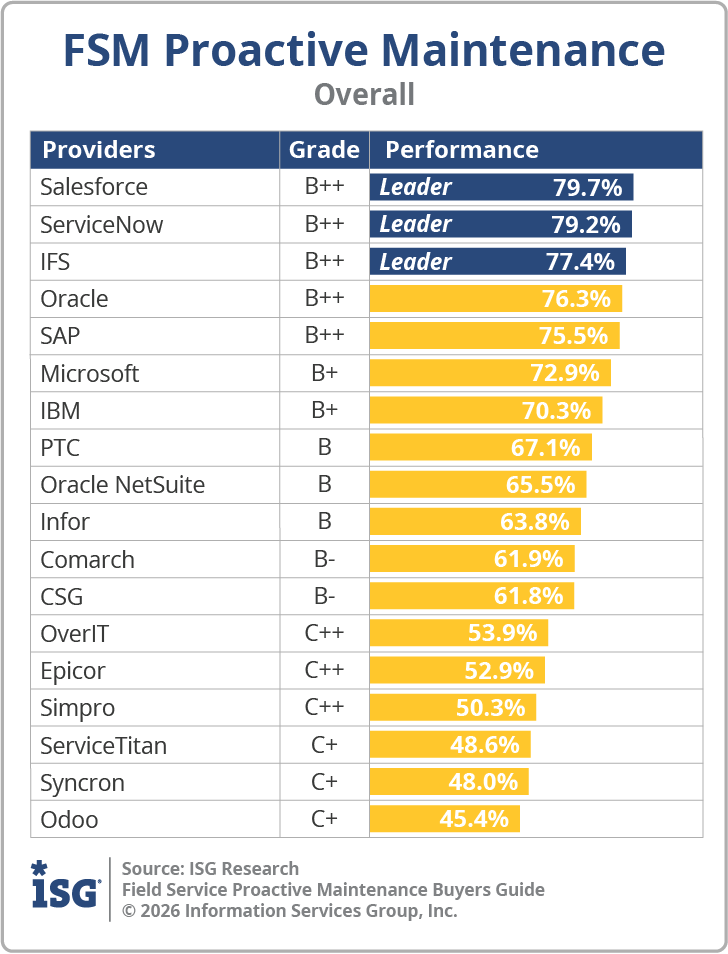 The research finds Salesforce atop the list, followed by ServiceNow and IFS. Providers that place in the top three of a category earn the designation of Leader. IFS, Salesforce and ServiceNow have done so in five categories and Oracle in one category.
The overall representation of the research below places the rating of the Product Experience and Customer Experience on the x and y axes, respectively, to provide a visual representation and classification of the software providers. Those providers whose Product Experience have above median weighted performance to the axis in aggregate of the two product categories place farther to the right, while the performance and weighting for the Customer Experience category determines placement on the vertical axis. In short, software providers that place closer to the upper-right on this chart performed better than those closer to the lower-left.
The research categorizes and rates software providers into one of four categories: Assurance, Exemplary, Merit or Innovative. This representation of software providers’ weighted performance in meeting the requirements in product and customer experience.
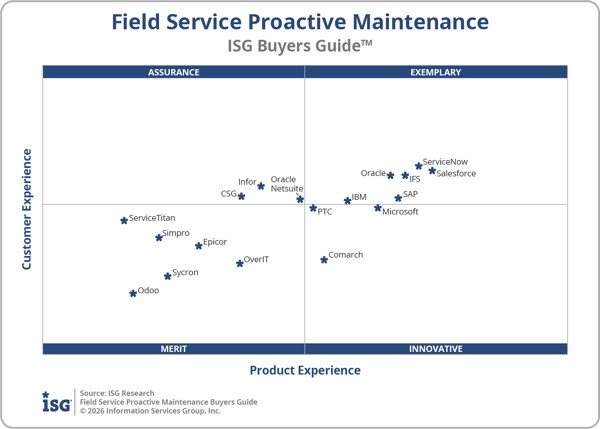
Exemplary: This rating (upper right) represents those that performed above median in Product and Customer Experience requirements. The providers rated Exemplary are: IBM, IFS, Oracle, Salesforce, SAP and ServiceNow.
Innovative: This rating (lower right) represents those that performed above median in Product Experience but not in Customer Experience. The providers rated Innovative are: Comarch, Microsoft and PTC.
Assurance: This rating (upper left) represents those that performed above median in Customer Experience but not in Product Experience. The providers rated Assurance are: CSG, Infor and Oracle NetSuite.
Merit: This rating (lower left) represents those that did not surpass the median in Customer or Product Experience. The providers rated Merit are: Epicor, Odoo, OverIT, ServiceTitan, Simpro and Syncron.
We advise enterprises to use this research as a supplement to their own evaluations, recognizing that ratings or rankings do not solely represent the value of a provider nor indicate universal suitability of a set of products.
Product Experience
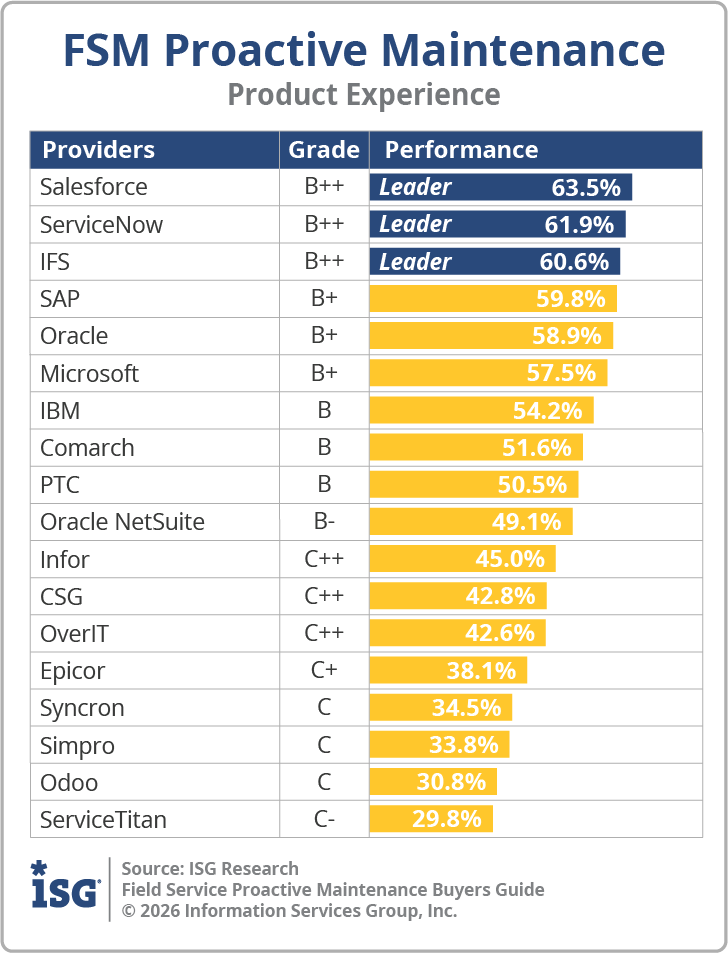 The process of researching products to address an enterprise’s needs should be comprehensive and evaluate specific capabilities and the underlying platform to the product experience. Our evaluation of the Product Experience examines the lifecycle of onboarding, configuration, operations, usage and maintenance. Too often, software providers are not evaluated for the entirety of the product; instead, they are evaluated on market execution and vision of the future.
The research results in Product Experience are ranked at 80%, or four-fifths, using the underlying weighted performance. Importance was placed on the categories as follows: Capability (30%) and Platform (50%). Salesforce, ServiceNow and IFS were designated Product Experience Leaders.
Customer Experience
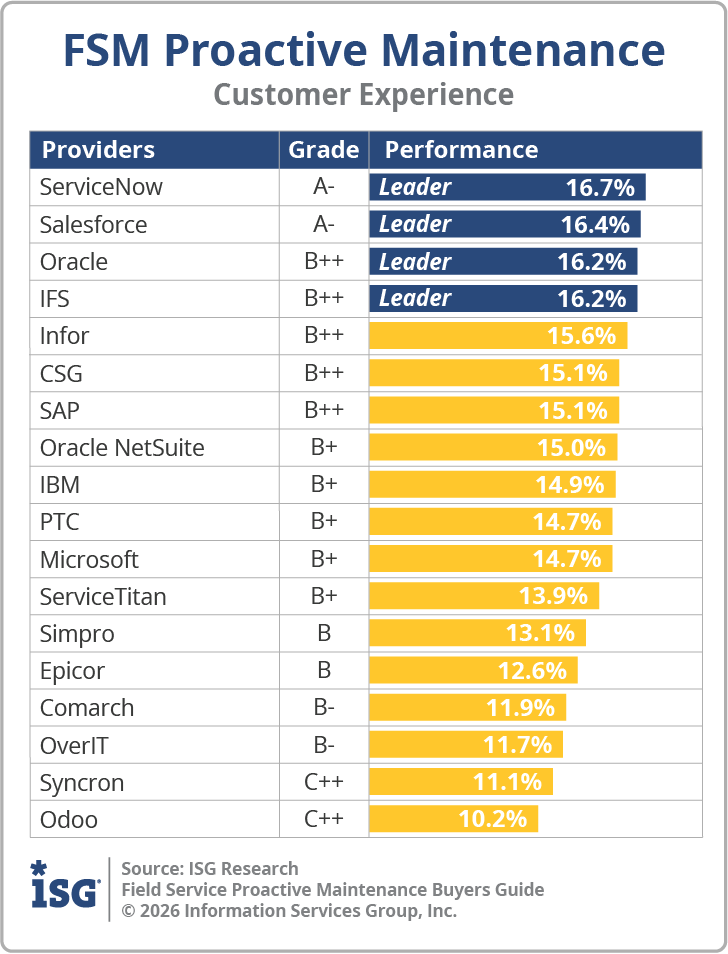 The importance of a customer relationship with a software provider is essential to the actual success of the products and technology. The evaluation of the Customer Experience and the entire lifecycle an enterprise has with its software provider is critical for ensuring satisfaction in working with that provider. The ISG Buyers Guide examines a software provider’s customer commitment, viability, customer success, sales and onboarding, product roadmap and services with partners and support. The customer experience category also investigates the TCO/ROI and how well a software provider demonstrates the product’s overall value, cost and benefits, including the tools and resources to evaluate these factors.
The research results in Customer Experience are ranked at 20%, or one-fifth of the 100% index, and represent the underlying provider validation and TCO/ROI requirements as they relate to the framework of commitment and value to the software provider-customer relationship.
The software providers that evaluated the highest in the Customer Experience category are ServiceNow, Salesforce, Oracle and IFS. These category leaders best communicate commitment and dedication to customer needs.
Software providers that did not perform well in this category were unable to provide or make sufficient information readily available to demonstrate success or articulate their commitment to customer experience. The use of a software provider requires continuous investment, so a holistic evaluation must include examination of how they support their customer experience.
Software Provider Inclusion – Field Service Proactive Maintenance
For inclusion in the 2026 ISG Buyers Guide™ for Field Service Proactive Maintenance, a software provider must be in good standing financially and ethically, have at least $50 million in annual or projected revenue verified using independent sources, sell products and provide support on at least two continents and have at least 25 customers. The principal source of the relevant business unit’s revenue must be software-related, and there must have been at least one major software release in the past 12 months.
Considered providers must include applications built into FSM platforms that focus on leveraging IoT-enabled asset monitoring and AI-driven predictive analytics to prevent equipment failures and optimize maintenance schedules. Systems must be able to monitor assets in real-time, trigger automated alerts based on asset conditions and manage the entire workflow from scheduling to completion of service. Features evaluated include IoT integration, asset monitoring, AI-driven predictive maintenance and triggers generating automated service actions.
The research is designed to be independent of the specifics of software provider packaging and pricing. To represent the real-world environment in which businesses operate, we include providers that offer suites or packages of products that may include relevant individual modules or applications. If a software provider is actively marketing, selling and developing a product for the general market and it is reflected on the provider’s website that the product is within the scope of the research, that provider is automatically evaluated for inclusion.
All software providers that offer relevant products and meet the inclusion requirements were invited to participate in the evaluation process at no cost to them.
Software providers that meet our inclusion criteria but did not completely participate in our Buyers Guide were assessed solely on publicly available information. As this could have a significant impact on classification and ratings, we recommend additional scrutiny when evaluating those providers.
Products Evaluated
| Provider | Product Names | Version | Release Month/Year |
|---|---|---|---|
| Comarch | Comarch FSM | N/A | October-25 |
| CSG | CSG Field Service Management | N/A | October-25 |
| Epicor | Epicor Field Service Management | N/A | October-25 |
| IBM | IBM Maximo Field Service Management | IBM Maximo Application Suite 9.2 | September-25 |
| IFS | IFS Cloud—Field Service Management | IFS Cloud 25R2 | October-25 |
| Infor | Infor Cloudsuite Field Service | N/A | October-25 |
| Microsoft | Dynamics 365 Field Service | 8.8.139.398 | October-25 |
| Odoo | Odoo Field Service | Odoo 19 | September-25 |
| Oracle | Oracle Fusion Field Service | 25C | October-25 |
| Oracle NetSuite | NetSuite Field Service Management | FSM SuiteApp 2025.10.1 (EA) | October-25 |
| OverIT | Nextgen FSM | NextGen Platform 2025 Wave Three | September-25 |
| PTC | ServiceMax | ServiceMax Core 25.1 (25R1) | June-25 |
| Salesforce | Salesforce Field Service | Winter ’26 | October-25 |
| SAP | Field Service Management | SAP FSM 2508 | August-25 |
| ServiceNow | Field Service Management | Zurich | October-25 |
| ServiceTitan | ServiceTitan | Fall 2025 (ST‑75) | September-25 |
| Simpro | Simpro Premium | Simpro Premium 25.4.2 | October-25 |
| Syncron | Syncron SLM Platform | N/A | October-25 |
Executive Summary
Buyers Guide Overview
ISG Research has conducted market research for over two decades across vertical industries, business applications, AI and IT. We have designed the ISG Buyers Guide™ to provide a balanced perspective of software providers and products that is rooted in an understanding of business and IT requirements. Utilization of our research methodology and decades of experience enables our Buyers Guide to be an effective method to assess and select software providers and products. The findings of this research provide a comprehensive approach to rating software providers and rank their ability to meet specific product and customer experience requirements.
ISG Research has designed the Buyers Guide to provide a balanced perspective of software providers and products that is rooted in an understanding of business and IT requirements.
The 2026 ISG Buyers Guides™ for Field Service Management, covering Field Service Management, Field Service Customer Engagement and Field Service Proactive Maintenance, are the distillation of continuous market and product research. It is an assessment of how well software providers’ offerings address enterprises’ requirements for field service management software. The Value Index methodology is structured to support a request for information (RFI) for a request for proposal (RFP) process by incorporating all criteria needed to evaluate, select, utilize and maintain relationships with software providers. The ISG Buyers Guide evaluates customer experience and the product experience in its capability and platform.
The structure of the research reflects our understanding that the effective evaluation of software providers and products involves far more than just examining product features, potential revenue or customers generated from a provider’s marketing and sales efforts. It can ensure the best long-term relationship and value achieved from a resource and financial investment We believe it is important to take a comprehensive, research-based approach, since making the wrong choice of field service management software can raise the total cost of ownership, lower the return on investment and hamper an enterprise’s ability to reach its potential. In addition, this approach can reduce the project’s development and deployment time and eliminate the risk of relying on opinions or historical biases.
ISG Research believes that an objective review of existing and potential new software providers and products is a critical strategy for the adoption and implementation of field service management software. An enterprise’s review should include an analysis of both what is possible and what is relevant. We urge enterprises to do a thorough job of evaluating field service management software and offer these Buyers Guides as both the results of our in-depth analysis of these providers and as an evaluation methodology.
How To Use This Buyers Guide
Evaluating Software Providers: The Process
We recommend using the Buyers Guide to assess and evaluate new or existing software providers for your enterprise. The market research can be used as an evaluation framework to assess existing approaches and software providers or establish a formal request for information from providers on products and customer experience and will shorten the cycle time when creating an RFI. The steps listed below provide a process that can facilitate best possible outcomes in the most efficient manner.
- Define the business case and goals.
Define the mission and business case for investment and the expected outcomes from your organizational and technological efforts. - Specify the business and IT needs.
Defining the business and IT requirements helps identify what specific capabilities are required with respect to people, processes, information and technology. - Assess the required roles and responsibilities.
Identify the individuals required for success at every level of the enterprise from executives to frontline workers and determine the needs of each. - Outline the project’s critical path.
What needs to be done, in what order and who will do it? This outline should make clear the prior dependencies at each step of the project plan. - Ascertain the technology approach.
Determine the business and technology approach that most closely aligns to your enterprise’s requirements. - Establish software provider evaluation criteria.
Utilize the product experience: capability and platform with support for adaptability, manageability, reliability and usability, and the customer experience in TCO/ROI and Validation. - Evaluate and select the software provider and products properly.
Apply a weighting the evaluation categories in the evaluation criteria to reflect your enterprise’s priorities to determine the short list of software providers and products. - Establish the business initiative team to start the project.
Identify who will lead the project and the members of the team needed to plan and execute it with timelines, priorities and resources.
Using the ISG Buyers Guide and process provides enterprises a clear, structured approach to making smarter software and business investment decisions. It ensures alignment between strategy, people, processes and technology while reducing risk, saving time, and improving outcomes. The ISG approach promotes data-driven decision-making and collaboration, helping choose the right software providers for maximum value and return on investment.
Field Service Management
Field service delivery is one of the most complex and highly orchestrated functions of an enterprise’s customer-facing activities. It can also be one of the most expensive and difficult to automate. Sending a worker or technician to a customer’s site represents an investment of time, materials and labor that goes well beyond what it costs to respond to a customer by phone. When the customer is a business, and the object being serviced is a highly advanced piece of machinery or critical infrastructure, the stakes for that interaction go far beyond customer satisfaction or NPS scores.
The market for field service software has been fragmented by function—tools for fleet management over here, technician communications over there—and is now consolidating into broad-based platforms that integrate multiple activities. The broader the platform, the easier it is to track and organize field service processes for maximum efficiency.
Change in this market is accelerating, due in part to advances in AI but also because the field service environment itself has grown more complex. Workforce dynamics are shifting, assets are becoming more sophisticated and customer expectations for speed, uptime and transparency continue to rise. In response, enterprises are increasingly focused on gaining end-to-end visibility across the service lifecycle, from work-order creation and technician scheduling through service execution and incident closeout. Greater emphasis is placed on workforce optimization, including skills-based scheduling and the ability to adapt in real time to disruptions.
Workforce dynamics are shifting, assets are becoming more sophisticated and customer expectations for speed, uptime and transparency continue to rise.
ISG Research defines field service management (FSM) as the practice of delivering technical customer support at the customer’s site, as opposed to relying solely on remote communication channels such as phone or chat. To implement that practice, FSM software is defined as a digital platform that coordinates and optimizes all activities required to deploy, manage and support field technicians. This typically includes capabilities for scheduling and dispatching, work-order management, mobile workforce enablement, asset and inventory tracking, customer communication and real-time data capture. Together, these capabilities ensure that technicians have the right information, parts and tools to complete service tasks efficiently and consistently.
AI has proven particularly effective in two areas of field service delivery: optimizing technician dispatch and travel time, and coordinating the use of technical knowledge by both customers and technicians. These advances alone would have delivered meaningful improvements. But field service operations are also benefiting from the way broad-based enterprise software platforms now support a more comprehensive digitalization of service processes. By connecting knowledge, scheduling, skills, measurement, asset tracking and financial performance under one software roof, organizations gain clearer insight into the true cost of service. They can react faster in real time, prioritize incidents more effectively and maintain more consistent communication with customers throughout the service lifecycle.
The nature of the service experience for business customers differs significantly from that of consumers. Costs differ, as do expectations, particularly when service levels are governed by contractual SLAs. These differences influence how service organizations prioritize response times, technician skills and parts availability, and whether platforms emphasize customer communication, asset visibility or strict service-level enforcement.
The platformization of field service software is also enabling a more predictive approach to service delivery. When organizations can anticipate maintenance needs, scheduling visits becomes more efficient, or service can be resolved without requiring an on-site visit. These capabilities are driven largely by advances in AI. In practice, this shifts field service from reactive break/fix models toward planned, data-driven interventions that reduce downtime, improve asset utilization and lower the overall cost of service delivery. For many organizations, this shift is helping balance preventive maintenance with customer disruption, improving uptime while lowering the total cost of service operations.
FSM software and practices have progressed rapidly from digitized versions of paper-based work orders to advanced platforms that unify scheduling, work order management and knowledge access. The widespread adoption of smartphones and reliable mobile broadband enabled real-time technician connectivity, GPS-based routing and faster data capture.
More recently, IoT, AI and machine learning have reshaped the category by enabling remote monitoring, predictive maintenance, automated workflows and intelligent technician assignment. These capabilities have moved FSM from reactive issue resolution toward more proactive service delivery models that improve uptime and customer experience. Today’s FSM platforms support data-driven decision-making, higher workforce productivity and, in some cases, help transform field service from a cost center into a strategic source of differentiation.
Knowledge management is one example of how enterprises are using FSM platforms to connect functions that were previously managed in isolation. When a single platform coordinates documentation across contact centers, customer portals and internal service teams, centralization becomes both practical and valuable. ISG asserts that by 2027, most field service technicians will have access to AI-boosted knowledge resources to accelerate on-site issue resolution. By 2028, two-thirds of enterprises will use AI to coordinate and optimize scheduling, dispatch and workflow management for field service teams.
Mobility remains central to field service operations. FSM platforms focus on controlling scheduling and communicating updates to all parties involved. Mobile applications provide technicians with access to technical documentation, product catalogs, customer histories and SLA information, while customers benefit from improved communication and, in some cases, media sharing or remote assistance. This mobile-first approach reduces administrative overhead, shortens service cycles and ensures that technicians can make informed decisions at the point of service.
FSM capabilities center on scheduling and dispatch optimization, mobile workforce enablement, work order lifecycle management, asset and inventory tracking, knowledge delivery, analytics and integration with the broader enterprise environment.
FSM capabilities center on scheduling and dispatch optimization, mobile workforce enablement and work order lifecycle management.
Enterprises should approach FSM adoption as a structured transformation rather than a single system deployment. Successful programs often begin with phased rollouts by region or asset class. Alignment across service, IT, operations and finance is essential to ensure shared accountability for outcomes such as SLA performance, cost control and asset uptime.
FSM success is measured through metrics that reflect both efficiency and effectiveness, including first-time fix rate, mean time to repair, truck roll reduction, SLA compliance, technician utilization and inventory performance. Together, these measures provide a fact-based view of FSM value and support continuous improvement.
Enterprises evaluating FSM providers should look beyond core scheduling and dispatch to assess integration depth, AI maturity, security and governance practices and alignment with long-term operational strategies. Any selected platform should be able to scale and deliver measurable improvements in operational efficiency and customer experience.
The 2026 ISG Buyers Guide™ for Field Service Management evaluates software providers in key areas, including mobile workforce management, scheduling and dispatch optimization, work-order and asset management and related capabilities. This research evaluates the following software providers: Comarch, CSG, Epicor, IBM, IFS, Infor, Microsoft, Odoo, Oracle, Oracle NetSuite, OverIT, PTC, Salesforce, SAP, ServiceNow, ServiceTitan, Simpro and Syncron.
Key Takeaways
Field service management is evolving into a platform-centric discipline as enterprises seek tighter coordination across scheduling, execution and customer engagement. Rising asset complexity, shifting workforce dynamics and higher expectations for uptime are increasing the operational and financial stakes of on-site service delivery. Organizations are prioritizing end-to-end visibility across the service lifecycle to balance cost control with service reliability. As a result, FSM platforms are increasingly positioned as foundational systems for operational resilience rather than point solutions for dispatch.
Software Provider Summary
The ISG Buyers Guide™ for Field Service Management evaluates 18 software providers offering products that support end-to-end coordination of field service operations. The research ranked the top three overall leaders as Salesforce, ServiceNow and IFS. Providers were classified using weighted performance in Product Experience and Customer Experience for ISG quadrant placement. IBM, IFS, Oracle, Salesforce, SAP and ServiceNow were rated as Exemplary, with Comarch, Microsoft and PTC rated as Innovative. CSG, Infor and Oracle NetSuite were rated as Assurance, and Epicor, Odoo, OverIT, ServiceTitan, Simpro and Syncron were rated as Merit.
Product Experience Insights
Product Experience, representing 80% of the evaluation, focuses on Capability (30%) and Platform (50%), which includes adaptability, manageability, reliability and usability. Salesforce, ServiceNow and IFS achieved the highest performance as Leaders in this category, supported by strengths in scheduling and dispatch optimization and enterprise-grade platform adaptability and manageability. Leaders demonstrated enterprise-grade platform capabilities across varied roles and contexts.
Customer Experience Value
Customer Experience, representing 20% of the evaluation, focuses on validation and TCO/ROI. ServiceNow, Salesforce and Oracle were the Leaders in this category, showing strong customer advocacy and clear investment in success outcomes. Providers with lower performance often lacked publicly available customer validation or failed to demonstrate structured ROI measurement and proactive lifecycle engagement.
Strategic Recommendations
Enterprises should approach field service management as a coordinated transformation that aligns service operations, IT and financial accountability. Buyers should prioritize platforms that integrate deeply with the broader enterprise environment while embedding AI to improve scheduling efficiency and service predictability. Strong governance, scalable mobility and measurable service outcomes should be treated as core requirements rather than incremental enhancements. This approach enables organizations to improve uptime and cost control while sustaining consistent service experiences at scale.
The Findings – Field Service Management
The software providers and products evaluated in the research provide product and customer experiences, but not everything offered is equally valuable to every enterprise or is needed to operate in business processes and use cases. Moreover, the existence of too many capabilities in products may be a negative factor for an enterprise if it introduces unnecessary complexity. Nonetheless, you may decide that a more comprehensive set of capabilities in the product is important, and where they match your enterprise’s requirements.
An effective customer relationship with a software provider is vital to the success of any investment. The overall customer experience and the full lifecycle of engagement play a key role in ensuring satisfaction and long-term success. Providers with dedicated customer leadership, such as chief customer officers, tend to invest more deeply in these relationships and prioritize customer outcomes to TCO and ROI expectations. It is equally important that this commitment to customer success is clearly demonstrated throughout the provider’s website, buying process and customer journey.
Overall Scoring of Software Providers Across Categories
The research finds Salesforce atop the list, followed by ServiceNow and IFS. Providers that place in the top three of a category earn the designation of Leader. IFS, Salesforce and ServiceNow have done so in five categories and Oracle in one category.
The overall representation of the research below places the rating of the Product Experience and Customer Experience on the x and y axes, respectively, to provide a visual representation and classification of the software providers. Those providers whose Product Experience have above median weighted performance to the axis in aggregate of the two product categories place farther to the right, while the performance and weighting for the Customer Experience category determines placement on the vertical axis. In short, software providers that place closer to the upper-right on this chart performed better than those closer to the lower-left.
The research categorizes and rates software providers into one of four categories: Assurance, Exemplary, Merit or Innovative. This representation of software providers’ weighted performance in meeting the requirements in product and customer experience.
Exemplary: This rating (upper right) represents those that performed above median in Product and Customer Experience requirements. The providers rated Exemplary are: IBM, IFS, Oracle, Salesforce, SAP and ServiceNow.
Innovative: This rating (lower right) represents those that performed above median in Product Experience but not in Customer Experience. The providers rated Innovative are: Comarch, Microsoft and PTC.
Assurance: This rating (upper left) represents those that performed above median in Customer Experience but not in Product Experience. The providers rated Assurance are: CSG, Infor and Oracle NetSuite.
Merit: This rating (lower left) represents those that did not surpass the median in Customer or Product Experience. The providers rated Merit are: Epicor, Odoo, OverIT, ServiceTitan, Simpro and Syncron.
We advise enterprises to use this research as a supplement to their own evaluations, recognizing that ratings or rankings do not solely represent the value of a provider nor indicate universal suitability of a set of products.
Product Experience
The process of researching products to address an enterprise’s needs should be comprehensive and evaluate specific capabilities and the underlying platform to the product experience. Our evaluation of the Product Experience examines the lifecycle of onboarding, configuration, operations, usage and maintenance. Too often, software providers are not evaluated for the entirety of the product; instead, they are evaluated on market execution and vision of the future.
The research results in Product Experience are ranked at 80%, or four-fifths, using the underlying weighted performance. Importance was placed on the categories as follows: Capability (30%) and Platform (50%). Salesforce, ServiceNow and IFS were designated Product Experience Leaders.
Customer Experience
The importance of a customer relationship with a software provider is essential to the actual success of the products and technology. The evaluation of the Customer Experience and the entire lifecycle an enterprise has with its software provider is critical for ensuring satisfaction in working with that provider. The ISG Buyers Guide examines a software provider’s customer commitment, viability, customer success, sales and onboarding, product roadmap and services with partners and support. The customer experience category also investigates the TCO/ROI and how well a software provider demonstrates the product’s overall value, cost and benefits, including the tools and resources to evaluate these factors.
The research results in Customer Experience are ranked at 20%, or one-fifth of the 100% index, and represent the underlying provider validation and TCO/ROI requirements as they relate to the framework of commitment and value to the software provider-customer relationship.
The software providers that evaluated the highest in the Customer Experience category are ServiceNow, Salesforce, Oracle and IFS. These category leaders best communicate commitment and dedication to customer needs.
Software providers that did not perform well in this category were unable to provide or make sufficient information readily available to demonstrate success or articulate their commitment to customer experience. The use of a software provider requires continuous investment, so a holistic evaluation must include examination of how they support their customer experience.
Software Provider Inclusion – Field Service Management
For inclusion in the 2026 ISG Buyers Guide™ for Field Service Management, a software provider must be in good standing financially and ethically, have at least $50 million in annual or projected revenue verified using independent sources, sell products and provide support on at least two continents and have at least 25 customers. The principal source of the relevant business unit’s revenue must be software-related, and there must have been at least one major software release in the past 12 months.
Products evaluated must include support for mobile applications used by technicians in the field, mobile workforce management, scheduling and dispatch optimization, and work order and asset management. Products should support customer engagement and experience functions, automation and AI, data and analytics, knowledge management tools and proactive service delivery.
The research is designed to be independent of the specifics of software provider packaging and pricing. To represent the real-world environment in which businesses operate, we include providers that offer suites or packages of products that may include relevant individual modules or applications. If a software provider is actively marketing, selling and developing a product for the general market and it is reflected on the provider’s website that the product is within the scope of the research, that provider is automatically evaluated for inclusion.
All software providers that offer relevant products and meet the inclusion requirements were invited to participate in the evaluation process at no cost to them.
Software providers that meet our inclusion criteria but did not completely participate in our Buyers Guide were assessed solely on publicly available information. As this could have a significant impact on classification and ratings, we recommend additional scrutiny when evaluating those providers.
Products Evaluated
| Provider | Product Names | Version | Release Month/Year |
|---|---|---|---|
| Comarch | Comarch FSM | N/A | Oct-25 |
| CSG | CSG Field Service Management | N/A | Oct-25 |
| Epicor | Epicor Field Service Management | N/A | Oct-25 |
| IBM | IBM Maximo Field Service Management | IBM Maximo Application Suite 9.2 | Sep-25 |
| IFS | IFS Cloud—Field Service Management | IFS Cloud 25R2 | Oct-25 |
| Infor | Infor Cloudsuite Field Service | N/A | Oct-25 |
| Microsoft | Dynamics 365 Field Service | 8.8.139.398 | Oct-25 |
| Odoo | Odoo Field Service | Odoo 19 | Sep-25 |
| Oracle | Oracle Fusion Field Service | 25C | Oct-25 |
| Oracle NetSuite | NetSuite Field Service Management | FSM SuiteApp 2025.10.1 (EA) | Oct-25 |
| OverIT | Nextgen FSM | NextGen Platform 2025 Wave Three | Sep-25 |
| PTC | ServiceMax | ServiceMax Core 25.1 (25R1) | Jun-25 |
| Salesforce | Salesforce Field Service | Winter ’26 | Oct-25 |
| SAP | Field Service Management | SAP FSM 2508 | Aug-25 |
| ServiceNow | Field Service Management | Zurich | Oct-25 |
| ServiceTitan | ServiceTitan | Fall 2025 (ST‑75) | Sep-25 |
| Simpro | Simpro Premium | Simpro Premium 25.4.2 | Oct-25 |
| Syncron | Syncron SLM Platform | N/A | Oct-25 |
Field Service Customer Engagement
Field service customer engagement systems are customer-centric tools that enhance the on-site service experience. These platforms prioritize proactive communication, real-time updates and remote engagement and integrate tightly with core field service management (FSM) software, while remaining distinct from workforce and asset management tools.
Service interactions are often the most visible and emotionally charged touchpoints between an enterprise and its customers. Missed appointments, late arrivals and limited communication can have a disproportionate impact on trust, renewal decisions and brand perception, particularly in asset-intensive and contract-driven environments. Because these interactions occur under time pressure and operational stress, the quality of communication often outweighs the technical outcome in shaping customer perception and long-term loyalty.
Service interactions are the most visible touchpoints between an enterprise and its customers.
ISG Research defines field service customer engagement as tools that facilitate communication between businesses and customers across the field service lifecycle, from service request through on-site execution and follow-up, with a focus on transparency and timely information. Customer engagement within FSM is shifting toward proactive, digitally mediated interaction. AI-assisted communication personalizes updates, explains delays or next steps and adjusts engagement based on customer context and priority. In practice, this allows service organizations to set expectations earlier, reduce uncertainty during service events and intervene before communication gaps translate into dissatisfaction or escalations.
Enterprises need engagement-oriented FSM software that makes service predictable and easy to navigate from the customer’s perspective, combining accurate arrival windows, real-time technician ETAs, access to SLA status and service history, two-way messaging, automated notifications and structured post-visit feedback within core FSM workflows. Together, these capabilities reduce inbound status inquiries, improve first-time resolution and help service organizations manage customer expectations more consistently at scale. When evaluating providers, enterprises should prioritize deep integration with FSM workflows, a high-quality customer-facing experience, support for remote engagement scenarios and the ability to scale consistently across regions and service lines.
The 2026 ISG Buyers Guide™ for Field Service Customer Engagement evaluates software providers in key areas, including customer portals, automated notifications, two-way messaging, remote engagement and feedback workflows. This research evaluates the following providers: Comarch, CSG, Epicor, IBM, IFS, Infor, Microsoft, Odoo, Oracle, Oracle NetSuite, OverIT, PTC, Salesforce, SAP, ServiceNow, ServiceTitan, Simpro and Syncron.
Key Takeaways
Field service customer engagement is becoming a distinct but tightly integrated layer within broader field service platforms as enterprises focus on improving service transparency and predictability. Communication quality during on-site service events increasingly shapes customer trust, renewal decisions and brand perception, particularly in contract-driven environments. Organizations are prioritizing proactive, digitally mediated engagement to reduce uncertainty and manage expectations across the service lifecycle. As a result, customer engagement capabilities are emerging as a critical enabler of consistent service outcomes rather than a secondary interface layer.
Software Provider Summary
The ISG Buyers Guide™ for Field Service Customer Engagement evaluates 18 software providers offering products that support customer-facing communication and interaction across the field service lifecycle. The research ranked the top three overall leaders as Salesforce, ServiceNow and IFS. Providers were classified using weighted performance in Product Experience and Customer Experience for ISG quadrant placement. CSG, IFS, Oracle, Salesforce, SAP and ServiceNow were rated as Exemplary, with Comarch, Microsoft and PTC rated as Innovative. IBM, Infor and Oracle NetSuite were rated as Assurance, and Epicor, Odoo, OverIT, ServiceTitan, Simpro and Syncron were rated as Merit.
Product Experience Insights
Product Experience, representing 80% of the evaluation, focuses on Capability (50%) and Platform (30%), which includes adaptability, manageability, reliability and usability. Salesforce, IFS and SAP achieved the highest performance as Leaders in this category, supported by strengths in customer-facing communication workflows and broad enterprise-grade capability coverage. Leaders demonstrated enterprise-grade platform capabilities across varied roles and contexts.
Customer Experience Value
Customer Experience, representing 20% of the evaluation, focuses on validation and TCO/ROI. ServiceNow, Salesforce, Oracle and IFS were the Leaders in this category, showing strong customer advocacy and clear investment in success outcomes. Providers with lower performance often lacked publicly available customer validation or failed to demonstrate structured ROI measurement and proactive lifecycle engagement.
Strategic Recommendations
Enterprises should treat field service customer engagement as a core component of service delivery rather than an add-on to operational systems. Buyers should prioritize platforms that integrate directly into FSM workflows while supporting proactive, real-time communication at scale. Consistent governance, intuitive customer experiences and measurable service impact should be evaluated together to avoid fragmented engagement models. This approach enables service organizations to improve trust and predictability without increasing operational complexity.
The Findings – Field Service Customer Engagement
The software providers and products evaluated in the research provide product and customer experiences, but not everything offered is equally valuable to every enterprise or is needed to operate in business processes and use cases. Moreover, the existence of too many capabilities in products may be a negative factor for an enterprise if it introduces unnecessary complexity. Nonetheless, you may decide that a more comprehensive set of capabilities in the product is important, and where they match your enterprise’s requirements.
An effective customer relationship with a software provider is vital to the success of any investment. The overall customer experience and the full lifecycle of engagement play a key role in ensuring satisfaction and long-term success. Providers with dedicated customer leadership, such as chief customer officers, tend to invest more deeply in these relationships and prioritize customer outcomes to TCO and ROI expectations. It is equally important that this commitment to customer success is clearly demonstrated throughout the provider’s website, buying process and customer journey.
Overall Scoring of Software Providers Across Categories
The research finds Salesforce atop the list, followed by ServiceNow and IFS. Providers that place in the top three of a category earn the designation of Leader. IFS and Salesforce have done so in five categories, ServiceNow in three, SAP in two and Oracle in one category.
The overall representation of the research below places the rating of the Product Experience and Customer Experience on the x and y axes, respectively, to provide a visual representation and classification of the software providers. Those providers whose Product Experience have above median weighted performance to the axis in aggregate of the two product categories place farther to the right, while the performance and weighting for the Customer Experience category determines placement on the vertical axis. In short, software providers that place closer to the upper-right on this chart performed better than those closer to the lower-left.
The research categorizes and rates software providers into one of four categories: Assurance, Exemplary, Merit or Innovative. This representation of software providers’ weighted performance in meeting the requirements in product and customer experience.
Exemplary: This rating (upper right) represents those that performed above median in Product and Customer Experience requirements. The providers rated Exemplary are CSG, IFS, Oracle, Salesforce, SAP and ServiceNow.
Innovative: This rating (lower right) represents those that performed above median in Product Experience but not in Customer Experience. The providers rated Innovative are: Comarch, Microsoft and PTC.
Assurance: This rating (upper left) represents those that performed above median in Customer Experience but not in Product Experience. The providers rated Assurance are: IBM, Infor and Oracle NetSuite.
Merit: This rating (lower left) represents those that did not surpass the median in Customer or Product Experience. The providers rated Merit are: Epicor, Odoo, OverIT, ServiceTitan, Simpro and Syncron.
We advise enterprises to use this research as a supplement to their own evaluations, recognizing that ratings or rankings do not solely represent the value of a provider nor indicate universal suitability of a set of products.
Product Experience
The process of researching products to address an enterprise’s needs should be comprehensive and evaluate specific capabilities and the underlying platform to the product experience. Our evaluation of the Product Experience examines the lifecycle of onboarding, configuration, operations, usage and maintenance. Too often, software providers are not evaluated for the entirety of the product; instead, they are evaluated on market execution and vision of the future.
The research results in Product Experience are ranked at 80%, or four-fifths, using the underlying weighted performance. Importance was placed on the categories as follows: Capability (50%) and Platform (30%). Salesforce, IFS and SAP were designated Product Experience Leaders.
Customer Experience
The importance of a customer relationship with a software provider is essential to the actual success of the products and technology. The evaluation of the Customer Experience and the entire lifecycle an enterprise has with its software provider is critical for ensuring satisfaction in working with that provider. The ISG Buyers Guide examines a software provider’s customer commitment, viability, customer success, sales and onboarding, product roadmap and services with partners and support. The customer experience category also investigates the TCO/ROI and how well a software provider demonstrates the product’s overall value, cost and benefits, including the tools and resources to evaluate these factors.
The research results in Customer Experience are ranked at 20%, or one-fifth of the 100% index, and represent the underlying provider validation and TCO/ROI requirements as they relate to the framework of commitment and value to the software provider-customer relationship.
The software providers that evaluated the highest in the Customer Experience category are ServiceNow, Salesforce, Oracle and IFS. These category leaders best communicate commitment and dedication to customer needs.
Software providers that did not perform well in this category were unable to provide or make sufficient information readily available to demonstrate success or articulate their commitment to customer experience. The use of a software provider requires continuous investment, so a holistic evaluation must include examination of how they support their customer experience.
Software Provider Inclusion − Field Service Customer Engagement
For inclusion in the 2026 ISG Buyers Guide™ for Field Service Customer Engagement, a software provider must be in good standing financially and ethically, have at least $50 million in annual or projected revenue verified using independent sources, sell products and provide support on at least two continents and have at least 25 customers. The principal source of the relevant business unit’s revenue must be software-related, and there must have been at least one major software release in the past 12 months.
Evaluated products must include support for proactive communication, real-time updates and remote troubleshooting. Tools for customer engagement must be fully integrated with core FSM processes such as scheduling, dispatching and asset management. Tools evaluated must focus on physical, on-site interactions that are unique to field service environments. Features evaluated include self-service (including appointment management and portals), real-time notifications and communications, post-service feedback management, and control of customer data and SLAs.
The research is designed to be independent of the specifics of software provider packaging and pricing. To represent the real-world environment in which businesses operate, we include providers that offer suites or packages of products that may include relevant individual modules or applications. If a software provider is actively marketing, selling and developing a product for the general market and it is reflected on the provider’s website that the product is within the scope of the research, that provider is automatically evaluated for inclusion.
All software providers that offer relevant products and meet the inclusion requirements were invited to participate in the evaluation process at no cost to them.
Software providers that meet our inclusion criteria but did not completely participate in our Buyers Guide were assessed solely on publicly available information. As this could have a significant impact on classification and ratings, we recommend additional scrutiny when evaluating those providers.
Products Evaluated
| Provider | Product Names | Version | Release Month/Year |
|---|---|---|---|
| Comarch | Comarch FSM | N/A | October 2025 |
| CSG | CSG Field Service Management | N/A | October 2025 |
| Epicor | Epicor Field Service Management | N/A | October 2025 |
| IBM | IBM Maximo Field Service Management | IBM Maximo Application Suite 9.2 | September 2025 |
| IFS | IFS Cloud—Field Service Management | IFS Cloud 25R2 | October 2025 |
| Infor | Infor Cloudsuite Field Service | N/A | October 2025 |
| Microsoft | Dynamics 365 Field Service | 8.8.139.398 | October 2025 |
| Odoo | Odoo Field Service | Odoo 19 | September 2025 |
| Oracle | Oracle Fusion Field Service | 25C | October 2025 |
| Oracle NetSuite | NetSuite Field Service Management | FSM SuiteApp 2025.10.1 (EA) | October 2025 |
| OverIT | Nextgen FSM | NextGen Platform 2025 Wave Three | September 2025 |
| PTC | ServiceMax | ServiceMax Core 25.1 (25R1) | June 2025 |
| Salesforce | Salesforce Field Service | Winter ’26 | October 2025 |
| SAP | Field Service Management | SAP FSM 2508 | August 2025 |
| ServiceNow | Field Service Management | Zurich | October 2025 |
| ServiceTitan | ServiceTitan | Fall 2025 (ST‑75) | September 2025 |
| Simpro | Simpro Premium | Simpro Premium 25.4.2 | October 2025 |
| Syncron | Syncron SLM Platform | N/A | October 2025 |
Field Service Proactive Maintenance
Field service proactive maintenance addresses two longstanding challenges in traditional service delivery: high cost and reactive execution. Rolling trucks to customer sites is expensive, and break/fix models require organizations to wait for failures before taking action, increasing downtime, cost and customer impact.
ISG Research defines field service proactive maintenance as strategies and technologies designed to anticipate and address equipment and service needs before they result in failures or emergencies. By leveraging IoT connectivity and AI-driven predictive analytics, enterprises can monitor assets in real time and generate condition-based alerts to minimize reactive repairs. Predictive maintenance focuses on identifying elevated failure risk by analyzing condition data, usage patterns and historical trends. Proactive maintenance builds on those insights by triggering actions within FSM workflows before issues affect operations or customers.
Predictive and proactive maintenance has become strategically urgent.
Predictive and proactive maintenance has become strategically urgent as unplanned downtime grows more costly and service organizations face tighter operating margins. Assets are increasingly complex, while customers expect near-continuous uptime and rapid resolution. Missed SLAs now carry direct financial penalties. As enterprises shift away from break/fix models, field service platforms must support early detection, prioritized intervention and coordinated response to control cost while meeting contractual expectations.
Enterprises need proactive maintenance capabilities that translate asset insight into controlled, executable action. This includes asset health scoring and risk-based prioritization, contextual alerting that avoids noise and tight integration with scheduling and dispatch to align preventive work with technician skills and availability. Effective platforms provide robust sensor ingestion, asset modeling, advanced prediction and anomaly detection, analytics and automated workflow orchestration, integrated with FSM and core enterprise systems.
When evaluating providers, enterprises should assess the maturity of IoT and AI analytics, scalability across asset types, integration depth and the ability to convert predictive insight into governed maintenance execution. Predictive and proactive maintenance are not standalone products but foundational capabilities within broader FSM platforms.
The 2026 ISG Buyers Guide™ for Field Service Proactive Maintenance evaluates software providers in key areas, including IoT and sensor data ingestion, AI-driven prediction, asset monitoring and automated notification. This research evaluates the following providers: Comarch, CSG, Epicor, IBM, IFS, Infor, Microsoft, Odoo, Oracle, Oracle NetSuite, OverIT, PTC, Salesforce, SAP, ServiceNow, ServiceTitan, Simpro and Syncron.
Key Takeaways
Field service proactive maintenance is shifting service organizations away from reactive, break/fix models toward earlier, data-driven intervention. Rising downtime costs, tighter margins and stronger SLA enforcement are increasing the need to anticipate failures rather than respond to them. Enterprises are prioritizing asset visibility and risk-based decision-making to control service costs while protecting uptime. As a result, proactive maintenance capabilities are becoming embedded requirements within broader field service platforms.
Software Provider Summary
The ISG Buyers Guide™ for Field Service Proactive Maintenance evaluates 18 software providers offering products that support predictive insight and governed maintenance execution within field service environments. The research ranked the top three overall leaders as Salesforce, ServiceNow and IFS. Providers were classified using weighted performance in Product Experience and Customer Experience for ISG quadrant placement. IBM, IFS, Oracle, Salesforce, SAP and ServiceNow were rated as Exemplary, with Comarch, Microsoft and PTC rated as Innovative. CSG, Infor and Oracle NetSuite were rated as Assurance, and Epicor, Odoo, OverIT, ServiceTitan, Simpro and Syncron were rated as Merit.
Product Experience Insights
Product Experience, representing 80% of the evaluation, focuses on Capability (30%) and Platform (50%), which includes adaptability, manageability, reliability and usability. Salesforce, ServiceNow and IFS achieved the highest performance as Leaders in this category, supported by strengths in AI-driven predictive maintenance analytics and tight integration of asset insights into scheduling and dispatch workflows. Leaders demonstrated enterprise-grade platform capabilities across varied roles and contexts.
Customer Experience Value
Customer Experience, representing 20% of the evaluation, focuses on validation and TCO/ROI. ServiceNow, Salesforce, Oracle and IFS were the Leaders in this category, showing strong customer advocacy and clear investment in success outcomes. Providers with lower performance often lacked publicly available customer validation or failed to demonstrate structured ROI measurement and proactive lifecycle engagement.
Strategic Recommendations
Enterprises should evaluate proactive maintenance as a foundational capability within field service platforms rather than a standalone initiative. Buyers should prioritize providers that combine IoT connectivity, advanced analytics and workflow automation to translate prediction into controlled action. Strong integration, scalable governance and measurable service impact are essential to realizing value. This approach enables organizations to reduce downtime while maintaining cost discipline and contractual performance.
The Findings – Field Service Proactive Maintenance
The software providers and products evaluated in the research provide product and customer experiences, but not everything offered is equally valuable to every enterprise or is needed to operate in business processes and use cases. Moreover, the existence of too many capabilities in products may be a negative factor for an enterprise if it introduces unnecessary complexity. Nonetheless, you may decide that a more comprehensive set of capabilities in the product is important, and where they match your enterprise’s requirements.
An effective customer relationship with a software provider is vital to the success of any investment. The overall customer experience and the full lifecycle of engagement play a key role in ensuring satisfaction and long-term success. Providers with dedicated customer leadership, such as chief customer officers, tend to invest more deeply in these relationships and prioritize customer outcomes to TCO and ROI expectations. It is equally important that this commitment to customer success is clearly demonstrated throughout the provider’s website, buying process and customer journey.
Overall Scoring of Software Providers Across Categories
The research finds Salesforce atop the list, followed by ServiceNow and IFS. Providers that place in the top three of a category earn the designation of Leader. IFS, Salesforce and ServiceNow have done so in five categories and Oracle in one category.
The overall representation of the research below places the rating of the Product Experience and Customer Experience on the x and y axes, respectively, to provide a visual representation and classification of the software providers. Those providers whose Product Experience have above median weighted performance to the axis in aggregate of the two product categories place farther to the right, while the performance and weighting for the Customer Experience category determines placement on the vertical axis. In short, software providers that place closer to the upper-right on this chart performed better than those closer to the lower-left.
The research categorizes and rates software providers into one of four categories: Assurance, Exemplary, Merit or Innovative. This representation of software providers’ weighted performance in meeting the requirements in product and customer experience.
Exemplary: This rating (upper right) represents those that performed above median in Product and Customer Experience requirements. The providers rated Exemplary are: IBM, IFS, Oracle, Salesforce, SAP and ServiceNow.
Innovative: This rating (lower right) represents those that performed above median in Product Experience but not in Customer Experience. The providers rated Innovative are: Comarch, Microsoft and PTC.
Assurance: This rating (upper left) represents those that performed above median in Customer Experience but not in Product Experience. The providers rated Assurance are: CSG, Infor and Oracle NetSuite.
Merit: This rating (lower left) represents those that did not surpass the median in Customer or Product Experience. The providers rated Merit are: Epicor, Odoo, OverIT, ServiceTitan, Simpro and Syncron.
We advise enterprises to use this research as a supplement to their own evaluations, recognizing that ratings or rankings do not solely represent the value of a provider nor indicate universal suitability of a set of products.
Product Experience
The process of researching products to address an enterprise’s needs should be comprehensive and evaluate specific capabilities and the underlying platform to the product experience. Our evaluation of the Product Experience examines the lifecycle of onboarding, configuration, operations, usage and maintenance. Too often, software providers are not evaluated for the entirety of the product; instead, they are evaluated on market execution and vision of the future.
The research results in Product Experience are ranked at 80%, or four-fifths, using the underlying weighted performance. Importance was placed on the categories as follows: Capability (30%) and Platform (50%). Salesforce, ServiceNow and IFS were designated Product Experience Leaders.
Customer Experience
The importance of a customer relationship with a software provider is essential to the actual success of the products and technology. The evaluation of the Customer Experience and the entire lifecycle an enterprise has with its software provider is critical for ensuring satisfaction in working with that provider. The ISG Buyers Guide examines a software provider’s customer commitment, viability, customer success, sales and onboarding, product roadmap and services with partners and support. The customer experience category also investigates the TCO/ROI and how well a software provider demonstrates the product’s overall value, cost and benefits, including the tools and resources to evaluate these factors.
The research results in Customer Experience are ranked at 20%, or one-fifth of the 100% index, and represent the underlying provider validation and TCO/ROI requirements as they relate to the framework of commitment and value to the software provider-customer relationship.
The software providers that evaluated the highest in the Customer Experience category are ServiceNow, Salesforce, Oracle and IFS. These category leaders best communicate commitment and dedication to customer needs.
Software providers that did not perform well in this category were unable to provide or make sufficient information readily available to demonstrate success or articulate their commitment to customer experience. The use of a software provider requires continuous investment, so a holistic evaluation must include examination of how they support their customer experience.
Software Provider Inclusion – Field Service Proactive Maintenance
For inclusion in the 2026 ISG Buyers Guide™ for Field Service Proactive Maintenance, a software provider must be in good standing financially and ethically, have at least $50 million in annual or projected revenue verified using independent sources, sell products and provide support on at least two continents and have at least 25 customers. The principal source of the relevant business unit’s revenue must be software-related, and there must have been at least one major software release in the past 12 months.
Considered providers must include applications built into FSM platforms that focus on leveraging IoT-enabled asset monitoring and AI-driven predictive analytics to prevent equipment failures and optimize maintenance schedules. Systems must be able to monitor assets in real-time, trigger automated alerts based on asset conditions and manage the entire workflow from scheduling to completion of service. Features evaluated include IoT integration, asset monitoring, AI-driven predictive maintenance and triggers generating automated service actions.
The research is designed to be independent of the specifics of software provider packaging and pricing. To represent the real-world environment in which businesses operate, we include providers that offer suites or packages of products that may include relevant individual modules or applications. If a software provider is actively marketing, selling and developing a product for the general market and it is reflected on the provider’s website that the product is within the scope of the research, that provider is automatically evaluated for inclusion.
All software providers that offer relevant products and meet the inclusion requirements were invited to participate in the evaluation process at no cost to them.
Software providers that meet our inclusion criteria but did not completely participate in our Buyers Guide were assessed solely on publicly available information. As this could have a significant impact on classification and ratings, we recommend additional scrutiny when evaluating those providers.
Products Evaluated
| Provider | Product Names | Version | Release Month/Year |
|---|---|---|---|
| Comarch | Comarch FSM | N/A | October-25 |
| CSG | CSG Field Service Management | N/A | October-25 |
| Epicor | Epicor Field Service Management | N/A | October-25 |
| IBM | IBM Maximo Field Service Management | IBM Maximo Application Suite 9.2 | September-25 |
| IFS | IFS Cloud—Field Service Management | IFS Cloud 25R2 | October-25 |
| Infor | Infor Cloudsuite Field Service | N/A | October-25 |
| Microsoft | Dynamics 365 Field Service | 8.8.139.398 | October-25 |
| Odoo | Odoo Field Service | Odoo 19 | September-25 |
| Oracle | Oracle Fusion Field Service | 25C | October-25 |
| Oracle NetSuite | NetSuite Field Service Management | FSM SuiteApp 2025.10.1 (EA) | October-25 |
| OverIT | Nextgen FSM | NextGen Platform 2025 Wave Three | September-25 |
| PTC | ServiceMax | ServiceMax Core 25.1 (25R1) | June-25 |
| Salesforce | Salesforce Field Service | Winter ’26 | October-25 |
| SAP | Field Service Management | SAP FSM 2508 | August-25 |
| ServiceNow | Field Service Management | Zurich | October-25 |
| ServiceTitan | ServiceTitan | Fall 2025 (ST‑75) | September-25 |
| Simpro | Simpro Premium | Simpro Premium 25.4.2 | October-25 |
| Syncron | Syncron SLM Platform | N/A | October-25 |
Fill out the form to continue reading.