

Keith leads the Customer Experience (CX) expertise at ISG Software Research, covering applications and technology that facilitate engagement to optimize customer-facing processes across marketing, sales and Customer Relationship Management (CRM). His focus areas of coverage include agent management, contact center, customer experience management, field service, intelligent self-service and voice of the customer. Keith’s specialization is in natural language and speech tools with intelligent virtual assistants, multichannel routing and journey management, and a wide array of customer analytics. Keith’s experience spans over two decades as an industry analyst and as the editorial director of Call Center Magazine. There he pioneered coverage of cloud-based contact centers, speech recognition and processing, and the shift from voice to multichannel communications. He is a graduate of Amherst College.
narration area
Executive Summary
Healthcare Field Service
Healthcare organizations rely on equipment and technology that are highly sensitive and critical to daily operations. Hospitals, medical device manufacturers and home health providers operate under tight uptime requirements, with little tolerance for service disruption. Increasingly, these environments also depend on connected, data-driven service operations. To maintain reliability, healthcare organizations are turning to field service platforms that extend beyond traditional work order and dispatch tools, supporting biomedical and clinical engineering workflows, medical device calibration and compliance tracking, along with other healthcare-specific requirements.

Healthcare organizations rely on equipment and technology that are highly sensitive and critical to daily operations.
ISG Research defines field service management (FSM) as the practice of delivering technical support at the customer’s site or related locations. In healthcare, this approach is critical as providers must combine technical service delivery with transparent communication, rigorous compliance and cost control. Field service is not simply about dispatching technicians; it is a complex orchestration of assets, workflows and people that must be optimized and automated to ensure safe, timely resolution of service events.
Field service challenges in healthcare are uniquely high stakes because care delivery environments operate continuously. Life-critical medical equipment, from imaging systems to ventilators and infusion devices, elevates service failure from an operational issue to a patient safety concern. Unplanned device downtime can immediately disrupt care pathways, delay procedures and reduce facility revenue, while eroding trust among clinicians, patients and regulators.
These challenges vary across care settings. Acute care hospitals manage centralized asset fleets where uptime, compliance and rapid response are paramount. Outpatient facilities emphasize predictable scheduling and fast turnaround to maintain patient throughput. Home health environments introduce additional complexity through decentralized assets, variable operating conditions and limited on-site technical support. Across all settings, FSM platforms must support precise coordination, strict compliance and rapid decision-making, as the consequences of service failure extend beyond cost into patient outcomes and organizational credibility.
Healthcare organizations are investing in FSM in response to heightened regulatory scrutiny and growing cybersecurity risks associated with connected medical devices. Increased connectivity requires stronger control, visibility and auditability of service activities. These pressures are compounded by the shift toward value-based care and the rapid expansion of home health and distributed care models, where equipment uptime, compliance and coordinated service directly affect patient outcomes and reimbursement.
The healthcare field service landscape is evolving toward interoperable, highly regulated and outcome-focused platforms. Modern FSM systems help ensure equipment reliability, reduce compliance risk and enable predictive and proactive maintenance for increasingly connected medical devices. By integrating asset intelligence, scheduling and service execution, these platforms support consistent, auditable operations across diverse care environments.
The healthcare field service landscape is evolving toward interoperable, highly regulated and outcome-focused platforms.
Healthcare enterprises require FSM capabilities that track assets across their full lifecycle by device class, enforce preventive maintenance schedules aligned with clinical risk and ensure technicians meet credentialing and certification requirements. Additional requirements include support for infection control workflows, structured incident escalation and recall management and comprehensive audit trails to demonstrate compliance and protect patient safety. Asset history, calibration records and service documentation must be readily available to withstand audits and inspections.
Predictive and proactive maintenance capabilities are becoming more important as device fleets grow more complex. Remote monitoring, condition-based alerts and risk-based prioritization allow service teams to intervene before failures affect patient care. When integrated with scheduling and dispatch, these capabilities help plan preventive work efficiently, align technician skills and availability and reduce unplanned downtime.
Successful adoption of FSM in healthcare depends on positioning the platform as a patient safety and compliance enabler rather than solely an operational tool. Executive sponsorship and ownership by clinical engineering teams are essential. Change management must respect established maintenance practices, reduce manual documentation and integrate naturally into daily workflows. Integration with existing hospital IT environments is critical to maintain accurate asset data, coordinate scheduling with clinical operations and produce audit-ready reporting without increasing administrative burden.
Mobility remains central to healthcare field service operations. FSM platforms focus on controlling scheduling and communicating updates to all parties involved. Mobile applications provide technicians with access to technical documentation, device histories, calibration requirements and SLA information, while enabling real-time data capture at the point of service. These capabilities support faster resolution, better compliance and more informed decision-making in clinical environments.
Healthcare organizations also measure the success of field service programs through metrics tied directly to patient safety, compliance and operational performance. Core indicators include equipment uptime, mean time to repair, preventive maintenance compliance and audit pass rates, alongside service response times and technician utilization. Tracking these measures helps organizations demonstrate regulatory readiness, identify risk trends and prioritize investments that improve care continuity while controlling cost.
Healthcare organizations measure the success of field service programs through metrics tied directly to patient safety and compliance.
Cybersecurity considerations further elevate the role of FSM in healthcare. As connected medical devices expand the attack surface, service platforms must support secure access controls, encrypted communications and detailed audit trails for all service activities. Integration with security and identity systems helps ensure that only authorized personnel interact with regulated devices, protecting both patient data and clinical operations.
When evaluating FSM tools, healthcare organizations should focus on regulatory readiness, interoperability and the ability to support specialized clinical engineering workflows at scale. Platforms must provide end-to-end traceability through audit logs, technician identity verification, calibration histories and compliance documentation aligned with healthcare standards. Security, data governance and system resilience are equally important, given the risks associated with connected medical devices and patient data.
The 2026 ISG Buyers Guide™ for Healthcare Field Service evaluates software providers in key areas including mobile workforce management, scheduling and dispatch optimization, work order and asset management, customer engagement, automation and artificial intelligence (AI) integration, data and analytics, knowledge management, and predictive and proactive maintenance. This research evaluates the following software providers: Comarch, Fieldcode, FSM Global, Gomocha, GPS Insight, IBM, IFS, Infor, Microsoft, Mobile Reach, Oracle, Praxedo, PTC, Salesforce, SAP, Solvares Field Service and Syncron.
Buyers Guide Overview
ISG Research has conducted market research for over two decades across vertical industries, business applications, AI and IT. We have designed the ISG Buyers Guide™ to provide a balanced perspective of software providers and products that is rooted in an understanding of business and IT requirements. Utilization of our research methodology and decades of experience enables our Buyers Guide to be an effective method to assess and select software providers and products. The findings of this research provide a comprehensive approach to rating software providers and rank their ability to meet specific product and customer experience requirements.
ISG Research has designed the Buyers Guide to provide a balanced perspective of software providers and products that is rooted in an understanding of business and IT requirements.
The 2026 ISG Buyers Guide™ for Healthcare Field Service is the distillation of continuous market and product research. It is an assessment of how well software providers’ offerings address enterprises’ requirements for field service software in the healthcare industry. The Value Index methodology is structured to support a request for information (RFI) for a request for proposal (RFP) process by incorporating all criteria needed to evaluate, select, utilize and maintain relationships with software providers. The ISG Buyers Guide evaluates customer experience and the product experience in its capability and platform.
The structure of the research reflects our understanding that the effective evaluation of software providers and products involves far more than just examining product features, potential revenue or customers generated from a provider’s marketing and sales efforts. It can ensure the best long-term relationship and value achieved from a resource and financial investment We believe it is important to take a comprehensive, research-based approach, since making the wrong choice of field service software can raise the total cost of ownership, lower the return on investment and hamper an enterprise’s ability to reach its potential. In addition, this approach can reduce the project’s development and deployment time and eliminate the risk of relying on opinions or historical biases.
ISG Research believes that an objective review of existing and potential new software providers and products is a critical strategy for the adoption and implementation of field service software. An enterprise’s review should include an analysis of both what is possible and what is relevant. We urge healthcare enterprises to do a thorough job of evaluating field service software and offer this Buyers Guide as both the results of our in-depth analysis of these providers and as an evaluation methodology.
Key Takeaways
Healthcare field service is increasingly being positioned as a patient safety and compliance enabler rather than a purely operational function. Rising device connectivity, regulatory scrutiny and zero tolerance for downtime are elevating service execution risk. As a result, healthcare organizations are adopting field service platforms that prioritize asset visibility, auditability and controlled service execution across diverse care settings.
Software Provider Summary
The ISG Buyers Guide™ for Healthcare Field Service evaluates 17 software providers offering products supporting regulated, asset-centric field service operations in healthcare environments. The research ranked the top three overall leaders as Salesforce, IFS and SAP. Providers were classified using weighted performance in Product Experience and Customer Experience for ISG quadrant placement. IBM, IFS, Microsoft, Oracle, PTC, SAP and Salesforce were rated as Exemplary, with Comarch and Praxedo rated as Innovative. Fieldcode and Infor were rated as Assurance; and FSM Global, GPS Insight, Gomocha, Mobile Reach, Solvares Field Service and Syncron were rated as Merit.
Product Experience Insights
Product Experience, representing 80% of the evaluation, focuses on Capability (35%) and Platform (45%), which includes adaptability, manageability, reliability and usability. Salesforce, SAP and IFS achieved the highest performance as Leaders in this category, supported by strengths in asset lifecycle tracking tied to preventive maintenance and compliance-ready platform governance and security controls. Leaders demonstrated enterprise-grade platform capabilities across varied roles and contexts.
Customer Experience Value
Customer Experience, representing 20% of the evaluation, focuses on validation and TCO/ROI. Salesforce, Oracle and IFS were the Leaders in this category, showing strong customer advocacy and clear investment in success outcomes. Providers with lower performance often lacked publicly available customer validation or failed to demonstrate structured ROI measurement and proactive lifecycle engagement.
Strategic Recommendations
Healthcare organizations should evaluate field service platforms through the lens of patient safety, regulatory readiness and operational resilience. Buyers should prioritize solutions that unify asset data, compliance workflows and secure service execution across clinical environments. Integration with hospital IT systems, strong identity controls and audit-ready reporting should be baseline requirements. This approach supports safer care delivery while reducing regulatory risk and operational disruption.
How To Use This Buyers Guide
Evaluating Software Providers: The Process
We recommend using the Buyers Guide to assess and evaluate new or existing software providers for your enterprise. The market research can be used as an evaluation framework to assess existing approaches and software providers or establish a formal request for information from providers on products and customer experience and will shorten the cycle time when creating an RFI. The steps listed below provide a process that can facilitate best possible outcomes in the most efficient manner.
- Define the business case and goals.
Define the mission and business case for investment and the expected outcomes from your organizational and technological efforts. - Specify the business and IT needs.
Defining the business and IT requirements helps identify what specific capabilities are required with respect to people, processes, information and technology. - Assess the required roles and responsibilities.
Identify the individuals required for success at every level of the enterprise from executives to frontline workers and determine the needs of each. - Outline the project’s critical path.
What needs to be done, in what order and who will do it? This outline should make clear the prior dependencies at each step of the project plan. - Ascertain the technology approach.
Determine the business and technology approach that most closely aligns to your enterprise’s requirements. - Establish software provider evaluation criteria.
Utilize the product experience: capability and platform with support for adaptability, manageability, reliability and usability, and the customer experience in TCO/ROI and Validation. - Evaluate and select the software provider and products properly.
Apply a weighting the evaluation categories in the evaluation criteria to reflect your enterprise’s priorities to determine the short list of software providers and products. - Establish the business initiative team to start the project.
Identify who will lead the project and the members of the team needed to plan and execute it with timelines, priorities and resources.
Using the ISG Buyers Guide and process provides enterprises a clear, structured approach to making smarter software and business investment decisions. It ensures alignment between strategy, people, processes and technology while reducing risk, saving time, and improving outcomes. The ISG approach promotes data-driven decision-making and collaboration, helping choose the right software providers for maximum value and return on investment.
The Findings
The software providers and products evaluated in the research provide product and customer experiences, but not everything offered is equally valuable to every enterprise or is needed to operate in business processes and use cases. Moreover, the existence of too many capabilities in products may be a negative factor for an enterprise if it introduces unnecessary complexity. Nonetheless, you may decide that a more comprehensive set of capabilities in the product is important, and where they match your enterprise’s requirements.
An effective customer relationship with a software provider is vital to the success of any investment. The overall customer experience and the full lifecycle of engagement play a key role in ensuring satisfaction and long-term success. Providers with dedicated customer leadership, such as chief customer officers, tend to invest more deeply in these relationships and prioritize customer outcomes to TCO and ROI expectations. It is equally important that this commitment to customer success is clearly demonstrated throughout the provider’s website, buying process and customer journey.
Overall Scoring of Software Providers Across Categories
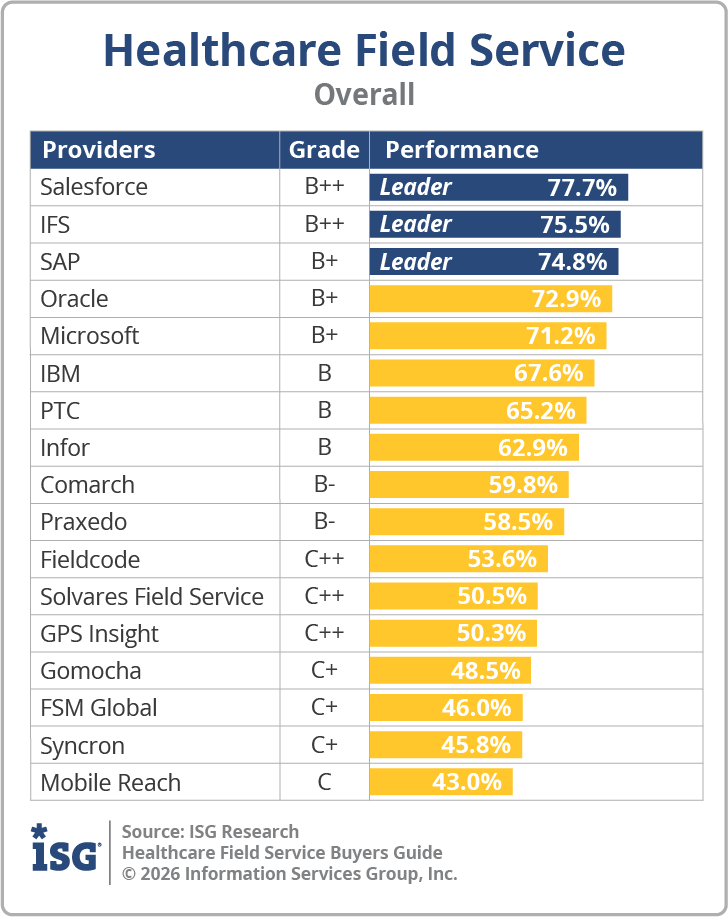 The research finds Salesforce atop the list, followed by IFS and SAP. Providers that place in the top three of a category earn the designation of Leader. IFS and Salesforce have done so in five categories; SAP in three; and Oracle in two categories.
The overall representation of the research below places the rating of the Product Experience and Customer Experience on the x and y axes, respectively, to provide a visual representation and classification of the software providers. Those providers whose Product Experience have above median weighted performance to the axis in aggregate of the two product categories place farther to the right, while the performance and weighting for the Customer Experience category determines placement on the vertical axis. In short, software providers that place closer to the upper-right on this chart performed better than those closer to the lower-left.
The research categorizes and rates software providers into one of four categories: Assurance, Exemplary, Merit or Innovative. This representation of software providers’ weighted performance in meeting the requirements in product and customer experience.
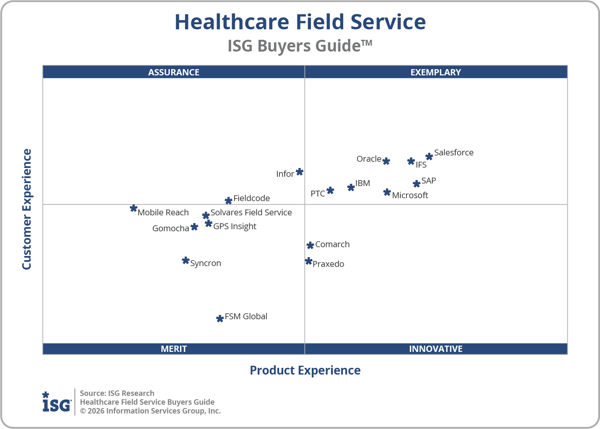
Exemplary: This rating (upper right) represents those that performed above median in Product and Customer Experience requirements. The providers rated Exemplary are: IBM, IFS, Microsoft, Oracle, PTC, SAP, and Salesforce.
Innovative: This rating (lower right) represents those that performed above median in Product Experience but not in Customer Experience. The providers rated Innovative are: Comarch and Praxedo.
Assurance: This rating (upper left) represents those that performed above median in Customer Experience but not in Product Experience. The providers rated Assurance are: Fieldcode and Infor.
Merit: This rating (lower left) represents those that did not surpass the median in Customer or Product Experience. The providers rated Merit are: FSM Global, GPS Insight, Gomocha, Mobile Reach, Solvares Field Service, Syncron.
We advise enterprises to use this research as a supplement to their own evaluations, recognizing that ratings or rankings do not solely represent the value of a provider nor indicate universal suitability of a set of products.
Product Experience
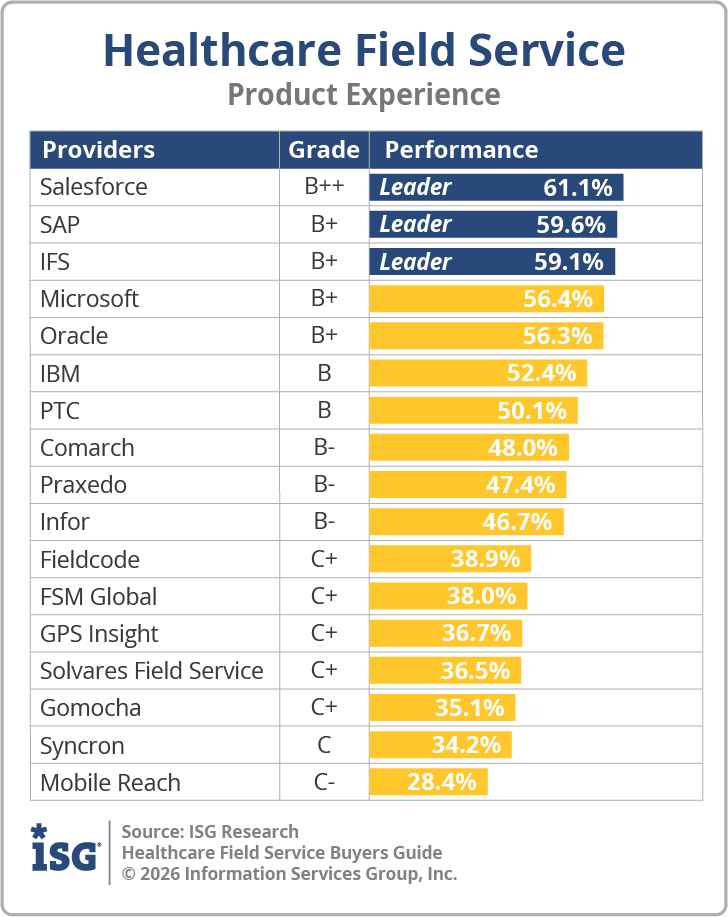 The process of researching products to address an enterprise’s needs should be comprehensive and evaluate specific capabilities and the underlying platform to the product experience. Our evaluation of the Product Experience examines the lifecycle of onboarding, configuration, operations, usage and maintenance. Too often, software providers are not evaluated for the entirety of the product; instead, they are evaluated on market execution and vision of the future.
The research results in Product Experience are ranked at 80%, or four-fifths, using the underlying weighted performance. Importance was placed on the categories as follows: Capability (35%) and Platform (45%). Salesforce, SAP and IFS were designated Product Experience Leaders.
Customer Experience
 The importance of a customer relationship with a software provider is essential to the actual success of the products and technology. The evaluation of the Customer Experience and the entire lifecycle an enterprise has with its software provider is critical for ensuring satisfaction in working with that provider. The ISG Buyers Guide examines a software provider’s customer commitment, viability, customer success, sales and onboarding, product roadmap and services with partners and support. The customer experience category also investigates the TCO/ROI and how well a software provider demonstrates the product’s overall value, cost and benefits, including the tools and resources to evaluate these factors.
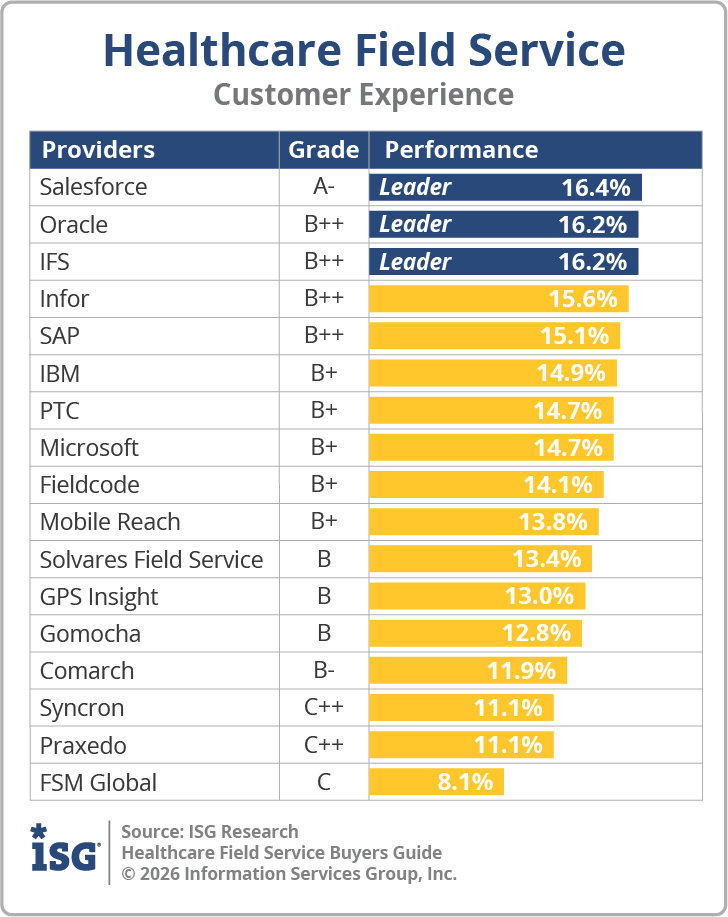
The research results in Customer Experience are ranked at 20%, or one-fifth of the 100% index, and represent the underlying provider validation and TCO/ROI requirements as they relate to the framework of commitment and value to the software provider-customer relationship.
The software providers that evaluated the highest in the Customer Experience category are Salesforce, Oracle and IFS. These category Leaders best communicate commitment and dedication to customer needs.
Software providers that did not perform well in this category were unable to provide or make sufficient information readily available to demonstrate success or articulate their commitment to customer experience. The use of a software provider requires continuous investment, so a holistic evaluation must include examination of how they support their customer experience.
Products Evaluated
| Provider | Product Names | Version | Release Month/Year |
|---|---|---|---|
| Comarch | Comarch FSM | N/A | October 2025 |
| Fieldcode | Fieldcode Plus | N/A | September 2025 |
| FSM Global | FSM Grid | 2025.2.1 | October 2025 |
| Gomocha | Gomocha Field Service Platform (FSP) | 5.2.5 | September 2025 |
| GPS Insight | FieldAware | N/A | October 2025 |
| IBM | IBM Maximo Field Service Management | IBM Maximo Application Suite 9.2 | September 2025 |
| IFS | IFS Cloud – Field Service Management | IFS Cloud 25R2 | October 2025 |
| Infor | Infor Cloudsuite Field Service | N/A | October 2025 |
| Microsoft | Dynamics 365 Field Service | 8.8.139.398 | October 2025 |
| Mobile Reach | Mobile Reach mobility platform | N/A | October 2025 |
| Oracle | Oracle Fusion Field Service | 25C | October 2025 |
| Praxedo | Praxedo | Spring 2025 | June 2025 |
| PTC | ServiceMax | ServiceMax Core 25.1 (25R1) | June 2025 |
| Salesforce | Salesforce Field Service | Winter ’26 | October 2025 |
| SAP | Field Service Management | SAP FSM 2508 | August 2025 |
| Solvares Field Service | VISITOUR | N/A | October 2025 |
| Syncron | Syncron SLM Platform | N/A | October 2025 |
Executive Summary
Healthcare Field Service
Healthcare organizations rely on equipment and technology that are highly sensitive and critical to daily operations. Hospitals, medical device manufacturers and home health providers operate under tight uptime requirements, with little tolerance for service disruption. Increasingly, these environments also depend on connected, data-driven service operations. To maintain reliability, healthcare organizations are turning to field service platforms that extend beyond traditional work order and dispatch tools, supporting biomedical and clinical engineering workflows, medical device calibration and compliance tracking, along with other healthcare-specific requirements.
Healthcare organizations rely on equipment and technology that are highly sensitive and critical to daily operations.
ISG Research defines field service management (FSM) as the practice of delivering technical support at the customer’s site or related locations. In healthcare, this approach is critical as providers must combine technical service delivery with transparent communication, rigorous compliance and cost control. Field service is not simply about dispatching technicians; it is a complex orchestration of assets, workflows and people that must be optimized and automated to ensure safe, timely resolution of service events.
Field service challenges in healthcare are uniquely high stakes because care delivery environments operate continuously. Life-critical medical equipment, from imaging systems to ventilators and infusion devices, elevates service failure from an operational issue to a patient safety concern. Unplanned device downtime can immediately disrupt care pathways, delay procedures and reduce facility revenue, while eroding trust among clinicians, patients and regulators.
These challenges vary across care settings. Acute care hospitals manage centralized asset fleets where uptime, compliance and rapid response are paramount. Outpatient facilities emphasize predictable scheduling and fast turnaround to maintain patient throughput. Home health environments introduce additional complexity through decentralized assets, variable operating conditions and limited on-site technical support. Across all settings, FSM platforms must support precise coordination, strict compliance and rapid decision-making, as the consequences of service failure extend beyond cost into patient outcomes and organizational credibility.
Healthcare organizations are investing in FSM in response to heightened regulatory scrutiny and growing cybersecurity risks associated with connected medical devices. Increased connectivity requires stronger control, visibility and auditability of service activities. These pressures are compounded by the shift toward value-based care and the rapid expansion of home health and distributed care models, where equipment uptime, compliance and coordinated service directly affect patient outcomes and reimbursement.
The healthcare field service landscape is evolving toward interoperable, highly regulated and outcome-focused platforms. Modern FSM systems help ensure equipment reliability, reduce compliance risk and enable predictive and proactive maintenance for increasingly connected medical devices. By integrating asset intelligence, scheduling and service execution, these platforms support consistent, auditable operations across diverse care environments.
The healthcare field service landscape is evolving toward interoperable, highly regulated and outcome-focused platforms.
Healthcare enterprises require FSM capabilities that track assets across their full lifecycle by device class, enforce preventive maintenance schedules aligned with clinical risk and ensure technicians meet credentialing and certification requirements. Additional requirements include support for infection control workflows, structured incident escalation and recall management and comprehensive audit trails to demonstrate compliance and protect patient safety. Asset history, calibration records and service documentation must be readily available to withstand audits and inspections.
Predictive and proactive maintenance capabilities are becoming more important as device fleets grow more complex. Remote monitoring, condition-based alerts and risk-based prioritization allow service teams to intervene before failures affect patient care. When integrated with scheduling and dispatch, these capabilities help plan preventive work efficiently, align technician skills and availability and reduce unplanned downtime.
Successful adoption of FSM in healthcare depends on positioning the platform as a patient safety and compliance enabler rather than solely an operational tool. Executive sponsorship and ownership by clinical engineering teams are essential. Change management must respect established maintenance practices, reduce manual documentation and integrate naturally into daily workflows. Integration with existing hospital IT environments is critical to maintain accurate asset data, coordinate scheduling with clinical operations and produce audit-ready reporting without increasing administrative burden.
Mobility remains central to healthcare field service operations. FSM platforms focus on controlling scheduling and communicating updates to all parties involved. Mobile applications provide technicians with access to technical documentation, device histories, calibration requirements and SLA information, while enabling real-time data capture at the point of service. These capabilities support faster resolution, better compliance and more informed decision-making in clinical environments.
Healthcare organizations also measure the success of field service programs through metrics tied directly to patient safety, compliance and operational performance. Core indicators include equipment uptime, mean time to repair, preventive maintenance compliance and audit pass rates, alongside service response times and technician utilization. Tracking these measures helps organizations demonstrate regulatory readiness, identify risk trends and prioritize investments that improve care continuity while controlling cost.
Healthcare organizations measure the success of field service programs through metrics tied directly to patient safety and compliance.
Cybersecurity considerations further elevate the role of FSM in healthcare. As connected medical devices expand the attack surface, service platforms must support secure access controls, encrypted communications and detailed audit trails for all service activities. Integration with security and identity systems helps ensure that only authorized personnel interact with regulated devices, protecting both patient data and clinical operations.
When evaluating FSM tools, healthcare organizations should focus on regulatory readiness, interoperability and the ability to support specialized clinical engineering workflows at scale. Platforms must provide end-to-end traceability through audit logs, technician identity verification, calibration histories and compliance documentation aligned with healthcare standards. Security, data governance and system resilience are equally important, given the risks associated with connected medical devices and patient data.
The 2026 ISG Buyers Guide™ for Healthcare Field Service evaluates software providers in key areas including mobile workforce management, scheduling and dispatch optimization, work order and asset management, customer engagement, automation and artificial intelligence (AI) integration, data and analytics, knowledge management, and predictive and proactive maintenance. This research evaluates the following software providers: Comarch, Fieldcode, FSM Global, Gomocha, GPS Insight, IBM, IFS, Infor, Microsoft, Mobile Reach, Oracle, Praxedo, PTC, Salesforce, SAP, Solvares Field Service and Syncron.
Buyers Guide Overview
ISG Research has conducted market research for over two decades across vertical industries, business applications, AI and IT. We have designed the ISG Buyers Guide™ to provide a balanced perspective of software providers and products that is rooted in an understanding of business and IT requirements. Utilization of our research methodology and decades of experience enables our Buyers Guide to be an effective method to assess and select software providers and products. The findings of this research provide a comprehensive approach to rating software providers and rank their ability to meet specific product and customer experience requirements.
ISG Research has designed the Buyers Guide to provide a balanced perspective of software providers and products that is rooted in an understanding of business and IT requirements.
The 2026 ISG Buyers Guide™ for Healthcare Field Service is the distillation of continuous market and product research. It is an assessment of how well software providers’ offerings address enterprises’ requirements for field service software in the healthcare industry. The Value Index methodology is structured to support a request for information (RFI) for a request for proposal (RFP) process by incorporating all criteria needed to evaluate, select, utilize and maintain relationships with software providers. The ISG Buyers Guide evaluates customer experience and the product experience in its capability and platform.
The structure of the research reflects our understanding that the effective evaluation of software providers and products involves far more than just examining product features, potential revenue or customers generated from a provider’s marketing and sales efforts. It can ensure the best long-term relationship and value achieved from a resource and financial investment We believe it is important to take a comprehensive, research-based approach, since making the wrong choice of field service software can raise the total cost of ownership, lower the return on investment and hamper an enterprise’s ability to reach its potential. In addition, this approach can reduce the project’s development and deployment time and eliminate the risk of relying on opinions or historical biases.
ISG Research believes that an objective review of existing and potential new software providers and products is a critical strategy for the adoption and implementation of field service software. An enterprise’s review should include an analysis of both what is possible and what is relevant. We urge healthcare enterprises to do a thorough job of evaluating field service software and offer this Buyers Guide as both the results of our in-depth analysis of these providers and as an evaluation methodology.
Key Takeaways
Healthcare field service is increasingly being positioned as a patient safety and compliance enabler rather than a purely operational function. Rising device connectivity, regulatory scrutiny and zero tolerance for downtime are elevating service execution risk. As a result, healthcare organizations are adopting field service platforms that prioritize asset visibility, auditability and controlled service execution across diverse care settings.
Software Provider Summary
The ISG Buyers Guide™ for Healthcare Field Service evaluates 17 software providers offering products supporting regulated, asset-centric field service operations in healthcare environments. The research ranked the top three overall leaders as Salesforce, IFS and SAP. Providers were classified using weighted performance in Product Experience and Customer Experience for ISG quadrant placement. IBM, IFS, Microsoft, Oracle, PTC, SAP and Salesforce were rated as Exemplary, with Comarch and Praxedo rated as Innovative. Fieldcode and Infor were rated as Assurance; and FSM Global, GPS Insight, Gomocha, Mobile Reach, Solvares Field Service and Syncron were rated as Merit.
Product Experience Insights
Product Experience, representing 80% of the evaluation, focuses on Capability (35%) and Platform (45%), which includes adaptability, manageability, reliability and usability. Salesforce, SAP and IFS achieved the highest performance as Leaders in this category, supported by strengths in asset lifecycle tracking tied to preventive maintenance and compliance-ready platform governance and security controls. Leaders demonstrated enterprise-grade platform capabilities across varied roles and contexts.
Customer Experience Value
Customer Experience, representing 20% of the evaluation, focuses on validation and TCO/ROI. Salesforce, Oracle and IFS were the Leaders in this category, showing strong customer advocacy and clear investment in success outcomes. Providers with lower performance often lacked publicly available customer validation or failed to demonstrate structured ROI measurement and proactive lifecycle engagement.
Strategic Recommendations
Healthcare organizations should evaluate field service platforms through the lens of patient safety, regulatory readiness and operational resilience. Buyers should prioritize solutions that unify asset data, compliance workflows and secure service execution across clinical environments. Integration with hospital IT systems, strong identity controls and audit-ready reporting should be baseline requirements. This approach supports safer care delivery while reducing regulatory risk and operational disruption.
How To Use This Buyers Guide
Evaluating Software Providers: The Process
We recommend using the Buyers Guide to assess and evaluate new or existing software providers for your enterprise. The market research can be used as an evaluation framework to assess existing approaches and software providers or establish a formal request for information from providers on products and customer experience and will shorten the cycle time when creating an RFI. The steps listed below provide a process that can facilitate best possible outcomes in the most efficient manner.
- Define the business case and goals.
Define the mission and business case for investment and the expected outcomes from your organizational and technological efforts. - Specify the business and IT needs.
Defining the business and IT requirements helps identify what specific capabilities are required with respect to people, processes, information and technology. - Assess the required roles and responsibilities.
Identify the individuals required for success at every level of the enterprise from executives to frontline workers and determine the needs of each. - Outline the project’s critical path.
What needs to be done, in what order and who will do it? This outline should make clear the prior dependencies at each step of the project plan. - Ascertain the technology approach.
Determine the business and technology approach that most closely aligns to your enterprise’s requirements. - Establish software provider evaluation criteria.
Utilize the product experience: capability and platform with support for adaptability, manageability, reliability and usability, and the customer experience in TCO/ROI and Validation. - Evaluate and select the software provider and products properly.
Apply a weighting the evaluation categories in the evaluation criteria to reflect your enterprise’s priorities to determine the short list of software providers and products. - Establish the business initiative team to start the project.
Identify who will lead the project and the members of the team needed to plan and execute it with timelines, priorities and resources.
Using the ISG Buyers Guide and process provides enterprises a clear, structured approach to making smarter software and business investment decisions. It ensures alignment between strategy, people, processes and technology while reducing risk, saving time, and improving outcomes. The ISG approach promotes data-driven decision-making and collaboration, helping choose the right software providers for maximum value and return on investment.
The Findings
The software providers and products evaluated in the research provide product and customer experiences, but not everything offered is equally valuable to every enterprise or is needed to operate in business processes and use cases. Moreover, the existence of too many capabilities in products may be a negative factor for an enterprise if it introduces unnecessary complexity. Nonetheless, you may decide that a more comprehensive set of capabilities in the product is important, and where they match your enterprise’s requirements.
An effective customer relationship with a software provider is vital to the success of any investment. The overall customer experience and the full lifecycle of engagement play a key role in ensuring satisfaction and long-term success. Providers with dedicated customer leadership, such as chief customer officers, tend to invest more deeply in these relationships and prioritize customer outcomes to TCO and ROI expectations. It is equally important that this commitment to customer success is clearly demonstrated throughout the provider’s website, buying process and customer journey.
Overall Scoring of Software Providers Across Categories
The research finds Salesforce atop the list, followed by IFS and SAP. Providers that place in the top three of a category earn the designation of Leader. IFS and Salesforce have done so in five categories; SAP in three; and Oracle in two categories.
The overall representation of the research below places the rating of the Product Experience and Customer Experience on the x and y axes, respectively, to provide a visual representation and classification of the software providers. Those providers whose Product Experience have above median weighted performance to the axis in aggregate of the two product categories place farther to the right, while the performance and weighting for the Customer Experience category determines placement on the vertical axis. In short, software providers that place closer to the upper-right on this chart performed better than those closer to the lower-left.
The research categorizes and rates software providers into one of four categories: Assurance, Exemplary, Merit or Innovative. This representation of software providers’ weighted performance in meeting the requirements in product and customer experience.
Exemplary: This rating (upper right) represents those that performed above median in Product and Customer Experience requirements. The providers rated Exemplary are: IBM, IFS, Microsoft, Oracle, PTC, SAP, and Salesforce.
Innovative: This rating (lower right) represents those that performed above median in Product Experience but not in Customer Experience. The providers rated Innovative are: Comarch and Praxedo.
Assurance: This rating (upper left) represents those that performed above median in Customer Experience but not in Product Experience. The providers rated Assurance are: Fieldcode and Infor.
Merit: This rating (lower left) represents those that did not surpass the median in Customer or Product Experience. The providers rated Merit are: FSM Global, GPS Insight, Gomocha, Mobile Reach, Solvares Field Service, Syncron.
We advise enterprises to use this research as a supplement to their own evaluations, recognizing that ratings or rankings do not solely represent the value of a provider nor indicate universal suitability of a set of products.
Product Experience
The process of researching products to address an enterprise’s needs should be comprehensive and evaluate specific capabilities and the underlying platform to the product experience. Our evaluation of the Product Experience examines the lifecycle of onboarding, configuration, operations, usage and maintenance. Too often, software providers are not evaluated for the entirety of the product; instead, they are evaluated on market execution and vision of the future.
The research results in Product Experience are ranked at 80%, or four-fifths, using the underlying weighted performance. Importance was placed on the categories as follows: Capability (35%) and Platform (45%). Salesforce, SAP and IFS were designated Product Experience Leaders.
Customer Experience
The importance of a customer relationship with a software provider is essential to the actual success of the products and technology. The evaluation of the Customer Experience and the entire lifecycle an enterprise has with its software provider is critical for ensuring satisfaction in working with that provider. The ISG Buyers Guide examines a software provider’s customer commitment, viability, customer success, sales and onboarding, product roadmap and services with partners and support. The customer experience category also investigates the TCO/ROI and how well a software provider demonstrates the product’s overall value, cost and benefits, including the tools and resources to evaluate these factors.
The research results in Customer Experience are ranked at 20%, or one-fifth of the 100% index, and represent the underlying provider validation and TCO/ROI requirements as they relate to the framework of commitment and value to the software provider-customer relationship.
The software providers that evaluated the highest in the Customer Experience category are Salesforce, Oracle and IFS. These category Leaders best communicate commitment and dedication to customer needs.
Software providers that did not perform well in this category were unable to provide or make sufficient information readily available to demonstrate success or articulate their commitment to customer experience. The use of a software provider requires continuous investment, so a holistic evaluation must include examination of how they support their customer experience.
Products Evaluated
| Provider | Product Names | Version | Release Month/Year |
|---|---|---|---|
| Comarch | Comarch FSM | N/A | October 2025 |
| Fieldcode | Fieldcode Plus | N/A | September 2025 |
| FSM Global | FSM Grid | 2025.2.1 | October 2025 |
| Gomocha | Gomocha Field Service Platform (FSP) | 5.2.5 | September 2025 |
| GPS Insight | FieldAware | N/A | October 2025 |
| IBM | IBM Maximo Field Service Management | IBM Maximo Application Suite 9.2 | September 2025 |
| IFS | IFS Cloud – Field Service Management | IFS Cloud 25R2 | October 2025 |
| Infor | Infor Cloudsuite Field Service | N/A | October 2025 |
| Microsoft | Dynamics 365 Field Service | 8.8.139.398 | October 2025 |
| Mobile Reach | Mobile Reach mobility platform | N/A | October 2025 |
| Oracle | Oracle Fusion Field Service | 25C | October 2025 |
| Praxedo | Praxedo | Spring 2025 | June 2025 |
| PTC | ServiceMax | ServiceMax Core 25.1 (25R1) | June 2025 |
| Salesforce | Salesforce Field Service | Winter ’26 | October 2025 |
| SAP | Field Service Management | SAP FSM 2508 | August 2025 |
| Solvares Field Service | VISITOUR | N/A | October 2025 |
| Syncron | Syncron SLM Platform | N/A | October 2025 |
Fill out the form to continue reading.