Executive Summary
Key Takeaways
Collaborative AI suites are evolving into enterprise coordination platforms that integrate communication, content and workflow execution. These platforms support distributed work by embedding artificial intelligence (AI) into daily interactions, enabling conversations to move into tasks, approvals and system actions. Governance, integration depth and interaction intelligence are central to enterprise value as organizations seek consistent execution across teams, systems and operating models.
Software Provider Summary
The ISG Buyers Guide™ for Collaborative AI Suites evaluates 13 software providers offering products that support communication, collaboration, AI-driven workflow orchestration, interaction analytics, governance, security and enterprise integration. The research ranked the top three overall leaders as Microsoft, Google and Zoom. Providers were classified using weighted performance in Product Experience and Customer Experience for ISG quadrant placement. Google, Microsoft, RingCentral, Salesforce, Zoho and Zoom were rated Exemplary, with Cisco rated Innovative. Dialpad was rated Assurance, and 8x8, Atlassian, GoTo, HCLSoftware and Notion were rated as Merit.
Product Experience Insights
Product Experience, representing 80% of the evaluation, focuses on Capability (35%) and Platform (45%), which includes adaptability, manageability, reliability and usability. Microsoft, Google and Zoom achieved the highest performance as Leaders in this category, supported by broad collaborative AI capability coverage and enterprise-grade platform support across adaptability, manageability, reliability and usability. Leaders demonstrated resilient platform capabilities for business and IT teams across varied deployment models and usage personas.
Customer Experience Value
Customer Experience, representing 20% of the evaluation, focuses on validation and TCO/ROI. Google, Zoom and Salesforce were the Leaders in this category, showing strong communication of customer commitment and clear dedication to customer needs. Providers with lower performance often lacked sufficient information to demonstrate customer success or articulate a structured commitment to customer experience.
Strategic Recommendations
Enterprises should evaluate collaborative AI suites as systems of execution rather than communication tools. Selection should prioritize workflow orchestration, enterprise application integration, governance controls and the ability to turn interaction data into actionable intelligence. Adoption strategies should align IT, business and functional stakeholders around workflows, policy design and integration priorities to reduce fragmentation and support consistent execution.
The Findings
The software providers and products evaluated in this research offer product and customer experiences, but not every feature is equally valuable to every enterprise or is needed to support the relevant business processes and use cases. Moreover, having too many product capabilities may be a negative factor for an enterprise if it introduces unnecessary complexity. Nonetheless, you may decide that a more comprehensive set of capabilities is important and meets your enterprise’s requirements.
An effective customer relationship with a software provider is vital to the success of any investment. The overall customer experience and the full lifecycle of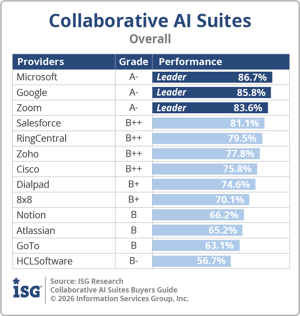 engagement play a key role in ensuring satisfaction and long-term success. Providers with dedicated customer leadership, such as chief customer officers, tend to invest more deeply in these relationships and prioritize customer outcomes in line with TCO and ROI expectations. It is equally important that this commitment to customer success is evident throughout the provider’s website, the buying process and the customer journey.
Overall Scoring of Software Providers Across Categories
The research finds Microsoft atop the list, followed by Google and Zoom. Providers that place in the top three of a category earn the designation of Leader. Google has done so in five categories, Microsoft in four, Zoom in three, Salesforce in two and RingCentral in one category.