

Rob leads and manages the business software research and advisory team at ISG Software Research, focusing on the intersection of information technology and applications across the front- and back-office areas of enterprises. Rob leads the Office of Finance practice and the AI for Business efforts and is a book author and thought leader on integrated business planning (IBP). Prior to ISG and two decades at Ventana Research, he was an equity research analyst at several firms including Credit Suisse, Morgan Stanley and Drexel Burnham, and a consultant with McKinsey and Company. Rob was an Institutional Investor All-American Team member and on the Wall Street Journal All-Star list. Rob earned his BA in Economics/Finance at Hampshire College, an MBA in Finance/Accounting at Columbia University and is a CFA charter holder.
narration area
Executive Summary
Buyers Guide Overview
ISG Research has conducted market research for over two decades across vertical industries, business applications, AI and IT. We have designed the ISG Buyers Guide™ to provide a balanced perspective of software providers and products that is rooted in an understanding of business and IT requirements. Utilization of our research methodology and decades of experience enables our Buyers Guide to be an effective method to assess and select software providers and products. The findings of this research provide a comprehensive approach to rating software providers and rank their ability to meet specific product and customer experience requirements.

ISG Research has designed the Buyers Guide to provide a balanced perspective of software providers and products that is rooted in an understanding of business and IT requirements.
The 2025 ISG Buyers Guides™ for Midsize Enterprise Resource Planning, covering Midsize ERP and Midsize Financial Management ERP software, are the distillation of continuous market and product research. It is an assessment of how well software providers’ offerings address enterprises’ requirements for midsize ERP software. The Value Index methodology is structured to support a request for information (RFI) for a request for proposal (RFP) process by incorporating all criteria needed to evaluate, select, utilize and maintain relationships with software providers. The ISG Buyers Guide evaluates customer experience and the product experience in its capability and platform.
The structure of the research reflects our understanding that the effective evaluation of software providers and products involves far more than just examining product features, potential revenue or customers generated from a provider’s marketing and sales efforts. It can ensure the best long-term relationship and value achieved from a resource and financial investment We believe it is important to take a comprehensive, research-based approach, since making the wrong choice of ERP software can raise the total cost of ownership, lower the return on investment and hamper an enterprise’s ability to reach its potential. In addition, this approach can reduce the project’s development and deployment time and eliminate the risk of relying on opinions or historical biases.
ISG Research believes that an objective review of existing and potential new software providers and products is a critical strategy for the adoption and implementation of ERP software. An enterprise’s review should include an analysis of both what is possible and what is relevant. We urge enterprises to do a thorough job of evaluating midsize ERP software and offer these Buyers Guides as both the results of our in-depth analysis of these providers and as an evaluation methodology.
How To Use This Buyers Guide
Evaluating Software Providers: The Process
We recommend using the Buyers Guide to assess and evaluate new or existing software providers for your enterprise. The market research can be used as an evaluation framework to assess existing approaches and software providers or establish a formal request for information from providers on products and customer experience and will shorten the cycle time when creating an RFI. The steps listed below provide a process that can facilitate best possible outcomes in the most efficient manner.
- Define the business case and goals.
Define the mission and business case for investment and the expected outcomes from your organizational and technological efforts.
- Specify the business and IT needs.
Defining the business and IT requirements helps identify what specific capabilities are required with respect to people, processes, information and technology.
- Assess the required roles and responsibilities.
Identify the individuals required for success at every level of the enterprise from executives to frontline workers and determine the needs of each.
- Outline the project’s critical path.
What needs to be done, in what order and who will do it? This outline should make clear the prior dependencies at each step of the project plan.
- Ascertain the technology approach.
Determine the business and technology approach that most closely aligns to your enterprise’s requirements.
- Establish software provider evaluation criteria.
Utilize the product experience: capability and platform with support for adaptability, manageability, reliability and usability, and the customer experience in TCO/ROI and Validation.
- Evaluate and select the software provider and products properly.
Apply a weighting the evaluation categories in the evaluation criteria to reflect your enterprise’s priorities to determine the short list of software providers and products.
- Establish the business initiative team to start the project.
Identify who will lead the project and the members of the team needed to plan and execute it with timelines, priorities and resources.
Using the ISG Buyers Guide and process provides enterprises a clear, structured approach to making smarter software and business investment decisions. It ensures alignment between strategy, people, processes and technology while reducing risk, saving time and improving outcomes. The ISG approach promotes data-driven decision-making and collaboration, helping choose the right software providers for maximum value and return on investment.
Midsize ERP
Enterprise resource planning (ERP) systems have evolved from tools built for manufacturers into essential platforms for organizations of all types. They integrate data, processes and reporting across departments to improve efficiency and decision-making. Over the past three decades, ERP systems have become the foundation of business operations, combining financial management, human resources, supply chain and customer management into a unified system. These capabilities continue to advance as artificial intelligence (AI), automation and cloud computing reshape how enterprises manage the most critical processes.
ERP systems integrate data, processes and reporting across departments to improve efficiency and decision-making.
ISG Research defines ERP systems as comprehensive software platforms designed to integrate and manage the core processes of an enterprise while recording transactions and their financial consequences to support accounting and finance. ERP systems consolidate data from functions such as finance, human resources, supply chain and customer management into a unified database, providing real-time access that enhances transparency and productivity.
ERP systems serve a broad range of organizations, from global enterprises to midsize companies. Large enterprises often deploy Tier I ERP platforms—highly configurable systems that scale across international operations and support complex, specialized business processes. Midsize enterprises, generally those with 100 to 999 employees, adopt Tier II ERP systems that balance functionality and simplicity. These platforms combine configurability, performance and cost efficiency, providing industry-specific capabilities that speed deployment and reduce the need for customization. Large organizations may also use Tier II systems for divisions or regional operations where faster deployment or lower cost is the priority.
ERP has served as the operational and financial backbone of organizations for more than three decades. Its origins lie in material requirements planning (MRP) methods introduced in the 1960s to help manufacturers manage inventories and production schedules. MRP II expanded these capabilities by incorporating quality assurance and equipment maintenance. By the 1990s, advances in relational databases, graphical interfaces and programming languages enabled ERP systems to connect financial and operational processes across the enterprise. As companies broadly adopted ERP systems, the benefits included streamlined workflows and reduced administrative overhead from automating processes previously managed through disconnected tools.
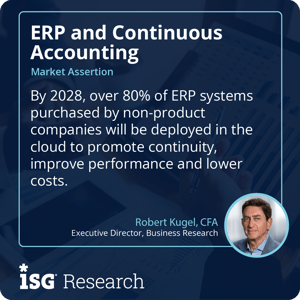 Cloud-based ERP systems emerged in the early 2000s but initially saw limited adoption due to implementation cost and perceived risk. Over time, maturing cloud architectures improved scalability, performance and security, leading enterprises to replace legacy on-premises systems with today’s continuously updated platforms. The cloud transition has been particularly effective for midsize organizations seeking to minimize infrastructure investment and accelerate deployment timelines. We assert that by 2028, over 80% of ERP systems purchased by non-product companies will be deployed in the cloud to promote continuity, improve performance and lower costs.
For midsize enterprises, cloud ERP systems offer flexibility aligned with growth ambitions. Subscription-based models reduce upfront costs and provide access to new functionality through regular updates. Integrated analytics deliver insight into financial and operational performance, helping midsize businesses compete with larger enterprises that rely on highly customized Tier I platforms. Industry-specific templates and preconfigured workflows enable faster time-to-value while maintaining governance and security standards appropriate for the organization’s scale.
For midsize organizations, ERP software is increasingly viewed as a driver of competitiveness rather than a maintenance expense. As these enterprises expand geographically or diversify product and service portfolios, ERP systems provide the structure to standardize processes, manage financial controls and support consistent decision-making across locations. Today’s platforms also offer advanced reporting and embedded analytics that give executives greater insight into profitability, inventory management and customer trends, enabling faster, evidence-based decisions.
Today’s ERP systems also emphasize usability, adaptability and extensibility. Cloud-native architectures simplify upgrades and maintenance while ensuring access to emerging technologies. Software development kits (SDKs) and application programming interfaces (APIs) allow third parties to integrate or extend ERP capabilities, connecting core financial and operational data with analytics, human capital management and supply chain systems. This ecosystem approach enables midsize enterprises to achieve enterprise-grade integration without the complexity or expense associated with large-scale ERP implementations.
Current technology trends are further transforming ERP systems. Innovations such as AI, generative AI (GenAI), natural language processing (NLP) and agentic systems are changing how organizations interact with business software. Early features such as anomaly detection and automated data entry are improving accuracy and accelerating processes. AI-driven assistants now handle tasks such as expense processing, reconciliation and reporting, reducing repetitive workloads and freeing staff for higher-value analysis. We assert that by 2028, almost all providers of ERP software will have incorporated AI to reduce workloads and errors and speed 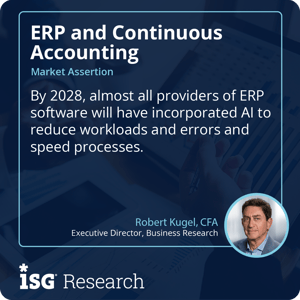 processes.
As midsize organizations adopt these technologies, ERP systems become a catalyst for strategic growth rather than a back-office function. AI and predictive analytics allow leaders to anticipate financial and operational trends, improving forecasting and resource allocation. These advances, combined with cloud deployment, create a platform that scales with the business and adapts to new regulatory or competitive demands.
Modernization remains a priority for midsize companies with legacy ERP installations. Replacement or upgrade projects require careful planning but deliver substantial benefits, including enhanced data visibility, faster reporting and better compliance. The shift from on-premises to cloud deployment is accelerating, driven by improved configurability and easier integration with industry-specific modules. Terms such as “configuration” and “customization” define how systems adapt to user needs without altering core code. Executives increasingly evaluate a provider’s roadmap, AI capabilities and interoperability as critical factors for long-term value.
Midsize enterprises upgrading ERP platforms often seek improved automation, reduced IT complexity and tighter integration with other business systems. New platforms emphasize intuitive interfaces and role-based dashboards that simplify use for nontechnical staff while maintaining governance and security. The move to cloud ERP systems also ensures greater resilience and scalability, providing midsize businesses with enterprise-grade reliability without the operational burden of managing infrastructure.
Although ERP systems unify multiple business functions, this Buyers Guide focuses on capabilities most relevant to midsize organizations. It emphasizes ease of deployment, scalability, cost efficiency and functional breadth within accounting, financial management, operations and analytics. These capabilities enable midsize enterprises to achieve the advantages of enterprise-class ERP software with the flexibility and simplicity suited to scale.
The 2025 ISG Buyers Guide™ for Midsize ERP evaluates software providers and products in key areas, including accounting and financial management, compliance, risk management, manufacturing, operations, planning and distribution. This research assessed the following software providers: Acumatica, Aptean, Epicor, Exact, Forterro, IFS, Infor, Microsoft, Oracle NetSuite, QAD, Ramco, Rockwell Automation, Sage X3 and SAP Business One.
Key Takeaways
Midsize ERP platforms integrate financial, operational and analytical capabilities into unified systems that support growth, governance and day-to-day execution. This category has evolved from manufacturing-focused tools into cloud-enabled platforms that balance functional breadth with cost efficiency, ease of deployment and configurability suited to midsize organizations. Current research underscores how industry-specific templates, embedded analytics and extensible architectures help midsize enterprises standardize processes across locations while preserving agility. As ERP modernization accelerates, midsize organizations can treat these platforms as drivers of competitiveness rather than maintenance investments.
Software Provider Summary
The ISG Buyers Guide™ for Midsize ERP evaluates 14 software providers offering products that support accounting, financial management, manufacturing, operations, planning and distribution for midsize organizations. The research ranked the top three overall leaders as IFS, Sage X3 and Microsoft. Providers were classified using weighted performance in Product Experience and Customer Experience for ISG quadrant placement. IFS, Infor, Microsoft and Sage X3 were rated as Exemplary, with Acumatica, Epicor and Forterro rated as Innovative. Oracle NetSuite, QAD and SAP Business One were rated as Assurance, and Aptean, Exact, Ramco and Rockwell Automation were rated as Merit.
Product Experience Insights
Product Experience, representing 80% of the evaluation, focuses on Capability (35%) and Platform (45%), which includes adaptability, manageability, reliability and usability. IFS, Sage X3 and Microsoft achieved the highest performance as Leaders in this category, supported by breadth and depth across midsize ERP capabilities and robust platform architecture that enables adaptability, manageability, reliability and usability. Leaders demonstrated enterprise-grade platform capabilities across varied roles and contexts.
Customer Experience Value
Customer Experience, representing 20% of the evaluation, focuses on validation and TCO/ROI. Oracle NetSuite, IFS, and Sage X3 were the Leaders in this category showing strong customer advocacy and clear investment in success outcomes. Providers with lower performance often lacked publicly available customer validation or failed to demonstrate structured ROI measurement and proactive lifecycle engagement.
Strategic Recommendations
Midsize enterprises should evaluate ERP platforms as strategic enablers of growth, standardization and financial control rather than as purely back-office systems. Buyers should prioritize solutions that combine industry-specific functionality, cloud deployment and extensible integration with adjacent applications to reduce complexity and accelerate time to value. Organizations benefit from selecting platforms that balance configurability with governance, supporting intuitive user experiences while maintaining security and compliance. A structured modernization roadmap helps midsize businesses align ERP software investments with expansion plans, operational resilience and evolving regulatory demands.
The Findings – Midsize ERP
The software providers and products evaluated in the research provide product and customer experiences, but not everything offered is equally valuable to every enterprise or is needed to operate in business processes and use cases. Moreover, the existence of too many capabilities in products may be a negative factor for an enterprise if it introduces unnecessary complexity. Nonetheless, you may decide that a more comprehensive set of capabilities in the product is important, and where they match your enterprise’s requirements.
An effective customer relationship with a software provider is vital to the success of any investment. The overall customer experience and the full lifecycle of engagement play a key role in ensuring satisfaction and long-term success. Providers with dedicated customer leadership, such as chief customer officers, tend to invest more deeply in these relationships and prioritize customer outcomes to TCO and ROI expectations. It is equally important that this commitment to customer success is clearly demonstrated throughout the provider’s website, buying process and customer journey.
Overall Scoring of Software Providers Across Categories
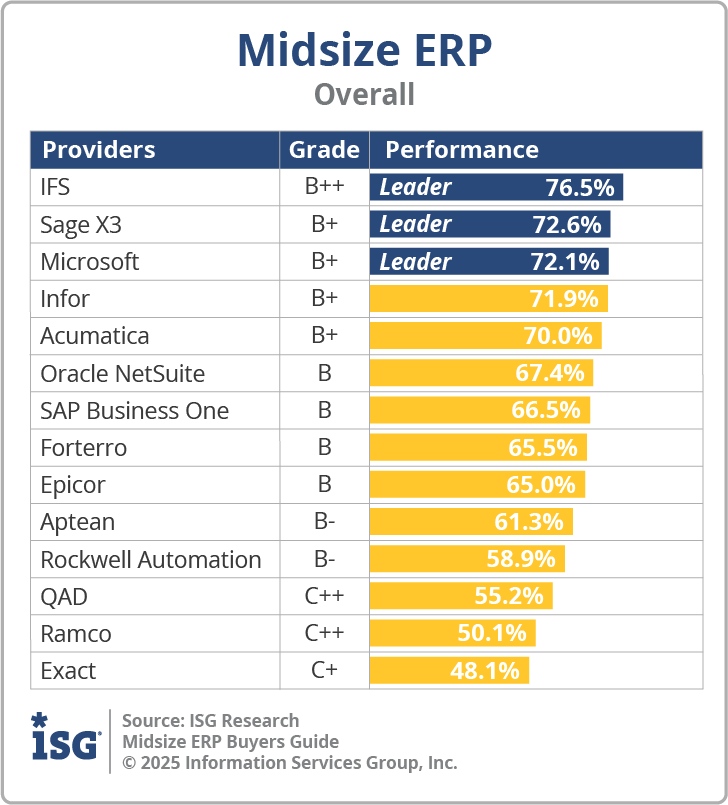 The research finds IFS atop the list, followed by Sage X3 and Microsoft. Providers that place in the top three of a category earn the designation of Leader. IFS has done so in five categories, Sage X3 in four, Microsoft in three and Infor, SAP Business One and Oracle NetSuite in one category.
The overall representation of the research below places the rating of the Product Experience and Customer Experience on the x and y axes, respectively, to provide a visual representation and classification of the software providers. Those providers whose Product Experience have above median weighted performance to the axis in aggregate of the two product categories place farther to the right, while the performance and weighting for the Customer Experience category determines placement on the vertical axis. In short, software providers that place closer to the upper-right on this chart performed better than those closer to the lower-left.
The research categorizes and rates software providers into one of four categories: Assurance, Exemplary, Merit or Innovative. This representation of software providers’ weighted performance in meeting the requirements in product and customer experience.
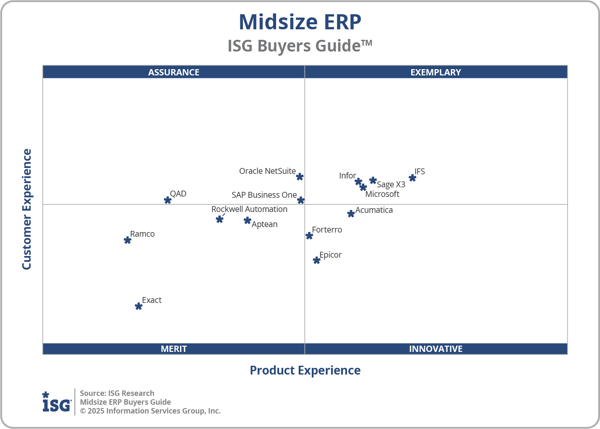
Exemplary: This rating (upper right) represents those that performed above median in Product and Customer Experience requirements. The providers rated Exemplary are: IFS, Infor, Microsoft and Sage X3.
Innovative: This rating (lower right) represents those that performed above median in Product Experience but not in Customer Experience. The providers rated Innovative are: Acumatica, Epicor and Forterro.
Assurance: This rating (upper left) represents those that performed above median in Customer Experience but not in Product Experience. The providers rated Assurance are: Oracle NetSuite, QAD and SAP Business One.
Merit: This rating (lower left) represents those that did not surpass the median in Customer or Product Experience. The providers rated Merit are: Aptean, Exact , Ramco and Rockwell Automation.
We advise enterprises to use this research as a supplement to their own evaluations, recognizing that ratings or rankings do not solely represent the value of a provider nor indicate universal suitability of a set of products.
Product Experience
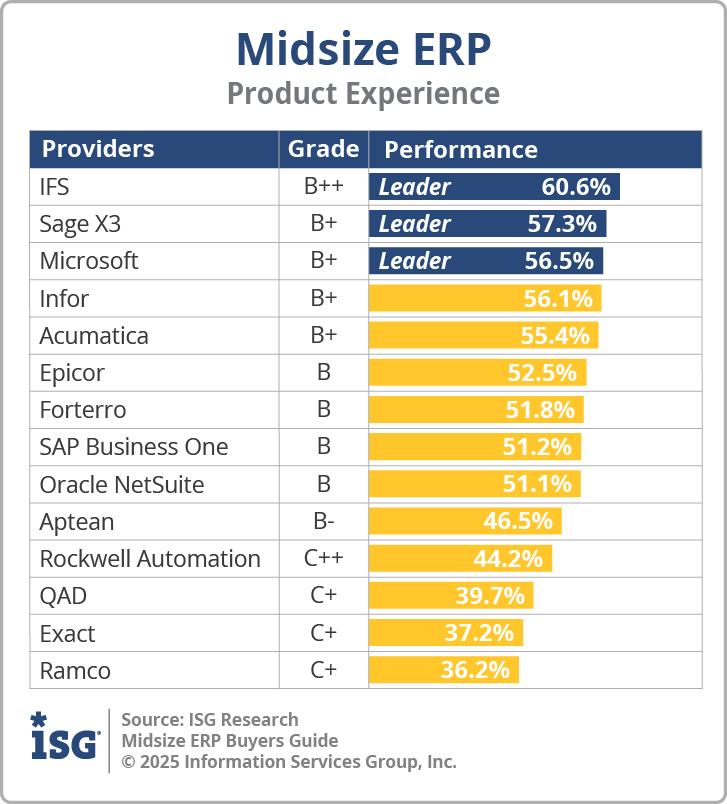 The process of researching products to address an enterprise’s needs should be comprehensive and evaluate specific capabilities and the underlying platform to the product experience. Our evaluation of the Product Experience examines the lifecycle of onboarding, configuration, operations, usage and maintenance. Too often, software providers are not evaluated for the entirety of the product; instead, they are evaluated on market execution and vision of the future.
The research results in Product Experience are ranked at 80%, or four-fifths, using the underlying weighted performance. Importance was placed on the categories as follows: Capability (35%) and Platform (45%). IFS, Sage X3 and Microsoft were designated Product Experience Leaders.
Customer Experience
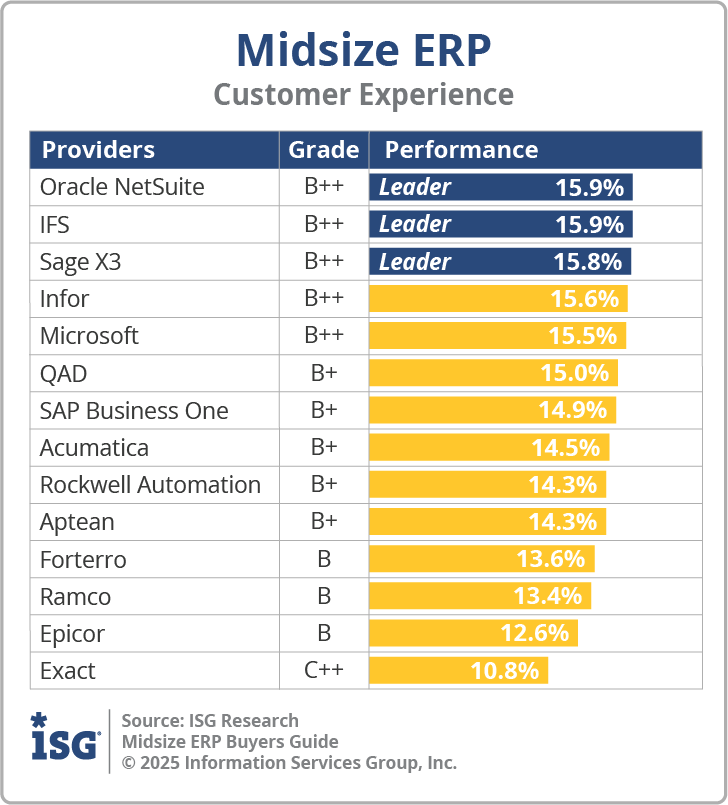 The importance of a customer relationship with a software provider is essential to the actual success of the products and technology. The evaluation of the Customer Experience and the entire lifecycle an enterprise has with its software provider is critical for ensuring satisfaction in working with that provider. The ISG Buyers Guide examines a software provider’s customer commitment, viability, customer success, sales and onboarding, product roadmap and services with partners and support. The customer experience category also investigates the TCO/ROI and how well a software provider demonstrates the product’s overall value, cost and benefits, including the tools and resources to evaluate these factors.
The research results in Customer Experience are ranked at 20%, or one-fifth of the 100% index, and represent the underlying provider validation and TCO/ROI requirements as they relate to the framework of commitment and value to the software provider-customer relationship.
The software providers that evaluated the highest in the Customer Experience category are Oracle NetSuite, IFS and Sage X3. These category leaders best communicate commitment and dedication to customer needs. While not a Leader, Infor was also found to meet a broad range of enterprise customer experience requirements.
Software providers that did not perform well in this category were unable to provide or make sufficient information readily available to demonstrate success or articulate their commitment to customer experience. The use of a software provider requires continuous investment, so a holistic evaluation must include examination of how they support their customer experience.
Software Provider Inclusion – Midsize ERP
For inclusion in the 2025 ISG Buyers Guide™ for Midsize ERP, a software provider must be in good standing financially and ethically, have at least $40 million in annual or projected revenue verified using independent sources, sell products and provide support on at least two continents, and have at least 50 customers. The principal source of the relevant business unit’s revenue must be software-related, and there must have been at least one major software release in the past 12 months. The ISG Buyers Guide™ for Midsize ERP excludes providers that derive more than two-thirds of their total software revenue from customers with more than 1,000 employees and that meet our inclusion criteria. We include providers that support midsize and larger enterprises in both services and manufacturing or product-related industries. The software must include the following for financial management: Accounting Operations, Risk Management, Cash Management, Inventory Management, Fixed Asset Management, Order-to-Cash Management, Procure-to-Pay Management, Consolidation. For manufacturing and product-related functions, the software must include the following: Advanced Planning and Scheduling, Demand Planning, Manufacturing Execution, Shop Floor Management, Materiel Flow Optimization, Multi-site Operations, Quality Management, Supplier and Partner Collaboration, Facilities and Equipment Maintenance, Warranty Management, Environmental Data and Metrics tracking, Smart Manufacturing and Distribution.
The research is designed to be independent of the specifics of software provider packaging and pricing. To represent the real-world environment in which businesses operate, we include providers that offer suites or packages of products that may include relevant individual modules or applications. If a software provider is actively marketing, selling and developing a product for the general market and it is reflected on the provider’s website that the product is within the scope of the research, that provider is automatically evaluated for inclusion.
All software providers that offer relevant products and meet the inclusion requirements were invited to participate in the evaluation process at no cost to them.
Software providers that meet our inclusion criteria but did not completely participate in our Buyers Guide were assessed solely on publicly available information. As this could have a significant impact on classification and ratings, we recommend additional scrutiny when evaluating those providers.
Products Evaluated
| Provider | Product Names | Version | Release Month/Year |
|---|---|---|---|
| Acumatica | Acumatica Cloud ERP | 2025 R1 | March 2025 |
| Aptean | Aptean ERP | 8.04 July 2025 HF1 | July 2025 |
| Epicor | Epicor Kinetic | 2025.1 | May 2025 |
| Exact | Exact Globe+ | Product Update 506 | August 2025 |
| Forterro | abas ERP |
2024.Q3.1 (Service Pack) |
June 2025 |
| IFS | IFS Cloud | IFS Cloud 25R1 | April 2025 |
| Infor | Infor CloudSuite | N/A | August 2025 |
| Microsoft | Dynamics 365 Finance | 10.0.44 | June 2025 |
| Oracle NetSuite | NetSuite ERP | 2025.2 | July 2025 |
| Ramco | Ramco ERP | N/A | August 2025 |
| Rockwell Automation | Plex Enterprise Resource Planning | N/A | August 2025 |
| QAD | QAD Adaptive ERP | N/A | August 2025 |
| SAP Business One | SAP Business One | 10.0 SP 2505 | May 2025 |
| Sage X3 | Sage X3 | 2025 R1 (12.0.37) | June 2025 |
Midsize Financial Management ERP
Enterprise resource planning (ERP) systems have evolved from manufacturing tools into essential platforms that unify accounting, reporting and financial operations, improving accuracy, compliance and efficiency. ISG Research defines financial management ERP systems as comprehensive software platforms that automate an enterprise’s financial and accounting functions while connecting with operational data. These systems record transactions and the financial consequences in real time to support areas such as general ledger, accounts payable and receivable and financial reporting.
Midsize enterprises use Tier II ERP systems that balance functionality and simplicity.
Midsize enterprises—typically those with 100 to 999 employees—use Tier II ERP systems that balance functionality and simplicity to meet financial and operational needs. These platforms combine configurability, cost efficiency and performance, making them easier to implement and maintain than Tier I systems while still providing the scalability midsize companies need for growth.
Tier II financial management ERP systems include preconfigured, industry-specific capabilities that shorten implementation and reduce customization, offering cost-effective control and better visibility into finances. Their design emphasizes usability, analytics and rapid deployment while supporting finance and accounting functions. Many large enterprises also use Tier II systems in divisions or regions where faster deployment or lower cost is a priority.
Financial ERP software continues to evolve through cloud computing. Once adopted slowly, cloud-based ERP systems are now the preferred model for midsize companies replacing aging platforms to improve performance and scalability. We assert that by 2028, over 80% of ERP systems purchased by non-product companies will be deployed in the cloud to promote continuity, improve performance and lower costs. Cloud ERP software reduces infrastructure demands, shortens upgrade cycles and provides a foundation for innovation. Today’s financial management ERP systems benefit from emerging technologies. AI and generative AI automate accounting tasks, enhance accuracy and accelerate decision-making. Software providers continue embedding AI capabilities that streamline financial workflows and improve insight.
The 2025 ISG Buyers Guide™ for Midsize Financial Management ERP evaluates software providers and products in key areas, including accounting and financial management, consolidation and intercompany management, indirect tax, compliance, risk management, fixed assets, order-to-cash, procure-to-pay, inventory and investment management. This research assessed the following software providers: Acumatica, Aptean, Certinia, Deltek, Epicor, Exact, Forterro, IFS, Infor, Microsoft, Oracle NetSuite, QAD, Ramco, Rockwell Automation, Sage Intacct, Sage X3, SAP Business One, TechnologyOne and Unit4.
Key Takeaways
Midsize financial management ERP platforms unify accounting, reporting and operational finance to improve accuracy, compliance and decision-making. These systems emphasize configurability, cost efficiency and rapid deployment, enabling modernization without Tier I complexity. Cloud architectures, embedded analytics and industry-specific capabilities streamline adoption, while AI and automation increasingly makes ERP software a foundation for financial visibility and control.
Software Provider Summary
The ISG Buyers Guide™ for Midsize Financial Management ERP evaluates 19 software providers offering products supporting accounting, financial management, consolidation, tax, compliance, fixed assets and operational finance functions. The research ranked the top three overall leaders as Sage Intacct, IFS and Microsoft. Providers were classified using weighted performance in Product Experience and Customer Experience for ISG quadrant placement. Acumatica, IFS, Infor, Microsoft, Oracle NetSuite, Sage Intacct, Sage X3 and SAP Business One were rated as Exemplary, with Epicor and Forterro rated as Innovative. Deltek and QAD were rated as Assurance, and Aptean, Certinia, Exact, Ramco, Rockwell Automation, TechnologyOne and Unit4 were rated as Merit.
Product Experience Insights
Product Experience, representing 80% of the evaluation, focuses on Capability (35%) and Platform (45%) which includes adaptability, manageability, reliability and usability. Sage Intacct, Microsoft, IFS and Sage X3 achieved the highest performance as Leaders in this category, supported by breadth and depth across midsize financial management ERP capabilities and robust platform architecture that enables adaptability, manageability, reliability and usability. Leaders demonstrated enterprise-grade platform capabilities across varied roles and contexts.
Customer Experience Value
Customer Experience, representing 20% of the evaluation, focuses on validation and TCO/ROI. Oracle NetSuite, IFS, Sage Intacct and Sage X3 were the Leaders in this category showing strong customer advocacy and clear investment in success outcomes. Providers with lower performance often lacked publicly available customer validation or failed to demonstrate structured ROI measurement and proactive lifecycle engagement.
Strategic Recommendations
Midsize enterprises should approach financial management ERP systems as a strategic enabler of governance, financial integrity and operational efficiency. Buyers should prioritize platforms that combine strong configurability, cloud-native extensibility and embedded intelligence to streamline finance workflows and improve visibility. Organizations benefit by selecting systems that reduce customization risk, connect financial processes with adjacent applications and support scalable modernization. A structured evaluation approach helps midsize companies align ERP investments with regulatory expectations, performance goals and long-term growth strategies.
The Findings – Midsize Financial Management ERP
The software providers and products evaluated in the research provide product and customer experiences, but not everything offered is equally valuable to every enterprise or is needed to operate in business processes and use cases. Moreover, the existence of too many capabilities in products may be a negative factor for an enterprise if it introduces unnecessary complexity. Nonetheless, you may decide that a more comprehensive set of capabilities in the product is important, and where they match your enterprise’s requirements.
An effective customer relationship with a software provider is vital to the success of any investment. The overall customer experience and the full lifecycle of engagement play a key role in ensuring satisfaction and long-term success. Providers with dedicated customer leadership, such as chief customer officers, tend to invest more deeply in these relationships and prioritize customer outcomes to TCO and ROI expectations. It is equally important that this commitment to customer success is clearly demonstrated throughout the provider’s website, buying process and customer journey.
Overall Scoring of Software Providers Across Categories
 The research finds Sage Intacct atop the list, followed by IFS and Microsoft. Providers that place in the top three of a category earn the designation of Leader. Sage Intacct has done so in five categories, IFS in four, Microsoft and Sage X3 in three and Oracle NetSuite in two categories.
The overall representation of the research below places the rating of the Product Experience and Customer Experience on the x and y axes, respectively, to provide a visual representation and classification of the software providers. Those providers whose Product Experience have above median weighted performance to the axis in aggregate of the two product categories place farther to the right, while the performance and weighting for the Customer Experience category determines placement on the vertical axis. In short, software providers that place closer to the upper-right on this chart performed better than those closer to the lower-left.
The research categorizes and rates software providers into one of four categories: Assurance, Exemplary, Merit or Innovative. This representation of software providers’ weighted performance in meeting the requirements in product and customer experience.
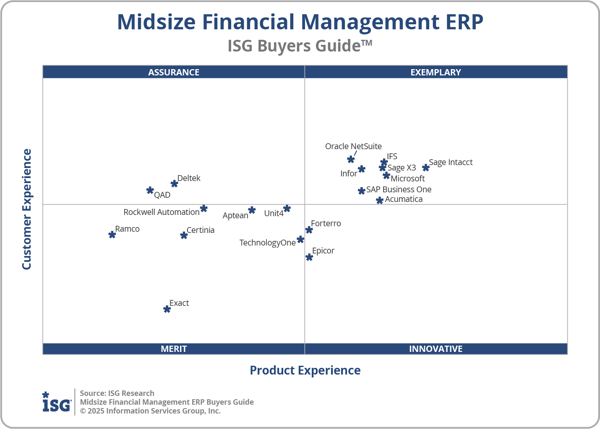
Exemplary: This rating (upper right) represents those that performed above median in Product and Customer Experience requirements. The providers rated Exemplary are: Acumatica, IFS, Infor, Microsoft, Oracle NetSuite, Sage Intacct, Sage X3 and SAP Business One.
Innovative: This rating (lower right) represents those that performed above median in Product Experience but not in Customer Experience. The providers rated Innovative are: Epicor and Forterro.
Assurance: This rating (upper left) represents those that performed above median in Customer Experience but not in Product Experience. The providers rated Assurance are: Deltek and QAD.
Merit: This rating (lower left) represents those that did not surpass the median in Customer or Product Experience. The providers rated Merit are: Aptean, Certinia, Exact, Ramco, Rockwell Automation, Technology One, and Unit4.
We advise enterprises to use this research as a supplement to their own evaluations, recognizing that ratings or rankings do not solely represent the value of a provider nor indicate universal suitability of a set of products.
Product Experience
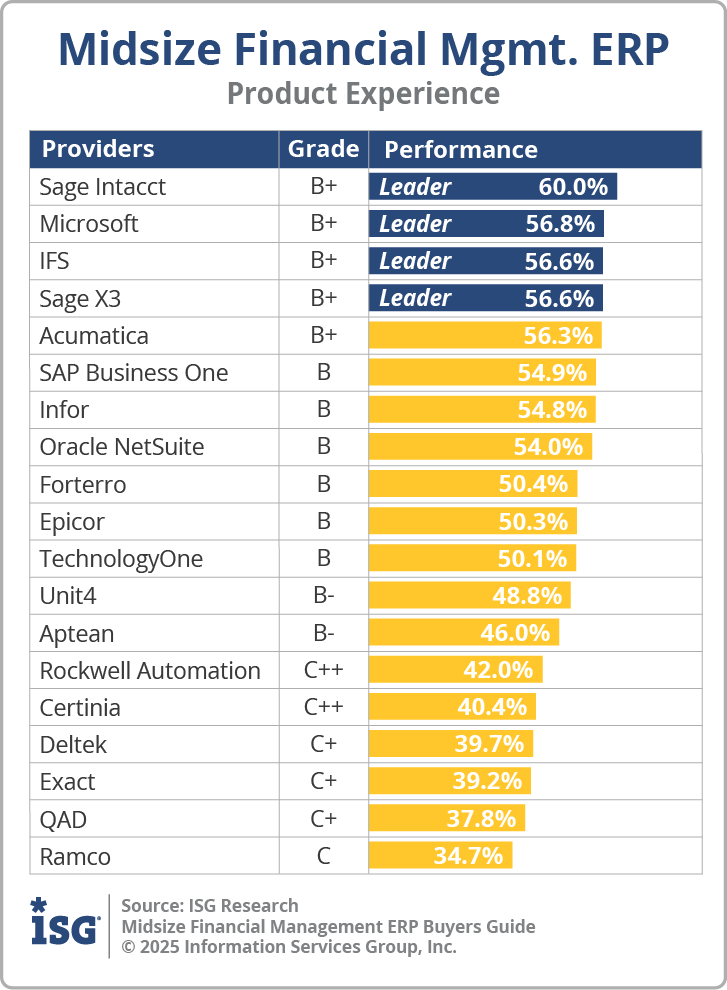 The process of researching products to address an enterprise’s needs should be comprehensive and evaluate specific capabilities and the underlying platform to the product experience. Our evaluation of the Product Experience examines the lifecycle of onboarding, configuration, operations, usage and maintenance. Too often, software providers are not evaluated for the entirety of the product; instead, they are evaluated on market execution and vision of the future.
The research results in Product Experience are ranked at 80%, or four-fifths, using the underlying weighted performance. Importance was placed on the categories as follows: Capability (35%) and Platform (45%). Sage Intacct, Microsoft and IFS and Sage X3 were designated Product Experience Leaders. While not a Leader, Acumatica was also found to meet a broad range of enterprise product experience requirements.
Customer Experience
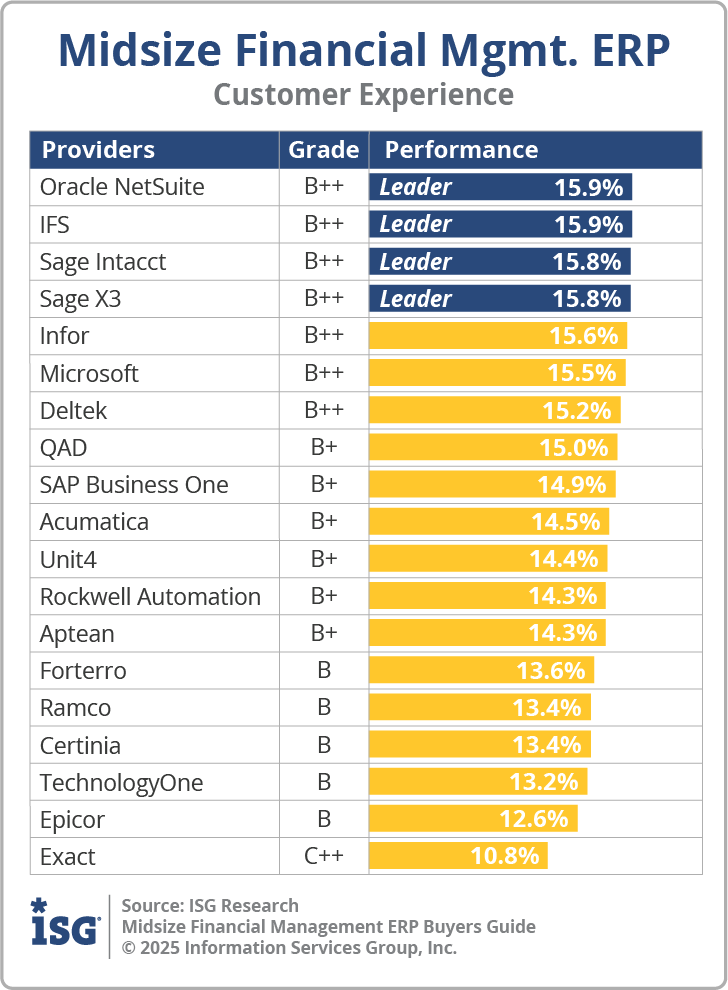 The importance of a customer relationship with a software provider is essential to the actual success of the products and technology. The evaluation of the Customer Experience and the entire lifecycle an enterprise has with its software provider is critical for ensuring satisfaction in working with that provider. The ISG Buyers Guide examines a software provider’s customer commitment, viability, customer success, sales and onboarding, product roadmap and services with partners and support. The customer experience category also investigates the TCO/ROI and how well a software provider demonstrates the product’s overall value, cost and benefits, including the tools and resources to evaluate these factors.
The research results in Customer Experience are ranked at 20%, or one-fifth of the 100% index, and represent the underlying provider validation and TCO/ROI requirements as they relate to the framework of commitment and value to the software provider-customer relationship.
The software providers that evaluated the highest in the Customer Experience category are Oracle NetSuite, IFS, Sage Intacct and Sage X3. These category leaders best communicate commitment and dedication to customer needs.
Software providers that did not perform well in this category were unable to provide or make sufficient information readily available to demonstrate success or articulate their commitment to customer experience. The use of a software provider requires continuous investment, so a holistic evaluation must include examination of how they support their customer experience.
Software Provider Inclusion – Midsize Financial Management ERP
For inclusion in the 2025 ISG Buyers Guide™ for Midsize Financial Management ERP, a software provider must be in good standing financially and ethically, have at least $40 million in annual or projected revenue verified using independent sources, sell products and provide support on at least two continents, and have at least 50 customers. The principal source of the relevant business unit’s revenue must be software-related, and there must have been at least one major software release in the past 12 months.
The research is designed to be independent of the specifics of software provider packaging and pricing. To represent the real-world environment in which businesses operate, we include providers that offer suites or packages of products that may include relevant individual modules or applications. If a software provider is actively marketing, selling and developing a product for the general market and it is reflected on the provider’s website that the product is within the scope of the research, that provider is automatically evaluated for inclusion.
All software providers that offer relevant products and meet the inclusion requirements were invited to participate in the evaluation process at no cost to them.
Software providers that meet our inclusion criteria but did not completely participate in our Buyers Guide were assessed solely on publicly available information. As this could have a significant impact on classification and ratings, we recommend additional scrutiny when evaluating those providers.
Products Evaluated
| Provider | Product Names | Version | Release Month/Year |
|---|---|---|---|
| Acumatica | Acumatica Cloud ERP | 2025 R1 | Mar-25 |
| Aptean | Aptean ERP | 8.04 July 2025 HF1 | Jul-25 |
| Certinia | Financial Management Cloud | Summer'25 | Aug-25 |
| Deltek | Deltek Maconomy | 2.6.7 (GA) | Jul-25 |
| Epicor | Epicor Kinetic | 2025.1 | May-25 |
| Exact | Exact Globe+ | Product Update 506 | Aug-25 |
| Forterro | abas ERP |
2024.Q3.1 (Service Pack) |
Jun-25 |
| IFS | IFS Cloud | IFS Cloud 25R1 | Apr-25 |
| Infor | Infor CloudSuite | N/A | Apr-25 |
| Microsoft | Dynamics 365 Finance | 10.0.44 | Jun-25 |
| Oracle NetSuite | NetSuite ERP | 2025.2 | Jul-25 |
| QAD | QAD Adaptive ERP | N/A | Aug-25 |
| Ramco Systems | Ramco ERP | N/A | Aug-25 |
| Rockwell Automation | Plex Enterprise Resource Planning | NA | Aug-25 |
| Sage Intacct | Sage Intacct | 2025 R3 | Aug-25 |
| Sage X3 | Sage X3 | 2025 R1 (12.0.37) | Jun-25 |
| SAP Business One | SAP Business One | 10.0 SP 2505 | May-25 |
| TechnologyOne | Global SaaS ERP | 2025A | Jul-25 |
| Unit4 | Unit4 ERPx | Spring 2025 | May-25 |
About ISG Software Research and Advisory
ISG Software Research and Advisory provides market research and coverage of the technology industry, informing enterprises, software and service providers, and investment firms. The ISG Buyers Guides provide insight on software categories and providers that can be used in the RFI/RFP process to assess, evaluate and select software providers.
About ISG Research
ISG Research provides subscription research, advisory, consulting and executive event services focused on market trends and disruptive technologies. ISG Research delivers guidance that helps businesses accelerate growth and create more value. For further information about ISG Research subscriptions, please visit research.isg-one.com.
About ISG
ISG (Nasdaq: III) is a global AI-centered technology research and advisory firm. A trusted partner to more than 900 clients, including 75 of the world’s top 100 enterprises, ISG is a long-time leader in technology and business services sourcing that is now at the forefront of leveraging AI to help organizations achieve operational excellence and faster growth. The firm, founded in 2006, is known for its proprietary market data, in-depth knowledge of provider ecosystems, and the expertise of its 1,600 professionals worldwide working together to help clients maximize the value of their technology investments.
Executive Summary
Buyers Guide Overview
ISG Research has conducted market research for over two decades across vertical industries, business applications, AI and IT. We have designed the ISG Buyers Guide™ to provide a balanced perspective of software providers and products that is rooted in an understanding of business and IT requirements. Utilization of our research methodology and decades of experience enables our Buyers Guide to be an effective method to assess and select software providers and products. The findings of this research provide a comprehensive approach to rating software providers and rank their ability to meet specific product and customer experience requirements.
ISG Research has designed the Buyers Guide to provide a balanced perspective of software providers and products that is rooted in an understanding of business and IT requirements.
The 2025 ISG Buyers Guides™ for Midsize Enterprise Resource Planning, covering Midsize ERP and Midsize Financial Management ERP software, are the distillation of continuous market and product research. It is an assessment of how well software providers’ offerings address enterprises’ requirements for midsize ERP software. The Value Index methodology is structured to support a request for information (RFI) for a request for proposal (RFP) process by incorporating all criteria needed to evaluate, select, utilize and maintain relationships with software providers. The ISG Buyers Guide evaluates customer experience and the product experience in its capability and platform.
The structure of the research reflects our understanding that the effective evaluation of software providers and products involves far more than just examining product features, potential revenue or customers generated from a provider’s marketing and sales efforts. It can ensure the best long-term relationship and value achieved from a resource and financial investment We believe it is important to take a comprehensive, research-based approach, since making the wrong choice of ERP software can raise the total cost of ownership, lower the return on investment and hamper an enterprise’s ability to reach its potential. In addition, this approach can reduce the project’s development and deployment time and eliminate the risk of relying on opinions or historical biases.
ISG Research believes that an objective review of existing and potential new software providers and products is a critical strategy for the adoption and implementation of ERP software. An enterprise’s review should include an analysis of both what is possible and what is relevant. We urge enterprises to do a thorough job of evaluating midsize ERP software and offer these Buyers Guides as both the results of our in-depth analysis of these providers and as an evaluation methodology.
How To Use This Buyers Guide
Evaluating Software Providers: The Process
We recommend using the Buyers Guide to assess and evaluate new or existing software providers for your enterprise. The market research can be used as an evaluation framework to assess existing approaches and software providers or establish a formal request for information from providers on products and customer experience and will shorten the cycle time when creating an RFI. The steps listed below provide a process that can facilitate best possible outcomes in the most efficient manner.
- Define the business case and goals.
Define the mission and business case for investment and the expected outcomes from your organizational and technological efforts.
- Specify the business and IT needs.
Defining the business and IT requirements helps identify what specific capabilities are required with respect to people, processes, information and technology.
- Assess the required roles and responsibilities.
Identify the individuals required for success at every level of the enterprise from executives to frontline workers and determine the needs of each.
- Outline the project’s critical path.
What needs to be done, in what order and who will do it? This outline should make clear the prior dependencies at each step of the project plan.
- Ascertain the technology approach.
Determine the business and technology approach that most closely aligns to your enterprise’s requirements.
- Establish software provider evaluation criteria.
Utilize the product experience: capability and platform with support for adaptability, manageability, reliability and usability, and the customer experience in TCO/ROI and Validation.
- Evaluate and select the software provider and products properly.
Apply a weighting the evaluation categories in the evaluation criteria to reflect your enterprise’s priorities to determine the short list of software providers and products.
- Establish the business initiative team to start the project.
Identify who will lead the project and the members of the team needed to plan and execute it with timelines, priorities and resources.
Using the ISG Buyers Guide and process provides enterprises a clear, structured approach to making smarter software and business investment decisions. It ensures alignment between strategy, people, processes and technology while reducing risk, saving time and improving outcomes. The ISG approach promotes data-driven decision-making and collaboration, helping choose the right software providers for maximum value and return on investment.
Midsize ERP
Enterprise resource planning (ERP) systems have evolved from tools built for manufacturers into essential platforms for organizations of all types. They integrate data, processes and reporting across departments to improve efficiency and decision-making. Over the past three decades, ERP systems have become the foundation of business operations, combining financial management, human resources, supply chain and customer management into a unified system. These capabilities continue to advance as artificial intelligence (AI), automation and cloud computing reshape how enterprises manage the most critical processes.
ERP systems integrate data, processes and reporting across departments to improve efficiency and decision-making.
ISG Research defines ERP systems as comprehensive software platforms designed to integrate and manage the core processes of an enterprise while recording transactions and their financial consequences to support accounting and finance. ERP systems consolidate data from functions such as finance, human resources, supply chain and customer management into a unified database, providing real-time access that enhances transparency and productivity.
ERP systems serve a broad range of organizations, from global enterprises to midsize companies. Large enterprises often deploy Tier I ERP platforms—highly configurable systems that scale across international operations and support complex, specialized business processes. Midsize enterprises, generally those with 100 to 999 employees, adopt Tier II ERP systems that balance functionality and simplicity. These platforms combine configurability, performance and cost efficiency, providing industry-specific capabilities that speed deployment and reduce the need for customization. Large organizations may also use Tier II systems for divisions or regional operations where faster deployment or lower cost is the priority.
ERP has served as the operational and financial backbone of organizations for more than three decades. Its origins lie in material requirements planning (MRP) methods introduced in the 1960s to help manufacturers manage inventories and production schedules. MRP II expanded these capabilities by incorporating quality assurance and equipment maintenance. By the 1990s, advances in relational databases, graphical interfaces and programming languages enabled ERP systems to connect financial and operational processes across the enterprise. As companies broadly adopted ERP systems, the benefits included streamlined workflows and reduced administrative overhead from automating processes previously managed through disconnected tools.
Cloud-based ERP systems emerged in the early 2000s but initially saw limited adoption due to implementation cost and perceived risk. Over time, maturing cloud architectures improved scalability, performance and security, leading enterprises to replace legacy on-premises systems with today’s continuously updated platforms. The cloud transition has been particularly effective for midsize organizations seeking to minimize infrastructure investment and accelerate deployment timelines. We assert that by 2028, over 80% of ERP systems purchased by non-product companies will be deployed in the cloud to promote continuity, improve performance and lower costs.
For midsize enterprises, cloud ERP systems offer flexibility aligned with growth ambitions. Subscription-based models reduce upfront costs and provide access to new functionality through regular updates. Integrated analytics deliver insight into financial and operational performance, helping midsize businesses compete with larger enterprises that rely on highly customized Tier I platforms. Industry-specific templates and preconfigured workflows enable faster time-to-value while maintaining governance and security standards appropriate for the organization’s scale.
For midsize organizations, ERP software is increasingly viewed as a driver of competitiveness rather than a maintenance expense. As these enterprises expand geographically or diversify product and service portfolios, ERP systems provide the structure to standardize processes, manage financial controls and support consistent decision-making across locations. Today’s platforms also offer advanced reporting and embedded analytics that give executives greater insight into profitability, inventory management and customer trends, enabling faster, evidence-based decisions.
Today’s ERP systems also emphasize usability, adaptability and extensibility. Cloud-native architectures simplify upgrades and maintenance while ensuring access to emerging technologies. Software development kits (SDKs) and application programming interfaces (APIs) allow third parties to integrate or extend ERP capabilities, connecting core financial and operational data with analytics, human capital management and supply chain systems. This ecosystem approach enables midsize enterprises to achieve enterprise-grade integration without the complexity or expense associated with large-scale ERP implementations.
Current technology trends are further transforming ERP systems. Innovations such as AI, generative AI (GenAI), natural language processing (NLP) and agentic systems are changing how organizations interact with business software. Early features such as anomaly detection and automated data entry are improving accuracy and accelerating processes. AI-driven assistants now handle tasks such as expense processing, reconciliation and reporting, reducing repetitive workloads and freeing staff for higher-value analysis. We assert that by 2028, almost all providers of ERP software will have incorporated AI to reduce workloads and errors and speed processes.
As midsize organizations adopt these technologies, ERP systems become a catalyst for strategic growth rather than a back-office function. AI and predictive analytics allow leaders to anticipate financial and operational trends, improving forecasting and resource allocation. These advances, combined with cloud deployment, create a platform that scales with the business and adapts to new regulatory or competitive demands.
Modernization remains a priority for midsize companies with legacy ERP installations. Replacement or upgrade projects require careful planning but deliver substantial benefits, including enhanced data visibility, faster reporting and better compliance. The shift from on-premises to cloud deployment is accelerating, driven by improved configurability and easier integration with industry-specific modules. Terms such as “configuration” and “customization” define how systems adapt to user needs without altering core code. Executives increasingly evaluate a provider’s roadmap, AI capabilities and interoperability as critical factors for long-term value.
Midsize enterprises upgrading ERP platforms often seek improved automation, reduced IT complexity and tighter integration with other business systems. New platforms emphasize intuitive interfaces and role-based dashboards that simplify use for nontechnical staff while maintaining governance and security. The move to cloud ERP systems also ensures greater resilience and scalability, providing midsize businesses with enterprise-grade reliability without the operational burden of managing infrastructure.
Although ERP systems unify multiple business functions, this Buyers Guide focuses on capabilities most relevant to midsize organizations. It emphasizes ease of deployment, scalability, cost efficiency and functional breadth within accounting, financial management, operations and analytics. These capabilities enable midsize enterprises to achieve the advantages of enterprise-class ERP software with the flexibility and simplicity suited to scale.
The 2025 ISG Buyers Guide™ for Midsize ERP evaluates software providers and products in key areas, including accounting and financial management, compliance, risk management, manufacturing, operations, planning and distribution. This research assessed the following software providers: Acumatica, Aptean, Epicor, Exact, Forterro, IFS, Infor, Microsoft, Oracle NetSuite, QAD, Ramco, Rockwell Automation, Sage X3 and SAP Business One.
Key Takeaways
Midsize ERP platforms integrate financial, operational and analytical capabilities into unified systems that support growth, governance and day-to-day execution. This category has evolved from manufacturing-focused tools into cloud-enabled platforms that balance functional breadth with cost efficiency, ease of deployment and configurability suited to midsize organizations. Current research underscores how industry-specific templates, embedded analytics and extensible architectures help midsize enterprises standardize processes across locations while preserving agility. As ERP modernization accelerates, midsize organizations can treat these platforms as drivers of competitiveness rather than maintenance investments.
Software Provider Summary
The ISG Buyers Guide™ for Midsize ERP evaluates 14 software providers offering products that support accounting, financial management, manufacturing, operations, planning and distribution for midsize organizations. The research ranked the top three overall leaders as IFS, Sage X3 and Microsoft. Providers were classified using weighted performance in Product Experience and Customer Experience for ISG quadrant placement. IFS, Infor, Microsoft and Sage X3 were rated as Exemplary, with Acumatica, Epicor and Forterro rated as Innovative. Oracle NetSuite, QAD and SAP Business One were rated as Assurance, and Aptean, Exact, Ramco and Rockwell Automation were rated as Merit.
Product Experience Insights
Product Experience, representing 80% of the evaluation, focuses on Capability (35%) and Platform (45%), which includes adaptability, manageability, reliability and usability. IFS, Sage X3 and Microsoft achieved the highest performance as Leaders in this category, supported by breadth and depth across midsize ERP capabilities and robust platform architecture that enables adaptability, manageability, reliability and usability. Leaders demonstrated enterprise-grade platform capabilities across varied roles and contexts.
Customer Experience Value
Customer Experience, representing 20% of the evaluation, focuses on validation and TCO/ROI. Oracle NetSuite, IFS, and Sage X3 were the Leaders in this category showing strong customer advocacy and clear investment in success outcomes. Providers with lower performance often lacked publicly available customer validation or failed to demonstrate structured ROI measurement and proactive lifecycle engagement.
Strategic Recommendations
Midsize enterprises should evaluate ERP platforms as strategic enablers of growth, standardization and financial control rather than as purely back-office systems. Buyers should prioritize solutions that combine industry-specific functionality, cloud deployment and extensible integration with adjacent applications to reduce complexity and accelerate time to value. Organizations benefit from selecting platforms that balance configurability with governance, supporting intuitive user experiences while maintaining security and compliance. A structured modernization roadmap helps midsize businesses align ERP software investments with expansion plans, operational resilience and evolving regulatory demands.
The Findings – Midsize ERP
The software providers and products evaluated in the research provide product and customer experiences, but not everything offered is equally valuable to every enterprise or is needed to operate in business processes and use cases. Moreover, the existence of too many capabilities in products may be a negative factor for an enterprise if it introduces unnecessary complexity. Nonetheless, you may decide that a more comprehensive set of capabilities in the product is important, and where they match your enterprise’s requirements.
An effective customer relationship with a software provider is vital to the success of any investment. The overall customer experience and the full lifecycle of engagement play a key role in ensuring satisfaction and long-term success. Providers with dedicated customer leadership, such as chief customer officers, tend to invest more deeply in these relationships and prioritize customer outcomes to TCO and ROI expectations. It is equally important that this commitment to customer success is clearly demonstrated throughout the provider’s website, buying process and customer journey.
Overall Scoring of Software Providers Across Categories
The research finds IFS atop the list, followed by Sage X3 and Microsoft. Providers that place in the top three of a category earn the designation of Leader. IFS has done so in five categories, Sage X3 in four, Microsoft in three and Infor, SAP Business One and Oracle NetSuite in one category.
The overall representation of the research below places the rating of the Product Experience and Customer Experience on the x and y axes, respectively, to provide a visual representation and classification of the software providers. Those providers whose Product Experience have above median weighted performance to the axis in aggregate of the two product categories place farther to the right, while the performance and weighting for the Customer Experience category determines placement on the vertical axis. In short, software providers that place closer to the upper-right on this chart performed better than those closer to the lower-left.
The research categorizes and rates software providers into one of four categories: Assurance, Exemplary, Merit or Innovative. This representation of software providers’ weighted performance in meeting the requirements in product and customer experience.
Exemplary: This rating (upper right) represents those that performed above median in Product and Customer Experience requirements. The providers rated Exemplary are: IFS, Infor, Microsoft and Sage X3.
Innovative: This rating (lower right) represents those that performed above median in Product Experience but not in Customer Experience. The providers rated Innovative are: Acumatica, Epicor and Forterro.
Assurance: This rating (upper left) represents those that performed above median in Customer Experience but not in Product Experience. The providers rated Assurance are: Oracle NetSuite, QAD and SAP Business One.
Merit: This rating (lower left) represents those that did not surpass the median in Customer or Product Experience. The providers rated Merit are: Aptean, Exact , Ramco and Rockwell Automation.
We advise enterprises to use this research as a supplement to their own evaluations, recognizing that ratings or rankings do not solely represent the value of a provider nor indicate universal suitability of a set of products.
Product Experience
The process of researching products to address an enterprise’s needs should be comprehensive and evaluate specific capabilities and the underlying platform to the product experience. Our evaluation of the Product Experience examines the lifecycle of onboarding, configuration, operations, usage and maintenance. Too often, software providers are not evaluated for the entirety of the product; instead, they are evaluated on market execution and vision of the future.
The research results in Product Experience are ranked at 80%, or four-fifths, using the underlying weighted performance. Importance was placed on the categories as follows: Capability (35%) and Platform (45%). IFS, Sage X3 and Microsoft were designated Product Experience Leaders.
Customer Experience
The importance of a customer relationship with a software provider is essential to the actual success of the products and technology. The evaluation of the Customer Experience and the entire lifecycle an enterprise has with its software provider is critical for ensuring satisfaction in working with that provider. The ISG Buyers Guide examines a software provider’s customer commitment, viability, customer success, sales and onboarding, product roadmap and services with partners and support. The customer experience category also investigates the TCO/ROI and how well a software provider demonstrates the product’s overall value, cost and benefits, including the tools and resources to evaluate these factors.
The research results in Customer Experience are ranked at 20%, or one-fifth of the 100% index, and represent the underlying provider validation and TCO/ROI requirements as they relate to the framework of commitment and value to the software provider-customer relationship.
The software providers that evaluated the highest in the Customer Experience category are Oracle NetSuite, IFS and Sage X3. These category leaders best communicate commitment and dedication to customer needs. While not a Leader, Infor was also found to meet a broad range of enterprise customer experience requirements.
Software providers that did not perform well in this category were unable to provide or make sufficient information readily available to demonstrate success or articulate their commitment to customer experience. The use of a software provider requires continuous investment, so a holistic evaluation must include examination of how they support their customer experience.
Software Provider Inclusion – Midsize ERP
For inclusion in the 2025 ISG Buyers Guide™ for Midsize ERP, a software provider must be in good standing financially and ethically, have at least $40 million in annual or projected revenue verified using independent sources, sell products and provide support on at least two continents, and have at least 50 customers. The principal source of the relevant business unit’s revenue must be software-related, and there must have been at least one major software release in the past 12 months. The ISG Buyers Guide™ for Midsize ERP excludes providers that derive more than two-thirds of their total software revenue from customers with more than 1,000 employees and that meet our inclusion criteria. We include providers that support midsize and larger enterprises in both services and manufacturing or product-related industries. The software must include the following for financial management: Accounting Operations, Risk Management, Cash Management, Inventory Management, Fixed Asset Management, Order-to-Cash Management, Procure-to-Pay Management, Consolidation. For manufacturing and product-related functions, the software must include the following: Advanced Planning and Scheduling, Demand Planning, Manufacturing Execution, Shop Floor Management, Materiel Flow Optimization, Multi-site Operations, Quality Management, Supplier and Partner Collaboration, Facilities and Equipment Maintenance, Warranty Management, Environmental Data and Metrics tracking, Smart Manufacturing and Distribution.
The research is designed to be independent of the specifics of software provider packaging and pricing. To represent the real-world environment in which businesses operate, we include providers that offer suites or packages of products that may include relevant individual modules or applications. If a software provider is actively marketing, selling and developing a product for the general market and it is reflected on the provider’s website that the product is within the scope of the research, that provider is automatically evaluated for inclusion.
All software providers that offer relevant products and meet the inclusion requirements were invited to participate in the evaluation process at no cost to them.
Software providers that meet our inclusion criteria but did not completely participate in our Buyers Guide were assessed solely on publicly available information. As this could have a significant impact on classification and ratings, we recommend additional scrutiny when evaluating those providers.
Products Evaluated
| Provider | Product Names | Version | Release Month/Year |
|---|---|---|---|
| Acumatica | Acumatica Cloud ERP | 2025 R1 | March 2025 |
| Aptean | Aptean ERP | 8.04 July 2025 HF1 | July 2025 |
| Epicor | Epicor Kinetic | 2025.1 | May 2025 |
| Exact | Exact Globe+ | Product Update 506 | August 2025 |
| Forterro | abas ERP |
2024.Q3.1 (Service Pack) |
June 2025 |
| IFS | IFS Cloud | IFS Cloud 25R1 | April 2025 |
| Infor | Infor CloudSuite | N/A | August 2025 |
| Microsoft | Dynamics 365 Finance | 10.0.44 | June 2025 |
| Oracle NetSuite | NetSuite ERP | 2025.2 | July 2025 |
| Ramco | Ramco ERP | N/A | August 2025 |
| Rockwell Automation | Plex Enterprise Resource Planning | N/A | August 2025 |
| QAD | QAD Adaptive ERP | N/A | August 2025 |
| SAP Business One | SAP Business One | 10.0 SP 2505 | May 2025 |
| Sage X3 | Sage X3 | 2025 R1 (12.0.37) | June 2025 |
Midsize Financial Management ERP
Enterprise resource planning (ERP) systems have evolved from manufacturing tools into essential platforms that unify accounting, reporting and financial operations, improving accuracy, compliance and efficiency. ISG Research defines financial management ERP systems as comprehensive software platforms that automate an enterprise’s financial and accounting functions while connecting with operational data. These systems record transactions and the financial consequences in real time to support areas such as general ledger, accounts payable and receivable and financial reporting.
Midsize enterprises use Tier II ERP systems that balance functionality and simplicity.
Midsize enterprises—typically those with 100 to 999 employees—use Tier II ERP systems that balance functionality and simplicity to meet financial and operational needs. These platforms combine configurability, cost efficiency and performance, making them easier to implement and maintain than Tier I systems while still providing the scalability midsize companies need for growth.
Tier II financial management ERP systems include preconfigured, industry-specific capabilities that shorten implementation and reduce customization, offering cost-effective control and better visibility into finances. Their design emphasizes usability, analytics and rapid deployment while supporting finance and accounting functions. Many large enterprises also use Tier II systems in divisions or regions where faster deployment or lower cost is a priority.
Financial ERP software continues to evolve through cloud computing. Once adopted slowly, cloud-based ERP systems are now the preferred model for midsize companies replacing aging platforms to improve performance and scalability. We assert that by 2028, over 80% of ERP systems purchased by non-product companies will be deployed in the cloud to promote continuity, improve performance and lower costs. Cloud ERP software reduces infrastructure demands, shortens upgrade cycles and provides a foundation for innovation. Today’s financial management ERP systems benefit from emerging technologies. AI and generative AI automate accounting tasks, enhance accuracy and accelerate decision-making. Software providers continue embedding AI capabilities that streamline financial workflows and improve insight.
The 2025 ISG Buyers Guide™ for Midsize Financial Management ERP evaluates software providers and products in key areas, including accounting and financial management, consolidation and intercompany management, indirect tax, compliance, risk management, fixed assets, order-to-cash, procure-to-pay, inventory and investment management. This research assessed the following software providers: Acumatica, Aptean, Certinia, Deltek, Epicor, Exact, Forterro, IFS, Infor, Microsoft, Oracle NetSuite, QAD, Ramco, Rockwell Automation, Sage Intacct, Sage X3, SAP Business One, TechnologyOne and Unit4.
Key Takeaways
Midsize financial management ERP platforms unify accounting, reporting and operational finance to improve accuracy, compliance and decision-making. These systems emphasize configurability, cost efficiency and rapid deployment, enabling modernization without Tier I complexity. Cloud architectures, embedded analytics and industry-specific capabilities streamline adoption, while AI and automation increasingly makes ERP software a foundation for financial visibility and control.
Software Provider Summary
The ISG Buyers Guide™ for Midsize Financial Management ERP evaluates 19 software providers offering products supporting accounting, financial management, consolidation, tax, compliance, fixed assets and operational finance functions. The research ranked the top three overall leaders as Sage Intacct, IFS and Microsoft. Providers were classified using weighted performance in Product Experience and Customer Experience for ISG quadrant placement. Acumatica, IFS, Infor, Microsoft, Oracle NetSuite, Sage Intacct, Sage X3 and SAP Business One were rated as Exemplary, with Epicor and Forterro rated as Innovative. Deltek and QAD were rated as Assurance, and Aptean, Certinia, Exact, Ramco, Rockwell Automation, TechnologyOne and Unit4 were rated as Merit.
Product Experience Insights
Product Experience, representing 80% of the evaluation, focuses on Capability (35%) and Platform (45%) which includes adaptability, manageability, reliability and usability. Sage Intacct, Microsoft, IFS and Sage X3 achieved the highest performance as Leaders in this category, supported by breadth and depth across midsize financial management ERP capabilities and robust platform architecture that enables adaptability, manageability, reliability and usability. Leaders demonstrated enterprise-grade platform capabilities across varied roles and contexts.
Customer Experience Value
Customer Experience, representing 20% of the evaluation, focuses on validation and TCO/ROI. Oracle NetSuite, IFS, Sage Intacct and Sage X3 were the Leaders in this category showing strong customer advocacy and clear investment in success outcomes. Providers with lower performance often lacked publicly available customer validation or failed to demonstrate structured ROI measurement and proactive lifecycle engagement.
Strategic Recommendations
Midsize enterprises should approach financial management ERP systems as a strategic enabler of governance, financial integrity and operational efficiency. Buyers should prioritize platforms that combine strong configurability, cloud-native extensibility and embedded intelligence to streamline finance workflows and improve visibility. Organizations benefit by selecting systems that reduce customization risk, connect financial processes with adjacent applications and support scalable modernization. A structured evaluation approach helps midsize companies align ERP investments with regulatory expectations, performance goals and long-term growth strategies.
The Findings – Midsize Financial Management ERP
The software providers and products evaluated in the research provide product and customer experiences, but not everything offered is equally valuable to every enterprise or is needed to operate in business processes and use cases. Moreover, the existence of too many capabilities in products may be a negative factor for an enterprise if it introduces unnecessary complexity. Nonetheless, you may decide that a more comprehensive set of capabilities in the product is important, and where they match your enterprise’s requirements.
An effective customer relationship with a software provider is vital to the success of any investment. The overall customer experience and the full lifecycle of engagement play a key role in ensuring satisfaction and long-term success. Providers with dedicated customer leadership, such as chief customer officers, tend to invest more deeply in these relationships and prioritize customer outcomes to TCO and ROI expectations. It is equally important that this commitment to customer success is clearly demonstrated throughout the provider’s website, buying process and customer journey.
Overall Scoring of Software Providers Across Categories
The research finds Sage Intacct atop the list, followed by IFS and Microsoft. Providers that place in the top three of a category earn the designation of Leader. Sage Intacct has done so in five categories, IFS in four, Microsoft and Sage X3 in three and Oracle NetSuite in two categories.
The overall representation of the research below places the rating of the Product Experience and Customer Experience on the x and y axes, respectively, to provide a visual representation and classification of the software providers. Those providers whose Product Experience have above median weighted performance to the axis in aggregate of the two product categories place farther to the right, while the performance and weighting for the Customer Experience category determines placement on the vertical axis. In short, software providers that place closer to the upper-right on this chart performed better than those closer to the lower-left.
The research categorizes and rates software providers into one of four categories: Assurance, Exemplary, Merit or Innovative. This representation of software providers’ weighted performance in meeting the requirements in product and customer experience.
Exemplary: This rating (upper right) represents those that performed above median in Product and Customer Experience requirements. The providers rated Exemplary are: Acumatica, IFS, Infor, Microsoft, Oracle NetSuite, Sage Intacct, Sage X3 and SAP Business One.
Innovative: This rating (lower right) represents those that performed above median in Product Experience but not in Customer Experience. The providers rated Innovative are: Epicor and Forterro.
Assurance: This rating (upper left) represents those that performed above median in Customer Experience but not in Product Experience. The providers rated Assurance are: Deltek and QAD.
Merit: This rating (lower left) represents those that did not surpass the median in Customer or Product Experience. The providers rated Merit are: Aptean, Certinia, Exact, Ramco, Rockwell Automation, Technology One, and Unit4.
We advise enterprises to use this research as a supplement to their own evaluations, recognizing that ratings or rankings do not solely represent the value of a provider nor indicate universal suitability of a set of products.
Product Experience
The process of researching products to address an enterprise’s needs should be comprehensive and evaluate specific capabilities and the underlying platform to the product experience. Our evaluation of the Product Experience examines the lifecycle of onboarding, configuration, operations, usage and maintenance. Too often, software providers are not evaluated for the entirety of the product; instead, they are evaluated on market execution and vision of the future.
The research results in Product Experience are ranked at 80%, or four-fifths, using the underlying weighted performance. Importance was placed on the categories as follows: Capability (35%) and Platform (45%). Sage Intacct, Microsoft and IFS and Sage X3 were designated Product Experience Leaders. While not a Leader, Acumatica was also found to meet a broad range of enterprise product experience requirements.
Customer Experience
The importance of a customer relationship with a software provider is essential to the actual success of the products and technology. The evaluation of the Customer Experience and the entire lifecycle an enterprise has with its software provider is critical for ensuring satisfaction in working with that provider. The ISG Buyers Guide examines a software provider’s customer commitment, viability, customer success, sales and onboarding, product roadmap and services with partners and support. The customer experience category also investigates the TCO/ROI and how well a software provider demonstrates the product’s overall value, cost and benefits, including the tools and resources to evaluate these factors.
The research results in Customer Experience are ranked at 20%, or one-fifth of the 100% index, and represent the underlying provider validation and TCO/ROI requirements as they relate to the framework of commitment and value to the software provider-customer relationship.
The software providers that evaluated the highest in the Customer Experience category are Oracle NetSuite, IFS, Sage Intacct and Sage X3. These category leaders best communicate commitment and dedication to customer needs.
Software providers that did not perform well in this category were unable to provide or make sufficient information readily available to demonstrate success or articulate their commitment to customer experience. The use of a software provider requires continuous investment, so a holistic evaluation must include examination of how they support their customer experience.
Software Provider Inclusion – Midsize Financial Management ERP
For inclusion in the 2025 ISG Buyers Guide™ for Midsize Financial Management ERP, a software provider must be in good standing financially and ethically, have at least $40 million in annual or projected revenue verified using independent sources, sell products and provide support on at least two continents, and have at least 50 customers. The principal source of the relevant business unit’s revenue must be software-related, and there must have been at least one major software release in the past 12 months.
The research is designed to be independent of the specifics of software provider packaging and pricing. To represent the real-world environment in which businesses operate, we include providers that offer suites or packages of products that may include relevant individual modules or applications. If a software provider is actively marketing, selling and developing a product for the general market and it is reflected on the provider’s website that the product is within the scope of the research, that provider is automatically evaluated for inclusion.
All software providers that offer relevant products and meet the inclusion requirements were invited to participate in the evaluation process at no cost to them.
Software providers that meet our inclusion criteria but did not completely participate in our Buyers Guide were assessed solely on publicly available information. As this could have a significant impact on classification and ratings, we recommend additional scrutiny when evaluating those providers.
Products Evaluated
| Provider | Product Names | Version | Release Month/Year |
|---|---|---|---|
| Acumatica | Acumatica Cloud ERP | 2025 R1 | Mar-25 |
| Aptean | Aptean ERP | 8.04 July 2025 HF1 | Jul-25 |
| Certinia | Financial Management Cloud | Summer'25 | Aug-25 |
| Deltek | Deltek Maconomy | 2.6.7 (GA) | Jul-25 |
| Epicor | Epicor Kinetic | 2025.1 | May-25 |
| Exact | Exact Globe+ | Product Update 506 | Aug-25 |
| Forterro | abas ERP |
2024.Q3.1 (Service Pack) |
Jun-25 |
| IFS | IFS Cloud | IFS Cloud 25R1 | Apr-25 |
| Infor | Infor CloudSuite | N/A | Apr-25 |
| Microsoft | Dynamics 365 Finance | 10.0.44 | Jun-25 |
| Oracle NetSuite | NetSuite ERP | 2025.2 | Jul-25 |
| QAD | QAD Adaptive ERP | N/A | Aug-25 |
| Ramco Systems | Ramco ERP | N/A | Aug-25 |
| Rockwell Automation | Plex Enterprise Resource Planning | NA | Aug-25 |
| Sage Intacct | Sage Intacct | 2025 R3 | Aug-25 |
| Sage X3 | Sage X3 | 2025 R1 (12.0.37) | Jun-25 |
| SAP Business One | SAP Business One | 10.0 SP 2505 | May-25 |
| TechnologyOne | Global SaaS ERP | 2025A | Jul-25 |
| Unit4 | Unit4 ERPx | Spring 2025 | May-25 |
About ISG Software Research and Advisory
ISG Software Research and Advisory provides market research and coverage of the technology industry, informing enterprises, software and service providers, and investment firms. The ISG Buyers Guides provide insight on software categories and providers that can be used in the RFI/RFP process to assess, evaluate and select software providers.
About ISG Research
ISG Research provides subscription research, advisory, consulting and executive event services focused on market trends and disruptive technologies. ISG Research delivers guidance that helps businesses accelerate growth and create more value. For further information about ISG Research subscriptions, please visit research.isg-one.com.
About ISG
ISG (Nasdaq: III) is a global AI-centered technology research and advisory firm. A trusted partner to more than 900 clients, including 75 of the world’s top 100 enterprises, ISG is a long-time leader in technology and business services sourcing that is now at the forefront of leveraging AI to help organizations achieve operational excellence and faster growth. The firm, founded in 2006, is known for its proprietary market data, in-depth knowledge of provider ecosystems, and the expertise of its 1,600 professionals worldwide working together to help clients maximize the value of their technology investments.
Fill out the form to continue reading.