

Jeff Orr leads the firm’s overall research and advisory for CIO and technology leaders focused on the expertise of digital technology and the modernization and transformation for IT at ISG Software Research. Jeff’s coverage spans cloud computing, DevOps and platforms, digital security, intelligent automation, ITOps and service management, and observation technologies for intelligent automation. Jeff previously led the products team at Ventana Research providing educational and research insights. Prior to joining ISG and Ventana Research, he served as editor-in-chief and thought leader for Cyber Security Hub. Jeff spent a decade as a Research Director at ABI Research, and two decades as a technology, product and marketing leader. Jeff attended Embry-Riddle Aeronautical University, UC Berkeley and UC Santa Cruz. He is also an Oregon State University Certified Master Gardener.
narration area
Executive Summary
Buyers Guide Overview
ISG Research has conducted market research for over two decades across vertical industries, business applications, AI and IT. We have designed the ISG Buyers Guide™ to provide a balanced perspective of software providers and products that is rooted in an understanding of business and IT requirements. Utilization of our research methodology and decades of experience enables our Buyers Guide to be an effective method to assess and select software providers and products. The findings of this research provide a comprehensive approach to rating software providers and rank their ability to meet specific product and customer experience requirements.

ISG Research has designed the Buyers Guide to provide a balanced perspective of software providers and products that is rooted in an understanding of business and IT requirements.
The 2026 ISG Buyers Guides™ for AI-Driven Development Platforms, covering AI-Driven AppDev Platforms and AI-Driven DevOps Platforms, are the distillation of continuous market and product research. It is an assessment of how well software providers’ offerings address enterprises’ requirements for AI-driven development platforms. The Value Index methodology is structured to support a request for information (RFI) for a request for proposal (RFP) process by incorporating all criteria needed to evaluate, select, utilize and maintain relationships with software providers. The ISG Buyers Guide evaluates customer experience and the product experience in its capability and platform.
The structure of the research reflects our understanding that the effective evaluation of software providers and products involves far more than just examining product features, potential revenue or customers generated from a provider’s marketing and sales efforts. It can ensure the best long-term relationship and value achieved from a resource and financial investment We believe it is important to take a comprehensive, research-based approach, since making the wrong choice of AI-driven development platforms can raise the total cost of ownership, lower the return on investment and hamper an enterprise’s ability to reach its potential. In addition, this approach can reduce the project’s development and deployment time and eliminate the risk of relying on opinions or historical biases.
ISG Research believes that an objective review of existing and potential new software providers and products is a critical strategy for the adoption and implementation of AI-driven development platform software. An enterprise’s review should include an analysis of both what is possible and what is relevant. We urge enterprises to do a thorough job of evaluating AI-driven development platforms and offer these Buyers Guides as both the results of our in-depth analysis of these providers and as an evaluation methodology.
How To Use This Buyers Guide
Evaluating Software Providers: The Process
We recommend using the Buyers Guide to assess and evaluate new or existing software providers for your enterprise. The market research can be used as an evaluation framework to assess existing approaches and software providers or establish a formal request for information from providers on products and customer experience and will shorten the cycle time when creating an RFI. The steps listed below provide a process that can facilitate best possible outcomes in the most efficient manner.
- Define the business case and goals.
Define the mission and business case for investment and the expected outcomes from your organizational and technological efforts. - Specify the business and IT needs.
Defining the business and IT requirements helps identify what specific capabilities are required with respect to people, processes, information and technology. - Assess the required roles and responsibilities.
Identify the individuals required for success at every level of the enterprise from executives to frontline workers and determine the needs of each. - Outline the project’s critical path.
What needs to be done, in what order and who will do it? This outline should make clear the prior dependencies at each step of the project plan. - Ascertain the technology approach.
Determine the business and technology approach that most closely aligns to your enterprise’s requirements. - Establish software provider evaluation criteria.
Utilize the product experience: capability and platform with support for adaptability, manageability, reliability and usability, and the customer experience in TCO/ROI and Validation. - Evaluate and select the software provider and products properly.
Apply a weighting the evaluation categories in the evaluation criteria to reflect your enterprise’s priorities to determine the short list of software providers and products. - Establish the business initiative team to start the project.
Identify who will lead the project and the members of the team needed to plan and execute it with timelines, priorities and resources.
Using the ISG Buyers Guide and process provides enterprises a clear, structured approach to making smarter software and business investment decisions. It ensures alignment between strategy, people, processes and technology while reducing risk, saving time, and improving outcomes. The ISG approach promotes data-driven decision-making and collaboration, helping choose the right software providers for maximum value and return on investment.
AI-Driven AppDev Platforms
Over the next 12 to 24 months, CIOs and IT leaders will face increasing pressure to deliver more software faster while improving quality, governance and compliance across hybrid and multicloud environments. Enterprises are modernizing core systems, expanding software-as-a-service (SaaS) portfolios and embedding artificial intelligence (AI) into business processes at scale. As application estates grow more complex, fragmented development toolchains and inconsistent lifecycle governance have become barriers to productivity and risk management. In response, organizations are consolidating development stacks under platform engineering, formalizing API- and event-driven architectures, and standardizing interoperability, security and telemetry. Advances in machine learning (ML), generative AI (GenAI) and agentic AI are accelerating developer productivity, test coverage, documentation and lifecycle visibility, increasing demand for platforms that embed AI directly into application development and delivery workflows.
AppDev platforms provide a unified environment where requirements, design, development, testing and governance remain tightly connected.
ISG Research defines AI-Driven AppDev platforms as integrated, enterprise-grade software platforms that unify and orchestrate end-to-end software development lifecycle capabilities. These capabilities include requirements management and traceability, design and documentation, project and task management, source code and artifact version control, testing, release planning, lifecycle governance, collaboration, analytics, workflow automation and integration, and security and access controls. AI-Driven AppDev platforms enhance these native capabilities through ML, GenAI and agentic AI to automate, assist and continuously improve application delivery without reliance on outsourced or managed services.
AI-Driven AppDev platforms prioritize the integrity and governance of the application itself. While DevOps tools focus on pipeline execution and infrastructure automation, AppDev platforms center on application logic, data and business value. They provide a unified environment where requirements, design, development, testing and governance remain tightly connected, ensuring traceability from initial business intent through deployment. This approach reduces rework, prevents drift between design and implementation and strengthens auditability across regulated and mission-critical applications.
For enterprise IT leaders, these platforms function as the central factory for application delivery. Disconnected workflows are replaced with shared workspaces where planning, development, testing and release governance occur in a coordinated manner. Changes to business rules or requirements propagate directly into backlogs, test plans and deployment workflows, reducing manual handoffs and improving delivery consistency. For business leadership, this translates into greater predictability, improved visibility into application health and clearer alignment between software delivery and business outcomes.
 AI-Driven AppDev platforms are industry-agnostic but see strong adoption in regulated and compliance-intensive sectors such as financial services, healthcare and the public sector. They are best suited for large enterprises operating multiple development teams across hybrid and multicloud environments with established platform engineering and governance functions. Prerequisites for success include standardized development workflows, robust version control and artifact repositories, clean and well-labeled project data to support AI models, defined policies for responsible AI use and integration maturity through APIs and event streams. Effective adoption often follows a phased approach, introducing AI-assisted capabilities such as code generation, test automation and documentation synthesis incrementally, while using value stream metrics to measure productivity, quality, compliance and cost. Through 2026, 4 in 5 enterprises will adopt low-code or no-code platforms for application development, reducing IT complexity and improving the agility to adapt to change.
The category has evolved from fragmented application lifecycle management toolchains toward unified, platform-engineered environments that integrate the full software development lifecycle (SDLC). Early gains from CI/CD, Infrastructure-as-Code (IaC) and microservices improved delivery speed but introduced complexity and governance gaps across distributed environments. As enterprises scaled, they moved to consolidate tooling, standardize architectures and establish end-to-end traceability. The infusion of AI has accelerated this consolidation, shifting the category from tool aggregation to intelligent orchestration of application delivery.
Enterprises now require platforms that shorten time-to-market while sustaining reliability, security and compliance. This requires unified lifecycle management supported by standardized identity, secrets management, network policy and Policy-as-Code. Interoperability remains critical. Platforms must support API-first and event-driven integration, GitOps and IaC practices, and adherence to widely recognized standards to reduce integration complexity and improve portability across environments.
To connect engineering performance to business outcomes, organizations need embedded telemetry mapped to service-level indicators (SLIs), service-level objectives (SLOs) and value stream metrics such as DORA and Site Reliability Engineering (SRE) measures. Analytics should link delivery health to cost, risk and customer experience. AI capabilities must operate under clear guardrails, including usage policies, model lifecycle management and human-in-the-loop oversight, ensuring automation improves throughput and quality without compromising compliance, privacy or supply-chain integrity.
Successful AI-Driven AppDev platforms deliver cohesive, native capabilities across the SDLC.
Successful AI-Driven AppDev platforms deliver cohesive, native capabilities across the SDLC. These include requirements and traceability, design and documentation, project and task management, source and artifact version control with provenance and software bills of materials, testing and release planning, lifecycle governance, collaboration and analytics, CI/CD, IaC and environment management, monitoring and observability, RBAC and Policy-as-Code, security and compliance, secrets management, multicloud and container orchestration, and disaster recovery. AI enhances productivity and decision-making across development and operations while remaining governed, auditable and measurable.
Equally important are standards-based interoperability and enterprise-grade control. Platforms must expose robust APIs and event streams, support open protocols and integrate with ERP, CRM, data platforms and security tooling. Governance should include audit-ready controls, least-privilege access, artifact signing, vulnerability management and data privacy controls. Effective adoption is phased, beginning with reference architectures and progressing through incremental AI enablement validated by consistent metrics.
Enterprises should prioritize AI-Driven AppDev platforms that unify the SDLC under embedded AI, lifecycle governance and standards-based interoperability. Evaluate providers for end-to-end native capabilities, policy consistency, artifact provenance and measurable improvements against value stream and reliability metrics. Establish platform engineering to enforce governance and reuse, and require transparency in cost and compliance controls to sustain outcomes at enterprise scale.
The 2026 ISG Buyers Guide™ for AI-Driven AppDev Platforms evaluates software providers across key areas including requirements management and traceability, design and documentation, project and task management, source and artifact version control, test management, release planning and lifecycle governance, collaboration and knowledge management, analytics dashboards, workflow automation and integration, security and access controls and user experiences spanning no-code, low-code and pro-code environments. This research evaluates the following software providers: Airtable, Appian, C3.ai, Caspio, Creatio, HCLSoftware, Kissflow, Mendix, Microsoft, Newgen, Nintex, Oracle, OutSystems, Pegasystems, Quickbase, Retool, Salesforce, SAP, ServiceNow, UiPath, Unqork and Zoho.
Key Takeaways
AI-Driven AppDev platforms are consolidating fragmented development toolchains into unified, enterprise-grade environments that govern the full SDLC under embedded AI. As hybrid and multicloud application estates expand, enterprises are standardizing platforms to improve traceability, interoperability and lifecycle control. Embedded AI is accelerating delivery efficiency and visibility while reinforcing governance across regulated and mission-critical applications.
Software Provider Summary
The ISG Buyers Guide™ for AI-Driven AppDev Platforms evaluates 22 software providers offering products supporting end-to-end application development, delivery and lifecycle governance with embedded AI capabilities. The research ranked the top three overall leaders as Microsoft, Appian and Pegasystems. Providers were classified using weighted performance in Product Experience and Customer Experience for ISG quadrant placement. Airtable, Appian, Microsoft, Pegasystems, Salesforce, ServiceNow, UiPath and Zoho were rated as Exemplary, with Kissflow, Nintex and OutSystems rated as Innovative. Mendix, Oracle, Retool and SAP were rated as Assurance; and C3.ai, Caspio, Creatio, HCLSoftware, Newgen, Quickbase and Unqork were rated as Merit.
Product Experience Insights
Product Experience, representing 80% of the evaluation, focuses on Capability (40%) and Platform (40%), which includes adaptability, manageability, reliability and usability. Appian, Microsoft and OutSystems achieved the highest performance as Leaders in this category, supported by breadth across AI-enabled SDLC capabilities and strong enterprise platform foundations spanning governance, scalability and usability. Leaders demonstrated enterprise-grade platform capabilities applicable across varied roles and deployment contexts.
Customer Experience Value
Customer Experience, representing 20% of the evaluation, focuses on validation and TCO/ROI. Microsoft, Oracle and ServiceNow were the Leaders in this category, showing strong customer advocacy and clear investment in successful outcomes. Providers with lower performance often lacked publicly available customer validation or failed to demonstrate structured ROI measurement and proactive lifecycle engagement.
Strategic Recommendations
Enterprises should treat AI-Driven AppDev platforms as strategic foundations for unifying application delivery, governance and AI enablement under a single operating model. Buyers should prioritize platforms with native end-to-end SDLC coverage, standards-based interoperability and embedded controls for policy, security and traceability. Establishing platform engineering discipline and phased AI adoption supported by value stream and reliability metrics will help organizations scale productivity gains while sustaining compliance and audit readiness.
The Findings – AI-Driven AppDev Platforms
The software providers and products evaluated in the research provide product and customer experiences, but not everything offered is equally valuable to every enterprise or is needed to operate in business processes and use cases. Moreover, the existence of too many capabilities in products may be a negative factor for an enterprise if it introduces unnecessary complexity. Nonetheless, you may decide that a more comprehensive set of capabilities in the product is important, and where they match your enterprise’s requirements.
An effective customer relationship with a software provider is vital to the success of any investment. The overall customer experience and the full lifecycle of engagement play a key role in ensuring satisfaction and long-term success. Providers with dedicated customer leadership, such as chief customer officers, tend to invest more deeply in these relationships and prioritize customer outcomes to TCO and ROI expectations. It is equally important that this commitment to customer success is clearly demonstrated throughout the provider’s website, buying process and customer journey.
Overall Scoring of Software Providers Across Categories
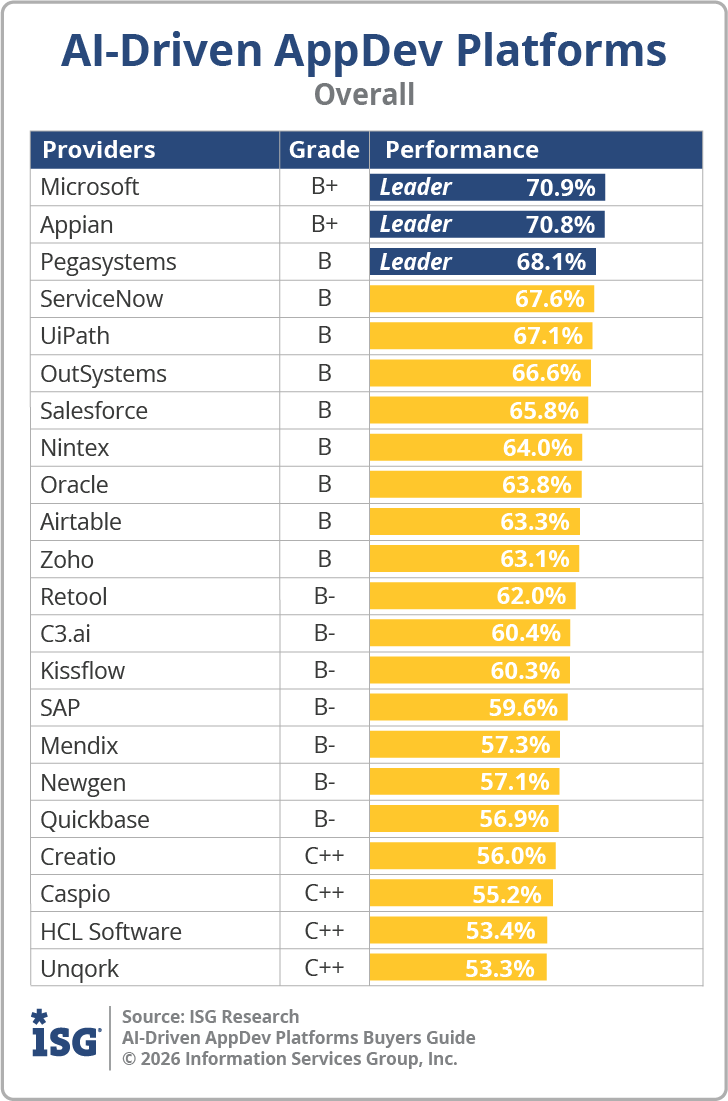 The research finds Microsoft atop the list, followed by Appian and Pegasystems. Providers that place in the top three of a category earn the designation of Leader. Appian and Microsoft have done so in four categories, OutSystems and Pegasystems in two categories, and Nintex, Oracle and ServiceNow in one category.
The overall representation of the research below places the rating of the Product Experience and Customer Experience on the x and y axes, respectively, to provide a visual representation and classification of the software providers. Those providers whose Product Experience have above median weighted performance to the axis in aggregate of the two product categories place farther to the right, while the performance and weighting for the Customer Experience category determines placement on the vertical axis. In short, software providers that place closer to the upper-right on this chart performed better than those closer to the lower-left.
The research categorizes and rates software providers into one of four categories: Assurance, Exemplary, Merit or Innovative. This representation of software providers’ weighted performance in meeting the requirements in product and customer experience.
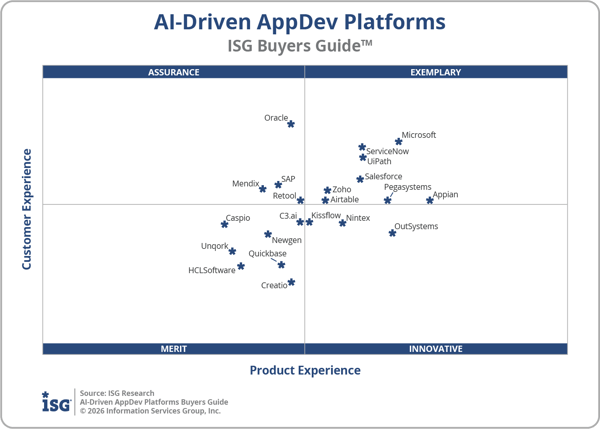
Exemplary: This rating (upper right) represents those that performed above median in Product and Customer Experience requirements. The providers rated Exemplary are: Airtable, Appian, Microsoft, Pegasystems, Salesforce, ServiceNow, UiPath and Zoho.
Innovative: This rating (lower right) represents those that performed above median in Product Experience but not in Customer Experience. The providers rated Innovative are: Kissflow, Nintex and OutSystems.
Assurance: This rating (upper left) represents those that performed above median in Customer Experience but not in Product Experience. The providers rated Assurance are: Mendix, Oracle, Retool and SAP.
Merit: This rating (lower left) represents those that did not surpass the median in Customer or Product Experience. The providers rated Merit are: C3.ai, Caspio, Creatio, HCLSoftware, Newgen, Quickbase and Unqork.
We advise enterprises to use this research as a supplement to their own evaluations, recognizing that ratings or rankings do not solely represent the value of a provider nor indicate universal suitability of a set of products.
Product Experience
 The process of researching products to address an enterprise’s needs should be comprehensive and evaluate specific capabilities and the underlying platform to the product experience. Our evaluation of the Product Experience examines the lifecycle of onboarding, configuration, operations, usage and maintenance. Too often, software providers are not evaluated for the entirety of the product; instead, they are evaluated on market execution and vision of the future.
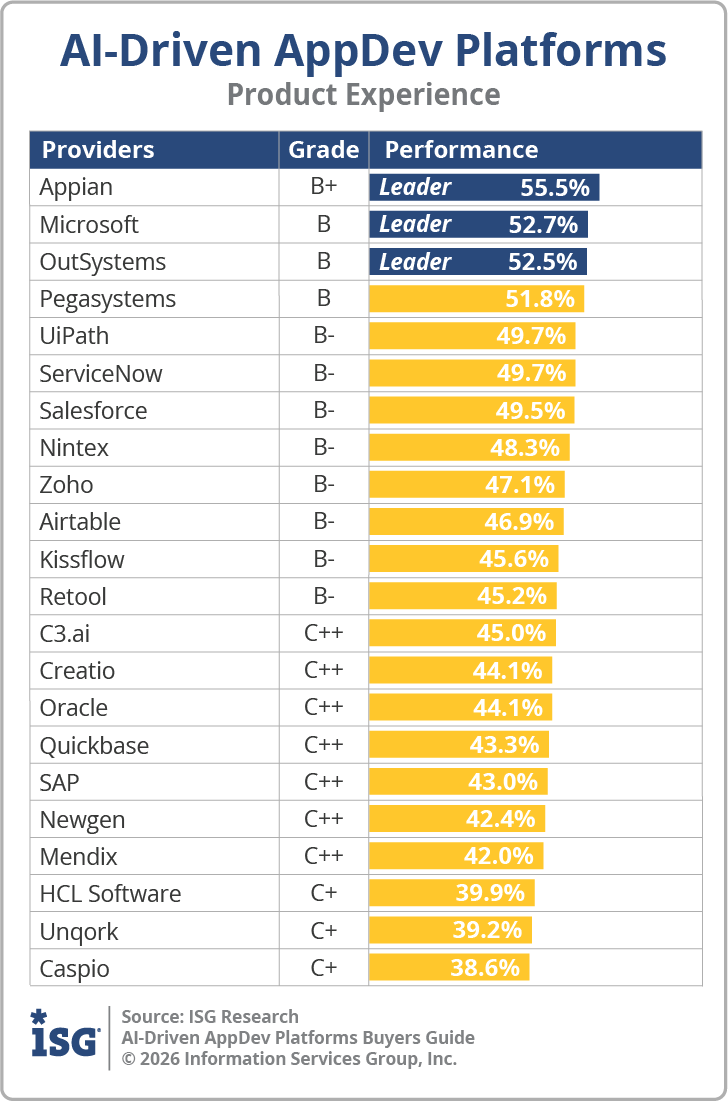
The research results in Product Experience are ranked at 80%, or four-fifths, using the underlying weighted performance. Importance was placed on the categories as follows: Capability (40%) and Platform (40%). Appian, Microsoft and OutSystems were designated Product Experience Leaders.
Customer Experience
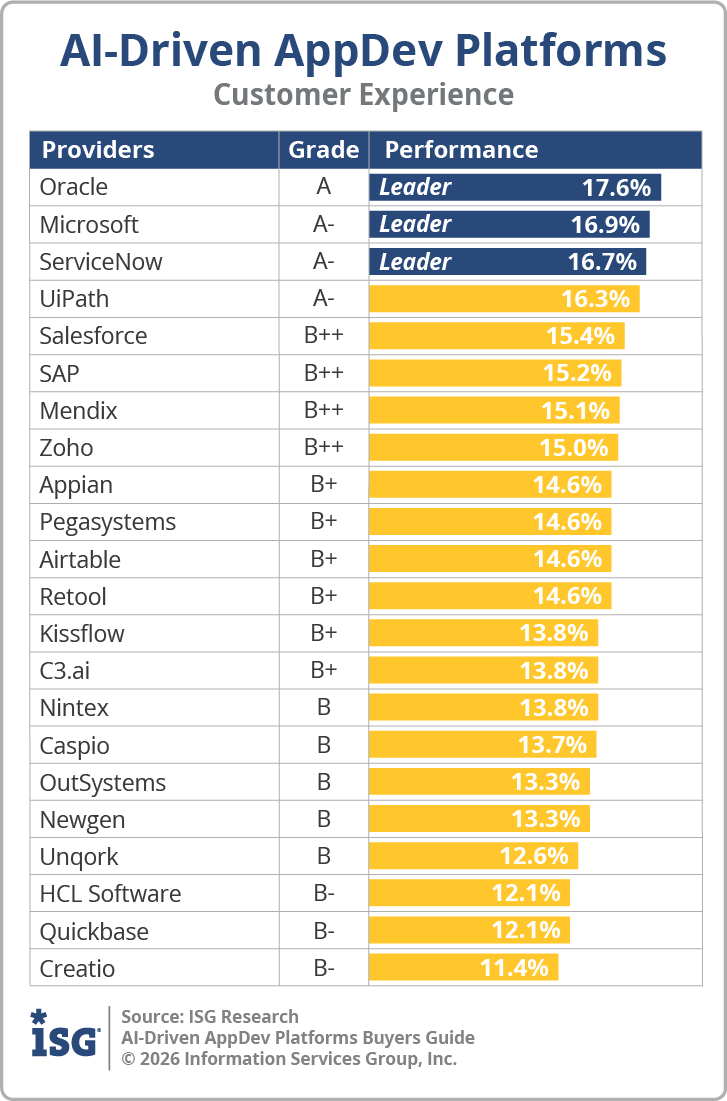 The importance of a customer relationship with a software provider is essential to the actual success of the products and technology. The evaluation of the Customer Experience and the entire lifecycle an enterprise has with its software provider is critical for ensuring satisfaction in working with that provider. The ISG Buyers Guide examines a software provider’s customer commitment, viability, customer success, sales and onboarding, product roadmap and services with partners and support. The customer experience category also investigates the TCO/ROI and how well a software provider demonstrates the product’s overall value, cost and benefits, including the tools and resources to evaluate these factors.
The research results in Customer Experience are ranked at 20%, or one-fifth of the 100% index, and represent the underlying provider validation and TCO/ROI requirements as they relate to the framework of commitment and value to the software provider-customer relationship.
The software providers that evaluated the highest in the Customer Experience category are Oracle, Microsoft and ServiceNow. These category Leaders best communicate commitment and dedication to customer needs.
Software providers that did not perform well in this category were unable to provide or make sufficient information readily available to demonstrate success or articulate their commitment to customer experience. The use of a software provider requires continuous investment, so a holistic evaluation must include examination of how they support their customer experience.
Software Provider Inclusion – AI-Driven AppDev Platforms
For inclusion in the 2026 ISG Buyers Guide™ for AI-Driven AppDev Platforms, a software provider must be in good standing financially and ethically, have at least $30 million in annual or projected revenue verified using independent sources, sell products and provide support on at least two continents, and have at least 250 full-time employees. The principal source of the relevant business unit’s revenue must be software-related, and there must have been at least one major software release in the last 12 months.
The research is designed to be independent of the specifics of software provider packaging and pricing. To represent the real-world environment in which businesses operate, we include providers that offer suites or packages of products that may include relevant individual modules or applications. If a software provider is actively marketing, selling and developing a product for the general market and it is reflected on the provider’s website that the product is within the scope of the research, that provider is automatically evaluated for inclusion.
All software providers that offer relevant products and meet the inclusion requirements were invited to participate in the evaluation process at no cost to them.
Software providers that meet our inclusion criteria but did not completely participate in our Buyers Guide were assessed solely on publicly available information. As this could have a significant impact on classification and ratings, we recommend additional scrutiny when evaluating those providers.
Products Evaluated
| Provider | Product Names | Version | Release Month/Year |
|---|---|---|---|
| Airtable | Airtable with Omni AI | N/A | June 2025 |
| Appian | Appian Platform | 25.4 | November 2025 |
| C3.ai | C3 Agentic AI Platform | 8.8 | July 2025 |
| Caspio | AI Assistant | 67.0 | December 2025 |
| Creatio | Creatio Studio | Creatio 8.3.1 Twin | October 2025 |
| HCLSoftware | HCL Volt MX | Volt Iris | November 2025 |
| Kissflow | Kissflow AI-driven Low-code Platform | N/A | October 2025 |
| Mendix | Mendix Platform - Mx11 | 11 | June 2025 |
| Microsoft | Power Apps | 9.2 25084 | August 2025 |
| Newgen | NewgenONE Platform | 1002 | December 2025 |
| Nintex | Nintex Cloud Automation CE App Development | v17.10.6.0 | December 2025 |
| Oracle | Oracle APEX | 24.2 | January 2025 |
| OutSystems | OutSystems Developer Cloud (ODC) | N/A | December 2025 |
| Pegasystems | Pega Platform | N/A | August 2025 |
| Quickbase | Smart Builder | N/A | July 2025 |
| Retool | Retool | 3.300.0 | December 2025 |
| Salesforce | Agentforce 360 Platform | Winter ’26 | September 2025 |
| SAP | SAP Build Process Automation | November 2025 | November 2025 |
| ServiceNow | Now Assist for Creator | 28.2.0 (Zurich Patch 2) | October 2025 |
| UiPath | Business Automation Platform | 2025.8.1 | September 2025 |
| Unqork | Unqork regenerative application platform | 7.28.0 | November 2025 |
| Zoho | Zoho Creator | N/A | November 2025 |
AI-Driven DevOps Platforms
Over the next 12 to 24 months, CIOs and IT leaders will prioritize reliability, security and delivery speed at scale as software delivery extends deeper into hybrid and multicloud environments built on containers and microservices. Talent constraints in DevOps and Site Reliability Engineering (SRE), growing software supply chain risk and tighter governance expectations are driving enterprises to standardize platform engineering and automate across the DevOps lifecycle. Organizations are consolidating fragmented toolchains, expanding Infrastructure-as-Code (IaC) and GitOps practices, and increasing focus on DORA and SRE metrics tied to business outcomes. Advances in machine learning (ML), generative AI (GenAI) and agentic AI are raising expectations for predictive incident management, proactive capacity optimization and automated policy enforcement, increasing demand for platforms that embed AI within DevOps workflows under consistent operational guardrails.
 ISG Research defines AI-Driven DevOps platforms as software platforms that provide native automation and infrastructure capabilities to support ongoing operations for enterprise developers and SRE teams. These platforms support continuous integration and delivery, IaC and environment management, automation and orchestration, monitoring, logging and observability, security, compliance and secrets management, collaboration and workflow management, role-based access control and Policy-as-Code, multicloud and container orchestration and disaster recovery. AI-Driven DevOps platforms enhance these native capabilities using ML, GenAI and agentic AI to improve delivery speed, reliability, security and cost efficiency without reliance on outsourced services.
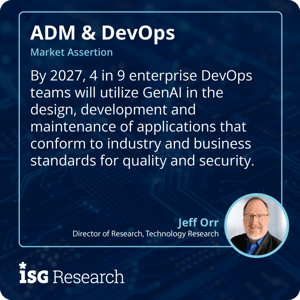
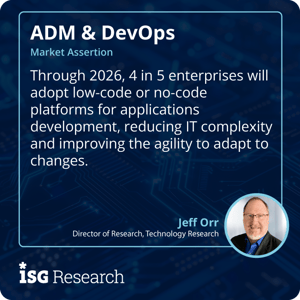
AI-Driven DevOps platforms are industry-agnostic and particularly valuable in sectors with strict uptime, security and audit requirements such as financial services, healthcare, telecom and the public sector. They are best suited for large enterprises operating Kubernetes-based workloads across hybrid and multicloud estates, with established CI/CD pipelines and platform engineering functions seeking unified governance and end-to-end automation. Prerequisites for success include mature IaC practices, standardized pipelines with artifact provenance and software bill of materials (SBOM) generation, consolidated observability telemetry mapped to service-level indicators (SLIs) and service-level objectives (SLOs), robust secrets management and adoption of Policy-as-Code for consistent controls. Effective adoption often begins with AI-assisted observability, incident classification and change risk analysis, followed by supervised automation and progressive remediation. By 2027, 4 in 9 enterprise DevOps teams will utilize GenAI in the design, development and maintenance of applications that conform to industry and business standards for quality and security.
AI-Driven DevOps platforms evolved from the convergence of agile development, CI/CD, IaC and cloud-native architectures. As enterprises adopted microservices and multicloud environments, operational complexity increased and drove adoption of GitOps, service meshes and comprehensive observability. In parallel, SRE practices formalized reliability targets and incident response, elevating uptime, change risk and recovery time to executive-level concerns. These shifts pushed organizations toward more integrated DevOps platforms capable of standardizing workflows and enforcing governance across environments.
The integration of AI has accelerated this evolution. Platforms now apply AI to detect anomalies, infer root cause, score change risk, optimize capacity and cost and enforce operational policies. This progression is moving DevOps from reactive operations toward proactive, automated execution supported by guardrails that align security, compliance and performance. AI capabilities increasingly connect operational telemetry to business outcomes, enabling faster response and improved reliability without increasing risk.
To safely apply AI, IT leaders require defined usage policies, model lifecycle management and human oversight for risk-sensitive actions.
Enterprises require DevOps platforms that support reliability, security and speed simultaneously. This begins with standardized pipelines, artifact provenance and SBOM generation to secure the software supply chain, along with IaC and GitOps practices that ensure consistent environments. Unified observability is essential, combining metrics, logs and traces mapped to SLIs and SLOs so teams can link operational health to customer experience and cost. Policy-as-Code and automated controls enable compliance without slowing delivery.
To safely apply AI, IT leaders require defined usage policies, model lifecycle management and human oversight for risk-sensitive actions. AI capabilities must integrate directly with CI/CD, Kubernetes orchestration, environment management and incident workflows to deliver measurable improvements in mean time to detect, mean time to resolve, change failure rate and cost efficiency. FinOps visibility is also critical as automation increases deployment frequency and resource consumption.
Successful AI-Driven DevOps platforms deliver cohesive, native capabilities across the operational lifecycle. These include CI/CD, IaC and environment management, automation and orchestration, monitoring, logging and observability, security and secrets management, RBAC and Policy-as-Code, multicloud and container orchestration and disaster recovery. AI augments these capabilities through predictive alerting, noise reduction, root-cause inference, change risk scoring, capacity optimization and supervised remediation under policy controls.
Prioritize AI-Driven DevOps platforms that combine strong native automation with standards-based interoperability, unified observability and enterprise-grade security.
Interoperability and governance remain essential. Platforms must expose robust APIs and event streams, integrate with major cloud and Kubernetes ecosystems and support artifact signing, vulnerability management and auditability. Effective adoption is phased, starting with AI-assisted observability and incident triage and expanding to policy-bound automation as maturity increases. Cost transparency, scalability and reliability at enterprise scale are required to sustain outcomes.
Enterprises should prioritize AI-Driven DevOps platforms that combine strong native automation with standards-based interoperability, unified observability and enterprise-grade security. Evaluate providers for IaC and GitOps maturity, SBOM and artifact provenance, Policy-as-Code adoption and measurable improvement in DORA and SRE metrics. Adopt AI incrementally under clear governance, establish platform engineering and SRE practices and require transparency in cost and compliance controls to support reliable delivery across hybrid and multicloud environments.
The 2026 ISG Buyers Guide™ for AI-Driven DevOps Platforms evaluates software providers across key areas including CI/CD, IaC and environment management, automation and orchestration, monitoring, logging and observability, security, compliance and secrets management, collaboration and workflow management, RBAC and Policy-as-Code, multicloud and container orchestration and disaster recovery. This research evaluates the following software providers: Atlassian, AWS, Copado, Digital.ai, GitLab, Google Cloud, HCLSoftware, IBM, JetBrains, JFrog, Microsoft and Red Hat.
Key Takeaways
AI-Driven DevOps platforms are evolving from fragmented toolchains into integrated, platform-engineered environments that standardize delivery, reliability and governance across hybrid and multicloud estates. As containerized and microservices-based architectures scale, enterprises are consolidating CI/CD, IaC and observability under unified operational models. Embedded AI is accelerating this shift by enabling predictive operations and automation while reinforcing security, compliance and reliability guardrails.
Software Provider Summary
The ISG Buyers Guide™ for AI-Driven DevOps Platforms evaluates 12 software providers offering products supporting continuous delivery, infrastructure automation, observability and secure operations with embedded AI. The research ranked the top three overall leaders as Microsoft, Google Cloud and AWS. Providers were classified using weighted performance in Product Experience and Customer Experience for ISG quadrant placement. AWS, Copado, Google Cloud and Microsoft were rated as Exemplary, with Atlassian and Red Hat rated as Innovative. GitLab, JetBrains and JFrog were rated as Assurance; and Digital.ai, HCLSoftware and IBM were rated as Merit.
Product Experience Insights
Product Experience, representing 80% of the evaluation, focuses on Capability (40%) and Platform (40%), which includes adaptability, manageability, reliability and usability. Microsoft, Google Cloud and AWS achieved the highest performance as Leaders in this category, supported by mature CI/CD and IaC automation and scalable, cloud-native platform reliability across complex environments. Leaders demonstrated enterprise-grade platform capabilities applicable across varied roles and operational contexts.
Customer Experience Value
Customer Experience, representing 20% of the evaluation, focuses on validation and TCO/ROI. GitLab, Microsoft and JFrog were the Leaders in this category, showing strong customer advocacy and clear investment in success outcomes. Providers with lower performance often lacked publicly available customer validation or failed to demonstrate structured ROI measurement and proactive lifecycle engagement.
Strategic Recommendations
Enterprises should prioritize AI-Driven DevOps platforms that unify delivery automation, observability and governance under standardized platform engineering and SRE practices. Buyers should evaluate providers for IaC and GitOps maturity, artifact provenance and SBOM support and embedded policy controls that secure the software supply chain. AI adoption should be incremental and governed, using measurable improvements in DORA and SRE metrics to balance speed, reliability and cost across hybrid and multicloud environments.
The Findings – AI-Driven DevOps Platforms
The software providers and products evaluated in the research provide product and customer experiences, but not everything offered is equally valuable to every enterprise or is needed to operate in business processes and use cases. Moreover, the existence of too many capabilities in products may be a negative factor for an enterprise if it introduces unnecessary complexity. Nonetheless, you may decide that a more comprehensive set of capabilities in the product is important, and where they match your enterprise’s requirements.
An effective customer relationship with a software provider is vital to the success of any investment. The overall customer experience and the full lifecycle of engagement play a key role in ensuring satisfaction and long-term success. Providers with dedicated customer leadership, such as chief customer officers, tend to invest more deeply in these relationships and prioritize customer outcomes to TCO and ROI expectations. It is equally important that this commitment to customer success is clearly demonstrated throughout the provider’s website, buying process and customer journey.
Overall Scoring of Software Providers Across Categories
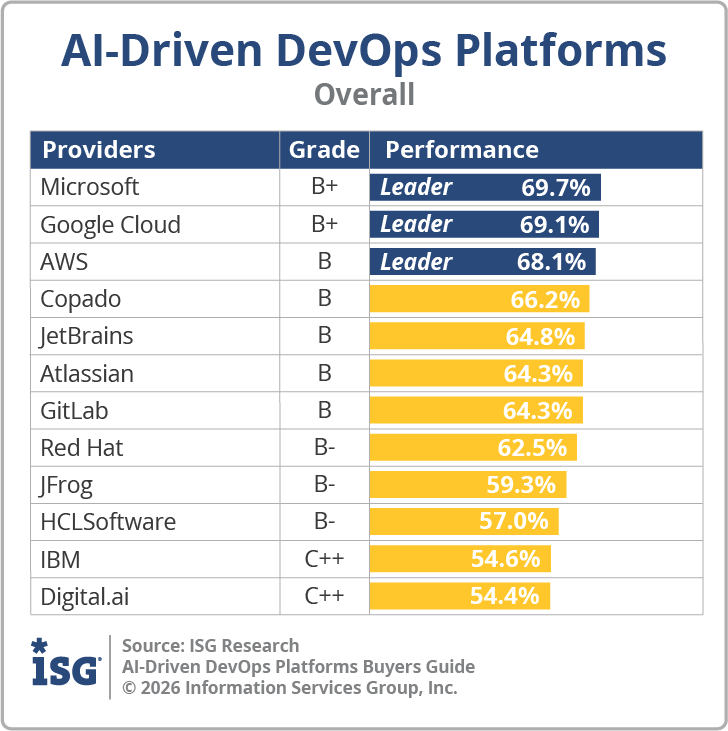 The research finds Microsoft atop the list, followed by Google Cloud and AWS. Providers that place in the top three of a category earn the designation of Leader. Microsoft has done so in four categories; AWS and Google Cloud in three; GitLab in two; and Copado, JetBrains and JFrog in one category.
The overall representation of the research below places the rating of the Product Experience and Customer Experience on the x and y axes, respectively, to provide a visual representation and classification of the software providers. Those providers whose Product Experience have above median weighted performance to the axis in aggregate of the two product categories place farther to the right, while the performance and weighting for the Customer Experience category determines placement on the vertical axis. In short, software providers that place closer to the upper-right on this chart performed better than those closer to the lower-left.
The research categorizes and rates software providers into one of four categories: Assurance, Exemplary, Merit or Innovative. This representation of software providers’ weighted performance in meeting the requirements in product and customer experience.
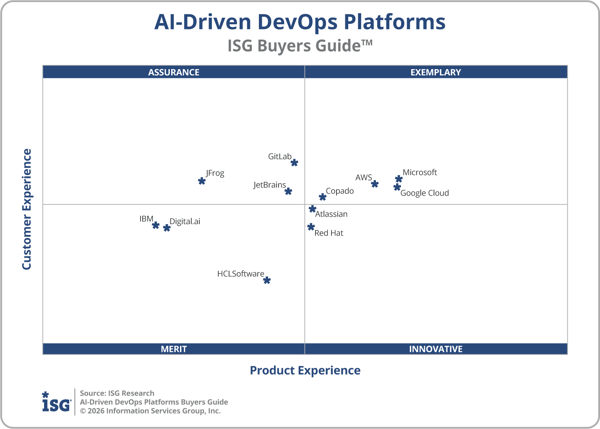
Exemplary: This rating (upper right) represents those that performed above median in Product and Customer Experience requirements. The providers rated Exemplary are: AWS, Copado, Google Cloud and Microsoft.
Innovative: This rating (lower right) represents those that performed above median in Product Experience but not in Customer Experience. The providers rated Innovative are: Atlassian and Red Hat.
Assurance: This rating (upper left) represents those that performed above median in Customer Experience but not in Product Experience. The providers rated Assurance are: GitLab, JetBrains and JFrog.
Merit: This rating (lower left) represents those that did not surpass the median in Customer or Product Experience. The providers rated Merit are: Digital.ai, HCLSoftware and IBM.
We advise enterprises to use this research as a supplement to their own evaluations, recognizing that ratings or rankings do not solely represent the value of a provider nor indicate universal suitability of a set of products.
Product Experience
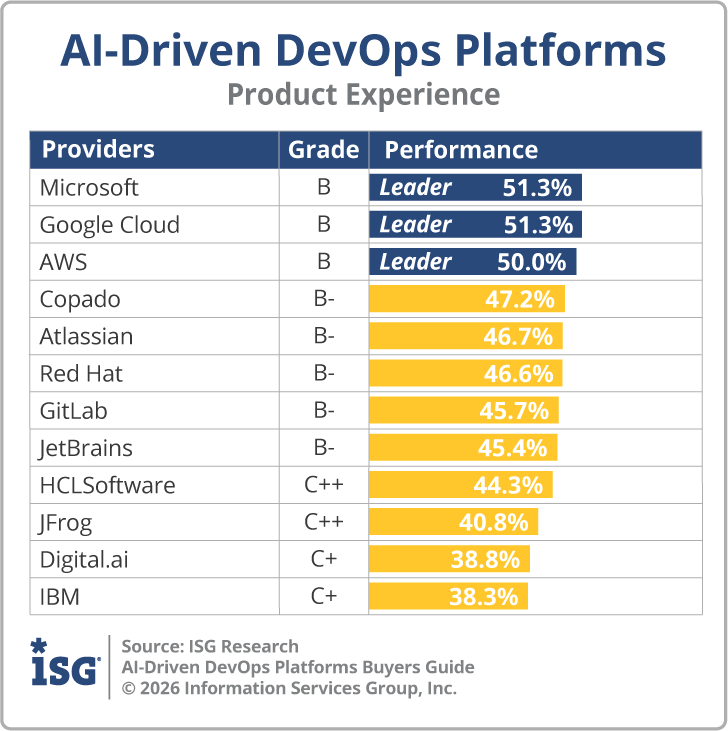 The process of researching products to address an enterprise’s needs should be comprehensive and evaluate specific capabilities and the underlying platform to the product experience. Our evaluation of the Product Experience examines the lifecycle of onboarding, configuration, operations, usage and maintenance. Too often, software providers are not evaluated for the entirety of the product; instead, they are evaluated on market execution and vision of the future.
The research results in Product Experience are ranked at 80%, or four-fifths, using the underlying weighted performance. Importance was placed on the categories as follows: Capability (40%) and Platform (40%). Microsoft, Google Cloud and AWS were designated Product Experience Leaders.
Customer Experience
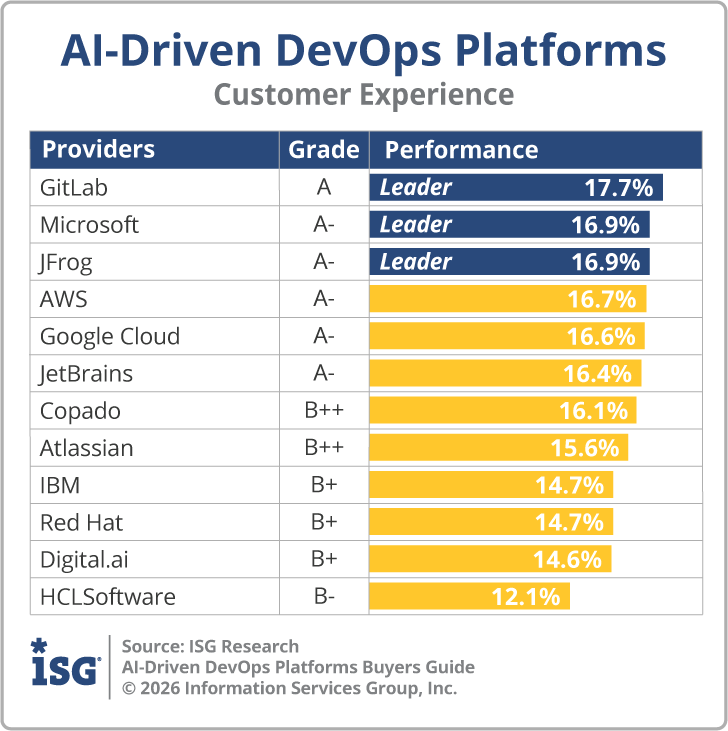 The importance of a customer relationship with a software provider is essential to the actual success of the products and technology. The evaluation of the Customer Experience and the entire lifecycle an enterprise has with its software provider is critical for ensuring satisfaction in working with that provider. The ISG Buyers Guide examines a software provider’s customer commitment, viability, customer success, sales and onboarding, product roadmap and services with partners and support. The customer experience category also investigates the TCO/ROI and how well a software provider demonstrates the product’s overall value, cost and benefits, including the tools and resources to evaluate these factors.
The research results in Customer Experience are ranked at 20%, or one-fifth of the 100% index, and represent the underlying provider validation and TCO/ROI requirements as they relate to the framework of commitment and value to the software provider-customer relationship.
The software providers that evaluated the highest in the Customer Experience category are GitLab, Microsoft and JFrog. These category Leaders best communicate commitment and dedication to customer needs.
Software providers that did not perform well in this category were unable to provide or make sufficient information readily available to demonstrate success or articulate their commitment to customer experience. The use of a software provider requires continuous investment, so a holistic evaluation must include examination of how they support their customer experience.
Software Provider Inclusion – AI-Driven DevOps Platforms
For inclusion in the 2026 ISG Buyers Guide™ for AI-Driven DevOps Platforms, a software provider must be in good standing financially and ethically, have at least $150 million in annual or projected revenue verified using independent sources, sell products and provide support on at least two continents, and have at least 500 full-time employees. The principal source of the relevant business unit’s revenue must be software-related, and there must have been at least one major software release in the last 12 months.
The research is designed to be independent of the specifics of software provider packaging and pricing. To represent the real-world environment in which businesses operate, we include providers that offer suites or packages of products that may include relevant individual modules or applications. If a software provider is actively marketing, selling and developing a product for the general market and it is reflected on the provider’s website that the product is within the scope of the research, that provider is automatically evaluated for inclusion.
All software providers that offer relevant products and meet the inclusion requirements were invited to participate in the evaluation process at no cost to them.
Software providers that meet our inclusion criteria but did not completely participate in our Buyers Guide were assessed solely on publicly available information. As this could have a significant impact on classification and ratings, we recommend additional scrutiny when evaluating those providers.
Products Evaluated
| Provider | Product Names | Version | Release Month/Year |
|---|---|---|---|
| Atlassian | Atlassian Open DevOps | Atlassian Cloud release | November 2025 |
| AWS | Amazon Q Developer | N/A | November 2025 |
| Copado | Copado DevOps Platform for Salesforce | N/A | October 2025 |
| Digital.ai | Digital.ai AI-Powered DevOps Platform | N/A | October 2025 |
| GitLab | GitLab Duo | 18.6 | November 2025 |
| Google Cloud | Google Cloud DevOps Solutions | N/A | May 2025 |
| HCLSoftware | HCL DevOps Velocity | 5.2.0 | December 2025 |
| IBM | IBM DevOps UrbanCode | 8.2.0 | December 2025 |
| JetBrains | JetBrains TeamCity | 252.26199.202 | October 2025 |
| JFrog | JFrog DevOps | N/A | March 2025 |
| Microsoft | Azure DevOps Services | N/A | October 2025 |
| Red Hat | Red Hat OpenShift | N/A | November 2025 |
Executive Summary
Buyers Guide Overview
ISG Research has conducted market research for over two decades across vertical industries, business applications, AI and IT. We have designed the ISG Buyers Guide™ to provide a balanced perspective of software providers and products that is rooted in an understanding of business and IT requirements. Utilization of our research methodology and decades of experience enables our Buyers Guide to be an effective method to assess and select software providers and products. The findings of this research provide a comprehensive approach to rating software providers and rank their ability to meet specific product and customer experience requirements.
ISG Research has designed the Buyers Guide to provide a balanced perspective of software providers and products that is rooted in an understanding of business and IT requirements.
The 2026 ISG Buyers Guides™ for AI-Driven Development Platforms, covering AI-Driven AppDev Platforms and AI-Driven DevOps Platforms, are the distillation of continuous market and product research. It is an assessment of how well software providers’ offerings address enterprises’ requirements for AI-driven development platforms. The Value Index methodology is structured to support a request for information (RFI) for a request for proposal (RFP) process by incorporating all criteria needed to evaluate, select, utilize and maintain relationships with software providers. The ISG Buyers Guide evaluates customer experience and the product experience in its capability and platform.
The structure of the research reflects our understanding that the effective evaluation of software providers and products involves far more than just examining product features, potential revenue or customers generated from a provider’s marketing and sales efforts. It can ensure the best long-term relationship and value achieved from a resource and financial investment We believe it is important to take a comprehensive, research-based approach, since making the wrong choice of AI-driven development platforms can raise the total cost of ownership, lower the return on investment and hamper an enterprise’s ability to reach its potential. In addition, this approach can reduce the project’s development and deployment time and eliminate the risk of relying on opinions or historical biases.
ISG Research believes that an objective review of existing and potential new software providers and products is a critical strategy for the adoption and implementation of AI-driven development platform software. An enterprise’s review should include an analysis of both what is possible and what is relevant. We urge enterprises to do a thorough job of evaluating AI-driven development platforms and offer these Buyers Guides as both the results of our in-depth analysis of these providers and as an evaluation methodology.
How To Use This Buyers Guide
Evaluating Software Providers: The Process
We recommend using the Buyers Guide to assess and evaluate new or existing software providers for your enterprise. The market research can be used as an evaluation framework to assess existing approaches and software providers or establish a formal request for information from providers on products and customer experience and will shorten the cycle time when creating an RFI. The steps listed below provide a process that can facilitate best possible outcomes in the most efficient manner.
- Define the business case and goals.
Define the mission and business case for investment and the expected outcomes from your organizational and technological efforts. - Specify the business and IT needs.
Defining the business and IT requirements helps identify what specific capabilities are required with respect to people, processes, information and technology. - Assess the required roles and responsibilities.
Identify the individuals required for success at every level of the enterprise from executives to frontline workers and determine the needs of each. - Outline the project’s critical path.
What needs to be done, in what order and who will do it? This outline should make clear the prior dependencies at each step of the project plan. - Ascertain the technology approach.
Determine the business and technology approach that most closely aligns to your enterprise’s requirements. - Establish software provider evaluation criteria.
Utilize the product experience: capability and platform with support for adaptability, manageability, reliability and usability, and the customer experience in TCO/ROI and Validation. - Evaluate and select the software provider and products properly.
Apply a weighting the evaluation categories in the evaluation criteria to reflect your enterprise’s priorities to determine the short list of software providers and products. - Establish the business initiative team to start the project.
Identify who will lead the project and the members of the team needed to plan and execute it with timelines, priorities and resources.
Using the ISG Buyers Guide and process provides enterprises a clear, structured approach to making smarter software and business investment decisions. It ensures alignment between strategy, people, processes and technology while reducing risk, saving time, and improving outcomes. The ISG approach promotes data-driven decision-making and collaboration, helping choose the right software providers for maximum value and return on investment.
AI-Driven AppDev Platforms
Over the next 12 to 24 months, CIOs and IT leaders will face increasing pressure to deliver more software faster while improving quality, governance and compliance across hybrid and multicloud environments. Enterprises are modernizing core systems, expanding software-as-a-service (SaaS) portfolios and embedding artificial intelligence (AI) into business processes at scale. As application estates grow more complex, fragmented development toolchains and inconsistent lifecycle governance have become barriers to productivity and risk management. In response, organizations are consolidating development stacks under platform engineering, formalizing API- and event-driven architectures, and standardizing interoperability, security and telemetry. Advances in machine learning (ML), generative AI (GenAI) and agentic AI are accelerating developer productivity, test coverage, documentation and lifecycle visibility, increasing demand for platforms that embed AI directly into application development and delivery workflows.
AppDev platforms provide a unified environment where requirements, design, development, testing and governance remain tightly connected.
ISG Research defines AI-Driven AppDev platforms as integrated, enterprise-grade software platforms that unify and orchestrate end-to-end software development lifecycle capabilities. These capabilities include requirements management and traceability, design and documentation, project and task management, source code and artifact version control, testing, release planning, lifecycle governance, collaboration, analytics, workflow automation and integration, and security and access controls. AI-Driven AppDev platforms enhance these native capabilities through ML, GenAI and agentic AI to automate, assist and continuously improve application delivery without reliance on outsourced or managed services.
AI-Driven AppDev platforms prioritize the integrity and governance of the application itself. While DevOps tools focus on pipeline execution and infrastructure automation, AppDev platforms center on application logic, data and business value. They provide a unified environment where requirements, design, development, testing and governance remain tightly connected, ensuring traceability from initial business intent through deployment. This approach reduces rework, prevents drift between design and implementation and strengthens auditability across regulated and mission-critical applications.
For enterprise IT leaders, these platforms function as the central factory for application delivery. Disconnected workflows are replaced with shared workspaces where planning, development, testing and release governance occur in a coordinated manner. Changes to business rules or requirements propagate directly into backlogs, test plans and deployment workflows, reducing manual handoffs and improving delivery consistency. For business leadership, this translates into greater predictability, improved visibility into application health and clearer alignment between software delivery and business outcomes.
AI-Driven AppDev platforms are industry-agnostic but see strong adoption in regulated and compliance-intensive sectors such as financial services, healthcare and the public sector. They are best suited for large enterprises operating multiple development teams across hybrid and multicloud environments with established platform engineering and governance functions. Prerequisites for success include standardized development workflows, robust version control and artifact repositories, clean and well-labeled project data to support AI models, defined policies for responsible AI use and integration maturity through APIs and event streams. Effective adoption often follows a phased approach, introducing AI-assisted capabilities such as code generation, test automation and documentation synthesis incrementally, while using value stream metrics to measure productivity, quality, compliance and cost. Through 2026, 4 in 5 enterprises will adopt low-code or no-code platforms for application development, reducing IT complexity and improving the agility to adapt to change.
The category has evolved from fragmented application lifecycle management toolchains toward unified, platform-engineered environments that integrate the full software development lifecycle (SDLC). Early gains from CI/CD, Infrastructure-as-Code (IaC) and microservices improved delivery speed but introduced complexity and governance gaps across distributed environments. As enterprises scaled, they moved to consolidate tooling, standardize architectures and establish end-to-end traceability. The infusion of AI has accelerated this consolidation, shifting the category from tool aggregation to intelligent orchestration of application delivery.
Enterprises now require platforms that shorten time-to-market while sustaining reliability, security and compliance. This requires unified lifecycle management supported by standardized identity, secrets management, network policy and Policy-as-Code. Interoperability remains critical. Platforms must support API-first and event-driven integration, GitOps and IaC practices, and adherence to widely recognized standards to reduce integration complexity and improve portability across environments.
To connect engineering performance to business outcomes, organizations need embedded telemetry mapped to service-level indicators (SLIs), service-level objectives (SLOs) and value stream metrics such as DORA and Site Reliability Engineering (SRE) measures. Analytics should link delivery health to cost, risk and customer experience. AI capabilities must operate under clear guardrails, including usage policies, model lifecycle management and human-in-the-loop oversight, ensuring automation improves throughput and quality without compromising compliance, privacy or supply-chain integrity.
Successful AI-Driven AppDev platforms deliver cohesive, native capabilities across the SDLC.
Successful AI-Driven AppDev platforms deliver cohesive, native capabilities across the SDLC. These include requirements and traceability, design and documentation, project and task management, source and artifact version control with provenance and software bills of materials, testing and release planning, lifecycle governance, collaboration and analytics, CI/CD, IaC and environment management, monitoring and observability, RBAC and Policy-as-Code, security and compliance, secrets management, multicloud and container orchestration, and disaster recovery. AI enhances productivity and decision-making across development and operations while remaining governed, auditable and measurable.
Equally important are standards-based interoperability and enterprise-grade control. Platforms must expose robust APIs and event streams, support open protocols and integrate with ERP, CRM, data platforms and security tooling. Governance should include audit-ready controls, least-privilege access, artifact signing, vulnerability management and data privacy controls. Effective adoption is phased, beginning with reference architectures and progressing through incremental AI enablement validated by consistent metrics.
Enterprises should prioritize AI-Driven AppDev platforms that unify the SDLC under embedded AI, lifecycle governance and standards-based interoperability. Evaluate providers for end-to-end native capabilities, policy consistency, artifact provenance and measurable improvements against value stream and reliability metrics. Establish platform engineering to enforce governance and reuse, and require transparency in cost and compliance controls to sustain outcomes at enterprise scale.
The 2026 ISG Buyers Guide™ for AI-Driven AppDev Platforms evaluates software providers across key areas including requirements management and traceability, design and documentation, project and task management, source and artifact version control, test management, release planning and lifecycle governance, collaboration and knowledge management, analytics dashboards, workflow automation and integration, security and access controls and user experiences spanning no-code, low-code and pro-code environments. This research evaluates the following software providers: Airtable, Appian, C3.ai, Caspio, Creatio, HCLSoftware, Kissflow, Mendix, Microsoft, Newgen, Nintex, Oracle, OutSystems, Pegasystems, Quickbase, Retool, Salesforce, SAP, ServiceNow, UiPath, Unqork and Zoho.
Key Takeaways
AI-Driven AppDev platforms are consolidating fragmented development toolchains into unified, enterprise-grade environments that govern the full SDLC under embedded AI. As hybrid and multicloud application estates expand, enterprises are standardizing platforms to improve traceability, interoperability and lifecycle control. Embedded AI is accelerating delivery efficiency and visibility while reinforcing governance across regulated and mission-critical applications.
Software Provider Summary
The ISG Buyers Guide™ for AI-Driven AppDev Platforms evaluates 22 software providers offering products supporting end-to-end application development, delivery and lifecycle governance with embedded AI capabilities. The research ranked the top three overall leaders as Microsoft, Appian and Pegasystems. Providers were classified using weighted performance in Product Experience and Customer Experience for ISG quadrant placement. Airtable, Appian, Microsoft, Pegasystems, Salesforce, ServiceNow, UiPath and Zoho were rated as Exemplary, with Kissflow, Nintex and OutSystems rated as Innovative. Mendix, Oracle, Retool and SAP were rated as Assurance; and C3.ai, Caspio, Creatio, HCLSoftware, Newgen, Quickbase and Unqork were rated as Merit.
Product Experience Insights
Product Experience, representing 80% of the evaluation, focuses on Capability (40%) and Platform (40%), which includes adaptability, manageability, reliability and usability. Appian, Microsoft and OutSystems achieved the highest performance as Leaders in this category, supported by breadth across AI-enabled SDLC capabilities and strong enterprise platform foundations spanning governance, scalability and usability. Leaders demonstrated enterprise-grade platform capabilities applicable across varied roles and deployment contexts.
Customer Experience Value
Customer Experience, representing 20% of the evaluation, focuses on validation and TCO/ROI. Microsoft, Oracle and ServiceNow were the Leaders in this category, showing strong customer advocacy and clear investment in successful outcomes. Providers with lower performance often lacked publicly available customer validation or failed to demonstrate structured ROI measurement and proactive lifecycle engagement.
Strategic Recommendations
Enterprises should treat AI-Driven AppDev platforms as strategic foundations for unifying application delivery, governance and AI enablement under a single operating model. Buyers should prioritize platforms with native end-to-end SDLC coverage, standards-based interoperability and embedded controls for policy, security and traceability. Establishing platform engineering discipline and phased AI adoption supported by value stream and reliability metrics will help organizations scale productivity gains while sustaining compliance and audit readiness.
The Findings – AI-Driven AppDev Platforms
The software providers and products evaluated in the research provide product and customer experiences, but not everything offered is equally valuable to every enterprise or is needed to operate in business processes and use cases. Moreover, the existence of too many capabilities in products may be a negative factor for an enterprise if it introduces unnecessary complexity. Nonetheless, you may decide that a more comprehensive set of capabilities in the product is important, and where they match your enterprise’s requirements.
An effective customer relationship with a software provider is vital to the success of any investment. The overall customer experience and the full lifecycle of engagement play a key role in ensuring satisfaction and long-term success. Providers with dedicated customer leadership, such as chief customer officers, tend to invest more deeply in these relationships and prioritize customer outcomes to TCO and ROI expectations. It is equally important that this commitment to customer success is clearly demonstrated throughout the provider’s website, buying process and customer journey.
Overall Scoring of Software Providers Across Categories
The research finds Microsoft atop the list, followed by Appian and Pegasystems. Providers that place in the top three of a category earn the designation of Leader. Appian and Microsoft have done so in four categories, OutSystems and Pegasystems in two categories, and Nintex, Oracle and ServiceNow in one category.
The overall representation of the research below places the rating of the Product Experience and Customer Experience on the x and y axes, respectively, to provide a visual representation and classification of the software providers. Those providers whose Product Experience have above median weighted performance to the axis in aggregate of the two product categories place farther to the right, while the performance and weighting for the Customer Experience category determines placement on the vertical axis. In short, software providers that place closer to the upper-right on this chart performed better than those closer to the lower-left.
The research categorizes and rates software providers into one of four categories: Assurance, Exemplary, Merit or Innovative. This representation of software providers’ weighted performance in meeting the requirements in product and customer experience.
Exemplary: This rating (upper right) represents those that performed above median in Product and Customer Experience requirements. The providers rated Exemplary are: Airtable, Appian, Microsoft, Pegasystems, Salesforce, ServiceNow, UiPath and Zoho.
Innovative: This rating (lower right) represents those that performed above median in Product Experience but not in Customer Experience. The providers rated Innovative are: Kissflow, Nintex and OutSystems.
Assurance: This rating (upper left) represents those that performed above median in Customer Experience but not in Product Experience. The providers rated Assurance are: Mendix, Oracle, Retool and SAP.
Merit: This rating (lower left) represents those that did not surpass the median in Customer or Product Experience. The providers rated Merit are: C3.ai, Caspio, Creatio, HCLSoftware, Newgen, Quickbase and Unqork.
We advise enterprises to use this research as a supplement to their own evaluations, recognizing that ratings or rankings do not solely represent the value of a provider nor indicate universal suitability of a set of products.
Product Experience
The process of researching products to address an enterprise’s needs should be comprehensive and evaluate specific capabilities and the underlying platform to the product experience. Our evaluation of the Product Experience examines the lifecycle of onboarding, configuration, operations, usage and maintenance. Too often, software providers are not evaluated for the entirety of the product; instead, they are evaluated on market execution and vision of the future.
The research results in Product Experience are ranked at 80%, or four-fifths, using the underlying weighted performance. Importance was placed on the categories as follows: Capability (40%) and Platform (40%). Appian, Microsoft and OutSystems were designated Product Experience Leaders.
Customer Experience
The importance of a customer relationship with a software provider is essential to the actual success of the products and technology. The evaluation of the Customer Experience and the entire lifecycle an enterprise has with its software provider is critical for ensuring satisfaction in working with that provider. The ISG Buyers Guide examines a software provider’s customer commitment, viability, customer success, sales and onboarding, product roadmap and services with partners and support. The customer experience category also investigates the TCO/ROI and how well a software provider demonstrates the product’s overall value, cost and benefits, including the tools and resources to evaluate these factors.
The research results in Customer Experience are ranked at 20%, or one-fifth of the 100% index, and represent the underlying provider validation and TCO/ROI requirements as they relate to the framework of commitment and value to the software provider-customer relationship.
The software providers that evaluated the highest in the Customer Experience category are Oracle, Microsoft and ServiceNow. These category Leaders best communicate commitment and dedication to customer needs.
Software providers that did not perform well in this category were unable to provide or make sufficient information readily available to demonstrate success or articulate their commitment to customer experience. The use of a software provider requires continuous investment, so a holistic evaluation must include examination of how they support their customer experience.
Software Provider Inclusion – AI-Driven AppDev Platforms
For inclusion in the 2026 ISG Buyers Guide™ for AI-Driven AppDev Platforms, a software provider must be in good standing financially and ethically, have at least $30 million in annual or projected revenue verified using independent sources, sell products and provide support on at least two continents, and have at least 250 full-time employees. The principal source of the relevant business unit’s revenue must be software-related, and there must have been at least one major software release in the last 12 months.
The research is designed to be independent of the specifics of software provider packaging and pricing. To represent the real-world environment in which businesses operate, we include providers that offer suites or packages of products that may include relevant individual modules or applications. If a software provider is actively marketing, selling and developing a product for the general market and it is reflected on the provider’s website that the product is within the scope of the research, that provider is automatically evaluated for inclusion.
All software providers that offer relevant products and meet the inclusion requirements were invited to participate in the evaluation process at no cost to them.
Software providers that meet our inclusion criteria but did not completely participate in our Buyers Guide were assessed solely on publicly available information. As this could have a significant impact on classification and ratings, we recommend additional scrutiny when evaluating those providers.
Products Evaluated
| Provider | Product Names | Version | Release Month/Year |
|---|---|---|---|
| Airtable | Airtable with Omni AI | N/A | June 2025 |
| Appian | Appian Platform | 25.4 | November 2025 |
| C3.ai | C3 Agentic AI Platform | 8.8 | July 2025 |
| Caspio | AI Assistant | 67.0 | December 2025 |
| Creatio | Creatio Studio | Creatio 8.3.1 Twin | October 2025 |
| HCLSoftware | HCL Volt MX | Volt Iris | November 2025 |
| Kissflow | Kissflow AI-driven Low-code Platform | N/A | October 2025 |
| Mendix | Mendix Platform - Mx11 | 11 | June 2025 |
| Microsoft | Power Apps | 9.2 25084 | August 2025 |
| Newgen | NewgenONE Platform | 1002 | December 2025 |
| Nintex | Nintex Cloud Automation CE App Development | v17.10.6.0 | December 2025 |
| Oracle | Oracle APEX | 24.2 | January 2025 |
| OutSystems | OutSystems Developer Cloud (ODC) | N/A | December 2025 |
| Pegasystems | Pega Platform | N/A | August 2025 |
| Quickbase | Smart Builder | N/A | July 2025 |
| Retool | Retool | 3.300.0 | December 2025 |
| Salesforce | Agentforce 360 Platform | Winter ’26 | September 2025 |
| SAP | SAP Build Process Automation | November 2025 | November 2025 |
| ServiceNow | Now Assist for Creator | 28.2.0 (Zurich Patch 2) | October 2025 |
| UiPath | Business Automation Platform | 2025.8.1 | September 2025 |
| Unqork | Unqork regenerative application platform | 7.28.0 | November 2025 |
| Zoho | Zoho Creator | N/A | November 2025 |
AI-Driven DevOps Platforms
Over the next 12 to 24 months, CIOs and IT leaders will prioritize reliability, security and delivery speed at scale as software delivery extends deeper into hybrid and multicloud environments built on containers and microservices. Talent constraints in DevOps and Site Reliability Engineering (SRE), growing software supply chain risk and tighter governance expectations are driving enterprises to standardize platform engineering and automate across the DevOps lifecycle. Organizations are consolidating fragmented toolchains, expanding Infrastructure-as-Code (IaC) and GitOps practices, and increasing focus on DORA and SRE metrics tied to business outcomes. Advances in machine learning (ML), generative AI (GenAI) and agentic AI are raising expectations for predictive incident management, proactive capacity optimization and automated policy enforcement, increasing demand for platforms that embed AI within DevOps workflows under consistent operational guardrails.
ISG Research defines AI-Driven DevOps platforms as software platforms that provide native automation and infrastructure capabilities to support ongoing operations for enterprise developers and SRE teams. These platforms support continuous integration and delivery, IaC and environment management, automation and orchestration, monitoring, logging and observability, security, compliance and secrets management, collaboration and workflow management, role-based access control and Policy-as-Code, multicloud and container orchestration and disaster recovery. AI-Driven DevOps platforms enhance these native capabilities using ML, GenAI and agentic AI to improve delivery speed, reliability, security and cost efficiency without reliance on outsourced services.
AI-Driven DevOps platforms are industry-agnostic and particularly valuable in sectors with strict uptime, security and audit requirements such as financial services, healthcare, telecom and the public sector. They are best suited for large enterprises operating Kubernetes-based workloads across hybrid and multicloud estates, with established CI/CD pipelines and platform engineering functions seeking unified governance and end-to-end automation. Prerequisites for success include mature IaC practices, standardized pipelines with artifact provenance and software bill of materials (SBOM) generation, consolidated observability telemetry mapped to service-level indicators (SLIs) and service-level objectives (SLOs), robust secrets management and adoption of Policy-as-Code for consistent controls. Effective adoption often begins with AI-assisted observability, incident classification and change risk analysis, followed by supervised automation and progressive remediation. By 2027, 4 in 9 enterprise DevOps teams will utilize GenAI in the design, development and maintenance of applications that conform to industry and business standards for quality and security.
AI-Driven DevOps platforms evolved from the convergence of agile development, CI/CD, IaC and cloud-native architectures. As enterprises adopted microservices and multicloud environments, operational complexity increased and drove adoption of GitOps, service meshes and comprehensive observability. In parallel, SRE practices formalized reliability targets and incident response, elevating uptime, change risk and recovery time to executive-level concerns. These shifts pushed organizations toward more integrated DevOps platforms capable of standardizing workflows and enforcing governance across environments.
The integration of AI has accelerated this evolution. Platforms now apply AI to detect anomalies, infer root cause, score change risk, optimize capacity and cost and enforce operational policies. This progression is moving DevOps from reactive operations toward proactive, automated execution supported by guardrails that align security, compliance and performance. AI capabilities increasingly connect operational telemetry to business outcomes, enabling faster response and improved reliability without increasing risk.
To safely apply AI, IT leaders require defined usage policies, model lifecycle management and human oversight for risk-sensitive actions.
Enterprises require DevOps platforms that support reliability, security and speed simultaneously. This begins with standardized pipelines, artifact provenance and SBOM generation to secure the software supply chain, along with IaC and GitOps practices that ensure consistent environments. Unified observability is essential, combining metrics, logs and traces mapped to SLIs and SLOs so teams can link operational health to customer experience and cost. Policy-as-Code and automated controls enable compliance without slowing delivery.
To safely apply AI, IT leaders require defined usage policies, model lifecycle management and human oversight for risk-sensitive actions. AI capabilities must integrate directly with CI/CD, Kubernetes orchestration, environment management and incident workflows to deliver measurable improvements in mean time to detect, mean time to resolve, change failure rate and cost efficiency. FinOps visibility is also critical as automation increases deployment frequency and resource consumption.
Successful AI-Driven DevOps platforms deliver cohesive, native capabilities across the operational lifecycle. These include CI/CD, IaC and environment management, automation and orchestration, monitoring, logging and observability, security and secrets management, RBAC and Policy-as-Code, multicloud and container orchestration and disaster recovery. AI augments these capabilities through predictive alerting, noise reduction, root-cause inference, change risk scoring, capacity optimization and supervised remediation under policy controls.
Prioritize AI-Driven DevOps platforms that combine strong native automation with standards-based interoperability, unified observability and enterprise-grade security.
Interoperability and governance remain essential. Platforms must expose robust APIs and event streams, integrate with major cloud and Kubernetes ecosystems and support artifact signing, vulnerability management and auditability. Effective adoption is phased, starting with AI-assisted observability and incident triage and expanding to policy-bound automation as maturity increases. Cost transparency, scalability and reliability at enterprise scale are required to sustain outcomes.
Enterprises should prioritize AI-Driven DevOps platforms that combine strong native automation with standards-based interoperability, unified observability and enterprise-grade security. Evaluate providers for IaC and GitOps maturity, SBOM and artifact provenance, Policy-as-Code adoption and measurable improvement in DORA and SRE metrics. Adopt AI incrementally under clear governance, establish platform engineering and SRE practices and require transparency in cost and compliance controls to support reliable delivery across hybrid and multicloud environments.
The 2026 ISG Buyers Guide™ for AI-Driven DevOps Platforms evaluates software providers across key areas including CI/CD, IaC and environment management, automation and orchestration, monitoring, logging and observability, security, compliance and secrets management, collaboration and workflow management, RBAC and Policy-as-Code, multicloud and container orchestration and disaster recovery. This research evaluates the following software providers: Atlassian, AWS, Copado, Digital.ai, GitLab, Google Cloud, HCLSoftware, IBM, JetBrains, JFrog, Microsoft and Red Hat.
Key Takeaways
AI-Driven DevOps platforms are evolving from fragmented toolchains into integrated, platform-engineered environments that standardize delivery, reliability and governance across hybrid and multicloud estates. As containerized and microservices-based architectures scale, enterprises are consolidating CI/CD, IaC and observability under unified operational models. Embedded AI is accelerating this shift by enabling predictive operations and automation while reinforcing security, compliance and reliability guardrails.
Software Provider Summary
The ISG Buyers Guide™ for AI-Driven DevOps Platforms evaluates 12 software providers offering products supporting continuous delivery, infrastructure automation, observability and secure operations with embedded AI. The research ranked the top three overall leaders as Microsoft, Google Cloud and AWS. Providers were classified using weighted performance in Product Experience and Customer Experience for ISG quadrant placement. AWS, Copado, Google Cloud and Microsoft were rated as Exemplary, with Atlassian and Red Hat rated as Innovative. GitLab, JetBrains and JFrog were rated as Assurance; and Digital.ai, HCLSoftware and IBM were rated as Merit.
Product Experience Insights
Product Experience, representing 80% of the evaluation, focuses on Capability (40%) and Platform (40%), which includes adaptability, manageability, reliability and usability. Microsoft, Google Cloud and AWS achieved the highest performance as Leaders in this category, supported by mature CI/CD and IaC automation and scalable, cloud-native platform reliability across complex environments. Leaders demonstrated enterprise-grade platform capabilities applicable across varied roles and operational contexts.
Customer Experience Value
Customer Experience, representing 20% of the evaluation, focuses on validation and TCO/ROI. GitLab, Microsoft and JFrog were the Leaders in this category, showing strong customer advocacy and clear investment in success outcomes. Providers with lower performance often lacked publicly available customer validation or failed to demonstrate structured ROI measurement and proactive lifecycle engagement.
Strategic Recommendations
Enterprises should prioritize AI-Driven DevOps platforms that unify delivery automation, observability and governance under standardized platform engineering and SRE practices. Buyers should evaluate providers for IaC and GitOps maturity, artifact provenance and SBOM support and embedded policy controls that secure the software supply chain. AI adoption should be incremental and governed, using measurable improvements in DORA and SRE metrics to balance speed, reliability and cost across hybrid and multicloud environments.
The Findings – AI-Driven DevOps Platforms
The software providers and products evaluated in the research provide product and customer experiences, but not everything offered is equally valuable to every enterprise or is needed to operate in business processes and use cases. Moreover, the existence of too many capabilities in products may be a negative factor for an enterprise if it introduces unnecessary complexity. Nonetheless, you may decide that a more comprehensive set of capabilities in the product is important, and where they match your enterprise’s requirements.
An effective customer relationship with a software provider is vital to the success of any investment. The overall customer experience and the full lifecycle of engagement play a key role in ensuring satisfaction and long-term success. Providers with dedicated customer leadership, such as chief customer officers, tend to invest more deeply in these relationships and prioritize customer outcomes to TCO and ROI expectations. It is equally important that this commitment to customer success is clearly demonstrated throughout the provider’s website, buying process and customer journey.
Overall Scoring of Software Providers Across Categories
The research finds Microsoft atop the list, followed by Google Cloud and AWS. Providers that place in the top three of a category earn the designation of Leader. Microsoft has done so in four categories; AWS and Google Cloud in three; GitLab in two; and Copado, JetBrains and JFrog in one category.
The overall representation of the research below places the rating of the Product Experience and Customer Experience on the x and y axes, respectively, to provide a visual representation and classification of the software providers. Those providers whose Product Experience have above median weighted performance to the axis in aggregate of the two product categories place farther to the right, while the performance and weighting for the Customer Experience category determines placement on the vertical axis. In short, software providers that place closer to the upper-right on this chart performed better than those closer to the lower-left.
The research categorizes and rates software providers into one of four categories: Assurance, Exemplary, Merit or Innovative. This representation of software providers’ weighted performance in meeting the requirements in product and customer experience.
Exemplary: This rating (upper right) represents those that performed above median in Product and Customer Experience requirements. The providers rated Exemplary are: AWS, Copado, Google Cloud and Microsoft.
Innovative: This rating (lower right) represents those that performed above median in Product Experience but not in Customer Experience. The providers rated Innovative are: Atlassian and Red Hat.
Assurance: This rating (upper left) represents those that performed above median in Customer Experience but not in Product Experience. The providers rated Assurance are: GitLab, JetBrains and JFrog.
Merit: This rating (lower left) represents those that did not surpass the median in Customer or Product Experience. The providers rated Merit are: Digital.ai, HCLSoftware and IBM.
We advise enterprises to use this research as a supplement to their own evaluations, recognizing that ratings or rankings do not solely represent the value of a provider nor indicate universal suitability of a set of products.
Product Experience
The process of researching products to address an enterprise’s needs should be comprehensive and evaluate specific capabilities and the underlying platform to the product experience. Our evaluation of the Product Experience examines the lifecycle of onboarding, configuration, operations, usage and maintenance. Too often, software providers are not evaluated for the entirety of the product; instead, they are evaluated on market execution and vision of the future.
The research results in Product Experience are ranked at 80%, or four-fifths, using the underlying weighted performance. Importance was placed on the categories as follows: Capability (40%) and Platform (40%). Microsoft, Google Cloud and AWS were designated Product Experience Leaders.
Customer Experience
The importance of a customer relationship with a software provider is essential to the actual success of the products and technology. The evaluation of the Customer Experience and the entire lifecycle an enterprise has with its software provider is critical for ensuring satisfaction in working with that provider. The ISG Buyers Guide examines a software provider’s customer commitment, viability, customer success, sales and onboarding, product roadmap and services with partners and support. The customer experience category also investigates the TCO/ROI and how well a software provider demonstrates the product’s overall value, cost and benefits, including the tools and resources to evaluate these factors.
The research results in Customer Experience are ranked at 20%, or one-fifth of the 100% index, and represent the underlying provider validation and TCO/ROI requirements as they relate to the framework of commitment and value to the software provider-customer relationship.
The software providers that evaluated the highest in the Customer Experience category are GitLab, Microsoft and JFrog. These category Leaders best communicate commitment and dedication to customer needs.
Software providers that did not perform well in this category were unable to provide or make sufficient information readily available to demonstrate success or articulate their commitment to customer experience. The use of a software provider requires continuous investment, so a holistic evaluation must include examination of how they support their customer experience.
Software Provider Inclusion – AI-Driven DevOps Platforms
For inclusion in the 2026 ISG Buyers Guide™ for AI-Driven DevOps Platforms, a software provider must be in good standing financially and ethically, have at least $150 million in annual or projected revenue verified using independent sources, sell products and provide support on at least two continents, and have at least 500 full-time employees. The principal source of the relevant business unit’s revenue must be software-related, and there must have been at least one major software release in the last 12 months.
The research is designed to be independent of the specifics of software provider packaging and pricing. To represent the real-world environment in which businesses operate, we include providers that offer suites or packages of products that may include relevant individual modules or applications. If a software provider is actively marketing, selling and developing a product for the general market and it is reflected on the provider’s website that the product is within the scope of the research, that provider is automatically evaluated for inclusion.
All software providers that offer relevant products and meet the inclusion requirements were invited to participate in the evaluation process at no cost to them.
Software providers that meet our inclusion criteria but did not completely participate in our Buyers Guide were assessed solely on publicly available information. As this could have a significant impact on classification and ratings, we recommend additional scrutiny when evaluating those providers.
Products Evaluated
| Provider | Product Names | Version | Release Month/Year |
|---|---|---|---|
| Atlassian | Atlassian Open DevOps | Atlassian Cloud release | November 2025 |
| AWS | Amazon Q Developer | N/A | November 2025 |
| Copado | Copado DevOps Platform for Salesforce | N/A | October 2025 |
| Digital.ai | Digital.ai AI-Powered DevOps Platform | N/A | October 2025 |
| GitLab | GitLab Duo | 18.6 | November 2025 |
| Google Cloud | Google Cloud DevOps Solutions | N/A | May 2025 |
| HCLSoftware | HCL DevOps Velocity | 5.2.0 | December 2025 |
| IBM | IBM DevOps UrbanCode | 8.2.0 | December 2025 |
| JetBrains | JetBrains TeamCity | 252.26199.202 | October 2025 |
| JFrog | JFrog DevOps | N/A | March 2025 |
| Microsoft | Azure DevOps Services | N/A | October 2025 |
| Red Hat | Red Hat OpenShift | N/A | November 2025 |
Fill out the form to continue reading.