

Jeff Orr leads the firm’s overall research and advisory for CIO and technology leaders focused on the expertise of digital technology and the modernization and transformation for IT at ISG Software Research. Jeff’s coverage spans cloud computing, DevOps and platforms, digital security, intelligent automation, ITOps and service management, and observation technologies for intelligent automation. Jeff previously led the products team at Ventana Research providing educational and research insights. Prior to joining ISG and Ventana Research, he served as editor-in-chief and thought leader for Cyber Security Hub. Jeff spent a decade as a Research Director at ABI Research, and two decades as a technology, product and marketing leader. Jeff attended Embry-Riddle Aeronautical University, UC Berkeley and UC Santa Cruz. He is also an Oregon State University Certified Master Gardener.
narration area
Executive Summary
Buyers Guide Overview
ISG Research has conducted market research for over two decades across vertical industries, business applications, AI and IT. We have designed the ISG Buyers Guide™ to provide a balanced perspective of software providers and products that is rooted in an understanding of business and IT requirements. Utilization of our research methodology and decades of experience enables our Buyers Guide to be an effective method to assess and select software providers and products. The findings of this research provide a comprehensive approach to rating software providers and rank their ability to meet specific product and customer experience requirements.

ISG Research has designed the Buyers Guide to provide a balanced perspective of software providers and products that is rooted in an understanding of business and IT requirements.
The 2026 ISG Buyers Guides™ for Intelligent Automation Platforms, covering Process Intelligence Platforms, Intelligent Document Processing Platforms and Automation and Orchestration Platforms, are the distillation of continuous market and product research. It is an assessment of how well software providers’ offerings address enterprises’ requirements for intelligent automation software. The Value Index methodology is structured to support a request for information (RFI) for a request for proposal (RFP) process by incorporating all criteria needed to evaluate, select, utilize and maintain relationships with software providers. The ISG Buyers Guide evaluates customer experience and the product experience in its capability and platform.
The structure of the research reflects our understanding that the effective evaluation of software providers and products involves far more than just examining product features, potential revenue or customers generated from a provider’s marketing and sales efforts. It can ensure the best long-term relationship and value achieved from a resource and financial investment We believe it is important to take a comprehensive, research-based approach, since making the wrong choice of intelligent automation platform can raise the total cost of ownership, lower the return on investment and hamper an enterprise’s ability to reach its potential. In addition, this approach can reduce the project’s development and deployment time and eliminate the risk of relying on opinions or historical biases.
ISG Research believes that an objective review of existing and potential new software providers and products is a critical strategy for the adoption and implementation of intelligent automation software. An enterprise’s review should include an analysis of both what is possible and what is relevant. We urge enterprises to do a thorough job of evaluating intelligent automation platforms and offer these Buyers Guides as both the results of our in-depth analysis of these providers and as an evaluation methodology.
How To Use This Buyers Guide
Evaluating Software Providers: The Process
We recommend using the Buyers Guide to assess and evaluate new or existing software providers for your enterprise. The market research can be used as an evaluation framework to assess existing approaches and software providers or establish a formal request for information from providers on products and customer experience and will shorten the cycle time when creating an RFI. The steps listed below provide a process that can facilitate best possible outcomes in the most efficient manner.
- Define the business case and goals.
Define the mission and business case for investment and the expected outcomes from your organizational and technological efforts. - Specify the business and IT needs.
Defining the business and IT requirements helps identify what specific capabilities are required with respect to people, processes, information and technology. - Assess the required roles and responsibilities.
Identify the individuals required for success at every level of the enterprise from executives to frontline workers and determine the needs of each. - Outline the project’s critical path.
What needs to be done, in what order and who will do it? This outline should make clear the prior dependencies at each step of the project plan. - Ascertain the technology approach.
Determine the business and technology approach that most closely aligns to your enterprise’s requirements. - Establish software provider evaluation criteria.
Utilize the product experience: capability and platform with support for adaptability, manageability, reliability and usability, and the customer experience in TCO/ROI and Validation. - Evaluate and select the software provider and products properly.
Apply a weighting the evaluation categories in the evaluation criteria to reflect your enterprise’s priorities to determine the short list of software providers and products. - Establish the business initiative team to start the project.
Identify who will lead the project and the members of the team needed to plan and execute it with timelines, priorities and resources.
Using the ISG Buyers Guide and process provides enterprises a clear, structured approach to making smarter software and business investment decisions. It ensures alignment between strategy, people, processes and technology while reducing risk, saving time, and improving outcomes. The ISG approach promotes data-driven decision-making and collaboration, helping choose the right software providers for maximum value and return on investment.
Process Intelligence Platforms
Over the next 12 to 24 months, CIOs and business leaders will prioritize end-to-end process transparency, efficiency gains and risk reduction to unlock measurable productivity improvements from prior digital investments. As hybrid application landscapes expand across ERP, CRM, SaaS and legacy systems, the inability to see, measure and optimize cross-functional workflows has become a significant constraint on margins, customer experience and compliance. In response, enterprises are consolidating siloed deployments of robotic process automation, business process management and process mining, shifting from static process documentation toward continuous, data-driven monitoring and linking automation initiatives to KPI-backed value streams. Advances in machine learning, generative AI and agentic AI are accelerating discovery, conformance analysis, root-cause identification and recommendation generation, increasing demand for platforms that ingest diverse operational data, surface actionable insights and coordinate targeted remediation through integrated automation.
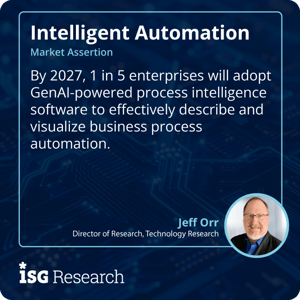 ISG Research defines process intelligence platforms as a data-driven approach to process optimization and continuous improvement. Process intelligence begins with discovery and mining that analyzes event logs and system data to provide insight into how business processes actually execute, identify inefficiencies and recommend improvements. Once opportunities are prioritized against enterprise KPIs, process intelligence coordinates with task automation and orchestration technologies to design effective remediation workflows. By integrating with existing systems and accessing structured, semi-structured and unstructured data, process intelligence enables insights that contribute to operational efficiency, innovation and competitive differentiation. By 2027, one in five enterprises will adopt GenAI-powered process intelligence software to effectively describe and visualize business process automation.
Process intelligence platforms are industry-agnostic but see strong adoption in high-volume, compliance-sensitive environments such as financial services, healthcare, manufacturing, telecommunications and the public sector. They are best suited for large enterprises with complex, cross-system processes that span domains such as order-to-cash, procure-to-pay, customer service and claims. Successful adoption typically requires mature data governance, clearly defined process ownership and an operating model capable of acting on insights through automation, orchestration and integration tools.
Deployments often begin with discovery and conformance analysis in a small number of high-impact processes, followed by simulation and “what-if” modeling to quantify potential improvements. Over time, organizations advance toward closed-loop optimization, linking insights to automated actions and measuring outcomes against baseline metrics. Mid-market organizations increasingly benefit from SaaS-based platforms that offer prebuilt connectors, opinionated templates, embedded benchmarks and lower-overhead data pipelines, enabling faster time-to-value and clearer ROI attribution.
The category has evolved from traditional BPM and static documentation toward continuous, data-driven process visibility. Early approaches relied heavily on workshops and manual mapping, which proved insufficient for capturing real-world execution across complex application environments. The emergence of process mining introduced event-log analysis, enabling fact-based views of process behavior and conformance to intended models.
Recent advances in machine learning and generative AI have expanded process intelligence from diagnostics to actionable optimization. Platforms now support automated root-cause analysis, bottleneck detection and scenario simulation, and increasingly connect insights directly to execution layers such as RPA, workflow orchestration and intelligent document processing. This evolution reflects enterprise demand to tie process performance directly to KPIs such as throughput, cost, quality and compliance, and to sustain continuous improvement rather than episodic reengineering initiatives.
Responsible AI and interoperability are essential to scaling process intelligence.
Enterprises require end-to-end transparency across critical value streams. That begins with broad ingestion of operational telemetry and event logs, rigorous data normalization and lineage and KPI frameworks that connect process performance to financial, risk and customer outcomes. Insight alone is insufficient; identified inefficiencies must drive targeted changes, including workflow adjustments, automation triggers or policy updates, rather than remaining in static dashboards.
Responsible AI and interoperability are essential to scaling process intelligence. IT leaders require governance frameworks that include model lifecycle management, auditability and human-in-the-loop controls for risk-sensitive processes. Platforms must integrate with core enterprise systems through APIs and event streams and interoperate with automation and orchestration tools to address exceptions, data quality issues and execution at scale. This combination enables measurable improvements in cycle time, accuracy and compliance without disrupting existing operations.
Leading process intelligence platforms deliver cohesive capabilities across discovery, mining, conformance and root-cause analysis, supported by simulation and scenario modeling to quantify impact before execution. They ingest data from diverse enterprise sources, provide connectors and SDKs for integration and include data preparation capabilities to ensure reliable insights. Embedded machine learning and generative AI enhance anomaly detection, recommendation generation and narrative explanation, with configurable guardrails to support responsible use.
Establishing process ownership and a center of excellence supports standardization and reuse across the organization.
Governance, security and actionability remain critical. Platforms should support role-based access, audit trails, privacy controls and model monitoring to manage drift and bias. Analytics must translate into decisions through benchmarks, target setting, impact tracking and seamless handoff to automation and orchestration layers. Operational dashboards should measure outcomes such as throughput, rework, accuracy and SLA adherence, enabling organizations to validate ROI and sustain continuous improvement.
Enterprises evaluating process intelligence platforms should prioritize broad system connectivity, high-fidelity analytics and tight integration with execution technologies. KPI-backed reporting, scenario simulation and phased rollouts focused on high-value processes help reduce risk and demonstrate value early. Establishing process ownership and a center of excellence supports standardization and reuse across the organization. Over time, successful platforms become foundational to enterprise operating models that emphasize transparency, accountability and continuous optimization.
The 2026 ISG Buyers Guide™ for Process Intelligence Platforms evaluates software providers across key areas, including process discovery and prioritization, data ingestion and mapping, conformance and deviation analysis, continuous metrics tracking, simulation and optimization, cognitive automation, machine learning and artificial intelligence, connector frameworks, low-code and pro-code extensibility, governance, security, collaboration and task mining. This research evaluates the following software providers: ABBYY, AgilePoint, Appian, Automation Anywhere, Celonis, IBM, iGrafx, Microsoft, Nintex, Pegasystems, ProcessMaker, SAP Signavio, ServiceNow, Software AG, Soroco, Tungsten Automation and UiPath.
Key Takeaways
Process intelligence is becoming a core capability for enterprises seeking transparency, efficiency and risk reduction across complex workflows. As processes span ERP, SaaS and legacy systems, organizations are moving beyond static documentation toward continuous, data-driven visibility tied to KPIs. Embedded machine learning and generative AI are accelerating the shift from diagnostic insight to sustained, actionable optimization.
Software Provider Summary
The ISG Buyers Guide™ for Process Intelligence Platforms evaluates 17 software providers offering products that support end-to-end process discovery, analysis, optimization and integration with execution technologies. The research ranked the top three overall leaders as Appian, Microsoft and Automation Anywhere. Providers were classified using weighted performance in Product Experience and Customer Experience for ISG quadrant placement. Appian, Automation Anywhere, Celonis, IBM, Microsoft, Pegasystems, ServiceNow and UiPath were rated as Exemplary, with Nintex rated as Innovative. SAP Signavio was rated as Assurance, and ABBYY, AgilePoint, iGrafx, ProcessMaker, Software AG, Soroco and Tungsten Automation were rated as Merit.
Product Experience Insights
Product Experience, representing 80% of the evaluation, focuses on Capability (50%) and Platform (30%), which includes adaptability, manageability, reliability and usability. Appian, Automation Anywhere and Microsoft achieved the highest performance as Leaders in this category, supported by broad end-to-end process intelligence functionality across the lifecycle and enterprise-grade platform foundations for governance, scalability and integration. Leaders demonstrated enterprise-grade platform capabilities across varied roles and contexts.
Customer Experience Value
Customer Experience, representing 20% of the evaluation, focuses on validation and TCO/ROI. SAP Signavio, ServiceNow and Microsoft were the Leaders in this category, showing strong customer advocacy and clear investment in success outcomes. Providers with lower performance often lacked publicly available customer validation or failed to demonstrate structured ROI measurement and proactive lifecycle engagement.
Strategic Recommendations
Enterprises should approach process intelligence platforms as long-term operating capabilities rather than isolated analytics tools. Buyers should prioritize platforms that combine high-fidelity discovery and analysis with tight integration to automation and orchestration layers. KPI-backed reporting, scenario simulation and phased adoption focused on high-impact processes help demonstrate value early and reduce risk. Establishing clear process ownership and governance enables insights to translate into sustained, measurable improvement.
The Findings – Process Intelligence Platforms
The software providers and products evaluated in the research provide product and customer experiences, but not everything offered is equally valuable to every enterprise or is needed to operate in business processes and use cases. Moreover, the existence of too many capabilities in products may be a negative factor for an enterprise if it introduces unnecessary complexity. Nonetheless, you may decide that a more comprehensive set of capabilities in the product is important, and where they match your enterprise’s requirements.
An effective customer relationship with a software provider is vital to the success of any investment. The overall customer experience and the full lifecycle of engagement play a key role in ensuring satisfaction and long-term success. Providers with dedicated customer leadership, such as chief customer officers, tend to invest more deeply in these relationships and prioritize customer outcomes to TCO and ROI expectations. It is equally important that this commitment to customer success is clearly demonstrated throughout the provider’s website, buying process and customer journey.
Overall Scoring of Software Providers Across Categories
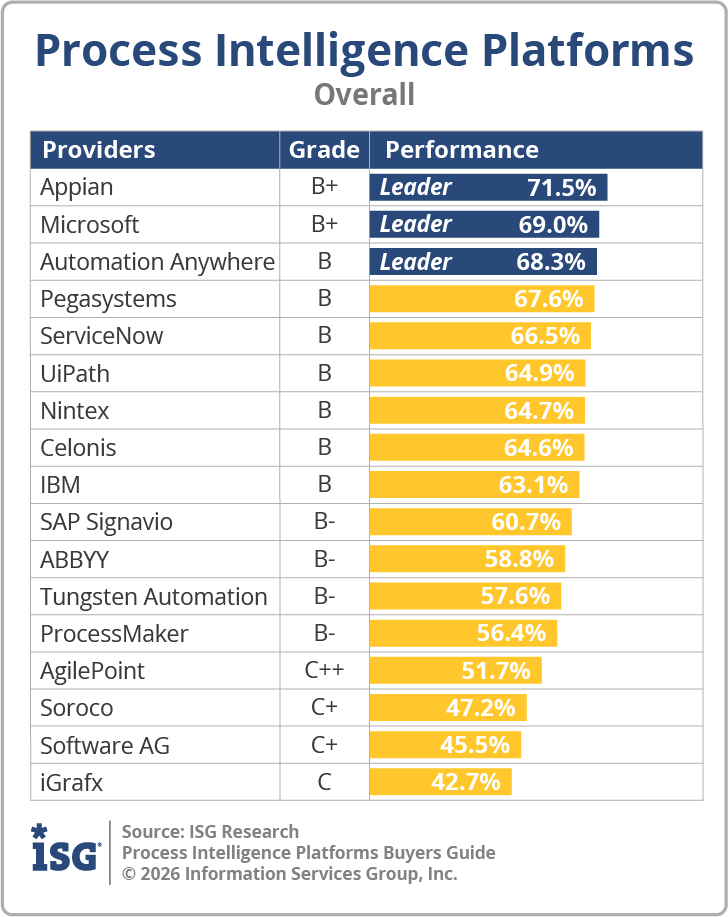 The research finds Appian atop the list, followed by Microsoft and Automation Anywhere. Providers that place in the top three of a category earn the designation of Leader. Appian, Automation Anywhere and Microsoft have done so in three categories, IBM and ServiceNow in two and Nintex, Pegasystems and SAP Signavio in one category.
The overall representation of the research below places the rating of the Product Experience and Customer Experience on the x and y axes, respectively, to provide a visual representation and classification of the software providers. Those providers whose Product Experience have above median weighted performance to the axis in aggregate of the two product categories place farther to the right, while the performance and weighting for the Customer Experience category determines placement on the vertical axis. In short, software providers that place closer to the upper-right on this chart performed better than those closer to the lower-left.
The research categorizes and rates software providers into one of four categories: Assurance, Exemplary, Merit or Innovative. This representation of software providers’ weighted performance in meeting the requirements in product and customer experience.
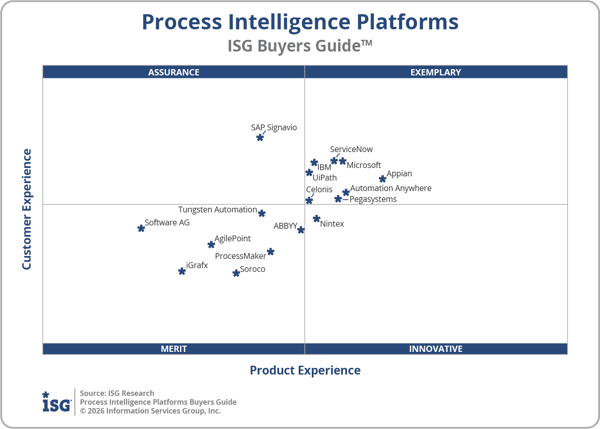
Exemplary: This rating (upper right) represents those that performed above median in Product and Customer Experience requirements. The providers rated Exemplary are: Appian, Automation Anywhere, Celonis, IBM, Microsoft, Pegasystems, ServiceNow and UiPath.
Innovative: This rating (lower right) represents those that performed above median in Product Experience but not in Customer Experience. The provider rated Innovative is: Nintex.
Assurance: This rating (upper left) represents those that performed above median in Customer Experience but not in Product Experience. The provider rated Assurance is: SAP Signavio.
Merit: This rating (lower left) represents those that did not surpass the median in Customer or Product Experience. The providers rated Merit are: ABBYY, AgilePoint, iGrafx, ProcessMaker, Software AG, Soroco and Tungsten Automation.
We advise enterprises to use this research as a supplement to their own evaluations, recognizing that ratings or rankings do not solely represent the value of a provider nor indicate universal suitability of a set of products.
Product Experience
 The process of researching products to address an enterprise’s needs should be comprehensive and evaluate specific capabilities and the underlying platform to the product experience. Our evaluation of the Product Experience examines the lifecycle of onboarding, configuration, operations, usage and maintenance. Too often, software providers are not evaluated for the entirety of the product; instead, they are evaluated on market execution and vision of the future.
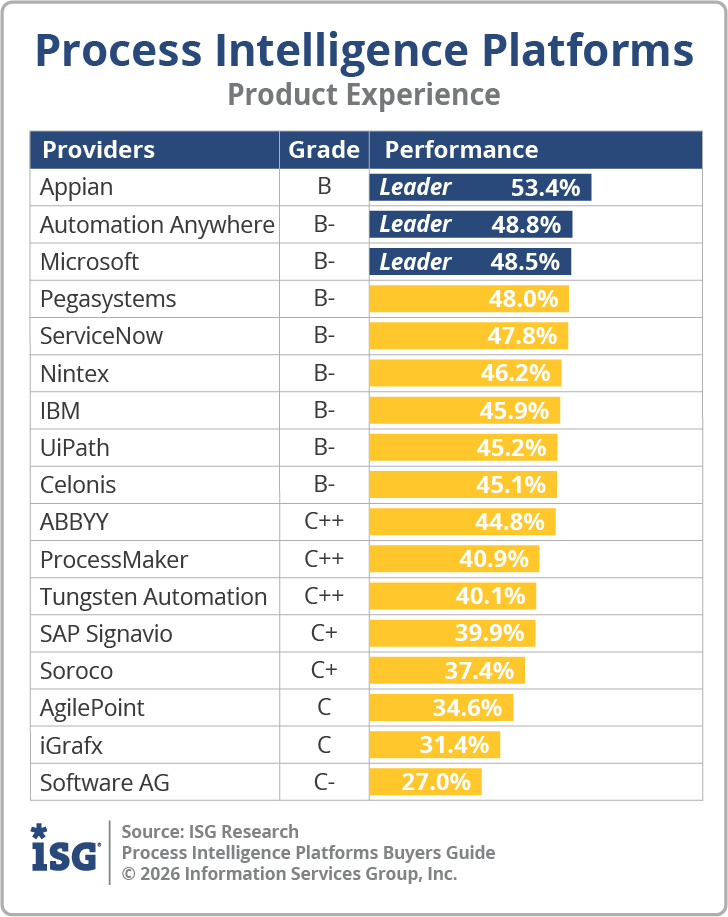
The research results in Product Experience are ranked at 80%, or four-fifths, using the underlying weighted performance. Importance was placed on the categories as follows: Capability (50%) and Platform (30%). Appian, Automation Anywhere, and Microsoft were designated Product Experience Leaders.
Customer Experience
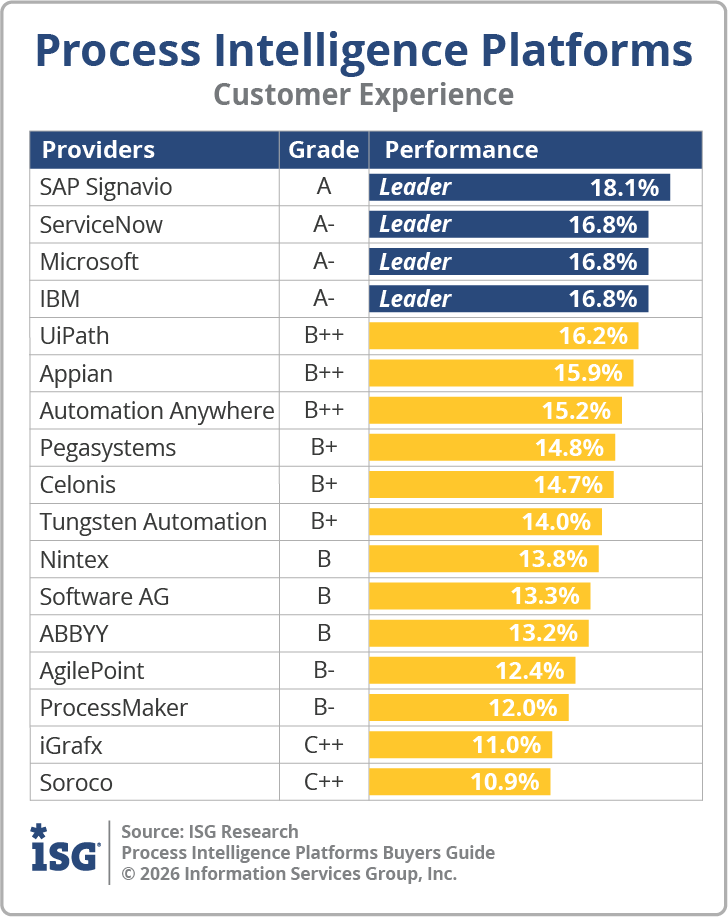 The importance of a customer relationship with a software provider is essential to the actual success of the products and technology. The evaluation of the Customer Experience and the entire lifecycle an enterprise has with its software provider is critical for ensuring satisfaction in working with that provider. The ISG Buyers Guide examines a software provider’s customer commitment, viability, customer success, sales and onboarding, product roadmap and services with partners and support. The customer experience category also investigates the TCO/ROI and how well a software provider demonstrates the product’s overall value, cost and benefits, including the tools and resources to evaluate these factors.
The research results in Customer Experience are ranked at 20%, or one-fifth of the 100% index, and represent the underlying provider validation and TCO/ROI requirements as they relate to the framework of commitment and value to the software provider-customer relationship.
The software providers that evaluated the highest in the Customer Experience category are SAP Signavio, ServiceNow, Microsoft and IBM. These category leaders best communicate commitment and dedication to customer needs.
Software providers that did not perform well in this category were unable to provide or make sufficient information readily available to demonstrate success or articulate their commitment to customer experience. The use of a software provider requires continuous investment, so a holistic evaluation must include examination of how they support their customer experience.
Software Provider Inclusion – Process Intelligence Platforms
For inclusion in the 2026 ISG Buyers Guide™ for Process Intelligence Platforms, a software provider must be in good standing financially and ethically, have at least $20 million in annual or projected revenue verified using independent sources, sell products and provide support on at least two continents and have at least 100 full-time employees. The principal source of the relevant business unit’s revenue must be software-related, and there must have been at least one major software release in the past 12 months.
The research is designed to be independent of the specifics of software provider packaging and pricing. To represent the real-world environment in which businesses operate, we include providers that offer suites or packages of products that may include relevant individual modules or applications. If a software provider is actively marketing, selling and developing a product for the general market and it is reflected on the provider’s website that the product is within the scope of the research, that provider is automatically evaluated for inclusion.
All software providers that offer relevant products and meet the inclusion requirements were invited to participate in the evaluation process at no cost to them.
Software providers that meet our inclusion criteria but did not completely participate in our Buyers Guide were assessed solely on publicly available information. As this could have a significant impact on classification and ratings, we recommend additional scrutiny when evaluating those providers.
Products Evaluated
| Provider | Product Names | Version | Release Month/Year |
|---|---|---|---|
| ABBYY | ABBYY Timeline | 6.1.4 | July 2025 |
| AgilePoint | AgilePoint NX | 9.0 | January 2025 |
| Appian | Process HQ | 25.4 | November 2025 |
| Automation Anywhere | Process Discovery | A360.35.0 | January 2025 |
| Celonis | Celonis Process Intelligence Platform | N/A | October 2025 |
| IBM | Process Mining | 2.0.3 | September 2025 |
| iGrafx | PROCESS360 LIVE | 19.17.0 | October 2025 |
| Microsoft | Power Automate | 2508.2 | August 2025 |
| Nintex | ProMapp Process Manager | 4.12.27.0 | December 2025 |
| Pegasystems | Pega Process AI | 8.8.7 | October 2025 |
| ProcessMaker | ProcessMaker Platform | 4.15.9 | October 2025 |
| SAP Signavio | SAP Signavio Process Intelligence | 2025 | November 2025 |
| ServiceNow | Process Mining | 28.8.7 (Zurich) | September 2025 |
| Software AG | ARIS Process Mining | ARIS 10.0 SR28 | April 2025 |
| Soroco | Soroco Scout | N/A | July 2025 |
| Tungsten Automation | TotalAgility | 6.5.0 Fix Pack 7 | April 2025 |
| UiPath | UiPath Process Mining | 2024.10.4 | June 2025 |
Intelligent Document Processing Platforms
Over the next 12 to 24 months, CIOs and IT leaders will prioritize converting unstructured content into actionable data to improve straight-through processing, compliance and customer experience across document-intensive workflows. The volume and variability of enterprise documents, including emails, PDFs, images, forms, contracts and multimedia, continue to increase, while talent constraints and heightened regulatory scrutiny around privacy, data residency and auditability demand higher accuracy with stronger controls. Enterprises are consolidating legacy OCR tools into AI-enabled platforms, adopting foundation models with human-in-the-loop review for risk-sensitive processes and integrating document intelligence with process mining, orchestration and line-of-business systems to close the loop from insight to action. Advances in machine learning, generative AI and agentic AI are increasing extraction precision, enabling semantic understanding and automating validation and exception handling, driving demand for IDP platforms that deliver enterprise-grade accuracy, governance and interoperability.
IDP platforms have evolved from template-driven OCR and rules-based classification toward AI-enabled document intelligence that can handle high variability and scale.
ISG Research defines intelligent document processing (IDP) platforms as enterprise software that automates the extraction, classification, analysis and processing of information from structured, semi-structured and unstructured documents. These platforms combine optical character recognition and computer vision, natural language processing and machine learning and are augmented by generative and agentic AI, to understand, validate and act on document content. Core capabilities include multi-channel ingestion, layout and semantic understanding, entity and table extraction, policy- and model-driven validation, human-in-the-loop review, enrichment and routing, integration with process intelligence and automation and orchestration systems, analytics and quality monitoring and security, privacy and access controls. The objective is to increase automation rates, reduce cycle times and errors and deliver governed, auditable document intelligence at enterprise scale.
IDP platforms have evolved from template-driven OCR and rules-based classification toward AI-enabled document intelligence that can handle high variability and scale. Early approaches focused on digitizing structured forms and invoices but struggled with unstructured content, multilingual inputs and complex layouts. Over time, improvements in computer vision, NLP and machine learning expanded extraction accuracy and coverage, while human-in-the-loop review became essential for reliability in compliance-sensitive workflows.
The recent infusion of generative and agentic AI has accelerated this evolution. Today’s IDP platforms perform semantic understanding, contextual validation and narrative summarization, and integrate directly with process intelligence and orchestration systems. This shift moves IDP from point tools toward enterprise platforms that convert document content into governed data and trigger downstream actions, enabling measurable gains in straight-through processing under strong governance.
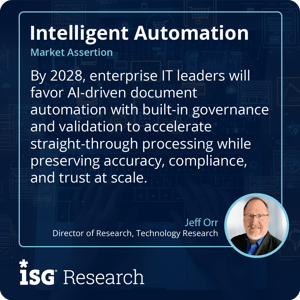 In the market, IDP platforms are industry-agnostic, but see strongest adoption in document-heavy and compliance-sensitive domains such as financial services, insurance, healthcare, public sector, manufacturing and logistics. They are best suited for large enterprises managing high document volumes, variability and multilingual requirements across hybrid and multicloud environments. By 2028, enterprise IT leaders will favor AI-driven document automation with built-in governance and validation to accelerate straight-through processing while preserving accuracy, compliance and trust at scale.
Successful adoption requires clear prerequisites. Enterprises must establish data governance and privacy policies for handling personally identifiable information and protected health information, ensure compliance with data residency requirements and maintain labeled, representative training datasets. Human-in-the-loop quality assurance remains essential for exception management, supported by model lifecycle management that includes versioning, monitoring and drift detection. Integration maturity via APIs and event streams is critical to connect IDP platforms with ERP, CRM, ECM and workflow tools. Effective deployments typically begin with high-impact use cases such as invoice-to-pay, claims intake or customer onboarding, and set explicit accuracy and straight-through processing targets and expand incrementally to more complex, multi-format documents.
Enterprises require IDP platforms that transform diverse documents, including contracts, emails, claims, shipping records and identity documents, into accurate and auditable data that supports end-to-end automation. This depends on multi-channel ingestion, robust extraction of text, tables and entities and policy-based validation aligned with business rules and regulatory requirements. To link document processing to business outcomes, organizations need embedded metrics for accuracy, straight-through processing and operational performance that connect improvements to cycle time reduction, error rates and customer experience.
Interoperability and responsible AI are equally important. IDP platforms must integrate through APIs and event streams with core business systems to route enriched data and manage exceptions. Governance must extend across data privacy, residency and model operations, with human-in-the-loop checkpoints for workflows carrying regulatory or financial risk. These foundations enable organizations to expand confidently from well-structured documents to complex, unstructured content without sacrificing control.
Scale and governance are non-negotiable requirements.
At a functional level, successful IDP Platforms deliver cohesive, native capabilities across OCR and computer vision, NLP and machine learning for layout and semantic understanding, and flexible validation that combines rules, models and referential data. Platforms provide annotation tools to accelerate model improvement, human-in-the-loop review and enrichment and routing to downstream systems. Generative AI should augment classification, summarization and exception guidance under configurable guardrails to prevent hallucinations and enforce policy.
Scale and governance are non-negotiable requirements. Platforms must offer secure access controls, audit trails, secrets management and compliance attestations, along with multilingual support and connectors or SDKs for rapid integration. Model operations, including dataset quality management, evaluation pipelines, bias checks and continuous monitoring, should be built in. Reliability features such as queueing, retries and fault tolerance, combined with deployment flexibility across SaaS and hybrid environments, ensure consistent performance at a global scale, while cost transparency supports ongoing management of total cost of ownership.
When evaluating IDP Platforms, enterprises should prioritize offerings that deliver high accuracy across diverse document types, strong governance and privacy controls and seamless integration with process intelligence and orchestration. Assessments should emphasize KPI-backed reporting for straight-through processing, exception rates and cycle time, along with human-in-the-loop capabilities for risk-sensitive steps and robust model lifecycle management. Successful adoption typically starts with targeted document flows, validates outcomes against business objectives and scales incrementally under clear AI guardrails. Providers that reduce manual effort, improve data quality and demonstrate sustained ROI in production environments will deliver the greatest long-term value.
The 2026 ISG Buyers Guide™ for Intelligent Document Processing Platforms evaluates software providers across key capabilities, including data extraction and recognition, document classification and categorization, AI/ML functionality, integration and export, error reduction and validation, model scalability and adaptability and support for no-code, low-code and pro-code interfaces. This research assesses the following software providers: ABBYY, Appian, Automation Anywhere, Fortra, HCLTech, Hyperscience, IBM, Infrrd, Iron Mountain, Laiye, Microsoft, MuleSoft, Newgen, Nividous, OpenText, ServiceNow, SS&C Blue Prism, Sutherland, Tungsten Automation, UiPath, Workato and WorkFusion.
Key Takeaways
Intelligent document processing platforms are becoming central to enterprise efforts to convert unstructured content into reliable, actionable data at scale. As document volumes and variability grow alongside regulatory and accuracy requirements, organizations are moving beyond standalone OCR toward governed, AI-enabled platforms integrated with business processes. Advances in machine learning and generative AI are accelerating semantic understanding and exception handling, shifting IDP from point automation to an enterprise capability tied to measurable outcomes.
Software Provider Summary
The ISG Buyers Guide™ for Intelligent Document Processing Platforms evaluates 22 software providers offering products that support enterprise document ingestion, extraction, validation and integration with downstream systems. The research ranked the top three overall leaders as Appian, Microsoft and ServiceNow. Providers were classified using weighted performance in Product Experience and Customer Experience for ISG quadrant placement. Appian, Automation Anywhere, IBM, Iron Mountain, Microsoft, ServiceNow and UiPath were rated as Exemplary, with Hyperscience, Newgen, Tungsten Automation and Workato rated as Innovative. MuleSoft, SS&C Blue Prism, and WorkFusion were rated as Assurance, and ABBYY, Fortra, HCLTech, Infrrd, Laiye, Nividous, OpenText and Sutherland were rated as Merit.
Product Experience Insights
Product Experience, representing 80% of the evaluation, focuses on Capability (50%) and Platform (30%), which includes adaptability, manageability, reliability and usability. Appian, ServiceNow and Microsoft achieved the highest performance as Leaders in this category, supported by high-accuracy extraction across diverse document types and enterprise-grade platform capabilities for governance, scalability and integration. Leaders demonstrated enterprise-grade platform capabilities across varied roles and contexts.
Customer Experience Value
Customer Experience, representing 20% of the evaluation, focuses on validation and TCO/ROI. IBM, ServiceNow and Microsoft were the Leaders in this category, showing strong customer advocacy and clear investment in success outcomes. Providers with lower performance often lacked publicly available customer validation or failed to demonstrate structured ROI measurement and proactive lifecycle engagement.
Strategic Recommendations
Enterprises should position intelligent document processing platforms as governed data foundations rather than isolated automation tools. Buyers should prioritize platforms that combine high extraction accuracy with strong privacy, auditability and human-in-the-loop controls for risk-sensitive workflows. Tight integration with core systems and process orchestration helps ensure document intelligence translates into measurable operational impact. Starting with targeted, high-volume use cases and scaling under clear AI guardrails supports sustained value realization.
The Findings – Intelligent Document Processing Platforms
The software providers and products evaluated in the research provide product and customer experiences, but not everything offered is equally valuable to every enterprise or is needed to operate in business processes and use cases. Moreover, the existence of too many capabilities in products may be a negative factor for an enterprise if it introduces unnecessary complexity. Nonetheless, you may decide that a more comprehensive set of capabilities in the product is important, and where they match your enterprise’s requirements.
An effective customer relationship with a software provider is vital to the success of any investment. The overall customer experience and the full lifecycle of engagement play a key role in ensuring satisfaction and long-term success. Providers with dedicated customer leadership, such as chief customer officers, tend to invest more deeply in these relationships and prioritize customer outcomes to TCO and ROI expectations. It is equally important that this commitment to customer success is clearly demonstrated throughout the provider’s website, buying process and customer journey.
Overall Scoring of Software Providers Across Categories
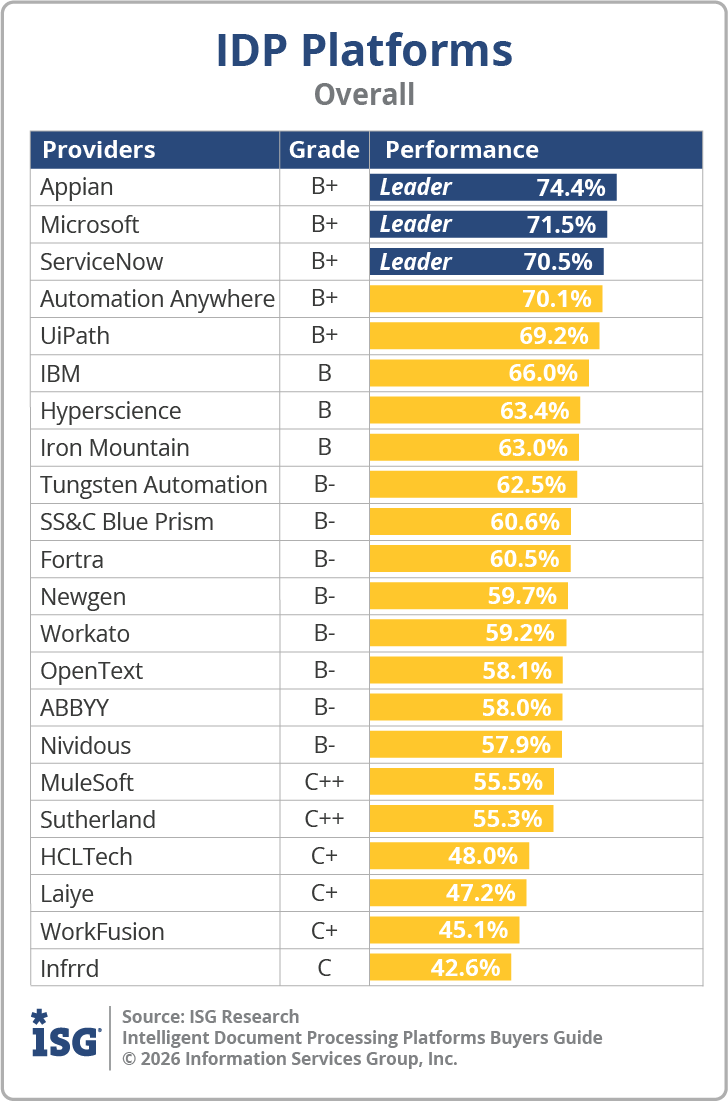 The research finds Appian atop the list, followed by Microsoft and ServiceNow. Providers that place in the top three of a category earn the designation of Leader. Appian and ServiceNow have done so in four categories, Microsoft in three and Automation Anywhere, Hyperscience, IBM and UiPath in one category.
The overall representation of the research below places the rating of the Product Experience and Customer Experience on the x and y axes, respectively, to provide a visual representation and classification of the software providers. Those providers whose Product Experience have above median weighted performance to the axis in aggregate of the two product categories place farther to the right, while the performance and weighting for the Customer Experience category determines placement on the vertical axis. In short, software providers that place closer to the upper-right on this chart performed better than those closer to the lower-left.
The research categorizes and rates software providers into one of four categories: Assurance, Exemplary, Merit or Innovative. This representation of software providers’ weighted performance in meeting the requirements in product and customer experience.
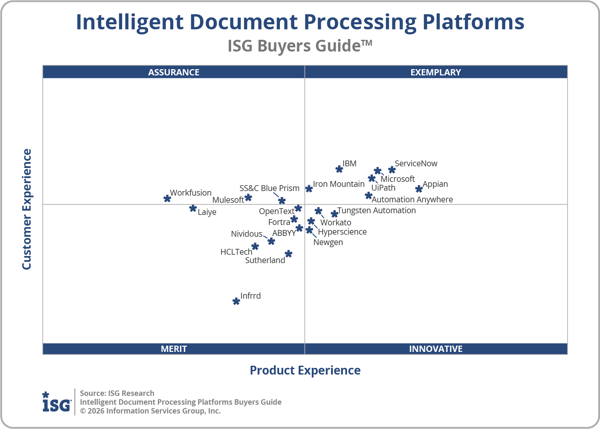
Exemplary: This rating (upper right) represents those that performed above median in Product and Customer Experience requirements. The providers rated Exemplary are: Appian, Automation Anywhere, IBM, Iron Mountain, Microsoft, ServiceNow and UiPath.
Innovative: This rating (lower right) represents those that performed above median in Product Experience but not in Customer Experience. The providers rated Innovative are: Hyperscience, Newgen, Tungsten Automation and Workato.
Assurance: This rating (upper left) represents those that performed above median in Customer Experience but not in Product Experience. The providers rated Assurance are: MuleSoft, SS&C Blue Prism and WorkFusion.
Merit: This rating (lower left) represents those that did not surpass the median in Customer or Product Experience. The providers rated Merit are:
ABBYY, Fortra, HCLTech, Infrrd, Laiye, Nividous, OpenText and Sutherland.
We advise enterprises to use this research as a supplement to their own evaluations, recognizing that ratings or rankings do not solely represent the value of a provider nor indicate universal suitability of a set of products.
Product Experience
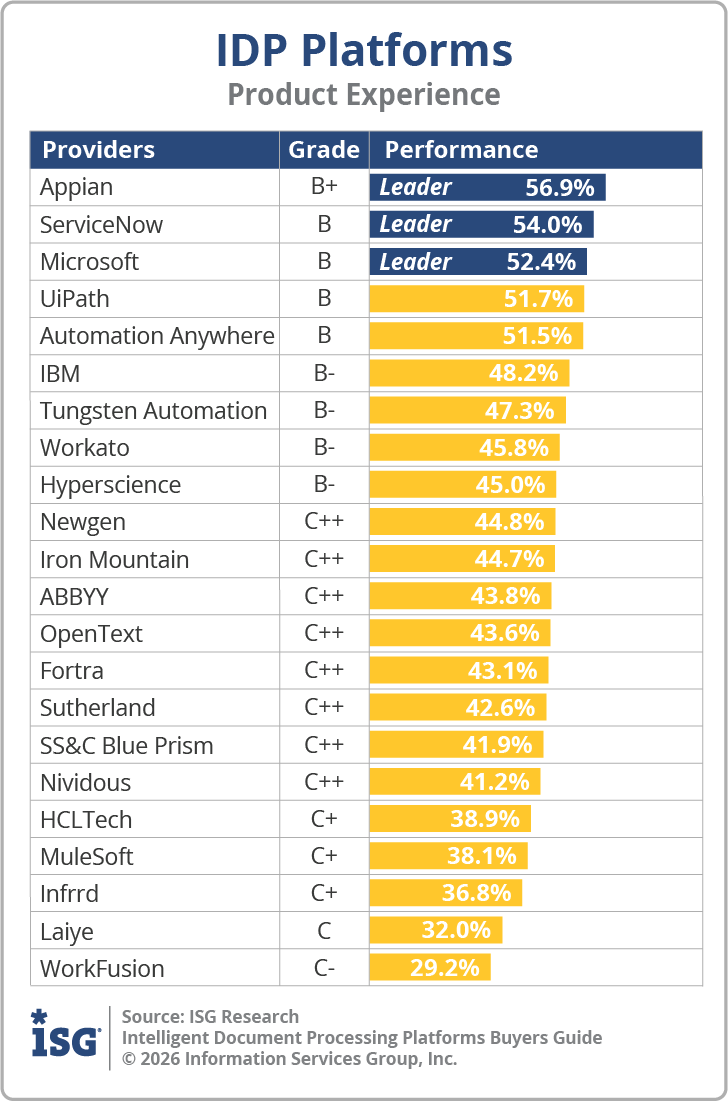 The process of researching products to address an enterprise’s needs should be comprehensive and evaluate specific capabilities and the underlying platform to the product experience. Our evaluation of the Product Experience examines the lifecycle of onboarding, configuration, operations, usage and maintenance. Too often, software providers are not evaluated for the entirety of the product; instead, they are evaluated on market execution and vision of the future.
The research results in Product Experience are ranked at 80%, or four-fifths, using the underlying weighted performance. Importance was placed on the categories as follows: Capability (50%) and Platform (30%). Appian, ServiceNow and Microsoft were designated Product Experience Leaders. While not Leaders, UiPath and Automation Anywhere were also found to meet a broad range of enterprise product experience requirements.
Customer Experience
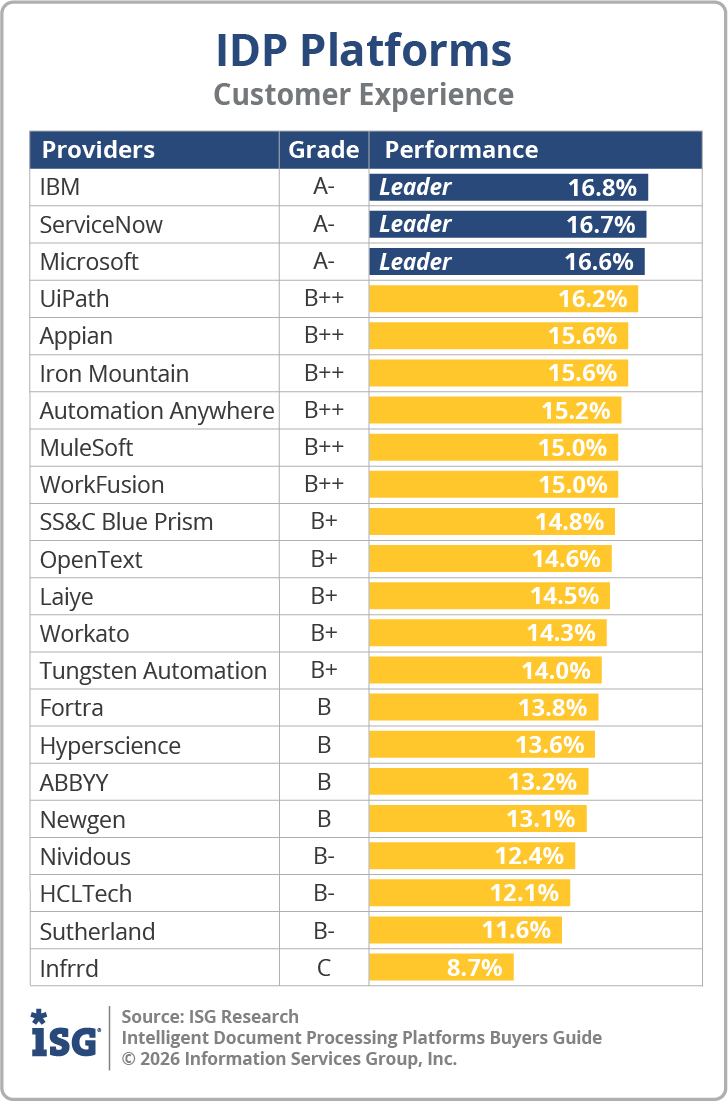 The importance of a customer relationship with a software provider is essential to the actual success of the products and technology. The evaluation of the Customer Experience and the entire lifecycle an enterprise has with its software provider is critical for ensuring satisfaction in working with that provider. The ISG Buyers Guide examines a software provider’s customer commitment, viability, customer success, sales and onboarding, product roadmap and services with partners and support. The customer experience category also investigates the TCO/ROI and how well a software provider demonstrates the product’s overall value, cost and benefits, including the tools and resources to evaluate these factors.
The research results in Customer Experience are ranked at 20%, or one-fifth of the 100% index, and represent the underlying provider validation and TCO/ROI requirements as they relate to the framework of commitment and value to the software provider-customer relationship.
The software providers that evaluated the highest in the Customer Experience category are IBM, ServiceNow and Microsoft. These category leaders best communicate commitment and dedication to customer needs.
Software providers that did not perform well in this category were unable to provide or make sufficient information readily available to demonstrate success or articulate their commitment to customer experience. The use of a software provider requires continuous investment, so a holistic evaluation must include examination of how they support their customer experience.
Software Provider Inclusion – Intelligent Document Processing Platforms
For inclusion in the 2026 ISG Buyers Guide™ for Intelligent Document Processing Platforms, a software provider must be in good standing financially and ethically, have at least $45 million in annual or projected revenue verified using independent sources, sell products and provide support on at least two continents, and have at least 150 full-time employees. The principal source of the relevant business unit’s revenue must be software-related, and there must have been at least one major software release in the past 12 months.
The research is designed to be independent of the specifics of software provider packaging and pricing. To represent the real-world environment in which businesses operate, we include providers that offer suites or packages of products that may include relevant individual modules or applications. If a software provider is actively marketing, selling and developing a product for the general market and it is reflected on the provider’s website that the product is within the scope of the research, that provider is automatically evaluated for inclusion.
All software providers that offer relevant products and meet the inclusion requirements were invited to participate in the evaluation process at no cost to them.
Software providers that meet our inclusion criteria but did not completely participate in our Buyers Guide were assessed solely on publicly available information. As this could have a significant impact on classification and ratings, we recommend additional scrutiny when evaluating those providers.
Products Evaluated
| Provider | Product Names | Version | Release Month/Year |
|---|---|---|---|
| Appian | AI Document Center | 25.4 | November 2025 |
| ABBYY | ABBYY Vantage | 2.7.1 | June 2025 |
| Automation Anywhere | Automation 360 | 38 | September 2025 |
| Fortra | Automate Intelligent Capture | 25.1.0 | August 2025 |
| HCLTech | EXACTO | N/A | September 2025 |
| Hyperscience | Hyperscience Platform | 42.1.3 | December 2025 |
| IBM | IBM Automation Document Processing (ADP) | 25.0.0 | June 2025 |
| Infrrd | Titan IDP | N/A | October 2025 |
| Iron Mountain | InSight Intelligent Document Processing (IDP) | N/A | August 2025 |
| Laiye | IDP | 3.25 Cloud | September 2025 |
| Microsoft | Power Automate | 2508.2 | August 2025 |
| MuleSoft | MuleSoft Intelligent Document Processing | N/A | June 2025 |
| Newgen | NewgenONE Platform | 1002 | December 2025 |
| Nividous | Nividous Platform | 7.5.1 | August 2025 |
| OpenText | OpenText Capture | CE 25.2 | June 2025 |
| ServiceNow | ServiceNow NOW Platform | 7.1.5 (Zurich) | September 2025 |
| SS&C Blue Prism | Decipher IDP | 2.4 | June 2025 |
| Sutherland | Sutherland Extract | 2 | October 2025 |
| Tungsten Automation | Tungsten Capture | 11.2.0 Fix Pack 1 | April 2025 |
| UiPath | UiPath IXP | 2024.10.5 | September 2025 |
| Workato | The Workato One Platform | N/A | September 2025 |
| WorkFusion | WorkFusion IDP | Edward | July 2025 |
Automation and Orchestration Platforms
Over the next 12 to 24 months, CIOs and IT leaders will intensify efforts to automate high-volume, rules-based tasks and orchestrate end-to-end workflows to improve productivity, reduce operational risk and realize measurable returns from prior digital investments. Rising labor costs, persistent talent shortages and fragmented application landscapes across ERP, CRM and SaaS environments are accelerating a shift from isolated RPA scripts to enterprise-wide automation fabrics. Enterprises are consolidating legacy bot estates, pairing task automation with process intelligence and embedding generative and agentic AI to handle variability, accelerate exception resolution and augment human work. At the same time, organizations are standardizing governance, expanding orchestration beyond desktop automation to API- and event-driven integrations and measuring outcomes against business KPIs, driving demand for platforms that combine reliability, security and AI-enabled flexibility as native capabilities.
Automation and orchestration platforms provide operational insight that can support continuous improvement, innovation and competitive advantage without reliance on external managed services.
ISG Research defines automation and orchestration platforms as integrated software platforms that automate repetitive, rule-based tasks across applications and systems and orchestrate end-to-end business workflows. Originally centered on robotic process automation that emulated human actions for high-volume transactional activities, these platforms now incorporate RPA and generative AI to support task and process automation and the orchestration and management of business automation. By integrating with existing systems and accessing structured, semi-structured and unstructured data, automation and orchestration platforms provide operational insight that can support continuous improvement, innovation and competitive advantage without reliance on external managed services.
The category has evolved significantly from its early focus on UI-based automation. Initial RPA deployments delivered quick wins by automating narrow, deterministic tasks but struggled with exception handling, scale and brittle integrations. As enterprise application estates expanded across ERP, CRM, SaaS and custom services, organizations required orchestration that could span systems, support parallel processing and deliver consistent auditability. This evolution led to broader automation fabrics that coordinate tasks, workflows and integrations across distributed environments.
Advances in machine learning, generative AI and event-driven architectures have accelerated this transition. Today’s automation and orchestration platforms blend attended and unattended automation with API-first and message-based integration, incorporate human-in-the-loop oversight where risk requires it and connect automation execution to process intelligence and analytics. The emphasis has shifted from isolated bots to closed-loop execution models, where insights identify improvement opportunities, orchestration implements changes under policy guardrails and analytics validate results against defined business KPIs.
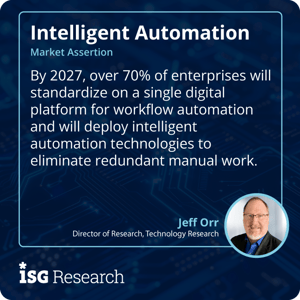 Enterprise adoption spans industries, with particularly strong impact in transaction- and compliance-intensive sectors, such as financial services, insurance, healthcare, public sector, manufacturing, logistics, telecom and retail. Through 2027, over 70% of enterprises will standardize on a single digital platform for workflow automation and will deploy intelligent automation technologies to eliminate redundant manual work. These platforms are best suited for large enterprises managing high volumes of repeatable tasks across multiple systems, supported by centralized automation centers of excellence or platform engineering functions that govern standards, reuse and scaling.
Successful adoption requires disciplined prerequisites. Enterprises must establish process discovery and prioritization tied to business KPIs, mature integration approaches that extend beyond UI automation to APIs and event streams and robust change management and testing practices. Clear policies for responsible AI use, segregation of duties and data privacy are essential. Effective deployments typically begin with well-defined, rules-based tasks to capture early value, then expand to end-to-end workflows that integrate intelligent document processing, process intelligence and core business systems. Mid-market organizations often favor SaaS delivery with prebuilt templates, managed runtimes and transparent pricing to accelerate time-to-value while maintaining governance.
At a capability level, enterprises expect automation and orchestration platforms to deliver cohesive, native functionality across design, execution and governance. Core capabilities include low-code development environments; connector libraries; UI-, API- and event-driven automation; queueing and scheduling; versioning and change control; and runtime monitoring and analytics that quantify throughput, accuracy, rework and compliance. Platforms must orchestrate bots, workflows and policy-bound AI agents while supporting human-in-the-loop validation and exception handling where required.
AI should be embedded to automate routine tasks and augment decision-making within configurable guardrails, particularly for document understanding, classification, enrichment, contextual guidance and exception resolution. Generative and agentic capabilities should operate under explicit policies, with model lifecycle management and oversight built into the platform to ensure predictable behavior and risk control in production environments.
Enterprises should prioritize offerings that unify task automation and orchestration with strong governance, broad integration and embedded AI under clear guardrails.
Interoperability and governance remain critical evaluation factors. Platforms should provide broad connectivity through APIs, event streams and connectors, adhere to open standards and integrate with identity, access and audit frameworks. Enterprise-grade governance capabilities include role-based access control, policy-as-code, secrets management, audit trails and compliance attestations, along with resilience features such as fault tolerance, retries and rollback. Cost transparency, deployment flexibility across cloud and hybrid environments and scalability across global workloads are necessary to sustain performance and return on investment as automation expands.
When evaluating automation and orchestration platforms, enterprises should prioritize offerings that unify task automation and orchestration with strong governance, broad integration and embedded AI under clear guardrails. Software provider assessments should focus on connector breadth, reliability features, human-in-the-loop support, policy enforcement and KPI-backed reporting for straight-through processing, exception rates and cycle time. Successful adoption typically requires a phased rollout led by an automation center of excellence in partnership with platform engineering, with measurable targets and ongoing oversight to ensure improvements in cost, quality and compliance at scale.
The 2026 ISG Buyers Guide™ for Automation and Orchestration Platforms evaluates software providers across key capability areas, including attended and unattended automation, system integrations, workflow design, analytics and reporting, AI and machine learning support, governance and security, error handling and exception management and orchestration functionality. This research assessed the following providers: Appian, Automation Anywhere, Bizagi, Fortra, IBM, Iron Mountain, Laiye, Microsoft, MuleSoft, Newgen, NiCE, Nintex, Nividous, Pegasystems, ProcessMaker, QAD, SAP, SAP Signavio, ServiceNow, SS&C Blue Prism, Sutherland, Tungsten Automation, UiPath, WorkFusion, Worksoft and Zendesk.
Key Takeaways
Automation and orchestration platforms are evolving from isolated task automation into enterprise execution layers that coordinate workflows across systems, teams and data. As organizations scale beyond brittle RPA scripts, priorities align around reliability, governance and integration alongside flexibility and speed. Embedded AI and event-driven orchestration are shifting automation toward closed-loop execution tied to measurable business outcomes.
Software Provider Summary
The ISG Buyers Guide™ for Automation and Orchestration Platforms evaluates 26 software providers offering products that support task automation, workflow orchestration and enterprise-scale governance. The research ranked the top three overall leaders as Microsoft, Appian and Automation Anywhere. Providers were classified using weighted performance in Product Experience and Customer Experience for ISG quadrant placement. Appian, Automation Anywhere, IBM, Iron Mountain, Microsoft, ServiceNow, UiPath and Zendesk were rated as Exemplary, with Bizagi, Nintex, Nividous, Pegasystems and Tungsten Automation rated as Innovative. Laiye, MuleSoft, NiCE, SAP, SAP Signavio and WorkFusion were rated as Assurance, and Fortra, Newgen, ProcessMaker, SS&C Blue Prism, Sutherland, QAD and Worksoft were rated as Merit.
Product Experience Insights
Product Experience, representing 80% of the evaluation, focuses on Capability (40%) and Platform (40%) which includes adaptability, manageability, reliability and usability. Appian, Microsoft and Pegasystems achieved the highest performance as Leaders in this category, supported by broad automation and orchestration coverage across UI-, API- and event-driven execution and enterprise-grade platform foundations for scalability, reliability and governance. Leaders demonstrated enterprise-grade platform capabilities across varied roles and contexts.
Customer Experience Value
Customer Experience, representing 20% of the evaluation, focuses on validation and TCO/ROI. SAP Signavio, ServiceNow and Microsoft were the Leaders in this category, showing strong customer advocacy and clear investment in success outcomes. Providers with lower performance often lacked publicly available customer validation or failed to demonstrate structured ROI measurement and proactive lifecycle engagement.
Strategic Recommendations
Enterprises should treat automation and orchestration platforms as core execution infrastructure rather than collections of bots. Buyers should prioritize platforms that unify task automation and orchestration with strong governance, integration breadth and reliability at scale. Phased adoption tied to KPI-backed outcomes and supported by an automation center of excellence helps reduce risk and sustain value. Over time, platforms that connect execution to analytics and policy enforcement enable continuous improvement across complex enterprise environments.
The Findings – Automation and Orchestration Platforms
The software providers and products evaluated in the research provide product and customer experiences, but not everything offered is equally valuable to every enterprise or is needed to operate in business processes and use cases. Moreover, the existence of too many capabilities in products may be a negative factor for an enterprise if it introduces unnecessary complexity. Nonetheless, you may decide that a more comprehensive set of capabilities in the product is important, and where they match your enterprise’s requirements.
An effective customer relationship with a software provider is vital to the success of any investment. The overall customer experience and the full lifecycle of engagement play a key role in ensuring satisfaction and long-term success. Providers with dedicated customer leadership, such as chief customer officers, tend to invest more deeply in these relationships and prioritize customer outcomes to TCO and ROI expectations. It is equally important that this commitment to customer success is clearly demonstrated throughout the provider’s website, buying process and customer journey.
Overall Scoring of Software Providers Across Categories
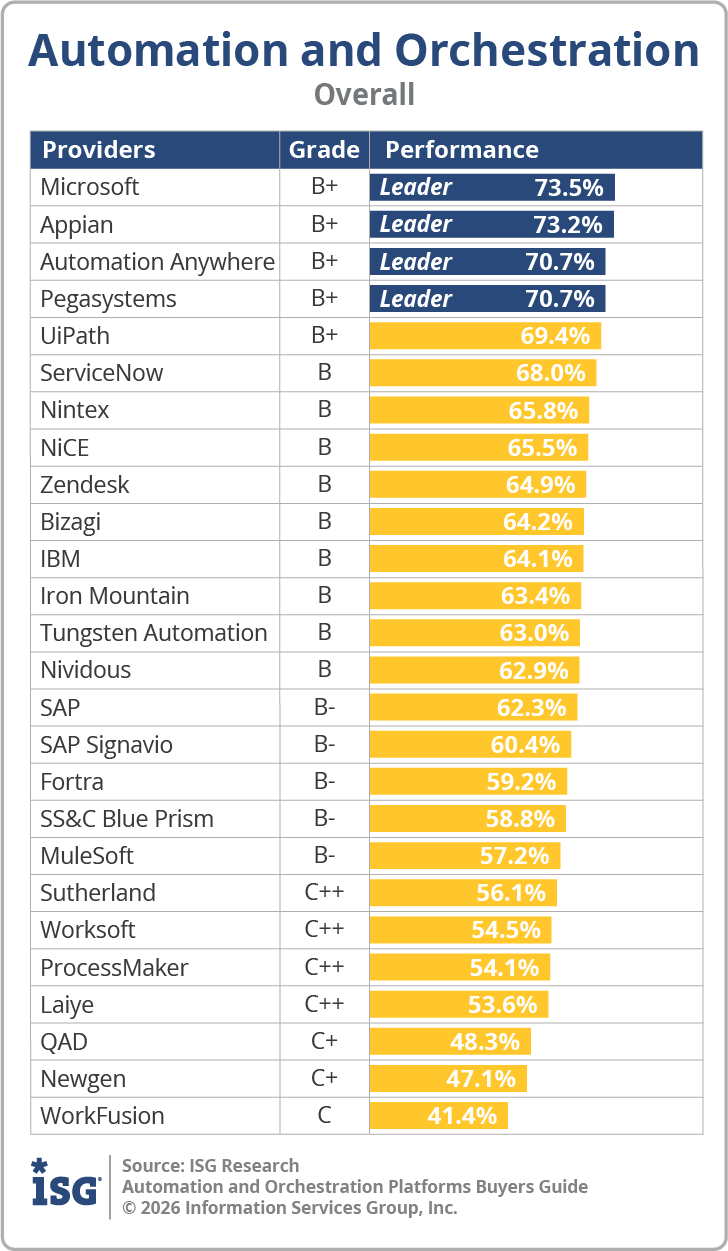 The research finds Microsoft atop the list, followed by Appian, Automation Anywhere and Pegasystems. Providers that place in the top three of a category earn the designation of Leader. Microsoft has done so in four categories, Appian and Pegasystems in three, Automation Anywhere in two and IBM, NiCE, Nintex, SAP Signavio, ServiceNow and UiPath in one category.
The overall representation of the research below places the rating of the Product Experience and Customer Experience on the x and y axes, respectively, to provide a visual representation and classification of the software providers. Those providers whose Product Experience have above median weighted performance to the axis in aggregate of the two product categories place farther to the right, while the performance and weighting for the Customer Experience category determines placement on the vertical axis. In short, software providers that place closer to the upper-right on this chart performed better than those closer to the lower-left.
The research categorizes and rates software providers into one of four categories: Assurance, Exemplary, Merit or Innovative. This representation of software providers’ weighted performance in meeting the requirements in product and customer experience.
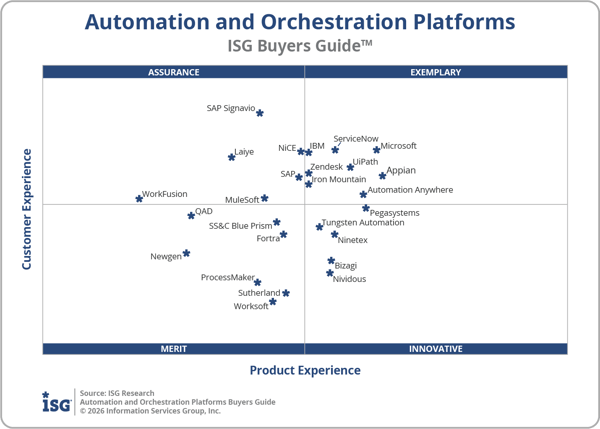
Exemplary: This rating (upper right) represents those that performed above median in Product and Customer Experience requirements. The providers rated Exemplary are: Appian, Automation Anywhere, IBM, Iron Mountain, Microsoft, ServiceNow, UiPath and Zendesk
Innovative: This rating (lower right) represents those that performed above median in Product Experience but not in Customer Experience. The providers rated Innovative are: Bizagi, Nintex, Nividous, Pegasystems and Tungsten Automation.
Assurance: This rating (upper left) represents those that performed above median in Customer Experience but not in Product Experience. The providers rated Assurance are: Laiye, MuleSoft, NiCE, SAP, SAP Signavio and WorkFusion
Merit: This rating (lower left) represents those that did not surpass the median in Customer or Product Experience. The providers rated Merit are: Fortra, Newgen, ProcessMaker, SS&C Blue Prism, Sutherland, QAD and Worksoft
We advise enterprises to use this research as a supplement to their own evaluations, recognizing that ratings or rankings do not solely represent the value of a provider nor indicate universal suitability of a set of products.
Product Experience
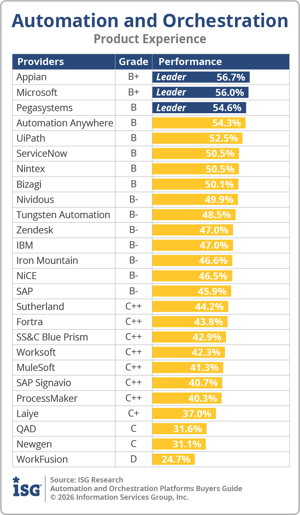
The process of researching products to address an enterprise’s needs should be comprehensive and evaluate specific capabilities and the underlying platform to the product experience. Our evaluation of the Product Experience examines the lifecycle of onboarding, configuration, operations, usage and maintenance. Too often, software providers are not evaluated for the entirety of the product; instead, they are evaluated on market execution and vision of the future.
The research results in Product Experience are ranked at 80%, or four-fifths, using the underlying weighted performance. Importance was placed on the categories as follows: Capability (40%) and Platform (40%). Appian, Microsoft and Pegasystems were designated Product Experience Leaders.
Customer Experience
 The importance of a customer relationship with a software provider is essential to the actual success of the products and technology. The evaluation of the Customer Experience and the entire lifecycle an enterprise has with its software provider is critical for ensuring satisfaction in working with that provider. The ISG Buyers Guide examines a software provider’s customer commitment, viability, customer success, sales and onboarding, product roadmap and services with partners and support. The customer experience category also investigates the TCO/ROI and how well a software provider demonstrates the product’s overall value, cost and benefits, including the tools and resources to evaluate these factors.
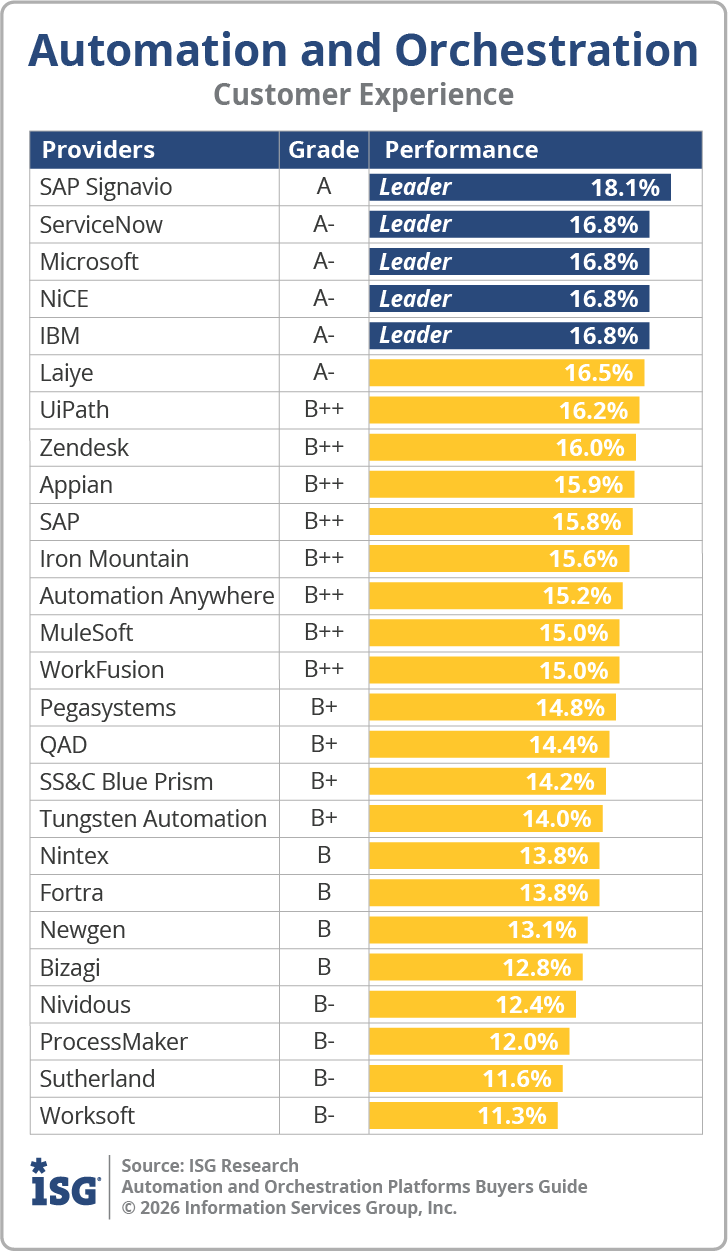
The research results in Customer Experience are ranked at 20%, or one-fifth of the 100% index, and represent the underlying provider validation and TCO/ROI requirements as they relate to the framework of commitment and value to the software provider-customer relationship.
The software providers that evaluated the highest in the Customer Experience category are SAP Signavio, ServiceNow, Microsoft, NiCE and IBM. These category leaders best communicate commitment and dedication to customer needs.
Software providers that did not perform well in this category were unable to provide or make sufficient information readily available to demonstrate success or articulate their commitment to customer experience. The use of a software provider requires continuous investment, so a holistic evaluation must include examination of how they support their customer experience.
Software Provider Inclusion – Automation and Orchestration Platforms
For inclusion in the 2026 ISG Buyers Guide™ for Automation and Orchestration Platforms, a software provider must be in good standing financially and ethically, have at least $32 million in annual or projected revenue verified using independent sources, sell products and provide support on at least two continents, and have at least 150 full-time employees. The principal source of the relevant business unit’s revenue must be software-related, and there must have been at least one major software release in the past 12 months.
The research is designed to be independent of the specifics of software provider packaging and pricing. To represent the real-world environment in which businesses operate, we include providers that offer suites or packages of products that may include relevant individual modules or applications. If a software provider is actively marketing, selling and developing a product for the general market and it is reflected on the provider’s website that the product is within the scope of the research, that provider is automatically evaluated for inclusion.
All software providers that offer relevant products and meet the inclusion requirements were invited to participate in the evaluation process at no cost to them.
Software providers that meet our inclusion criteria but did not completely participate in our Buyers Guide were assessed solely on publicly available information. As this could have a significant impact on classification and ratings, we recommend additional scrutiny when evaluating those providers.
Products Evaluated
| Provider | Product Names | Version | Release Month/Year |
|---|---|---|---|
| Appian | Robotic Process Automation (RPA) | 25.4 | November 2025 |
| Automation Anywhere | Automation 360 | 38 | September 2025 |
| Bizagi | Business Process Automation Software | Fall 2025 | November 2025 |
| Fortra | Automate Ultimate | 25.1.0 | August 2025 |
| IBM | IBM watsonx orchestrate | N/A | December 2025 |
| Iron Mountain | InSight Digital Experience Platform | N/A | August 2025 |
| Laiye | Work Execution System (WES) | 6.7.0.251120 | November 2025 |
| Microsoft | Power Automate | 2508.2 | August 2025 |
| MuleSoft | MuleSoft RPA | 6.7.14 | October 2025 |
| Newgen | NewgenONE Platform | 1002 | December 2025 |
| NiCE | CXone Mpower Workflow Orchestrator | N/A | March 2025 |
| Nintex | Nintex Automation Cloud | 24.4.4 | July 2025 |
| Nividous | Nividous Platform | 7.5.1 | August 2025 |
| Pegasystems | Pega Platform | R25 | May 2025 |
| ProcessMaker | ProcessMaker Platform | 4.15.9 | October 2025 |
| QAD | QAD Adaptive | N/A | December 2025 |
| SAP | SAP Build Process Automation | N/A | November 2025 |
| SAP Signavio | SAP Signavio Process Governance | N/A | November 2025 |
| ServiceNow | ServiceNow Flow Designer/Automation Center | 15.1.0 (Zurich Patch 1) | September 2025 |
| SS&C Blue Prism | Blue Enterprise Platform | 7.4.1 | May 2025 |
| Sutherland | Robility | 5.1.5 | March 2025 |
| Tungsten Automation | TotalAgility | 2025.2 | May 2025 |
| UiPath | UiPath Business Automation Platform | 2024.10.2 | April 2025 |
| WorkFusion | Work.ai Platform | Edward | July 2025 |
| Worksoft | Worksoft Connective Automation | 14.5 | June 2025 |
| Zendesk | Zendesk Platform | N/A | December 2025 |
Executive Summary
Buyers Guide Overview
ISG Research has conducted market research for over two decades across vertical industries, business applications, AI and IT. We have designed the ISG Buyers Guide™ to provide a balanced perspective of software providers and products that is rooted in an understanding of business and IT requirements. Utilization of our research methodology and decades of experience enables our Buyers Guide to be an effective method to assess and select software providers and products. The findings of this research provide a comprehensive approach to rating software providers and rank their ability to meet specific product and customer experience requirements.
ISG Research has designed the Buyers Guide to provide a balanced perspective of software providers and products that is rooted in an understanding of business and IT requirements.
The 2026 ISG Buyers Guides™ for Intelligent Automation Platforms, covering Process Intelligence Platforms, Intelligent Document Processing Platforms and Automation and Orchestration Platforms, are the distillation of continuous market and product research. It is an assessment of how well software providers’ offerings address enterprises’ requirements for intelligent automation software. The Value Index methodology is structured to support a request for information (RFI) for a request for proposal (RFP) process by incorporating all criteria needed to evaluate, select, utilize and maintain relationships with software providers. The ISG Buyers Guide evaluates customer experience and the product experience in its capability and platform.
The structure of the research reflects our understanding that the effective evaluation of software providers and products involves far more than just examining product features, potential revenue or customers generated from a provider’s marketing and sales efforts. It can ensure the best long-term relationship and value achieved from a resource and financial investment We believe it is important to take a comprehensive, research-based approach, since making the wrong choice of intelligent automation platform can raise the total cost of ownership, lower the return on investment and hamper an enterprise’s ability to reach its potential. In addition, this approach can reduce the project’s development and deployment time and eliminate the risk of relying on opinions or historical biases.
ISG Research believes that an objective review of existing and potential new software providers and products is a critical strategy for the adoption and implementation of intelligent automation software. An enterprise’s review should include an analysis of both what is possible and what is relevant. We urge enterprises to do a thorough job of evaluating intelligent automation platforms and offer these Buyers Guides as both the results of our in-depth analysis of these providers and as an evaluation methodology.
How To Use This Buyers Guide
Evaluating Software Providers: The Process
We recommend using the Buyers Guide to assess and evaluate new or existing software providers for your enterprise. The market research can be used as an evaluation framework to assess existing approaches and software providers or establish a formal request for information from providers on products and customer experience and will shorten the cycle time when creating an RFI. The steps listed below provide a process that can facilitate best possible outcomes in the most efficient manner.
- Define the business case and goals.
Define the mission and business case for investment and the expected outcomes from your organizational and technological efforts. - Specify the business and IT needs.
Defining the business and IT requirements helps identify what specific capabilities are required with respect to people, processes, information and technology. - Assess the required roles and responsibilities.
Identify the individuals required for success at every level of the enterprise from executives to frontline workers and determine the needs of each. - Outline the project’s critical path.
What needs to be done, in what order and who will do it? This outline should make clear the prior dependencies at each step of the project plan. - Ascertain the technology approach.
Determine the business and technology approach that most closely aligns to your enterprise’s requirements. - Establish software provider evaluation criteria.
Utilize the product experience: capability and platform with support for adaptability, manageability, reliability and usability, and the customer experience in TCO/ROI and Validation. - Evaluate and select the software provider and products properly.
Apply a weighting the evaluation categories in the evaluation criteria to reflect your enterprise’s priorities to determine the short list of software providers and products. - Establish the business initiative team to start the project.
Identify who will lead the project and the members of the team needed to plan and execute it with timelines, priorities and resources.
Using the ISG Buyers Guide and process provides enterprises a clear, structured approach to making smarter software and business investment decisions. It ensures alignment between strategy, people, processes and technology while reducing risk, saving time, and improving outcomes. The ISG approach promotes data-driven decision-making and collaboration, helping choose the right software providers for maximum value and return on investment.
Process Intelligence Platforms
Over the next 12 to 24 months, CIOs and business leaders will prioritize end-to-end process transparency, efficiency gains and risk reduction to unlock measurable productivity improvements from prior digital investments. As hybrid application landscapes expand across ERP, CRM, SaaS and legacy systems, the inability to see, measure and optimize cross-functional workflows has become a significant constraint on margins, customer experience and compliance. In response, enterprises are consolidating siloed deployments of robotic process automation, business process management and process mining, shifting from static process documentation toward continuous, data-driven monitoring and linking automation initiatives to KPI-backed value streams. Advances in machine learning, generative AI and agentic AI are accelerating discovery, conformance analysis, root-cause identification and recommendation generation, increasing demand for platforms that ingest diverse operational data, surface actionable insights and coordinate targeted remediation through integrated automation.
ISG Research defines process intelligence platforms as a data-driven approach to process optimization and continuous improvement. Process intelligence begins with discovery and mining that analyzes event logs and system data to provide insight into how business processes actually execute, identify inefficiencies and recommend improvements. Once opportunities are prioritized against enterprise KPIs, process intelligence coordinates with task automation and orchestration technologies to design effective remediation workflows. By integrating with existing systems and accessing structured, semi-structured and unstructured data, process intelligence enables insights that contribute to operational efficiency, innovation and competitive differentiation. By 2027, one in five enterprises will adopt GenAI-powered process intelligence software to effectively describe and visualize business process automation.
Process intelligence platforms are industry-agnostic but see strong adoption in high-volume, compliance-sensitive environments such as financial services, healthcare, manufacturing, telecommunications and the public sector. They are best suited for large enterprises with complex, cross-system processes that span domains such as order-to-cash, procure-to-pay, customer service and claims. Successful adoption typically requires mature data governance, clearly defined process ownership and an operating model capable of acting on insights through automation, orchestration and integration tools.
Deployments often begin with discovery and conformance analysis in a small number of high-impact processes, followed by simulation and “what-if” modeling to quantify potential improvements. Over time, organizations advance toward closed-loop optimization, linking insights to automated actions and measuring outcomes against baseline metrics. Mid-market organizations increasingly benefit from SaaS-based platforms that offer prebuilt connectors, opinionated templates, embedded benchmarks and lower-overhead data pipelines, enabling faster time-to-value and clearer ROI attribution.
The category has evolved from traditional BPM and static documentation toward continuous, data-driven process visibility. Early approaches relied heavily on workshops and manual mapping, which proved insufficient for capturing real-world execution across complex application environments. The emergence of process mining introduced event-log analysis, enabling fact-based views of process behavior and conformance to intended models.
Recent advances in machine learning and generative AI have expanded process intelligence from diagnostics to actionable optimization. Platforms now support automated root-cause analysis, bottleneck detection and scenario simulation, and increasingly connect insights directly to execution layers such as RPA, workflow orchestration and intelligent document processing. This evolution reflects enterprise demand to tie process performance directly to KPIs such as throughput, cost, quality and compliance, and to sustain continuous improvement rather than episodic reengineering initiatives.
Responsible AI and interoperability are essential to scaling process intelligence.
Enterprises require end-to-end transparency across critical value streams. That begins with broad ingestion of operational telemetry and event logs, rigorous data normalization and lineage and KPI frameworks that connect process performance to financial, risk and customer outcomes. Insight alone is insufficient; identified inefficiencies must drive targeted changes, including workflow adjustments, automation triggers or policy updates, rather than remaining in static dashboards.
Responsible AI and interoperability are essential to scaling process intelligence. IT leaders require governance frameworks that include model lifecycle management, auditability and human-in-the-loop controls for risk-sensitive processes. Platforms must integrate with core enterprise systems through APIs and event streams and interoperate with automation and orchestration tools to address exceptions, data quality issues and execution at scale. This combination enables measurable improvements in cycle time, accuracy and compliance without disrupting existing operations.
Leading process intelligence platforms deliver cohesive capabilities across discovery, mining, conformance and root-cause analysis, supported by simulation and scenario modeling to quantify impact before execution. They ingest data from diverse enterprise sources, provide connectors and SDKs for integration and include data preparation capabilities to ensure reliable insights. Embedded machine learning and generative AI enhance anomaly detection, recommendation generation and narrative explanation, with configurable guardrails to support responsible use.
Establishing process ownership and a center of excellence supports standardization and reuse across the organization.
Governance, security and actionability remain critical. Platforms should support role-based access, audit trails, privacy controls and model monitoring to manage drift and bias. Analytics must translate into decisions through benchmarks, target setting, impact tracking and seamless handoff to automation and orchestration layers. Operational dashboards should measure outcomes such as throughput, rework, accuracy and SLA adherence, enabling organizations to validate ROI and sustain continuous improvement.
Enterprises evaluating process intelligence platforms should prioritize broad system connectivity, high-fidelity analytics and tight integration with execution technologies. KPI-backed reporting, scenario simulation and phased rollouts focused on high-value processes help reduce risk and demonstrate value early. Establishing process ownership and a center of excellence supports standardization and reuse across the organization. Over time, successful platforms become foundational to enterprise operating models that emphasize transparency, accountability and continuous optimization.
The 2026 ISG Buyers Guide™ for Process Intelligence Platforms evaluates software providers across key areas, including process discovery and prioritization, data ingestion and mapping, conformance and deviation analysis, continuous metrics tracking, simulation and optimization, cognitive automation, machine learning and artificial intelligence, connector frameworks, low-code and pro-code extensibility, governance, security, collaboration and task mining. This research evaluates the following software providers: ABBYY, AgilePoint, Appian, Automation Anywhere, Celonis, IBM, iGrafx, Microsoft, Nintex, Pegasystems, ProcessMaker, SAP Signavio, ServiceNow, Software AG, Soroco, Tungsten Automation and UiPath.
Key Takeaways
Process intelligence is becoming a core capability for enterprises seeking transparency, efficiency and risk reduction across complex workflows. As processes span ERP, SaaS and legacy systems, organizations are moving beyond static documentation toward continuous, data-driven visibility tied to KPIs. Embedded machine learning and generative AI are accelerating the shift from diagnostic insight to sustained, actionable optimization.
Software Provider Summary
The ISG Buyers Guide™ for Process Intelligence Platforms evaluates 17 software providers offering products that support end-to-end process discovery, analysis, optimization and integration with execution technologies. The research ranked the top three overall leaders as Appian, Microsoft and Automation Anywhere. Providers were classified using weighted performance in Product Experience and Customer Experience for ISG quadrant placement. Appian, Automation Anywhere, Celonis, IBM, Microsoft, Pegasystems, ServiceNow and UiPath were rated as Exemplary, with Nintex rated as Innovative. SAP Signavio was rated as Assurance, and ABBYY, AgilePoint, iGrafx, ProcessMaker, Software AG, Soroco and Tungsten Automation were rated as Merit.
Product Experience Insights
Product Experience, representing 80% of the evaluation, focuses on Capability (50%) and Platform (30%), which includes adaptability, manageability, reliability and usability. Appian, Automation Anywhere and Microsoft achieved the highest performance as Leaders in this category, supported by broad end-to-end process intelligence functionality across the lifecycle and enterprise-grade platform foundations for governance, scalability and integration. Leaders demonstrated enterprise-grade platform capabilities across varied roles and contexts.
Customer Experience Value
Customer Experience, representing 20% of the evaluation, focuses on validation and TCO/ROI. SAP Signavio, ServiceNow and Microsoft were the Leaders in this category, showing strong customer advocacy and clear investment in success outcomes. Providers with lower performance often lacked publicly available customer validation or failed to demonstrate structured ROI measurement and proactive lifecycle engagement.
Strategic Recommendations
Enterprises should approach process intelligence platforms as long-term operating capabilities rather than isolated analytics tools. Buyers should prioritize platforms that combine high-fidelity discovery and analysis with tight integration to automation and orchestration layers. KPI-backed reporting, scenario simulation and phased adoption focused on high-impact processes help demonstrate value early and reduce risk. Establishing clear process ownership and governance enables insights to translate into sustained, measurable improvement.
The Findings – Process Intelligence Platforms
The software providers and products evaluated in the research provide product and customer experiences, but not everything offered is equally valuable to every enterprise or is needed to operate in business processes and use cases. Moreover, the existence of too many capabilities in products may be a negative factor for an enterprise if it introduces unnecessary complexity. Nonetheless, you may decide that a more comprehensive set of capabilities in the product is important, and where they match your enterprise’s requirements.
An effective customer relationship with a software provider is vital to the success of any investment. The overall customer experience and the full lifecycle of engagement play a key role in ensuring satisfaction and long-term success. Providers with dedicated customer leadership, such as chief customer officers, tend to invest more deeply in these relationships and prioritize customer outcomes to TCO and ROI expectations. It is equally important that this commitment to customer success is clearly demonstrated throughout the provider’s website, buying process and customer journey.
Overall Scoring of Software Providers Across Categories
The research finds Appian atop the list, followed by Microsoft and Automation Anywhere. Providers that place in the top three of a category earn the designation of Leader. Appian, Automation Anywhere and Microsoft have done so in three categories, IBM and ServiceNow in two and Nintex, Pegasystems and SAP Signavio in one category.
The overall representation of the research below places the rating of the Product Experience and Customer Experience on the x and y axes, respectively, to provide a visual representation and classification of the software providers. Those providers whose Product Experience have above median weighted performance to the axis in aggregate of the two product categories place farther to the right, while the performance and weighting for the Customer Experience category determines placement on the vertical axis. In short, software providers that place closer to the upper-right on this chart performed better than those closer to the lower-left.
The research categorizes and rates software providers into one of four categories: Assurance, Exemplary, Merit or Innovative. This representation of software providers’ weighted performance in meeting the requirements in product and customer experience.
Exemplary: This rating (upper right) represents those that performed above median in Product and Customer Experience requirements. The providers rated Exemplary are: Appian, Automation Anywhere, Celonis, IBM, Microsoft, Pegasystems, ServiceNow and UiPath.
Innovative: This rating (lower right) represents those that performed above median in Product Experience but not in Customer Experience. The provider rated Innovative is: Nintex.
Assurance: This rating (upper left) represents those that performed above median in Customer Experience but not in Product Experience. The provider rated Assurance is: SAP Signavio.
Merit: This rating (lower left) represents those that did not surpass the median in Customer or Product Experience. The providers rated Merit are: ABBYY, AgilePoint, iGrafx, ProcessMaker, Software AG, Soroco and Tungsten Automation.
We advise enterprises to use this research as a supplement to their own evaluations, recognizing that ratings or rankings do not solely represent the value of a provider nor indicate universal suitability of a set of products.
Product Experience
The process of researching products to address an enterprise’s needs should be comprehensive and evaluate specific capabilities and the underlying platform to the product experience. Our evaluation of the Product Experience examines the lifecycle of onboarding, configuration, operations, usage and maintenance. Too often, software providers are not evaluated for the entirety of the product; instead, they are evaluated on market execution and vision of the future.
The research results in Product Experience are ranked at 80%, or four-fifths, using the underlying weighted performance. Importance was placed on the categories as follows: Capability (50%) and Platform (30%). Appian, Automation Anywhere, and Microsoft were designated Product Experience Leaders.
Customer Experience
The importance of a customer relationship with a software provider is essential to the actual success of the products and technology. The evaluation of the Customer Experience and the entire lifecycle an enterprise has with its software provider is critical for ensuring satisfaction in working with that provider. The ISG Buyers Guide examines a software provider’s customer commitment, viability, customer success, sales and onboarding, product roadmap and services with partners and support. The customer experience category also investigates the TCO/ROI and how well a software provider demonstrates the product’s overall value, cost and benefits, including the tools and resources to evaluate these factors.
The research results in Customer Experience are ranked at 20%, or one-fifth of the 100% index, and represent the underlying provider validation and TCO/ROI requirements as they relate to the framework of commitment and value to the software provider-customer relationship.
The software providers that evaluated the highest in the Customer Experience category are SAP Signavio, ServiceNow, Microsoft and IBM. These category leaders best communicate commitment and dedication to customer needs.
Software providers that did not perform well in this category were unable to provide or make sufficient information readily available to demonstrate success or articulate their commitment to customer experience. The use of a software provider requires continuous investment, so a holistic evaluation must include examination of how they support their customer experience.
Software Provider Inclusion – Process Intelligence Platforms
For inclusion in the 2026 ISG Buyers Guide™ for Process Intelligence Platforms, a software provider must be in good standing financially and ethically, have at least $20 million in annual or projected revenue verified using independent sources, sell products and provide support on at least two continents and have at least 100 full-time employees. The principal source of the relevant business unit’s revenue must be software-related, and there must have been at least one major software release in the past 12 months.
The research is designed to be independent of the specifics of software provider packaging and pricing. To represent the real-world environment in which businesses operate, we include providers that offer suites or packages of products that may include relevant individual modules or applications. If a software provider is actively marketing, selling and developing a product for the general market and it is reflected on the provider’s website that the product is within the scope of the research, that provider is automatically evaluated for inclusion.
All software providers that offer relevant products and meet the inclusion requirements were invited to participate in the evaluation process at no cost to them.
Software providers that meet our inclusion criteria but did not completely participate in our Buyers Guide were assessed solely on publicly available information. As this could have a significant impact on classification and ratings, we recommend additional scrutiny when evaluating those providers.
Products Evaluated
| Provider | Product Names | Version | Release Month/Year |
|---|---|---|---|
| ABBYY | ABBYY Timeline | 6.1.4 | July 2025 |
| AgilePoint | AgilePoint NX | 9.0 | January 2025 |
| Appian | Process HQ | 25.4 | November 2025 |
| Automation Anywhere | Process Discovery | A360.35.0 | January 2025 |
| Celonis | Celonis Process Intelligence Platform | N/A | October 2025 |
| IBM | Process Mining | 2.0.3 | September 2025 |
| iGrafx | PROCESS360 LIVE | 19.17.0 | October 2025 |
| Microsoft | Power Automate | 2508.2 | August 2025 |
| Nintex | ProMapp Process Manager | 4.12.27.0 | December 2025 |
| Pegasystems | Pega Process AI | 8.8.7 | October 2025 |
| ProcessMaker | ProcessMaker Platform | 4.15.9 | October 2025 |
| SAP Signavio | SAP Signavio Process Intelligence | 2025 | November 2025 |
| ServiceNow | Process Mining | 28.8.7 (Zurich) | September 2025 |
| Software AG | ARIS Process Mining | ARIS 10.0 SR28 | April 2025 |
| Soroco | Soroco Scout | N/A | July 2025 |
| Tungsten Automation | TotalAgility | 6.5.0 Fix Pack 7 | April 2025 |
| UiPath | UiPath Process Mining | 2024.10.4 | June 2025 |
Intelligent Document Processing Platforms
Over the next 12 to 24 months, CIOs and IT leaders will prioritize converting unstructured content into actionable data to improve straight-through processing, compliance and customer experience across document-intensive workflows. The volume and variability of enterprise documents, including emails, PDFs, images, forms, contracts and multimedia, continue to increase, while talent constraints and heightened regulatory scrutiny around privacy, data residency and auditability demand higher accuracy with stronger controls. Enterprises are consolidating legacy OCR tools into AI-enabled platforms, adopting foundation models with human-in-the-loop review for risk-sensitive processes and integrating document intelligence with process mining, orchestration and line-of-business systems to close the loop from insight to action. Advances in machine learning, generative AI and agentic AI are increasing extraction precision, enabling semantic understanding and automating validation and exception handling, driving demand for IDP platforms that deliver enterprise-grade accuracy, governance and interoperability.
IDP platforms have evolved from template-driven OCR and rules-based classification toward AI-enabled document intelligence that can handle high variability and scale.
ISG Research defines intelligent document processing (IDP) platforms as enterprise software that automates the extraction, classification, analysis and processing of information from structured, semi-structured and unstructured documents. These platforms combine optical character recognition and computer vision, natural language processing and machine learning and are augmented by generative and agentic AI, to understand, validate and act on document content. Core capabilities include multi-channel ingestion, layout and semantic understanding, entity and table extraction, policy- and model-driven validation, human-in-the-loop review, enrichment and routing, integration with process intelligence and automation and orchestration systems, analytics and quality monitoring and security, privacy and access controls. The objective is to increase automation rates, reduce cycle times and errors and deliver governed, auditable document intelligence at enterprise scale.
IDP platforms have evolved from template-driven OCR and rules-based classification toward AI-enabled document intelligence that can handle high variability and scale. Early approaches focused on digitizing structured forms and invoices but struggled with unstructured content, multilingual inputs and complex layouts. Over time, improvements in computer vision, NLP and machine learning expanded extraction accuracy and coverage, while human-in-the-loop review became essential for reliability in compliance-sensitive workflows.
The recent infusion of generative and agentic AI has accelerated this evolution. Today’s IDP platforms perform semantic understanding, contextual validation and narrative summarization, and integrate directly with process intelligence and orchestration systems. This shift moves IDP from point tools toward enterprise platforms that convert document content into governed data and trigger downstream actions, enabling measurable gains in straight-through processing under strong governance.
In the market, IDP platforms are industry-agnostic, but see strongest adoption in document-heavy and compliance-sensitive domains such as financial services, insurance, healthcare, public sector, manufacturing and logistics. They are best suited for large enterprises managing high document volumes, variability and multilingual requirements across hybrid and multicloud environments. By 2028, enterprise IT leaders will favor AI-driven document automation with built-in governance and validation to accelerate straight-through processing while preserving accuracy, compliance and trust at scale.
Successful adoption requires clear prerequisites. Enterprises must establish data governance and privacy policies for handling personally identifiable information and protected health information, ensure compliance with data residency requirements and maintain labeled, representative training datasets. Human-in-the-loop quality assurance remains essential for exception management, supported by model lifecycle management that includes versioning, monitoring and drift detection. Integration maturity via APIs and event streams is critical to connect IDP platforms with ERP, CRM, ECM and workflow tools. Effective deployments typically begin with high-impact use cases such as invoice-to-pay, claims intake or customer onboarding, and set explicit accuracy and straight-through processing targets and expand incrementally to more complex, multi-format documents.
Enterprises require IDP platforms that transform diverse documents, including contracts, emails, claims, shipping records and identity documents, into accurate and auditable data that supports end-to-end automation. This depends on multi-channel ingestion, robust extraction of text, tables and entities and policy-based validation aligned with business rules and regulatory requirements. To link document processing to business outcomes, organizations need embedded metrics for accuracy, straight-through processing and operational performance that connect improvements to cycle time reduction, error rates and customer experience.
Interoperability and responsible AI are equally important. IDP platforms must integrate through APIs and event streams with core business systems to route enriched data and manage exceptions. Governance must extend across data privacy, residency and model operations, with human-in-the-loop checkpoints for workflows carrying regulatory or financial risk. These foundations enable organizations to expand confidently from well-structured documents to complex, unstructured content without sacrificing control.
Scale and governance are non-negotiable requirements.
At a functional level, successful IDP Platforms deliver cohesive, native capabilities across OCR and computer vision, NLP and machine learning for layout and semantic understanding, and flexible validation that combines rules, models and referential data. Platforms provide annotation tools to accelerate model improvement, human-in-the-loop review and enrichment and routing to downstream systems. Generative AI should augment classification, summarization and exception guidance under configurable guardrails to prevent hallucinations and enforce policy.
Scale and governance are non-negotiable requirements. Platforms must offer secure access controls, audit trails, secrets management and compliance attestations, along with multilingual support and connectors or SDKs for rapid integration. Model operations, including dataset quality management, evaluation pipelines, bias checks and continuous monitoring, should be built in. Reliability features such as queueing, retries and fault tolerance, combined with deployment flexibility across SaaS and hybrid environments, ensure consistent performance at a global scale, while cost transparency supports ongoing management of total cost of ownership.
When evaluating IDP Platforms, enterprises should prioritize offerings that deliver high accuracy across diverse document types, strong governance and privacy controls and seamless integration with process intelligence and orchestration. Assessments should emphasize KPI-backed reporting for straight-through processing, exception rates and cycle time, along with human-in-the-loop capabilities for risk-sensitive steps and robust model lifecycle management. Successful adoption typically starts with targeted document flows, validates outcomes against business objectives and scales incrementally under clear AI guardrails. Providers that reduce manual effort, improve data quality and demonstrate sustained ROI in production environments will deliver the greatest long-term value.
The 2026 ISG Buyers Guide™ for Intelligent Document Processing Platforms evaluates software providers across key capabilities, including data extraction and recognition, document classification and categorization, AI/ML functionality, integration and export, error reduction and validation, model scalability and adaptability and support for no-code, low-code and pro-code interfaces. This research assesses the following software providers: ABBYY, Appian, Automation Anywhere, Fortra, HCLTech, Hyperscience, IBM, Infrrd, Iron Mountain, Laiye, Microsoft, MuleSoft, Newgen, Nividous, OpenText, ServiceNow, SS&C Blue Prism, Sutherland, Tungsten Automation, UiPath, Workato and WorkFusion.
Key Takeaways
Intelligent document processing platforms are becoming central to enterprise efforts to convert unstructured content into reliable, actionable data at scale. As document volumes and variability grow alongside regulatory and accuracy requirements, organizations are moving beyond standalone OCR toward governed, AI-enabled platforms integrated with business processes. Advances in machine learning and generative AI are accelerating semantic understanding and exception handling, shifting IDP from point automation to an enterprise capability tied to measurable outcomes.
Software Provider Summary
The ISG Buyers Guide™ for Intelligent Document Processing Platforms evaluates 22 software providers offering products that support enterprise document ingestion, extraction, validation and integration with downstream systems. The research ranked the top three overall leaders as Appian, Microsoft and ServiceNow. Providers were classified using weighted performance in Product Experience and Customer Experience for ISG quadrant placement. Appian, Automation Anywhere, IBM, Iron Mountain, Microsoft, ServiceNow and UiPath were rated as Exemplary, with Hyperscience, Newgen, Tungsten Automation and Workato rated as Innovative. MuleSoft, SS&C Blue Prism, and WorkFusion were rated as Assurance, and ABBYY, Fortra, HCLTech, Infrrd, Laiye, Nividous, OpenText and Sutherland were rated as Merit.
Product Experience Insights
Product Experience, representing 80% of the evaluation, focuses on Capability (50%) and Platform (30%), which includes adaptability, manageability, reliability and usability. Appian, ServiceNow and Microsoft achieved the highest performance as Leaders in this category, supported by high-accuracy extraction across diverse document types and enterprise-grade platform capabilities for governance, scalability and integration. Leaders demonstrated enterprise-grade platform capabilities across varied roles and contexts.
Customer Experience Value
Customer Experience, representing 20% of the evaluation, focuses on validation and TCO/ROI. IBM, ServiceNow and Microsoft were the Leaders in this category, showing strong customer advocacy and clear investment in success outcomes. Providers with lower performance often lacked publicly available customer validation or failed to demonstrate structured ROI measurement and proactive lifecycle engagement.
Strategic Recommendations
Enterprises should position intelligent document processing platforms as governed data foundations rather than isolated automation tools. Buyers should prioritize platforms that combine high extraction accuracy with strong privacy, auditability and human-in-the-loop controls for risk-sensitive workflows. Tight integration with core systems and process orchestration helps ensure document intelligence translates into measurable operational impact. Starting with targeted, high-volume use cases and scaling under clear AI guardrails supports sustained value realization.
The Findings – Intelligent Document Processing Platforms
The software providers and products evaluated in the research provide product and customer experiences, but not everything offered is equally valuable to every enterprise or is needed to operate in business processes and use cases. Moreover, the existence of too many capabilities in products may be a negative factor for an enterprise if it introduces unnecessary complexity. Nonetheless, you may decide that a more comprehensive set of capabilities in the product is important, and where they match your enterprise’s requirements.
An effective customer relationship with a software provider is vital to the success of any investment. The overall customer experience and the full lifecycle of engagement play a key role in ensuring satisfaction and long-term success. Providers with dedicated customer leadership, such as chief customer officers, tend to invest more deeply in these relationships and prioritize customer outcomes to TCO and ROI expectations. It is equally important that this commitment to customer success is clearly demonstrated throughout the provider’s website, buying process and customer journey.
Overall Scoring of Software Providers Across Categories
The research finds Appian atop the list, followed by Microsoft and ServiceNow. Providers that place in the top three of a category earn the designation of Leader. Appian and ServiceNow have done so in four categories, Microsoft in three and Automation Anywhere, Hyperscience, IBM and UiPath in one category.
The overall representation of the research below places the rating of the Product Experience and Customer Experience on the x and y axes, respectively, to provide a visual representation and classification of the software providers. Those providers whose Product Experience have above median weighted performance to the axis in aggregate of the two product categories place farther to the right, while the performance and weighting for the Customer Experience category determines placement on the vertical axis. In short, software providers that place closer to the upper-right on this chart performed better than those closer to the lower-left.
The research categorizes and rates software providers into one of four categories: Assurance, Exemplary, Merit or Innovative. This representation of software providers’ weighted performance in meeting the requirements in product and customer experience.
Exemplary: This rating (upper right) represents those that performed above median in Product and Customer Experience requirements. The providers rated Exemplary are: Appian, Automation Anywhere, IBM, Iron Mountain, Microsoft, ServiceNow and UiPath.
Innovative: This rating (lower right) represents those that performed above median in Product Experience but not in Customer Experience. The providers rated Innovative are: Hyperscience, Newgen, Tungsten Automation and Workato.
Assurance: This rating (upper left) represents those that performed above median in Customer Experience but not in Product Experience. The providers rated Assurance are: MuleSoft, SS&C Blue Prism and WorkFusion.
Merit: This rating (lower left) represents those that did not surpass the median in Customer or Product Experience. The providers rated Merit are:
ABBYY, Fortra, HCLTech, Infrrd, Laiye, Nividous, OpenText and Sutherland.
We advise enterprises to use this research as a supplement to their own evaluations, recognizing that ratings or rankings do not solely represent the value of a provider nor indicate universal suitability of a set of products.
Product Experience
The process of researching products to address an enterprise’s needs should be comprehensive and evaluate specific capabilities and the underlying platform to the product experience. Our evaluation of the Product Experience examines the lifecycle of onboarding, configuration, operations, usage and maintenance. Too often, software providers are not evaluated for the entirety of the product; instead, they are evaluated on market execution and vision of the future.
The research results in Product Experience are ranked at 80%, or four-fifths, using the underlying weighted performance. Importance was placed on the categories as follows: Capability (50%) and Platform (30%). Appian, ServiceNow and Microsoft were designated Product Experience Leaders. While not Leaders, UiPath and Automation Anywhere were also found to meet a broad range of enterprise product experience requirements.
Customer Experience
The importance of a customer relationship with a software provider is essential to the actual success of the products and technology. The evaluation of the Customer Experience and the entire lifecycle an enterprise has with its software provider is critical for ensuring satisfaction in working with that provider. The ISG Buyers Guide examines a software provider’s customer commitment, viability, customer success, sales and onboarding, product roadmap and services with partners and support. The customer experience category also investigates the TCO/ROI and how well a software provider demonstrates the product’s overall value, cost and benefits, including the tools and resources to evaluate these factors.
The research results in Customer Experience are ranked at 20%, or one-fifth of the 100% index, and represent the underlying provider validation and TCO/ROI requirements as they relate to the framework of commitment and value to the software provider-customer relationship.
The software providers that evaluated the highest in the Customer Experience category are IBM, ServiceNow and Microsoft. These category leaders best communicate commitment and dedication to customer needs.
Software providers that did not perform well in this category were unable to provide or make sufficient information readily available to demonstrate success or articulate their commitment to customer experience. The use of a software provider requires continuous investment, so a holistic evaluation must include examination of how they support their customer experience.
Software Provider Inclusion – Intelligent Document Processing Platforms
For inclusion in the 2026 ISG Buyers Guide™ for Intelligent Document Processing Platforms, a software provider must be in good standing financially and ethically, have at least $45 million in annual or projected revenue verified using independent sources, sell products and provide support on at least two continents, and have at least 150 full-time employees. The principal source of the relevant business unit’s revenue must be software-related, and there must have been at least one major software release in the past 12 months.
The research is designed to be independent of the specifics of software provider packaging and pricing. To represent the real-world environment in which businesses operate, we include providers that offer suites or packages of products that may include relevant individual modules or applications. If a software provider is actively marketing, selling and developing a product for the general market and it is reflected on the provider’s website that the product is within the scope of the research, that provider is automatically evaluated for inclusion.
All software providers that offer relevant products and meet the inclusion requirements were invited to participate in the evaluation process at no cost to them.
Software providers that meet our inclusion criteria but did not completely participate in our Buyers Guide were assessed solely on publicly available information. As this could have a significant impact on classification and ratings, we recommend additional scrutiny when evaluating those providers.
Products Evaluated
| Provider | Product Names | Version | Release Month/Year |
|---|---|---|---|
| Appian | AI Document Center | 25.4 | November 2025 |
| ABBYY | ABBYY Vantage | 2.7.1 | June 2025 |
| Automation Anywhere | Automation 360 | 38 | September 2025 |
| Fortra | Automate Intelligent Capture | 25.1.0 | August 2025 |
| HCLTech | EXACTO | N/A | September 2025 |
| Hyperscience | Hyperscience Platform | 42.1.3 | December 2025 |
| IBM | IBM Automation Document Processing (ADP) | 25.0.0 | June 2025 |
| Infrrd | Titan IDP | N/A | October 2025 |
| Iron Mountain | InSight Intelligent Document Processing (IDP) | N/A | August 2025 |
| Laiye | IDP | 3.25 Cloud | September 2025 |
| Microsoft | Power Automate | 2508.2 | August 2025 |
| MuleSoft | MuleSoft Intelligent Document Processing | N/A | June 2025 |
| Newgen | NewgenONE Platform | 1002 | December 2025 |
| Nividous | Nividous Platform | 7.5.1 | August 2025 |
| OpenText | OpenText Capture | CE 25.2 | June 2025 |
| ServiceNow | ServiceNow NOW Platform | 7.1.5 (Zurich) | September 2025 |
| SS&C Blue Prism | Decipher IDP | 2.4 | June 2025 |
| Sutherland | Sutherland Extract | 2 | October 2025 |
| Tungsten Automation | Tungsten Capture | 11.2.0 Fix Pack 1 | April 2025 |
| UiPath | UiPath IXP | 2024.10.5 | September 2025 |
| Workato | The Workato One Platform | N/A | September 2025 |
| WorkFusion | WorkFusion IDP | Edward | July 2025 |
Automation and Orchestration Platforms
Over the next 12 to 24 months, CIOs and IT leaders will intensify efforts to automate high-volume, rules-based tasks and orchestrate end-to-end workflows to improve productivity, reduce operational risk and realize measurable returns from prior digital investments. Rising labor costs, persistent talent shortages and fragmented application landscapes across ERP, CRM and SaaS environments are accelerating a shift from isolated RPA scripts to enterprise-wide automation fabrics. Enterprises are consolidating legacy bot estates, pairing task automation with process intelligence and embedding generative and agentic AI to handle variability, accelerate exception resolution and augment human work. At the same time, organizations are standardizing governance, expanding orchestration beyond desktop automation to API- and event-driven integrations and measuring outcomes against business KPIs, driving demand for platforms that combine reliability, security and AI-enabled flexibility as native capabilities.
Automation and orchestration platforms provide operational insight that can support continuous improvement, innovation and competitive advantage without reliance on external managed services.
ISG Research defines automation and orchestration platforms as integrated software platforms that automate repetitive, rule-based tasks across applications and systems and orchestrate end-to-end business workflows. Originally centered on robotic process automation that emulated human actions for high-volume transactional activities, these platforms now incorporate RPA and generative AI to support task and process automation and the orchestration and management of business automation. By integrating with existing systems and accessing structured, semi-structured and unstructured data, automation and orchestration platforms provide operational insight that can support continuous improvement, innovation and competitive advantage without reliance on external managed services.
The category has evolved significantly from its early focus on UI-based automation. Initial RPA deployments delivered quick wins by automating narrow, deterministic tasks but struggled with exception handling, scale and brittle integrations. As enterprise application estates expanded across ERP, CRM, SaaS and custom services, organizations required orchestration that could span systems, support parallel processing and deliver consistent auditability. This evolution led to broader automation fabrics that coordinate tasks, workflows and integrations across distributed environments.
Advances in machine learning, generative AI and event-driven architectures have accelerated this transition. Today’s automation and orchestration platforms blend attended and unattended automation with API-first and message-based integration, incorporate human-in-the-loop oversight where risk requires it and connect automation execution to process intelligence and analytics. The emphasis has shifted from isolated bots to closed-loop execution models, where insights identify improvement opportunities, orchestration implements changes under policy guardrails and analytics validate results against defined business KPIs.
Enterprise adoption spans industries, with particularly strong impact in transaction- and compliance-intensive sectors, such as financial services, insurance, healthcare, public sector, manufacturing, logistics, telecom and retail. Through 2027, over 70% of enterprises will standardize on a single digital platform for workflow automation and will deploy intelligent automation technologies to eliminate redundant manual work. These platforms are best suited for large enterprises managing high volumes of repeatable tasks across multiple systems, supported by centralized automation centers of excellence or platform engineering functions that govern standards, reuse and scaling.
Successful adoption requires disciplined prerequisites. Enterprises must establish process discovery and prioritization tied to business KPIs, mature integration approaches that extend beyond UI automation to APIs and event streams and robust change management and testing practices. Clear policies for responsible AI use, segregation of duties and data privacy are essential. Effective deployments typically begin with well-defined, rules-based tasks to capture early value, then expand to end-to-end workflows that integrate intelligent document processing, process intelligence and core business systems. Mid-market organizations often favor SaaS delivery with prebuilt templates, managed runtimes and transparent pricing to accelerate time-to-value while maintaining governance.
At a capability level, enterprises expect automation and orchestration platforms to deliver cohesive, native functionality across design, execution and governance. Core capabilities include low-code development environments; connector libraries; UI-, API- and event-driven automation; queueing and scheduling; versioning and change control; and runtime monitoring and analytics that quantify throughput, accuracy, rework and compliance. Platforms must orchestrate bots, workflows and policy-bound AI agents while supporting human-in-the-loop validation and exception handling where required.
AI should be embedded to automate routine tasks and augment decision-making within configurable guardrails, particularly for document understanding, classification, enrichment, contextual guidance and exception resolution. Generative and agentic capabilities should operate under explicit policies, with model lifecycle management and oversight built into the platform to ensure predictable behavior and risk control in production environments.
Enterprises should prioritize offerings that unify task automation and orchestration with strong governance, broad integration and embedded AI under clear guardrails.
Interoperability and governance remain critical evaluation factors. Platforms should provide broad connectivity through APIs, event streams and connectors, adhere to open standards and integrate with identity, access and audit frameworks. Enterprise-grade governance capabilities include role-based access control, policy-as-code, secrets management, audit trails and compliance attestations, along with resilience features such as fault tolerance, retries and rollback. Cost transparency, deployment flexibility across cloud and hybrid environments and scalability across global workloads are necessary to sustain performance and return on investment as automation expands.
When evaluating automation and orchestration platforms, enterprises should prioritize offerings that unify task automation and orchestration with strong governance, broad integration and embedded AI under clear guardrails. Software provider assessments should focus on connector breadth, reliability features, human-in-the-loop support, policy enforcement and KPI-backed reporting for straight-through processing, exception rates and cycle time. Successful adoption typically requires a phased rollout led by an automation center of excellence in partnership with platform engineering, with measurable targets and ongoing oversight to ensure improvements in cost, quality and compliance at scale.
The 2026 ISG Buyers Guide™ for Automation and Orchestration Platforms evaluates software providers across key capability areas, including attended and unattended automation, system integrations, workflow design, analytics and reporting, AI and machine learning support, governance and security, error handling and exception management and orchestration functionality. This research assessed the following providers: Appian, Automation Anywhere, Bizagi, Fortra, IBM, Iron Mountain, Laiye, Microsoft, MuleSoft, Newgen, NiCE, Nintex, Nividous, Pegasystems, ProcessMaker, QAD, SAP, SAP Signavio, ServiceNow, SS&C Blue Prism, Sutherland, Tungsten Automation, UiPath, WorkFusion, Worksoft and Zendesk.
Key Takeaways
Automation and orchestration platforms are evolving from isolated task automation into enterprise execution layers that coordinate workflows across systems, teams and data. As organizations scale beyond brittle RPA scripts, priorities align around reliability, governance and integration alongside flexibility and speed. Embedded AI and event-driven orchestration are shifting automation toward closed-loop execution tied to measurable business outcomes.
Software Provider Summary
The ISG Buyers Guide™ for Automation and Orchestration Platforms evaluates 26 software providers offering products that support task automation, workflow orchestration and enterprise-scale governance. The research ranked the top three overall leaders as Microsoft, Appian and Automation Anywhere. Providers were classified using weighted performance in Product Experience and Customer Experience for ISG quadrant placement. Appian, Automation Anywhere, IBM, Iron Mountain, Microsoft, ServiceNow, UiPath and Zendesk were rated as Exemplary, with Bizagi, Nintex, Nividous, Pegasystems and Tungsten Automation rated as Innovative. Laiye, MuleSoft, NiCE, SAP, SAP Signavio and WorkFusion were rated as Assurance, and Fortra, Newgen, ProcessMaker, SS&C Blue Prism, Sutherland, QAD and Worksoft were rated as Merit.
Product Experience Insights
Product Experience, representing 80% of the evaluation, focuses on Capability (40%) and Platform (40%) which includes adaptability, manageability, reliability and usability. Appian, Microsoft and Pegasystems achieved the highest performance as Leaders in this category, supported by broad automation and orchestration coverage across UI-, API- and event-driven execution and enterprise-grade platform foundations for scalability, reliability and governance. Leaders demonstrated enterprise-grade platform capabilities across varied roles and contexts.
Customer Experience Value
Customer Experience, representing 20% of the evaluation, focuses on validation and TCO/ROI. SAP Signavio, ServiceNow and Microsoft were the Leaders in this category, showing strong customer advocacy and clear investment in success outcomes. Providers with lower performance often lacked publicly available customer validation or failed to demonstrate structured ROI measurement and proactive lifecycle engagement.
Strategic Recommendations
Enterprises should treat automation and orchestration platforms as core execution infrastructure rather than collections of bots. Buyers should prioritize platforms that unify task automation and orchestration with strong governance, integration breadth and reliability at scale. Phased adoption tied to KPI-backed outcomes and supported by an automation center of excellence helps reduce risk and sustain value. Over time, platforms that connect execution to analytics and policy enforcement enable continuous improvement across complex enterprise environments.
The Findings – Automation and Orchestration Platforms
The software providers and products evaluated in the research provide product and customer experiences, but not everything offered is equally valuable to every enterprise or is needed to operate in business processes and use cases. Moreover, the existence of too many capabilities in products may be a negative factor for an enterprise if it introduces unnecessary complexity. Nonetheless, you may decide that a more comprehensive set of capabilities in the product is important, and where they match your enterprise’s requirements.
An effective customer relationship with a software provider is vital to the success of any investment. The overall customer experience and the full lifecycle of engagement play a key role in ensuring satisfaction and long-term success. Providers with dedicated customer leadership, such as chief customer officers, tend to invest more deeply in these relationships and prioritize customer outcomes to TCO and ROI expectations. It is equally important that this commitment to customer success is clearly demonstrated throughout the provider’s website, buying process and customer journey.
Overall Scoring of Software Providers Across Categories
The research finds Microsoft atop the list, followed by Appian, Automation Anywhere and Pegasystems. Providers that place in the top three of a category earn the designation of Leader. Microsoft has done so in four categories, Appian and Pegasystems in three, Automation Anywhere in two and IBM, NiCE, Nintex, SAP Signavio, ServiceNow and UiPath in one category.
The overall representation of the research below places the rating of the Product Experience and Customer Experience on the x and y axes, respectively, to provide a visual representation and classification of the software providers. Those providers whose Product Experience have above median weighted performance to the axis in aggregate of the two product categories place farther to the right, while the performance and weighting for the Customer Experience category determines placement on the vertical axis. In short, software providers that place closer to the upper-right on this chart performed better than those closer to the lower-left.
The research categorizes and rates software providers into one of four categories: Assurance, Exemplary, Merit or Innovative. This representation of software providers’ weighted performance in meeting the requirements in product and customer experience.
Exemplary: This rating (upper right) represents those that performed above median in Product and Customer Experience requirements. The providers rated Exemplary are: Appian, Automation Anywhere, IBM, Iron Mountain, Microsoft, ServiceNow, UiPath and Zendesk
Innovative: This rating (lower right) represents those that performed above median in Product Experience but not in Customer Experience. The providers rated Innovative are: Bizagi, Nintex, Nividous, Pegasystems and Tungsten Automation.
Assurance: This rating (upper left) represents those that performed above median in Customer Experience but not in Product Experience. The providers rated Assurance are: Laiye, MuleSoft, NiCE, SAP, SAP Signavio and WorkFusion
Merit: This rating (lower left) represents those that did not surpass the median in Customer or Product Experience. The providers rated Merit are: Fortra, Newgen, ProcessMaker, SS&C Blue Prism, Sutherland, QAD and Worksoft
We advise enterprises to use this research as a supplement to their own evaluations, recognizing that ratings or rankings do not solely represent the value of a provider nor indicate universal suitability of a set of products.
Product Experience
The process of researching products to address an enterprise’s needs should be comprehensive and evaluate specific capabilities and the underlying platform to the product experience. Our evaluation of the Product Experience examines the lifecycle of onboarding, configuration, operations, usage and maintenance. Too often, software providers are not evaluated for the entirety of the product; instead, they are evaluated on market execution and vision of the future.
The research results in Product Experience are ranked at 80%, or four-fifths, using the underlying weighted performance. Importance was placed on the categories as follows: Capability (40%) and Platform (40%). Appian, Microsoft and Pegasystems were designated Product Experience Leaders.
Customer Experience
The importance of a customer relationship with a software provider is essential to the actual success of the products and technology. The evaluation of the Customer Experience and the entire lifecycle an enterprise has with its software provider is critical for ensuring satisfaction in working with that provider. The ISG Buyers Guide examines a software provider’s customer commitment, viability, customer success, sales and onboarding, product roadmap and services with partners and support. The customer experience category also investigates the TCO/ROI and how well a software provider demonstrates the product’s overall value, cost and benefits, including the tools and resources to evaluate these factors.
The research results in Customer Experience are ranked at 20%, or one-fifth of the 100% index, and represent the underlying provider validation and TCO/ROI requirements as they relate to the framework of commitment and value to the software provider-customer relationship.
The software providers that evaluated the highest in the Customer Experience category are SAP Signavio, ServiceNow, Microsoft, NiCE and IBM. These category leaders best communicate commitment and dedication to customer needs.
Software providers that did not perform well in this category were unable to provide or make sufficient information readily available to demonstrate success or articulate their commitment to customer experience. The use of a software provider requires continuous investment, so a holistic evaluation must include examination of how they support their customer experience.
Software Provider Inclusion – Automation and Orchestration Platforms
For inclusion in the 2026 ISG Buyers Guide™ for Automation and Orchestration Platforms, a software provider must be in good standing financially and ethically, have at least $32 million in annual or projected revenue verified using independent sources, sell products and provide support on at least two continents, and have at least 150 full-time employees. The principal source of the relevant business unit’s revenue must be software-related, and there must have been at least one major software release in the past 12 months.
The research is designed to be independent of the specifics of software provider packaging and pricing. To represent the real-world environment in which businesses operate, we include providers that offer suites or packages of products that may include relevant individual modules or applications. If a software provider is actively marketing, selling and developing a product for the general market and it is reflected on the provider’s website that the product is within the scope of the research, that provider is automatically evaluated for inclusion.
All software providers that offer relevant products and meet the inclusion requirements were invited to participate in the evaluation process at no cost to them.
Software providers that meet our inclusion criteria but did not completely participate in our Buyers Guide were assessed solely on publicly available information. As this could have a significant impact on classification and ratings, we recommend additional scrutiny when evaluating those providers.
Products Evaluated
| Provider | Product Names | Version | Release Month/Year |
|---|---|---|---|
| Appian | Robotic Process Automation (RPA) | 25.4 | November 2025 |
| Automation Anywhere | Automation 360 | 38 | September 2025 |
| Bizagi | Business Process Automation Software | Fall 2025 | November 2025 |
| Fortra | Automate Ultimate | 25.1.0 | August 2025 |
| IBM | IBM watsonx orchestrate | N/A | December 2025 |
| Iron Mountain | InSight Digital Experience Platform | N/A | August 2025 |
| Laiye | Work Execution System (WES) | 6.7.0.251120 | November 2025 |
| Microsoft | Power Automate | 2508.2 | August 2025 |
| MuleSoft | MuleSoft RPA | 6.7.14 | October 2025 |
| Newgen | NewgenONE Platform | 1002 | December 2025 |
| NiCE | CXone Mpower Workflow Orchestrator | N/A | March 2025 |
| Nintex | Nintex Automation Cloud | 24.4.4 | July 2025 |
| Nividous | Nividous Platform | 7.5.1 | August 2025 |
| Pegasystems | Pega Platform | R25 | May 2025 |
| ProcessMaker | ProcessMaker Platform | 4.15.9 | October 2025 |
| QAD | QAD Adaptive | N/A | December 2025 |
| SAP | SAP Build Process Automation | N/A | November 2025 |
| SAP Signavio | SAP Signavio Process Governance | N/A | November 2025 |
| ServiceNow | ServiceNow Flow Designer/Automation Center | 15.1.0 (Zurich Patch 1) | September 2025 |
| SS&C Blue Prism | Blue Enterprise Platform | 7.4.1 | May 2025 |
| Sutherland | Robility | 5.1.5 | March 2025 |
| Tungsten Automation | TotalAgility | 2025.2 | May 2025 |
| UiPath | UiPath Business Automation Platform | 2024.10.2 | April 2025 |
| WorkFusion | Work.ai Platform | Edward | July 2025 |
| Worksoft | Worksoft Connective Automation | 14.5 | June 2025 |
| Zendesk | Zendesk Platform | N/A | December 2025 |
Fill out the form to continue reading.