
2026 Network-as-a-Service Study
NaaS Adoption is Advancing, but Maturity is Still Limited
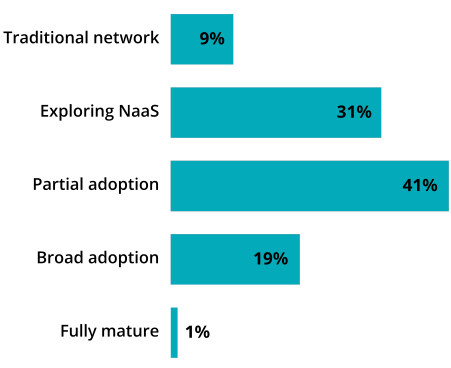
Network-as-a-Service is moving beyond early exploration. Only 9% of organizations operate a traditional network with no NaaS adoption, while 61% have at least partially adopted NaaS across selected users, sites, applications or broader network operations.
This reflects a market that is active but not yet mature. Many enterprises are testing or scaling NaaS, but only 1% describe their environment as fully mature, service-based and continuously optimized.
Network Operational Setup
NaaS is Viewed as a Strategic Architecture Shift
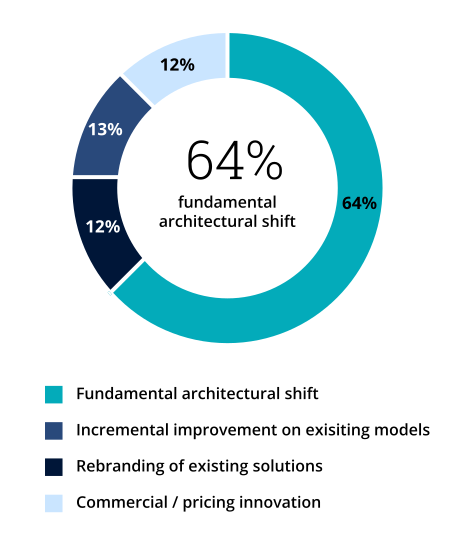
Most senior network decision-makers see NaaS as more than a pricing model or an SD-WAN rebrand. Sixty-four percent say NaaS represents a fundamental architectural shift toward cloud-native, service-based networking.
Executive sentiment is still developing. Eighteen percent say executives are excited about NaaS opportunities, while 42% say executives are interested but mostly unconvinced. This creates a clear opportunity to connect NaaS to business value, modernization and risk reduction.
Understanding of NaaS
Value Gaps Define the NaaS Opportunity
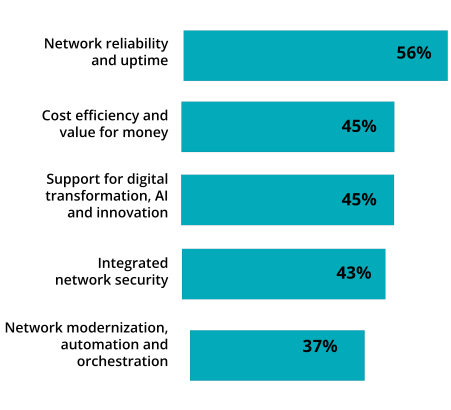
The strongest NaaS opportunities are in high-priority areas where current network performance is falling short. Cost efficiency and value for money, along with support for digital transformation, AI, and innovation, stand out as areas where enterprises need to achieve better outcomes.
These gaps point to where NaaS can create the most compelling business case. Buyers are looking for greater flexibility, faster provisioning, stronger modernization support and a clearer link between network investment and business performance.
Priority and Performance Gaps
Buyers Want Guided Control and Phased Migration
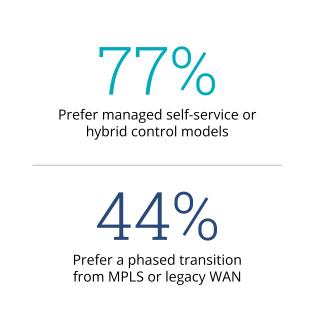
Enterprises want more control and self-service, but not unmanaged autonomy. Most organizations show appetite for self-service and automation, but they continue to prefer provider-supported models that balance flexibility, governance and operational risk.
Phased migration is the preferred adoption path. Among organizations running or piloting NaaS, 44% prefer a gradual transition that replaces MPLS or legacy WAN over time. The main friction points are transition complexity, integration with the existing ecosystem and consumption-pricing uncertainty.
Control Model and Transition Path