

Play audio
ISG Research is happy to share insights gleaned from our latest Buyers Guide, an assessment of how well software providers’ offerings meet buyers’ requirements. The Compensation Emerging Providers: ISG Research Buyers Guide is the distillation of a year of market and product research by ISG Research.
 Emerging providers capture the innovation frontier of the compensation technology market, where newer and niche entrants strive to balance breadth with distinctive approaches to usability, insight and transparency. These solutions often address the same foundational needs as established platforms—planning, analytics and operational administration—but differentiate through faster iteration, novel data models, embedded intelligence or reimagined user experiences (UX). For buyers exploring alternatives to incumbent suites, this segment offers options that can accelerate time to value or introduce capabilities that challenge the status quo, provided that governance, scale and integration needs are met.
ISG defines emerging providers within compensation management as having software offerings that deliver reasonable coverage across the core pillars of compensation—planning, analytics and operations—while demonstrating differentiated UX, features or architecture but not yet the maturity, scale or polish of leading total compensation management platforms. These solutions typically include elements of salary, bonus and equity planning; range and job architecture alignment; pay analytics and equity diagnostics; workflow, approvals and exception handling; and employee or manager-facing communication, though often with uneven depth by area. In practice, emerging providers emphasize innovation velocity, configuration flexibility and modern integration patterns to win footholds with design-forward HR teams, regional business units or enterprises undertaking targeted modernization.
The emerging cohort has historically gained traction by solving pain points left unaddressed by larger suites: clunky planning interfaces, rigid modeling, slow analytics refresh or limited transparency for managers and employees. Early entrants focused on replacing spreadsheets with elegant, web-first experiences and on accelerating implementations through templated configurations. As compensation programs expanded in complexity—multi-country policies, equity refresh cycles, pay transparency obligations—these providers layered in data pipelines, rules engines and baseline analytics to meet enterprise expectations without sacrificing speed.
Over the last few years, the most notable evolution has been the infusion of artificial intelligence (AI) into pricing, anomaly detection and guided decisioning, alongside a renewed focus on explainability and policy governance. Emerging providers have also embraced modern development practices—API-first architectures, event streams and componentized UI—enabling faster extensions and partner integrations. As they mature, many providers are investing in administrative control surfaces, audit and effective-dating rigor and performance under peak cycle loads, which are essential milestones on the path from promising alternative to enterprise-grade contender.
Enterprises evaluating emerging providers need a clear line of sight to innovation that is practical, governed and sustainable at scale. They should prioritize explainable AI that not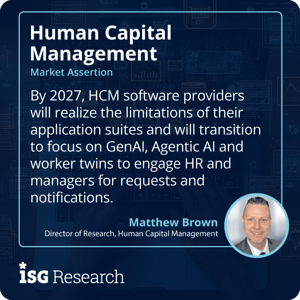 only flags anomalies and suggests guideline-consistent actions but also discloses assumptions, data lineage and guardrails. They should expect scenario modeling that reconciles budgets, eligibility and performance distributions while surfacing downstream payroll and equity implications. Importantly, they should calibrate risk by validating off-cycle administration, integration reliability with HRIS, payroll and survey sources, and the platform’s capacity to operate across multiple countries without fragmenting policy. In this context, by 2027, HCM software providers will realize the limitations of their application suites and will transition to focus on generative AI (GenAI), agentic AI and worker twins to engage HR and managers for requests and notifications. For compensation buyers, that shift means prioritizing providers whose AI roadmaps move beyond dashboards to agentic assistance that orchestrates tasks, enforces policy and explains outcomes in natural language.
Beyond intelligence, enterprises need operational durability. That includes preflight data checks, exception queues with financial materiality scoring and reconciliation from approved actions to payroll results. They need configuration lifecycle controls—sandboxing, change promotion and audit trails—so innovation does not outpace governance. They also need clarity on provider viability and support: documented security practices, compliance certifications, predictable SLAs and referenceable customers in comparable complexity. For many organizations, an emerging provider can be a fit for a defined scope such as planning and benchmarking or analytics and reporting, so long as the integration footprint is robust and the roadmap is credible for the broader total compensation management vision.
To meet enterprise needs, successful emerging platforms must pair differentiation with discipline. At a minimum, they should offer role-based access, configurable approvals, data validation and audit logging, effective-dated histories and reliable peak-season performance. Their data models should support job architecture, ranges and grades, eligibility logic and multiple reward instruments, with consistent definitions for compa-ratio, range penetration and target total compensation. Integrations must be secure and well-documented, with APIs and event hooks that keep HRIS, payroll and financial systems synchronized and reduce manual reconciliation.
Where emerging providers can truly stand out is in the quality of their intelligence, modeling and experience layers. Explainable AI should provide transparent rationales and sensitivity analyses, not black-box scores. Modeling should allow planners and finance partners to test funding strategies by P&L and talent segments and to compare scenarios side by side with clear equity and budget impact. Manager and employee experiences should elevate understanding with contextual guidance and total rewards narratives that adapt to local norms within global standards. Finally, administrative control surfaces must be first-class: policy engines, environment promotion workflows and monitoring that expose process health, queue backlogs and SLA adherence. These disciplines convert innovation into enterprise-ready reliability.
Within the Compensation Buyers Guide, the Emerging Providers category exists to spotlight platforms that deliver credible breadth across planning, analytics and operations but have not yet achieved the maturity, scale or polish of leading TCM providers. The guide’s purpose is to help buyers identify where an emerging solution can advance specific objectives—modern UX, faster iteration, skills-aware pricing or agentic assistance—without compromising governance and auditability. This lens recognizes that innovation cycles increasingly originate outside incumbent suites and that enterprises may adopt a phased approach, beginning with a targeted foothold while maintaining optionality for broader adoption.
Scope boundaries are explicit. Emerging Providers differs from total compensation management in that it does not assume end-to-end depth across design, execution, analytics and communication at global enterprise scale. It differs from planning and benchmarking, analytics and reporting, and compensation operations in that it evaluates breadth and innovation potential across these dimensions rather than excellence in a single, mature subcategory. The category also acknowledges that customer profiles may skew toward midmarket or specific regions even when the product is capable of enterprise deployments, and that provider trajectories are dynamic—today’s emerging provider can become tomorrow’s TCM contender as maturity and scale are proven.
Enterprises considering an emerging provider should test for innovation with governance by piloting real scenarios across multiple countries, currencies and worker types, validating integrations and reconciliation to payroll, and insisting on explainable AI that advances decision quality without obscuring policy. They should map provider roadmaps to a clear path toward enterprise-grade controls, ensure that administrative tooling supports safe change management and obtain references that match their complexity. Above all, buyers should frame the decision as a portfolio choice: adopt targeted innovation where it demonstrably improves planning precision, operational integrity or transparency while preserving integration and data standards that keep the door open to an eventual end-to-end TCM posture.
The 2025 ISG Buyers Guide™ for Compensation Emerging Providers highlights solutions that combine functional breadth with innovative design. It assesses platforms offering coverage across planning, analytics and operations, along with differentiated UX, strong collaboration features and scalability potential. The evaluation also considers readiness for production use, helping buyers identify forward-thinking options that deliver value without the complexity of enterprise-scale systems.
This research evaluates the following software providers that offer products that address key elements of compensation as we define it: Aeqium, BetterComp, ChartHop, CompLogix, Compport, Decusoft, Lattice, Leapsome, Pave, Quisitive and Zimyo.
This research-based index evaluates the full business and information technology value of compensation emerging providers software offerings. We encourage you to learn more about our Buyers Guide and its effectiveness as a provider selection and RFI/RFP tool.
We urge organizations to do a thorough job of evaluating compensation emerging providers offerings in this Buyers Guide as both the results of our in-depth analysis of these software providers and as an evaluation methodology. The Buyers Guide can be used to evaluate existing suppliers, plus provides evaluation criteria for new projects. Using it can shorten the cycle time for an RFP and the definition of an RFI.
The Buyers Guide for Compensation Emerging Providers in 2025 finds Pave atop the list, followed by Lattice and Leapsome.
Software providers that rated in the top three of any category ﹘ including the product and customer experience dimensions ﹘ earn the designation of Leader.
The Leaders in Product Experience are:
- Pave.
- Aeqium.
- ChartHop.
The Leaders in Customer Experience are:
- Lattice.
- Leapsome.
- Compport.
The Leaders across any of the seven categories are:
- Pave, which has achieved this rating in four of the five categories.
- Lattice and Leapsome in three categories.
- Aeqium in two categories.
- ChartHop, Compport and Decusoft in one category.
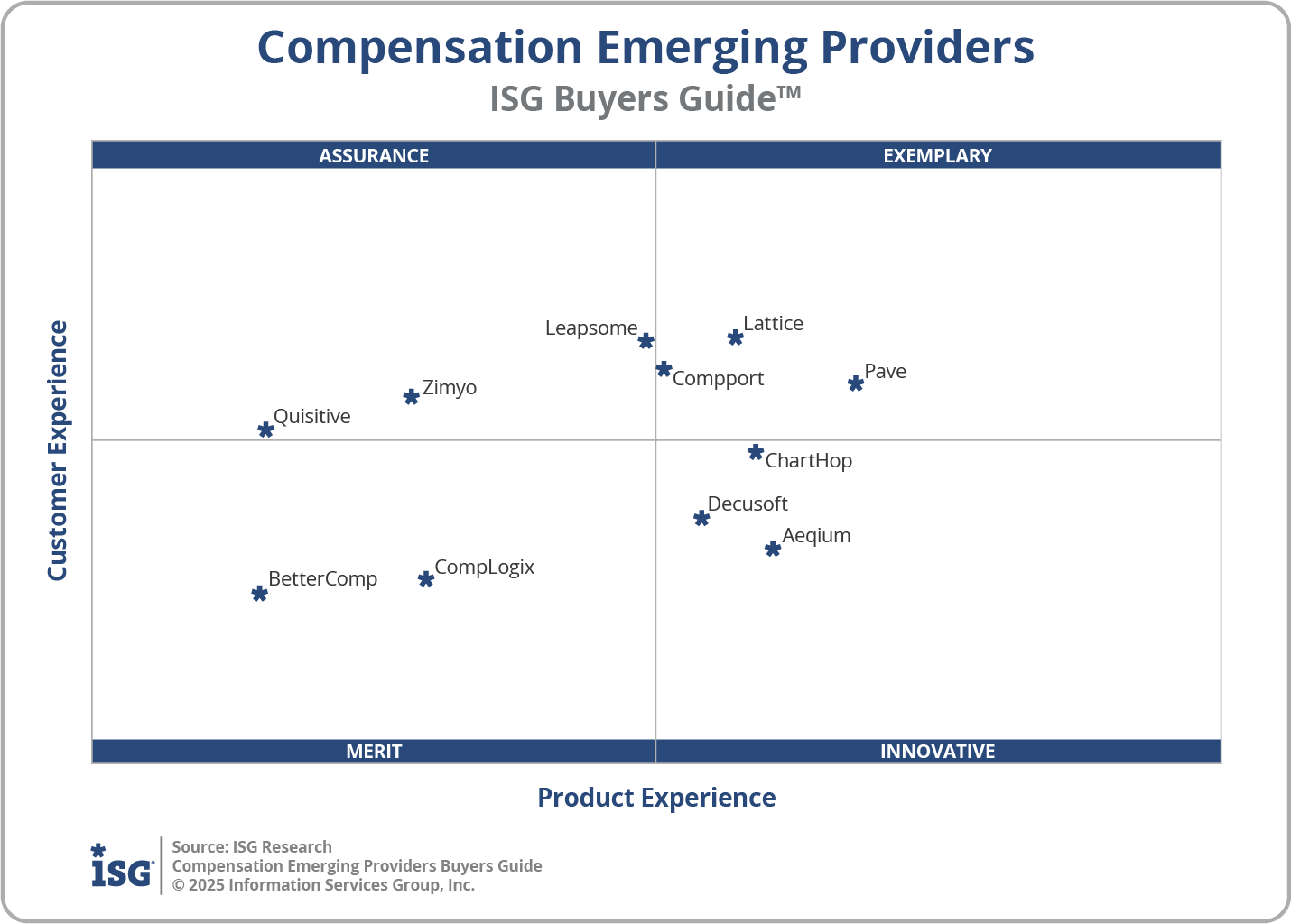
The overall performance chart provides a visual representation of how providers rate across product and customer experience. Software providers with products scoring higher in a weighted rating of the five product experience categories place farther to the right. The combination of ratings for the two customer experience categories determines their placement on the vertical axis. As a result, providers that place closer to the upper-right are “exemplary” and rated higher than those closer to the lower-left and identified as providers of “merit.” Software providers that excelled at customer experience over product experience have an “assurance” rating, and those excelling instead in product experience have an “innovative” rating.
Note that close provider scores should not be taken to imply that the packages evaluated are functionally identical or equally well-suited for use by every enterprise or process. Although there is a high degree of commonality in how organizations handle compensation emerging providers, there are many idiosyncrasies and differences that can make one provider’s offering a better fit than another.
ISG Research has made every effort to encompass in this Buyers Guide the overall product and customer experience from our compensation emerging providers blueprint, which we believe reflects what a well-crafted RFP should contain. Even so, there may be additional areas that affect which software provider and products best fit an enterprise’s particular requirements. Therefore, while this research is complete as it stands, utilizing it in your own organizational context is critical to ensure that products deliver the highest level of support for your projects.
You can find more details on our community as well as on our expertise in the research for this Buyers Guide.
Fill out the form to continue reading.