

Agentic AI is moving from pilots to production systems that execute work across enterprise applications, data platforms and business processes. As I’ve argued before, the value of AI is realized in action, not just answers, and enterprises are investing accordingly. One of the key questions now is how to coordinate the actions among different agents. My colleague Matt Aslett’s perspective on Model Context Protocol (MCP) explains that software providers are quickly embracing MCP as a standardized way for models and agents to find and use trusted data. But context alone doesn’t orchestrate multi-agent workflows. That’s where Agent-to-Agent Protocol (A2A) comes in, enabling agents to discover each other, exchange capabilities and hand off work reliably. Together, MCP and A2A form complementary lanes for agentic systems to share information and coordinate actions.
MCP’s purpose is straightforward: Give models and agents a consistent, secure, auditable way to connect to enterprise data sources and tools. Think of MCP as the data and tool interface—it supplies the “situational awareness” an agent needs to make grounded decisions. However, MCP does not define how agents talk to other agents. By design, it’s a technique for fetching data or context that will help inform the actions of an AI agent. Think of the difference between querying a database (MCP) versus calling another application’s API (A2A). In practice, enterprise use cases need both: An agent may retrieve policies and relevant data via MCP, then hand a task to a specialized agent to execute a task or business process via A2A.
Agentic AI has taken the technology world by storm. We assert that through 2027, 4 in 5 software providers will add agentic capabilities enabling automation and streamlining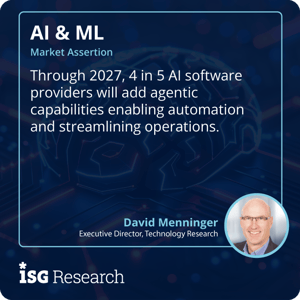 operations. As part of adding agentic capabilities, software providers have rapidly adopted MCP. A2A was introduced roughly six months after MCP, and that head start shows. We’re seeing software providers implement MCP first to unlock grounded use cases, and many have stated an intention to add A2A to support multi-agent patterns. While MCP appears to have established enough critical mass to become an industry standard, it is a little too early to declare the same for A2A. Early A2A traction is encouraging with about 60 companies publicly committing support when A2A was launched at Google Cloud Next in April. The merger of IBM Agent Communication Protocol with the A2A project was also a positive sign, but there are some potential alternatives such as Agntcy's Agent Connect Protocol and Agent Gateway Protocol. It's hard to tell at this stage, as industry support is still embryonic, hence the jury is still out.
Our conversations with software providers align with this pattern: MCP first for sharing context; then A2A for dynamic interaction among agents. The distinction between MCP and A2A maps directly to how enterprises will operationalize agentic AI. Without MCP, agents risk hallucinating or acting on stale or incomplete information. Without A2A, single agents balloon in scope, attempting to handle multiple tasks, orchestration becomes more difficult, and decomposition of processes into specialized agents remains limited. Relying solely on MCP can lead to inefficiencies as agents poll for new data which will direct the next step in the agentic process.
A standardized agent-to-agent protocol brings discovery of agents and their capabilities, contracted handoffs between agents, governance controls and resiliency patterns with timeouts, retries, and fallbacks. An agent-to-agent protocol facilitates using a network of smaller, safer, better-tested agents that can be invoked as needed. MCP’s rapid adoption increases context from data platforms, file systems and operational tools. A2A unlocks processes that run across business functions and enterprise applications, including multi-vendor scenarios. For example, supply chain agents coordinate with planning and logistics and procurement agents.
There are some risks and architectural concerns to address. Security and risk teams should note that both protocols expand the potential impact of errors or hacks. As my colleague, Jeff Orr notes, enterprises must address the security issues associated with the non-human identities some of these agents adopt. From an architecture perspective, A2A is a point-to-point protocol, which could lead to a tangled web of interconnections without using some sort of brokering architecture. And, independent of inter-agent protocols, our AI Platform Buyers Guide assessments have shown that agent monitoring and governance are still lacking, with only 11% of the nearly 30 software providers we evaluated providing comprehensive agent evaluation tools.
The bottom line is that enterprises should treat MCP and A2A as complementary, not competitive. Start by enabling MCP across the most critical data and tool surfaces to ground agent decisions. Push software providers to support MCP if it is not already available and learn the plans for supporting agent-to-agent interactions. Begin exploring A2A, particularly in scenarios that cross application or business process boundaries. Look for agents that have become bloated attempting to handle multiple tasks and attempt to decompose these agents into finer-grained components. Recognize the governance implications of agentic AI, including monitoring and non-human identities. Align with software provider roadmaps, filling in gaps where necessary with custom processes and human-in-the-loop oversight. Enterprises that institutionalize both protocols, MCP for grounded context and A2A for multi-agent interaction will realize agentic AI that is more complete, more modular and easier to evolve.
Regards,
David Menninger
Fill out the form to continue reading.