

I previously described data intelligence as fundamental to providing data analysts and business users with governed self-service access to data across an enterprise by delivering information about how data is produced and consumed across the organization. Data intelligence relies on a combination of technical and business metadata and functionality for knowledge graph, data inventory, data discovery and data governance to deliver a holistic, business-level view of data production and consumption. Many data governance and management providers are adapting their products to address data intelligence. A prime example is Actian, which took significant steps forward in 2025 with the addition of new functionality for data observability, data contracts and natural language search powered by artificial intelligence (AI).
Actian was founded as Relational Technologies in 1980 and has been through multiple iterations and acquisitions in the decades that have followed. The company is currently owned by HCL Technologies, which initially acquired Actian via a joint venture with Sumeru Equity Partners in 2018 before taking full ownership in 2021 as Actian became the data and analytics products division of HCLSoftware. Actian has remained focused on data processing and data management throughout its various incarnations and today leads with the Actian Data Intelligence Platform and Actian Data Observability products, which allow enterprises to enable governed self-service access to trusted data products for analytics and AI. The company also offers the Actian Data Platform data management and data warehousing environment, alongside other products addressing data integration, data quality, real-time data processing and application modernization. Actian was rated as Exemplary in ISG’s 2025 Buyers Guides for Data Governance, Data Intelligence, Data Management, Data Observability, Data Platforms, Data Products and Data Quality, and was also rated as a provider of Assurance in the 2025 ISG Buyers Guide for Real-Time Data.
The launch of the Actian Data Intelligence Platform in March 2025 followed Actian’s acquisition of Zeenea in September 2024 and delivered a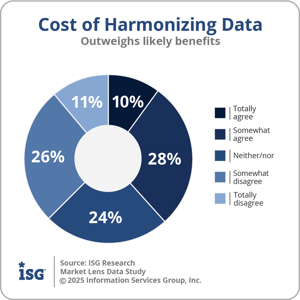 combination of data catalog, metadata management, data quality, data lineage, data governance and data marketplace capabilities. The platform is designed to enable enterprises to gain full understanding of the production and consumption of data across their organization, with dedicated application interfaces for self-service data discovery and data governance and usage monitoring, complemented by knowledge graph capabilities for business context. Data fragmentation remains a perennial challenge for many enterprises, with more than one-third (38%) of participants in ISG’s AI and Data Market Lens Study agreeing that the cost of harmonizing data outweighs the likely benefits. The delivery of data as a product via domain-based data ownership is one approach being adopted by enterprises to overcome this challenge. As I previously explained, data contracts are a critical element of data products. Data contracts form the basis of an agreement between the data owner and the data consumer and include a description of the structure, format and meaning of the data, as well as defined data quality and service-level key performance indicators and commitments. In June 2025, the company enhanced the Actian Data Intelligence Platform with the addition of data contracts embedded into the data product development workflow.
Data observability software is a key source of data reliability metrics for data contracts, and Actian Data Observability was therefore an important addition to the Actian software portfolio in May 2025. Actian Data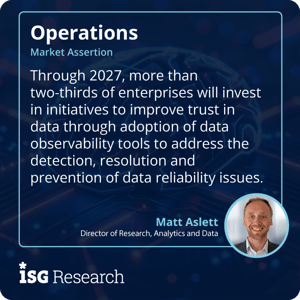 Observability provides anomaly detection driven by machine learning (ML) to identify, resolve and prevent data reliability and quality issues, enabling enterprises to accelerate AI initiatives, as well as self-service data discovery and the delivery of trusted data products. I assert that through 2027, more than two-thirds of enterprises will invest in initiatives to improve trust in data through adoption of data observability tools to address the detection, resolution and prevention of data reliability issues. Actian’s Spring 2025 launch also added AI-powered natural language search through Ask AI. In October, the company also announced the availability of Actian MCP Server, which enables integration of AI assistants and agents with the Actian Data Intelligence Platform’s business glossary definitions and knowledge graph via Model Context Protocol (MCP) to facilitate semantic search and understanding of data relationships.
In addition to Actian Data Intelligence Platform and Actian Data Observability, Actian Data Platform provides a consolidated platform for data integration, data processing and analytics, delivered as a cloud-based managed service, while Actian’s databases portfolio includes the Actian Ingres transactional database, which can be traced back to the origins of the company, and the Actian Zen embedded database. There is also HCL Informix, which offers parity with IBM Informix Advanced Enterprise Edition and is the result of a long-standing relationship between IBM and HCL through which the latter is responsible for the development, support and management of the Informix database.
Actian has revitalized its product portfolio in the past 12 months with the launch of the Actian Data Intelligence Platform and the introduction of Actian Data Observability, reflecting the evolving requirements for data management in the AI era. The company is well-positioned to help enterprises deliver trusted, reusable data assets in the context of improved understanding of data production and consumption. I recommend that any enterprise engaged in data intelligence initiatives and exploring the potential for data observability and the delivery of data products include Actian within its evaluations.
Regards,
Matt Aslett
Fill out the form to continue reading.