

Play audio
Oracle’s recent announcements around Fusion Agentic Applications represent a meaningful evolution in enterprise application architecture, especially as it facilitates automation and, ultimately, process transformation. Rather than following a prevailing view that assumes agentic systems must capture the nuances of every business process top-down, which would be prohibitively expensive and potentially unreliable, systems of record already possess almost all of the critical nuances that can enable agentic systems to act reliably within guardrails.
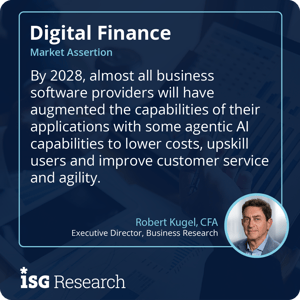 Agentic systems will also have a far greater impact on productivity than a simple assistant or conversational overlay. Oracle is embedding agentic capabilities directly into Fusion Cloud Applications across ERP, HCM, supply chain management and customer experience. As it affects productivity and cost reduction, the most valuable enterprise artificial intelligence (AI) use cases are not simple question-and-answer interactions, but process-level interventions that sense, reason, recommend and act within the systems where operational data, approvals, controls and execution already reside. ISG research asserts that by 2028, almost all business software providers will have augmented the capabilities of their applications with some agentic AI capabilities to lower costs, upskill users and improve customer service and agility.
The vision for Fusion Agentic Applications is notable for its breadth. Oracle has described a portfolio of agentic applications and AI agents designed to support outcomes across finance, human resources, supply chain, customer experience and related enterprise workflows. Oracle is attempting to transform Fusion to be both a business-critical system of record and a system of intelligent action that accurately and safely supports even complex domain processes. There is a long way to go before this vision is fully realized, but I view this as a marker of where enterprise software is moving.
The next phase of application value will come less from digitizing transactions and more from automating the work surrounding those transactions. Oracle’s AI Agent Studio is an important part of the proposition. It is intended to let organizations create, extend, validate, deploy and manage agents within the Fusion environment. Think of this as a major extension of the software development kit, which has enabled enterprises to extend and add customizations to multi-tenant software-as-a-service offerings. The availability of no-code, low-code and pro-code options broadens the potential user base, from functional administrators to developers. Oracle’s marketplace strategy, including partner-built agents, also offers domain experts the ability to monetize their unique intellectual property. This can rapidly build a broader agent ecosystem, addressing the nuances of even narrow niches of an industry with distinct business processes and terminology.
Oracle’s objectives have several structural advantages relative to a top-down approach to agentic systems. Fusion applications already hold most of the semantic, process and data nuances necessary for successful agents. These include business context, transaction histories, security models, workflow logic and approval structures. With these, a bottom-up approach provides a more credible and affordable foundation for enterprise-grade agents than generic AI tools that sit outside operational systems. Embedded agents can be governed through existing role-based access controls, audit trails, workflow states and application security policies. For midsize to large enterprises, context and control are essential to reliability and security.
Oracle’s approach also holds the potential for a meaningful impact on the productivity and efficiency of an enterprise. It’s quite common for processes handled by systems of record to require manual follow-ups, exception handling, reconciliations, coordinated approvals, data gathering and status tracking. Agentic AI can be especially useful where work is repetitive, largely rules-based, but still dependent on judgment and distributed across multiple actors or systems. In finance, procurement, HR case management, supply chain planning and customer service, the potential payoff is not just faster analysis but reduced cycle times, improved consistency of decisions and outcomes and better handling of exceptions.
Along with the promise of agentic AI, serious cautions should be noted. AI and agents present new operating model issues. Pure autonomy is a practical impossibility today, so enterprises will need to define when agents may recommend, when they may act, when humans must approve and how exceptions are escalated. Agent design and controls represent more than technical configuration challenges. They require a business-focused strategy that defines governance, risk management, process redesign and change management policies that guide the foundation of an enterprise’s agentic systems. Fusion provides some necessary support for these targets, but identifying and achieving longer-term business model objectives will require a clear plan and process for transitioning to achieve them.
Moreover, as has often been the case, Oracle’s strongest argument for adoption is within Fusion-centric environments. For organizations with heterogeneous application landscapes, the value of Oracle’s agentic applications will depend on the quality and depth of integrations with non-Oracle systems, data repositories and process platforms. Agentic AI that cannot operate across the real enterprise architecture may improve some important but selected workflows but will fall short of broader process transformation objectives. Future integration standards may diminish the issue, but until then, this is a limitation.
A second risk, especially from no-code approaches, is agent sprawl. As business users and developers use these tools to create and extend agents, enterprises will need solid controls for testing, approval, monitoring, retirement and accountability. Some of this is provided by Fusion, but without disciplined governance, organizations could reproduce the same problems experienced with unmanaged spreadsheets, robotic process automation scripts and departmental workflow tools. These are a source of near-unlimited technical debt, often harboring inconsistent logic and unclear ownership with limited auditability.
The third issue is liability and explainability. When an AI agent recommends or initiates an action, enterprise management and boards of directors nonetheless own the result. That is especially important in regulated areas such as finance, procurement, HR and supply chain, because compliance can define permissible actions, which may vary across the jurisdictions in which an enterprise operates. Oracle’s success, and the success of similar approaches, will depend not only on what agents can do, but on how clearly customers can inspect what they did, why they did it, what data they used and who approved the outcome. Again, Oracle has provided some capabilities that will be helpful, but enterprises will need a clear strategy that reflects the mission, business model and risk tolerance. Moreover, as regulations change, enterprises must be able to quickly and accurately identify how these affect agents.
A fourth, foundational issue is process definition. Simple, highly deterministic processes are easy to encode. So, if a process can be fully defined as “if A then B; if C then D,” creating an agent to execute this is relatively simple. Moreover, with systems of record, such cases require no token consumption to train an agent. However, it’s quite often the case that a multi-step process is not performed the same every time. Conditions or context may require a step-out to address an exception, or the way one division with a slightly different business model or priorities may consistently alter that process to meet its needs. Process analytics using process mining may find that for no good reason there are variations in how work is performed because someone prefers to do it that way. And not every implementation partner is on the A list, so whoever defined the process may have defined it in a suboptimal fashion. In all of these cases, a top-down approach to discovering and defining business processes will burn up a lot of tokens trying to make sense of these variations. But even relying on a system of record’s ability to use existing logs and context may present problems in resolving how best to train agents to achieve accuracy and safety.
Nonetheless, Oracle’s Fusion Agentic Applications are a credible and strategically significant development. The approach is directionally correct because it embeds AI into enterprise workflows rather than treating AI as a top-down-driven design process, a bolt-on solution or a detached conversational layer. The combination of the embedded Fusion application approach, AI Agent Studio and a partner marketplace can provide Oracle’s customers a reasonable first step and a path that can begin to operationalize agentic AI at scale.
I strongly recommend buyers take a pragmatic approach that reasonably tests the limits of what’s achievable. With a skeptical eye, buyers should assess the maturity of specific agents, because the devil is in the details. Test use cases against measurable outcomes such as reduction in cycle time, exception rate and manual effort. Look for forecast improvement, close acceleration or service-level improvement. Examine governance capabilities, auditability, integration depth, human-in-the-loop controls and lifecycle management. Focus on productivity—What can we do now that we couldn’t before?—not just efficiency.
Oracle’s offering will not deliver flip-the-switch overnight transformation. It is a serious step toward the potential of AI-enabled process execution. For current Fusion customers, it deserves serious near-term evaluation. For mixed-environment enterprises, the key question is whether Oracle’s agentic framework can extend beyond the Fusion core deeply enough to support end-to-end business processes. For other providers of system-of-record software, it outlines what will be necessary to remain competitive into the next decade.
Regards,
Robert Kugel
Fill out the form to continue reading.