

Spectacular accounting frauds happen with enough regularity to beg the question, how did the auditors miss that? In the wake of the 2008 financial crisis, the U.S. established the Public Company Accounting Oversight Board (PCAOB or “peekaboo”) with the aim of protecting investors and lenders by overseeing the audits of public companies to ensure the reports and opinions are accurate, independent and informative. Its establishment was, in effect, the answer to that famous phrase of Roman origin, “Who watches the watchman?” Although in this case, the context is not about abuse of power but dereliction of duty.
The PCAOB was created to address a perceived conflict of interest in the auditor’s oversight process, considering that the enterprise being examined pays the auditor for the services. The organization serves as the auditor’s auditor to ensure the soundness of the process. Yet when it comes to audit failure in detecting fraud, perhaps a bigger issue is being blinded by detail. This isn’t a matter of missing the forest for the trees as much as being unable to spot the diseased tree in the dense woods. To address this issue, using artificial intelligence (AI) and virtual audits can minimize blind spots in the process and deliver audits that adhere to the highest standards.
There’s an old saying: Bookkeeping is a matter of facts, while accounting is a matter of opinion. That is, even though debits and credits must always match, how those bookkeeping entries are classified and accounted for involves some degree of interpretation and judgment. For example, was that cash outlay an expense or the purchase of an asset, and what kind of expense or asset? Most of the time, the answers aren’t ambiguous, but when they are and have an impact on the soundness of the financial statements, auditors are needed to ensure that interpretations of generally accepted accounting principles are followed and performed consistently.
However, sometimes auditors have trouble assessing whether a client’s accounting treatments are sound. That’s often the case when an item in question is in a grey area, or the client has changed some longstanding treatment, or has adopted a novel approach or some combination of these. Until recently, audit opinions published in regulatory filings were largely binary, with no mention of any of the messy details that the auditors might have wrestled with in arriving at their opinion. Informing investors and lenders about these “critical audit matters” (CAMs) shines a light on these grey areas or significant judgment calls and, in turn, provides depth and color to the auditor’s statement of opinion.
CAMs are a relatively recent reporting requirement for auditors, created by the PCAOB and effective in 2019. CAMs cover issues that:
- Must be communicated by the auditor to the audit committee of the board of directors.
- Relate to accounts and disclosures that are material to the quality of the financial statements.
- Highlight complex, challenging or subjective issues auditors encountered in the process.
From the start, the PCAOB has found widespread deficiencies by auditors in handling CAMs. This has been a contentious issue because (no surprise) audit firms are keen to maintain a reputation for diligence and probity. There are likely multiple factors driving deficiencies, but regardless of the causes, there are two ways that technology can help improve audit quality. One is a more widespread adoption of a virtual audit process, and the other is the application of AI in all its forms to the practice. Both can provide those involved more time to focus on the most relevant matters and remediate deficiencies while achieving financial statement accuracy and fidelity with less effort.
The virtual audit is an outgrowth of the remote audits that became common during pandemic-era office lockdowns when auditors were prevented from making on-site visits and inspections. A virtual audit provides the audit firm’s team with remote access to financial systems, such as general ledgers, the consolidation application and close-management software, which are part of the standard inspection process. The software can be set to read-only mode and impose permissions that prevent access to nonessential and confidential information. This replaces the burdensome, time-consuming process of accounting staff gathering reams of financial documents and data and sending it to the auditors, who then spend hours performing manual data management and analysis tasks. Since time is tight in a manual review, auditors often must resort to sampling the data and do a limited amount of testing.
In many cases, a virtual audit can enable full testing rather than sampling, resulting in a higher quality audit and reliable financial statements—often with less effort. Using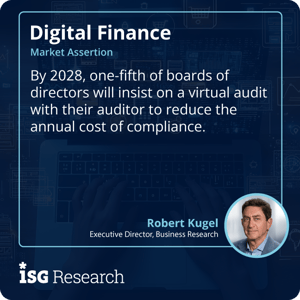 technology rather than manual processes for examination, testing and analysis can reduce the time accounting staff devotes to the audit. This and the reduced disruption can cut department costs and increase productivity. A virtual approach also benefits audit firms by substantially increasing efficiency and improving the ability to hire and retain staff by offering better working conditions (spending less time on the road, for example). ISG Research asserts that by 2028, one-fifth of boards of directors will insist on a virtual audit to reduce the annual cost of compliance.
The virtual audit structure also enables a continuous audit, where tests and tasks are spread out over a fiscal year to better balance the need for resources to avoid period-end spikes. As a result of the change in work patterns accelerated by the pandemic, audit firms are already doing this to some extent. However, a virtual audit that enables remote access to client systems broadens the scope of how testing and reviewing calendars are structured to better level workloads over a fiscal year.
Today, technology that reduces the need for on-site examinations is common, including remote teleconferencing, shared data repositories and collaborative document-sharing across and between organizations. Many financial software providers offer applications to support a virtual audit. An organization’s risk-management software can fully document audit analysis reviews and sign-offs to mitigate fraud, ensure separation of duties and prevent access violations. Such an approach can fully demonstrate to external auditors that systems are in place to monitor security and manage access workflows. Moreover, the increasing use of AI and audits in accounting software and systems is contributing to cleaner financial statements. For example, straightforward anomaly detection routines can reliably flag possible errors before transactions are posted in the system. Agents can ensure that accounting treatments are consistent and follow accounting principles. Natural language processing enables accountants to quickly get answers to proper procedures for handling unfamiliar situations and enter the rationale provided as evidence. AI is not infallible, but by improving the productivity of the department, accountants have more time to focus on using experience and skill to produce high-quality financial statements with much less effort.
The virtual audit is consistent with our definition of continuous accounting, an approach to managing the finance function that enables executives to transform how their organization operates to improve productivity while ensuring financial statement quality with less effort. Information technology has been at work keeping the books of organizations since the 1950s, but until recently, it was incapable of making fundamental changes to basic accounting and auditing methods because systems were really nothing more than a digital iteration of centuries-old analog methods.
Auditing is at a crossroads. Artificial intelligence will not put robots in charge of accounting departments, but it will eliminate a substantial amount of the robotic work that accountants do. On the other side of the process, auditors will have more time to identify, remediate where necessary and explain critical audit matters. Technology can transform how auditors work to address the current shortage of experienced workers. Software can make the auditing profession more attractive by significantly reducing the need for junior auditors to do soul-deadening, repetitive, rote work. A continuous audit methodology can also improve the quality of the work staff performs by reducing the cause of errors and oversight at their source. I recommend that auditors embrace technology to its fullest and adopt a continuous audit methodology.
Regards,
Robert Kugel
Fill out the form to continue reading.