

Play audio
If you’ve been around for more than a few years, watching some emerging trend in information technology can seem like coming full circle. Something new sounds a whole lot like something old. This may be true from one perspective, like looking down, but I’ve long thought that this progression is helical. That’s because, viewed sideways, we actually are at a higher level of capability, lower cost or greater scalability, all pushing out the boundaries of what’s possible. The arrival of agents as a core technology in business applications is revolutionizing their design and functionality. Rather than causing a SaaS-pocalypse, artificial intelligence (AI) and agents will substantially increase the value of business software in multiple ways, including increasing the productivity of those using the applications, shortening decision and execution cycles and reducing implementation and maintenance costs. Agents, often combined with process intelligence, also will enable enterprises to improve their performance through digital process reengineering (DPR). ISG Research asserts that by 2028, almost all business software providers will have augmented the capabilities of their applications with some agentic AI capabilities to lower costs, upskill users and improve customer service and agility.
Business process reengineering (BPR) was a consulting fashion in the early 1990s that 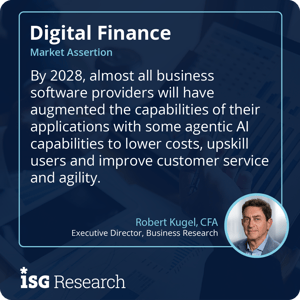 spurred many companies to purchase their first ERP systems. BPR was designed to enable a fundamental redesign of core business processes to achieve substantial improvements in market and customer responsiveness, productivity, cycle times and quality. As with AI and agents supporting DPR, technology was the catalyst. Those early ERP systems provided a first-of-their-kind platform to manage cross-functional business processes with a single program, allowing for much greater flexibility in orchestrating end-to-end processes than had been possible in the past. This became feasible because of the confluence of multiple innovations, including the commercialization of relational database technology, event-driven programming along with more powerful processors, client-server architecture and the declining costs of compute and storage. ERP and other digital systems were able to support BPR by guiding the step-by-step execution of the optimally redesigned process to ensure that it was performed consistently. They also automated the handoffs between individuals and departments to accelerate completion of that process and permit supervisory personnel to spend more time focusing on matters that required their judgement and experience and less time on administrivia.
Now, once again, the confluence of several innovations, years in the making, can support a new level of improved process design and execution.
“Digital transformation” has been in focus this decade. This sort of process reengineering employs technologies that provide enterprises more options to redefine how existing tasks are performed or to extend the range of tasks that a company’s technology systems manage. The objective of a digital redesign isn’t just to gain efficiency. It’s to use new technologies to restructure business models advantageously or alter an industry’s competitive balance of power, either to disrupt or to avoid being disrupted. Digital process reengineering provides a means to facilitate this transformation.
Process intelligence, covered in our Intelligent Automation Buyers Guides, is a technology still in its early stages of adoption with the potential to facilitate DPR. Process intelligence works by studying event data from the logs of software applications to map how processes are supposed to perform as well as how they actually perform. Typically, the technology will show there are many variations in how a process unfolds and the context in which those permutations occur. The results can be used to redefine how work is performed, eliminating redundant workflows while facilitating the execution of the rest. Process intelligence can uncover the source of bottlenecks, delays, unseen risks and unnecessary workloads. Once identified, enterprises can institute improvements. Automated process mapping and optimization also promise to accelerate the creation of agents and agentic systems and then continually test them to ensure they are performative. The Office of Finance has a wide range of functions and processes that are ripe for disruption through DPR.
First, I’ve been using the term continuous accounting for the past decade to describe a technology-led approach to managing the department. In part, it means distributing workloads more evenly across the accounting calendar. Historically, it was necessary to bunch up workloads at the end of the month and quarter because of the limitations of paper-based systems; until recently, even computer-based accounting, including close-related tasks, required batch processing or very long processing times. This effectively required the same sort of end-loading of work, driving long closing periods and staff overtime. Today’s systems are not so burdened and can offer greater flexibility, meaning that many tasks, such as reconciliations, can be done weekly, reducing workloads at the period end. AI and agents will further redefine how accounting processes are completed. For example, the period end fluctuation variance or “flux” analysis can be almost completely automated, transforming the role of today’s preparer to that of a first-line reviewer, saving hours or even days of staff time.
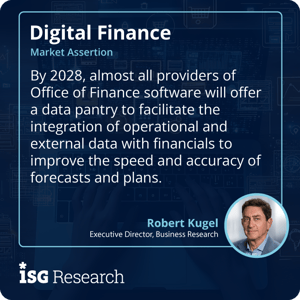 Second, I coined the term integrated business planning back in 2007 to describe a process built on a unified software and data platform that enables each department and business unit to plan and budget in a manner that works for them, but the output of those plans can be shared and integrated across the entire enterprise. It’s integrated because it brings together operational and financial plans. And it’s also integrated because it plans the income statement, balance sheet and cash flow statements concurrently. The evolution of business planning software to include a data pantry has made data-driven predictive analytics far more accessible with limited training and can almost eliminate the significant amount of time now spent on data preparation by business analysts. Having a definitive set of consistent and near real-time data also supports training and testing forecasting models to ensure they are accurate. ISG Research asserts that by 2028, almost all providers of Office of Finance software will offer a data pantry to facilitate the integration of operational and external data with financials to improve the speed and accuracy of forecasts and plans. Agents, in turn, can eliminate purely mechanical routines in business planning processes to shorten planning cycles as well as ensure process and methodological consistency
The third is the virtual audit. This isn’t the “remote audit” that companies adopted during lockdowns, which is just the same as on premises, except done remotely. The virtual audit is a different, open-book approach that gives the external auditor read-only access to financial systems. It replaces the time consuming and burdensome “provided by client” list of documents, freeing up a considerable amount of staff time. Ideally, some audit work is spread out over the calendar, enabling companies to address issues before year-end and shortening the auditor’s workload for the annual statement.
Digital process reengineering isn’t entirely new. In the 1990s, for example, 24-hour loan approval became possible using optical character recognition to accelerate processing of loan applications and using IT systems to manage parts of the approval process in parallel rather than serial fashion. It relied heavily on an early form of big data analytics, the credit score, to support the decision-making process. Enterprises have been using digital technologies since then to make incremental breakthroughs to achieve business breakthroughs. What is new today is the scope, scale and availability of the technologies and techniques that will make DPR a common feature of business management.
Using DPR successfully, especially in agentic systems, will be an increasingly important issue that business executives must address, ideally proactively. I assert that business challenges never change. However, the tools available to successfully meet those challenges do change, providing those who are best able to utilize them early on the potential to gain a competitive advantage or at least avoid disruption. Executives must use these emerging technologies to respond to the digital disruptions that are increasingly common as entrepreneurs utilize available technology innovations to create new product or service categories or create more effective business models to compete with established ones. It’s equally important to be able to distinguish between the overblown or immature technologies fancied by technologists that will have limited market impact and those that represent real opportunities for those who understand how to exploit them.
Regards,
Robert Kugel
Fill out the form to continue reading.