

I recently wrote about the distinction between personal productivity artificial intelligence (AI) and enterprise AI. Each has a role to play. An important challenge facing enterprises in the coming years will be encouraging and supporting the use of AI-enabled personal productivity applications for individuals and small workgroups while preventing their misuse in performing enterprise tasks and processes. This is especially the case with spreadsheets. For decades, spreadsheets have beguiled individuals into using them for tasks for which they are poorly suited, because of their versatility and depth of features. As AI and agents are woven into these personal productivity programs, they will supercharge what individuals—even casual users—can do.
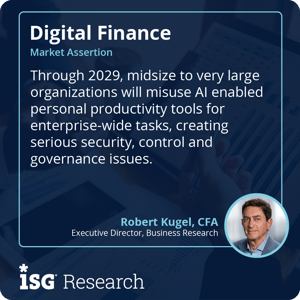 Along with these benefits, the ongoing challenge will be ensuring that these tools are used appropriately. Human nature being what it is, ISG Research believes that through 2029, midsize to very large organizations will misuse AI-enabled personal productivity tools for enterprise-wide tasks, creating serious security control and governance issues. Business software providers should help buyers and users set policies and criteria for the most appropriate use of each application.
On the flip side, more capable and efficient personal productivity applications will pose challenges to software providers, especially those that focus on the needs of midsize enterprises and divisions of larger corporations. These smaller entities are more likely to prioritize cost and apparent convenience to a greater degree than large enterprises, which place a higher value on security, governance and maintainability.
Beyond the obvious necessity of embedding as many workable and reliable AI and agentic capabilities into an application as quickly and safely as possible, there are multiple constraints that all software providers must respect in the design and execution of applications. These include:
- Focusing on efficient engineering to provide a sustainable competitive advantage.
- Illustrating how enterprise-level data management and permissions are essential for enterprise-wide tasks, while personal and small workgroup data management is only adequate for these limited purposes.
- Demonstrating how establishing clear boundaries between personal productivity AI and enterprise AI yields the greatest level of productivity.
- Emphasizing the importance of governance, security and maintainability to customers and prospects.
Today’s concerns about the cost of compute and memory are a bit of a throwback to an earlier age when, on average, these resources were multiple orders of magnitude more expensive than today. This forced software designers to prioritize engineering efficiency. A famous example was the use of two-digit year dating, which ultimately sparked the Y2K panic. As those resource costs fell, other considerations grew in importance, including achieving a faster time to market and expanding features and functionality.
Business software providers must offer customers better cost performance than competitors but also compared to what is available in personal productivity applications. The latter, being a general-purpose tool, is unlikely to offer the same performance and functionality for a task as a well-designed purpose-built application. The constraints on personal productivity software—especially on the operating cost side—provide a point of differentiation for business software providers.
Back in the ‘teens, I coined the term “data pantry” to describe (tongue-in-cheek) an approach to the design of enterprise software platforms that have a dedicated data store specifically for users of that software. It’s a pantry because all of the data relevant and useful to that application is readily available to users. The pantry also ensures that data and metadata are timely, consistent and easily understood by users. General-purpose and even departmental data stores typically cannot deliver those capabilities. For that reason, this type of data store has become a common feature in business application platforms. Having this type of automated, governed, secure and controlled data store is a feature that distinguishes enterprise AI from personal productivity AI.
I expect that providers of personal productivity tools will soon offer users greater automation and control of data sources as part of the tasks and routines. This will be an important step in increasing the productivity and reliability of individuals and small work groups. However, the capabilities and security of these roll-your-own data piles are unlikely to rival dedicated applications anytime soon. I readily acknowledge that “data pantry” greatly trivializes the effort behind their creation and maintenance. Moreover, the kind of fine-grained access control that is typically part of business applications will be hard for personal productivity and DIY applications to replicate. This is an important point of differentiation between personal productivity and enterprise-scale software.
An important part of making the case for investing in a dedicated enterprise application is enabling buyers and users to have a clear understanding of the appropriate boundaries between personal productivity AI and enterprise AI. I expect this will become more important and more challenging as AI supercharges the capabilities of those personal tools. When used for a wide range of appropriate tasks, increasingly AI-enabled personal productivity tools will multiply individuals’ competence and extend the scope of work they can be expected to perform. The same applies to small workgroups (fewer than 10).
Yet, based on how humans have behaved in the past, I expect this software will be misused by many for processes and purposes it was never designed for. Beyond security, governance and maintainability issues, this misuse is likely to result in less productivity as, for example, users constantly need to tinker with their processes, cut corners with design and functionality and deal with unintended errors from these systems. Over the past decade, business software providers have made inroads for the case of investing in a dedicated enterprise application. It will be a challenge to deal with increasingly capable personal productivity software. The message must be clear that these tools cannot reliably handle enterprise-wide tasks and workflows, and especially not security, governance and controls.
Finally, for many enterprises, governance, security and maintainability are important goals. But, like a better diet and exercise, they are not often carried out with sufficient rigor. One reason is that at the individual and small workgroup level these requirements seem like a hindrance to getting work done. Since the antidote to lax enforcement comes from the top down, software providers should emphasize the importance of using enterprise software for enterprise tasks, while promoting personal productivity software where appropriate. This messaging is necessary even though it may not be successful.
As experience with AI grows, enterprises and individuals will have a better idea of how to handle constraints and trade-offs. I recommend that software providers stay ahead of the curve by setting realistic expectations and highlighting the reasons for using the appropriate tool for the job. Customer success and adoption must be a key metric as the range of capabilities and ease of use expand, backed by an intentional customer success program. Enabling internal champions to make an effective case for investing in a dedicated enterprise application is equally important.
Regards,
Robert Kugel
Fill out the form to continue reading.