

I previously stated that too many enterprises allow the IT department to be wholly responsible for data and analytics, with the risk that strategies become divorced from business objectives and KPIs. I also stated that a pragmatic approach to organizing and operating data, analytics and artificial intelligence (AI) initiatives is essential to treating data as a business discipline. There are various organizational approaches to data, analytics and AI for enterprises to choose from, including ownership by a central IT department and the use of a specialist Center of Excellence (CoE) outside of IT. The results of ISG’s 2025 Market Lens Data and AI Program Study indicate that rather than selecting a single approach for all initiatives, each has potential benefits, depending on the specific focus area of the initiative and anticipated outcomes.
Almost one-half (49%) of participants in ISG’s 2025 Data and AI Program Study agree that data operations should be managed separately from other parts of the IT estate. Few have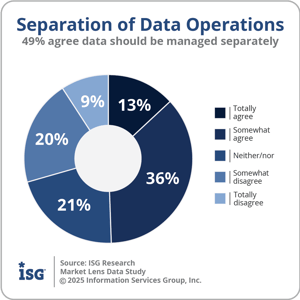 delivered on that concept, however, as—on average across all activities—the IT department is the home of data initiatives for 47% of respondents. Exploring the results of the study in more detail confirms that this is not a matter of respondents being split between two alternative approaches to managing data operations. Many enterprises recognize that data operations should be managed separately but are failing to put theory into practice. Alternative approaches to data operations assessed by ISG’s Data and AI Program Study include the use of a specialist CoE outside of IT, the distribution of responsibility to business units (BU), ownership by another business unit outside of IT and the use of outsourcing services, including managed service providers as well as offshore development or global capability centers.
The results illustrate that each of these approaches has benefits and challenges, and that most enterprises adopt a variety of approaches, depending on the data activity:
- The use of a CoE is more prevalent for data science (21% of participants) and AI initiatives (20%), and least popular for data cleaning and deduplication (9%).
- Distribution to BUs is most popular for data insights and business intelligence (BI) (27%), data science (22%) and data cleaning and deduplication (21%), and least popular for data integration and engineering (9%).
- Handing responsibility to an individual business unit outside IT is most popular for data governance (19%) and AI (16%), and least popular for data integration and engineering (8%).
- Despite the growth of alternative approaches, ownership by the IT department remains the most popular approach for all data activities but is particularly prevalent for data integration and engineering (61%) and data cleaning and deduplication (56%), and least popular for data insights (31%).
The popularity of an approach does not necessarily translate to success, however. In addition to asking participants about their organizational approach to seven key data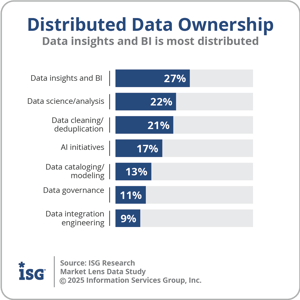 activities, ISG’s Data and AI Program Study also asked participants to assess the performance of their organization against expectations in relation to 16 criteria, including cost, delivery of business value, data quality, compliance, data security, speed of access, and productivity. By correlating this information with ownership of the various data activities, it is possible to assess the three most popular organizational approaches to data responsibility (IT, CoE and BUs) in relation to delivery against expectations. The results show that one approach is not definitively better in all situations. However, the use of a CoE outside of IT scored highest in 66 of the 112 combinations (seven data activities and 16 criteria), while ownership by the IT department scored highest in 21 and distribution to BUs scored highest in 20. Five were tied.
Organizations using a CoE performed particularly well against expectations for data governance, scoring highest in 13 of 16 criteria. Organizations using the IT department did best for data insights and BI, scoring highest in nine of 16 criteria, and organizations with data ownership distributed to BUs performed best in relation to data integration, scoring highest in seven of 16 criteria and tying one other. Distributing data ownership to BUs is a key component of delivering data products and should be a consideration for enterprises aiming to accelerate data democratization, as it scored highest for data discovery and speed of access in relation to data science, data integration and AI. Distributing data ownership to BUs also scored highest for business value in relation to data integration and AI initiatives, as well as transparency for both data insights and BI, and data integration.
Ideally, it would be possible to recommend a single approach to organizing and operating data, analytics and AI initiatives. The results of ISG’s Data and AI Program Study reinforce my previous advice that a pragmatic approach is essential. Unfortunately, there is no single approach that is guaranteed to be successful for all use cases, although the results do suggest that the use of a CoE outside of IT is more likely to deliver above expectations. I recommend that organizations that have not already done so evaluate the potential advantages of a CoE approach, but do so with the knowledge that a pragmatic and multi-faceted approach to ownership of multiple data-related activities is advisable.
Regards,
Matt Aslett
Fill out the form to continue reading.