

Revenue organizations are running out of room to hide. With increasingly complex buyer journeys, longer sales cycles and rising expectations for personalized outreach, today’s CROs face a mounting challenge: deliver predictable growth in a market that’s anything but predictable while simultaneously building a team that doesn’t burn out.
ISG asserts that through 2027, more than one-half of enterprises, due to outdated CRM and SFA processes and system design will be unable to deploy the latest AI technology to assist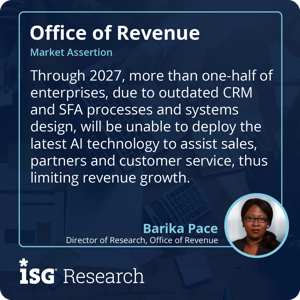 sales, partners and customer service, ultimately limiting revenue growth. This is the crux of the issue: even as AI accelerates around us, the systems that are supposed to empower sellers are increasingly the ones holding them back. The risk is clear: fail to close the gap between seller experience and sales technology and you risk stalled deal velocity, rep attrition and a go-to-market engine that looks fine on dashboards but crumbles under scrutiny. Most CROs didn’t inherit a clean slate. They’re leading revenue teams weighed down by fragmented tools, bloated workflows and well-meaning automation projects that were never fully adopted. At the same time, frontline talent is signaling fatigue, demanding more clarity, better coaching and fewer distractions disguised as enablement. The result is a trust gap that no single investment can fix. So, the question becomes: how can CROs realign their people, platforms and processes in a way that delivers both results and retention?
The answer is a mindset shift. Forward-thinking CROs are no longer just chiefs of forecasting or conversion; they're architects of revenue experience. They understand that seller productivity isn’t just a tech problem or a culture problem. It’s a systems design problem. And the solution starts by treating your sales environment like a product: one that must be tested, improved and optimized from the seller’s point of view.
Over the next quarter, CROs must take three key actions. First, it is time to map out the friction. Start with a tactical immersion into your sales team's daily experience. Shadow top performers and new hires alike. Observe not what tools they use, but how they use them and, more importantly, where they stall. Does your team waste time toggling between systems to log calls, pull pricing or validate ICP criteria? Are they creating shadow spreadsheets to track deals because the CRM structure doesn’t match reality?
Identify one high-friction workflow like opportunity progression, proposal creation or quote-to-contract and commit to a redesign sprint. Use design thinking techniques: map the steps, hear the pain and co-create improvements with your reps. Even a 10% drop in process friction can have a measurable impact on velocity and morale.
The second step means rethinking incentives for the Hybrid Era. Take a hard look at your compensation plans and team goals. Are they still optimized for individual performance or are they designed to reflect how selling actually works today: collaborative, cross-functional and often asynchronous?
Audit your incentive structure across three dimensions: clarity, collaboration and consistency. Eliminate overlapping Sales Performance Incentive Funds or metrics that compete with core revenue goals. Add shared team incentives for late-stage deal support or strategic expansion work that often goes unrewarded. And don’t wait for year-end planning cycles. Run a mid-year pulse survey and hold a comp feedback session to hear what reps are responding to. CROs who modernize comp models before Q4 not only gain a performance edge, they also signal to the team that leadership is listening, adapting and willing to align around what drives revenue now.
Finally, this is where the shift becomes real. Dedicate resources to build a pilot Revenue Experience Office or, at minimum, designate a cross-functional task force. The goal is to optimize the human layer of your revenue engine. This team should include stakeholders from Revenue Operations, Enablement, HR and frontline sales. Give them access to seller workflow data, onboarding completion rates and tool adoption metrics. Task them with answering one question: “Where are we losing seller energy?” From there, pick one pilot area—onboarding, weekly standups or deal desk handoffs—and test a new approach. Maybe it’s a one-stop enablement hub. Maybe it’s shortening approval chains. Maybe it’s redesigning sales to reflect team needs. The point is to stop assuming your people are the problem and start designing systems that reduce drag, align incentives and foster flow.
Let’s be clear: there is a new mandate. This isn’t about adding more dashboards or buying another AI widget. It’s about building trust, alignment and momentum by designing a revenue system that works with your team, not against them. Happy sellers don’t just stay longer, they sell smarter. And smart selling isn’t just about automation or activity levels. It’s about reducing friction, rewarding the right behavior and equipping your people to do their best work. The talent-tech gap is real. The CROs who win in this market are the ones who treat that gap not as a failure but as a design opportunity. In 100 days, you can begin to close it.
Regards,
Barika Pace
Fill out the form to continue reading.