
Data is one of the most valuable assets an organization owns, and a robust data backup and recovery system is foundational to protecting it. Weak data protection efforts jeopardize resilience and business continuity. With data residing in multiple places – including on-premises servers and public and private cloud environments – it is difficult to ensure that all data is backed up and recoverable in the event of a disaster.
Cyberattacks pose a unique data-protection challenge. Cybercriminals are constantly developing increasingly sophisticated methods to attack organizations and steal data. All  types of organizations across all industries seek a reliable and automatic way to backup and restore data – not just those with more workers to monitor. Our Data Governance Benchmark Research found that only one-third of organizations (37%) are auditing data access and usage on a daily basis.
Organizations typically focus on backing up data that is intended for internal use only, but there are also second and third tiers of data, which are not often discussed despite their importance. For example, second-tier data might include confidential information such as financial records, employee information and trade secrets. Third tier data, on the other hand, might include highly confidential information such as intellectual property, legal documents and strategic plans. It’s important for organizations to properly classify and protect all tiers of data to comply with relevant regulations and be recoverable in the event of a disaster or cyberattack.
Ventana Research asserts that by 2026, two-thirds of organizations' investments into software and cloud computing will not be prepared to ensure the continuity of business processes. To address these challenges, Cohesity offers data backup and recovery capabilities. The company focuses on data protection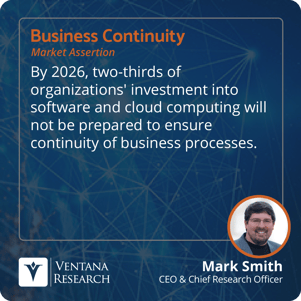 and recovery from cyber threats and ransomware to ensure business resilience. It has found success across organizations of different sizes and architectures and has demonstrated use cases in industries such as financial services, healthcare and government.
Cohesity Data Cloud is a unified platform for securing, managing and extracting value from an organization’s data, available as either self-managed software or a SaaS implementation. The platform provides data security, a single pane of glass management interface, threat detection, user behavior monitoring and recovery across on-premises and multi-cloud environments. Helios, the Cohesity control plane, provides a single user interface. DataHawk offers protection and recovery against ransomware with threat protection, cyber vaulting and machine learning-powered data classification to identify threats, assess an attack’s impact and recover critical data.
Cohesity has formed relationships with a variety of third-party apps and integrations, which is valuable for incorporating data backup and recovery services with other systems and applications already in use. If the organization uses a particular cloud storage service, having integration between Cohesity and the cloud storage provider makes it easier to keep backups in the cloud. It provides additional flexibility and scalability for the organization’s backup and recovery needs. One of the benefits of a data backup and recovery system is that it helps eliminate data silos by simplifying infrastructure or removing it using SaaS. Data silos occur when data is stored in separate systems or applications that do not communicate with each other, making it difficult to access, analyze and use the data effectively. A data backup and recovery approach integrates with multiple systems and applications so an organization can confirm that all of its data is backed up and recoverable in a centralized location. This system helps eliminate data silos, making it easier to access and use the data across the organization. Cloud platforms also reduce the complexity and costs of managing and maintaining on-premises backup and recovery infrastructure. The provider is responsible for the underlying infrastructure, leaving the organization to focus on its core business activities.
The range of technologies that organizations deploy varies, and so do approaches for data backup. Hybrid cloud backup systems provide flexibility but can be more complex to manage. Cloud-based disaster recovery approaches provide fast failover time but can be more expensive. Data backup and recovery systems contribute to an organization’s ability to access, analyze and use its data effectively, which leads to better business outcomes.
Another backup and recovery system benefit is moving away from legacy systems, which helps reduce technical debt associated with maintenance and operating costs. Technical debt refers to the costs of maintaining and operating outdated or inefficient systems. Legacy systems can be expensive due to their age and complexity. They often require specialized knowledge and skills to keep them running, which can be difficult and costly to find. In addition, legacy systems may not be able to take advantage of new technologies or integrate with other systems and applications. Moving away from legacy systems and implementing a multi-cloud backup and recovery system can reduce technical debt, leading to improved efficiency and effectiveness of an organization’s business processes.
Ultimately, the benefits of securing and managing data are clear. A robust data backup and recovery system helps organizations safeguard business continuity and the ability to meet business objectives and goals. These systems protect against data loss and minimize downtime. Organizations seeking a data backup and recovery system to improve resilience, simplify infrastructure, reduce technical debt from legacy systems and support multi-cloud environments should consider Cohesity in evaluations.
Regards,
Jeff Orr
About the author