

For the last year, we have watched as CX and CCaaS industry leaders maneuver their way toward an agentic strategy for customer interactions. NiCE used its 2026 Industry Analyst Summit to solidify its claims and demonstrate how the company is reorienting itself around the idea that as AI agents proliferate and become easier to build, enterprises need the ability to orchestrate, govern and optimize the work performed by humans and AI.
What we broadly call CCaaS doesn’t really fit that moniker anymore, as we’ve moved past “contact center in the cloud” being the defining quality of the CX tech stack. With that in mind, I think that NiCE isn’t best understood simply as a CCaaS leader expanding into AI. Its ambition is to become a CX control plane: a layer that connects all the components of the interaction (human workers, AI agents, enterprise systems and data) and coordinates them through to a measurable customer outcome. Cognigy provides much of the agentic execution capability, while CXone contributes the engagement, workforce, data and operational context on which the broader proposition depends.
It’s clear now, more than a year after the acquisition, that Cognigy was more strategically consequential than simply filling a conversational AI gap. NiCE now describes “one agentic core” with two deployment paths. Customers can consume Cognigy as part of the broader CXone environment or deploy it alongside another CCaaS, CRM or enterprise stack. This second path gives NiCE a route into enterprises without requiring a CXone displacement and effectively decouples part of its AI growth opportunity from traditional CCaaS replacement cycles.
NiCE’s platform strategy is undergoing a shift. While NiCE advocates consolidation of functions onto its platform, it doesn’t necessarily posit a future in which it’s the vendor for every application. This makes sense in a world where the newest transformational applications need—by definition—to be connected to larger enterprise stacks and platforms. When you’re knitting processes together across enterprise departments, you’re going to need to invoke connections between a much broader range of tools than you would in an old-school traditional call center. So it makes sense that NiCE is adopting a strategy that explicitly expects its platform to accommodate frontier models, third-party and homegrown agents, enterprise applications, developers and partners. The NiCE team describes this as control-plane consolidation: NiCE wants to orchestrate the customer-facing work even when some of that work occurs elsewhere.
NiCE also extended my sense of how human-plus-AI orchestration is becoming part of the core. The company described creating “learning loops” across the full experience and human/AI agents working together. It is connecting learning across domains that have typically been separate: customer intent and resolution, routing and outcomes, handoffs and memory, for example. My takeaway is that NiCE isn't promising that AI eliminates handoffs; it’s making handoffs less likely to create discontinuities in the customer experience. This is more credible than the idea of “end-to-end autonomous resolution,” which is getting more common around the industry.
As the industry conversation around enterprise automation takes shape, attention is turning to often-overlooked governance issues. NiCE argues that AI accountability is becoming a critical problem. Its architecture emphasizes runtime controls around what an agent intended, what it was permitted to do, what it actually did and whether the resulting outcome was correct. Guardian AI and some of its associated components are intended to make that accountability part of the execution process, rather than an audit performed after the fact. NiCE’s current nods towards governance suggest that accountability could become a more important product differentiator than access to any particular foundation model or agent technology.
The buying center is changing at the same time. Agentic CX brings enterprise AI, data and platform organizations into decisions historically dominated by contact center and CX ops teams. The more technical buyers expect APIs, MCP and A2A support, agentic development, evaluation and observability, model choice and, as noted, governance. This forces NiCE to satisfy two constituencies at the same time: business leaders looking for measurable CX outcomes and technical teams determining whether its architecture meets enterprise AI standards.
This also boosts the importance of partners. NiCE reported that 70% of its enterprise wins this year came through partners, and it is consolidating multiple programs into a unified ecosystem spanning sales, services and technology relationships. The NiCE of 2026 appears to have a more expansive and coherent partnership strategy than the NiCE of, say, 2021, a development that’s coming directly from the experience of the top executive leadership.
Perhaps the most consequential longer-term issue raised at the summit was the emergence of personal AI agents. NiCE’s formulation—“the customer’s agent is the channel”—points to a potentially fundamental change in CX. If consumers widely adopt personal agents for basic service, support and shopping interactions, brands lose a good deal of control over the customer journey. Machine-generated interaction volumes could rise substantially, and many long-held core assumptions about journey design, routing and contact center capacity could be undermined.
We don’t want to get ahead of the market. NiCE’s own customer panel showed that personal-agent traffic remains limited: adoption varies by interaction type and industry, and consumers remain reluctant to delegate some higher-trust interactions. For the moment, this appears to be a high-consequence strategic scenario to plan for, not something already evident in interaction volumes. Still, enterprises and CX technology providers have good reason to architect for it now because the operational consequences could be colossal if adoption accelerates.
Finally, NiCE’s ambitions broaden its competitive environment. If NiCE succeeds in making CX the orchestration layer for customer-facing AI, it will increasingly encounter service-management platforms, hyperscalers, horizontal agent platforms and enterprise orchestration and governance providers. Enterprises then have to ask themselves why they should grant the CX layer that architectural authority, rather than letting one of those other types of enterprise platforms take on the responsibility.
NiCE’s plausible answer is that it lives in the space where large volumes of human and machine activity converge, where enterprises possess unusually rich interaction data and where outcomes are comparatively measurable. That doesn’t make the transformed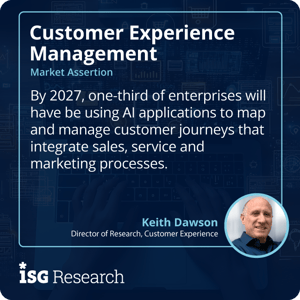 CCaaS platform a slam-dunk for running broader agentic activity, but it does provide a starting point for making those connections. ISG Research asserts that by 2029, one-third of enterprises will use AI applications to map and manage customer journeys, integrating sales, service and marketing processes. If true, there will be strong competition for tools that can connect and control all of the participating enterprise tools, platforms and applications.
NiCE isn’t primarily betting that it can indefinitely build better AI agents than everyone else. It’s betting that agents will become increasingly commoditized, while orchestration, governance, context, learning and outcome management become the scarce and prized enterprise capabilities. Cognigy gives NiCE a strong agentic execution layer; CXone provides the operational environment and accumulated CX context around it. What we’ll be looking for in 2027 and beyond is how the company turns those assets into an open but integrated control plane for customer-facing work.
And doing so means NiCE is stepping onto a considerably bigger competitive field than the CCaaS market in which it has competed so far. That next phase will depend on demonstrating that enterprises will trust them with coordinating the increasingly complex network of humans, AI agents and enterprise systems through which customer outcomes are produced.
Regards,
Keith Dawson
About the author