

The 2023 Ventana Research Buyers Guide for Embedded Analytics research enables me to provide observations about how the market has advanced.
The processes and technology of the analytics and data software industry play an instrumental role in enabling an organization’s business units and IT to optimally utilize data  in both tactical and strategic ways. To accomplish this, organizations must provide their workers technology that can access the data, generate and apply insights from analytics, communicate the results and support collaboration as needed.
When analytics are embedded in business processes and applications, analyses are easier to perform and more accessible to line-of-business personnel. The analyses are easier to perform in part because the application collects and assembles data. Our research shows that data preparation can be the most time-consuming step in the analytical process; embedded analytics can dramatically reduce or eliminate this step. Analysis is also easier to consume because there is no need to switch context between the business application and an analysis tool.
Perhaps more importantly, analytics embedded within applications can more easily lead to action. For instance, if an analysis suggests a change in pricing, the appropriate logic can be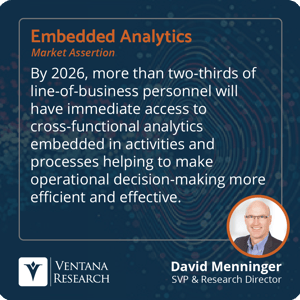 included in the application to make those changes. If an analysis suggests a marketing campaign for a specific customer segment, that segmentation can be performed and the campaign launched. For these reasons, we expect that by 2026, more than two-thirds of line-of-business personnel will have immediate access to cross-functional analytics embedded in their activities and processes, helping to make operational decision-making more efficient and effective.
This Buyers Guide focuses on the challenge of delivering analytics and business intelligence in the context of business processes and applications. These needs are substantial — more than half of organizations (53%) report their users of analytics tools cannot perform their own analyses without IT involvement. Our research on cloud-based analytics, predictive analytics, data preparation and big data analytics all show strong interest in embedded delivery of those capabilities. Analytics vendors understand the need to deliver embedded analytics; most have been developing and enhancing APIs and other mechanisms to integrate analytics more tightly into business processes and applications. However, it can be challenging for analytics and business intelligence vendors to package and deliver their capabilities in a way that makes them easy to embed into other applications and processes. Vendors are working to overcome these challenges because organizations recognize the importance of embedded analytics. Nearly three-quarters of participants in our Analytics and Data Benchmark Research said they considered embedded analytics important.
Vendors must provide tools for defining data models and accessing data from applications and other data sources. These tools will likely be used by a different audience than typical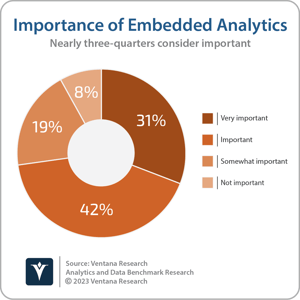 analytics tools. An application development team, for instance, would create the framework for line-of-business personnel to perform analyses. In addition, the tools must provide mechanisms to integrate both inputs to and outputs from the analytical processes with other applications. Embedded analytics also requires programmatic access to the management and administration functions to minimize installation and maintenance of the system for line-of-business personnel.
Organizations are aware of the value of embedded analytics. The next step is to embrace embedded analytics and determine what capabilities their vendor currently offers. They should also be comparing their current offering with what other vendors have to offer. In evaluating embedded analytics, one must also consider the underlying analytics capabilities. Great APIs and SDKs can only do so much if the foundation of underlying analytics is weak. Consequently, this Buyers Guide combines an assessment of embedded analytics capabilities with core analytics capabilities to determine the vendor’s overall rankings. Organizations can then use this report not only to help guide purchasing decisions, but to guide conversations with vendors about their roadmap for embedded analytics. The market continues to evolve, but organizations can realize value today that will improve their analytics processes.
This research evaluates the following vendors that offer products that address key elements of embedded analytics as we define it: AWS, Cloud Software Group, Domo, GoodData, Google, IBM, Idera, Incorta, Infor, insightsoftware, Microsoft, MicroStrategy, Oracle, Pyramid Analytics, Qlik, SAP, SAS, Sigma Computing, Sisense, Tableau Software, ThoughtSpot and Zoho.
You can find more details on our site as well as in the Buyers Guide Market Report.
Regards,
David Menninger
About the author