

We are kicking off our Supply Chain Planning Buyers Guide™ for 2026. ISG Software Research defines supply chain planning (SCP) as the business discipline of coordinating the future supply of materials and services used in the creation of specific products and services with the expected demand for them. The purpose of planning is to optimize the flow of goods and materials with related services from suppliers to customers. The guide evaluates products based on their support for the full scope of SCP. The software must be able to manage and reconcile demand and supply plans, manage the planning process, support cross-functional collaboration, support sales and operations planning, model data for analysis, analyze data using a variety of techniques and communicate the results in a variety of ways in support of data and analytical processes. Because of its cross-functional impact, SCP software improves tactical and strategic coordination. This is part of a broader trend. ISG Research asserts that by 2028, almost all users of business planning software will use its capabilities to align strategy and objectives to organizational performance across business silos.
Supply chain planning emerged as an operational discipline as industrial enterprises grew too complex for informal coordination between business roles and silos. Its foundations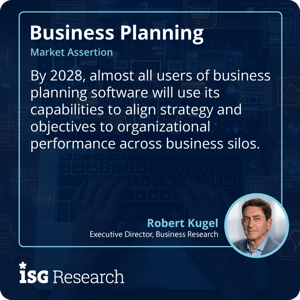 were laid in the early 20th century and accelerated during World War II through operations research and mathematical modeling of large-scale logistics necessary to prosecute global warfare. In the postwar decades, analytical techniques such as linear programming and inventory optimization models became common. The need for a data-driven approach grew as supply networks expanded geographically and product cycles shortened. Advances in computing enabled MRP systems in the 1970s and 80s, and further refinements became possible with integrated ERP systems and OLAP analytics in the 1990s. Globalization and the internet further increased complexity, driving adoption of advanced planning and scheduling tools to improve forecasting, coordination and responsiveness. Today, our research finds that almost all large enterprises have over 100 suppliers and more than 1,000 stock keeping units (SKUs).
Enterprises benefit from SCP software in multiple ways. The most important is through improved demand forecast accuracy. Increasingly, this software uses advanced algorithms and machine learning (ML) to achieve greater accuracy, which helps companies better anticipate customer needs and reduce the risk of overstocking or stock-outs. ISG Research finds that 56% of companies are planning to increase their investment in forecasting and scenario planning using artificial intelligence (AI) over the next two years. Minimizing costs and increasing supply chain agility are key objectives for these investments. Achieving superior order fulfillment promotes customer satisfaction. Better collaboration is critical because of the cross-functional and geographically distributed nature of enterprises and their physical resources. The software helps ensure that everyone is aligned and working towards common goals.
Because these tools provide real-time data and insights, enterprises can make informed decisions faster, allowing them to respond quickly to changes in markets, economies or any factor that could disrupt conditions. Similarly, the software can help identify potential risks and disruptions in the supply chain. By simulating various scenarios and planning for contingencies, companies can mitigate risks and ensure business continuity. All of which promotes enhanced efficiency and productivity, thereby reducing costs, especially for inventory holding costs, transportation, logistics and production.
Agents will play an increasingly important role in SCP. Agents are an important evolutionary step in the design of business software because they enable applications to be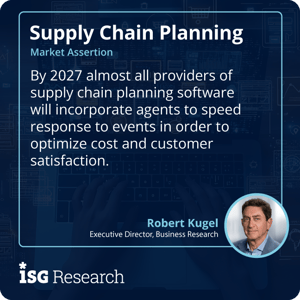 more flexible and responsive in replicating how people perform tasks and processes. Adding agents to the considerable body of well-developed business software takes the capabilities of these applications to the next level. This is especially the case for business tasks that involve orchestration of people and processes using a set of detailed, disparate data to forecast and plan future actions as well as managing day-to-day activities—specifically, SCP and execution. ISG asserts that by 2027, almost all providers of SCP software will incorporate agents to speed response to events in order to optimize cost and customer satisfaction.
The ISG Software Research Supply Chain Planning Buyers Guide™ is designed to support cross-functional decision-making rather than serve as a stand-alone selection tool. We created it to accelerate an enterprise’s request for information (RFI) or request for proposals (RFP) processes, using an evaluation framework intended to result in a more complete and informed evaluation and recognizing that, to be effective, SCP software selection is most valuable when it involves all stakeholders who collectively own supply chain strategy, execution, technology and risk. Our intention is to address the needs of supply chain executives and planning leaders who are accountable for forecast accuracy, inventory performance, service levels and cycle times, as well as CIOs and supply chain IT leaders who must assess architecture, integration, scalability and AI viability. Finance leaders who support planning benefit from understanding how planning tools drive financial alignment, scenario analysis and working capital outcomes, while program and transformation leaders can use the guide to anticipate implementation complexity, operating-model changes and change-management requirements.
The guide should be used to define evaluation criteria, shortlist providers and speed RFI/RFP cycles, but not as a replacement for process maturity assessments, data readiness analysis, proof-of-concept testing or reference validation. Its greatest value comes when a cross-functional leadership group uses the research as a shared reference point and translates it into a selection process grounded in the organization’s specific supply chain complexity and performance objectives.
I strongly recommend that supply chain professionals use our objective Buyers Guide as a starting point for their software provider selection. While it is common to hear that the pace of business has never been faster, business challenges remain essentially the same. Enterprises must be able to create products and services that meet market requirements, market and sell those products effectively, and operate efficiently and profitably, as well as attract and retain the human capital necessary to sustainably achieve those aims. What has changed are the tools for doing business, providing those enterprises that successfully adapt and learn how to use these tools with a competitive advantage. AI is playing an increasingly important role in SCP: It is a powerful tool that can separate winners from also-rans in the market. Enterprises with even moderately complex and lengthy supply chains must have a strategy and an evolving timeline for applying AI and generative AI (GenAI) to their planning processes. Those that do will have a cumulative strategic advantage over rivals that do not. Choosing the right software provider with the ability to provide AI-enabled tools will be important to facilitating adoption of this technology.
Regards,
Robert Kugel
Fill out the form to continue reading.