

Ten years ago, NiCE acquired inContact, and, in the process, began a radical transformation from its core business as a workforce application provider into a full-blown CCaaS and platform provider. It was a transformation as audacious and (ultimately) as well-executed as any I’ve seen in this industry. Now it’s clear that buying Cognigy last year will turn out to be just as significant a bet on a changed future as that reinvention in 2016. And perhaps just as necessary.
The NiCE World event in June was an opportunity to get a good feel for how the company is folding Cognigy’s technology into its own stack and how the executive team is building a narrative that coherently explains the changes to a curious buyer base. Buyers across the industry have been confronted in a short time with profound changes in the core technology that’s served them for decades, and are both excited by the possibilities and concerned about disruption and cost.
Against that backdrop, NiCE told a strong story. Cognigy has been integrated quickly and is now positioned as an essential part of the CXone platform. It is the substrate that allows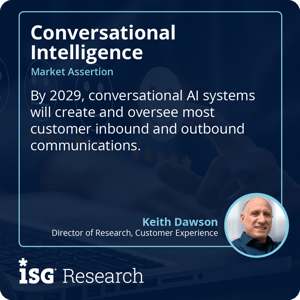 users to run AI agents, orchestrate processes, and extend contact center capabilities beyond the old-style “interaction machine.” It’s not an external, add-on facility; it’s a core element that’s fundamental, even essential to the things NiCE expects its customers will want to do. Indeed, ISG Research asserts that by 2029, conversational AI systems will create and oversee most customer inbound and outbound communications.
Until recently, one had to “have” AI to be taken seriously as a high-end CX or contact center provider. It didn’t really matter where in the suite the AI was deployed, or which combination of niche provider partners had to come together to supply it. If you “had” AI, you were invited to the discussion. That’s not a credible position anymore. Now, AI has to be at the core, not bolted on. It must be at the center of the platform, where it can be used for everything from routing to WEM to analysis to process automation, all centrally organized. And it must have a strong governance structure, especially as it moves into an agentic environment.
The model for the service tech stack has always centered around the interaction plumbing: the routing engine and its ability to optimize both call volume and the workforce. Now we have an industry-wide recognition that that’s the commodity stuff at the bottom of the stack. What sits above it (and what’s most valuable from a provider and buyer point of view) is the orchestration layer.
The orchestration layer contains a lot of optional components and capabilities, but the main point is that it allows for finer-grained control of the outcomes of the interaction environment. You can be proactive; you can interact based on behavioral characteristics; you can react in real time based on immense knowledge repositories that humans can’t analyze by themselves. But all of this is only possible if that orchestration layer is tightly bound to the interaction layer, and to the surrounding systems that hold various types of relevant, contextual data. And it’s only possible to execute such a layer with state-of-the-art AI.
There are some critiques of this strategy that focus on what might happen if some small, nimble AI startup shakes up the landscape with something completely new. That’s fair, as far as it goes. (What was Cognigy, after all, but a nimble AI startup with something completely new?) What we’re currently going through is so completely disruptive to existing practices that it will take time for buyers to absorb and operationalize what’s available today. And even if something stupendous comes out next quarter, there’s little appetite for a continuous, revolutionary treadmill. NiCE’s position in the market isn’t built just on Cognigy or AI. It’s due at least as much to the ability to meet customers where their needs are: highly efficient traditional operations, married to advanced interdepartmental analysis and proactivity, situated on a platform that grows with technology but doesn’t leave anyone behind.
Does that kind of tight connection foster lock-in to a single provider? Of course it does, and that’s part of what makes it attractive to providers like NiCE. But I question whether that really matters to contact center buyers who once installed an ACD and expected it to last for decades. I still encounter people who tell me they are using an IEX workforce management system (as an example), even though NiCE bought IEX in 2006 (and, to my knowledge, doesn’t encourage the use of that brand name anymore). That’s the strength and stickiness of some of the core elements of the interaction part of the stack. Contact center folks are not put off by lock-in at the basic level. IT teams responsible for decisions across the wider CX groups within the enterprise might take a different stance, but NiCE appears to be working hard to ensure that those stakeholders are comfortable with its AI strategy. For instance, there was a lot of discussion at NiCE World about governance structures necessary to make agentic orchestration real, practical and relatively painless. Some of the things buyers want to see in the NiCE/Cognigy platform are still works in progress—things related to auditing and compliance, model behavior and the relative openness of the platform. I did see a willingness by the NiCE team—eagerness, even—to engage frankly on the capabilities and timing of the things buyers are concerned about.
In his keynote address, CEO Scott Russell talked about fragmentation in the tech stack, arguing for platform integration as the answer to the chaos of the multi-provider environment. This is a perennial argument across technology, but it has particular salience at this moment when an endless parade of niche applications are bursting onto the scene. My gut tells me that the contact center buyer sees things similarly and wants a well-established platform to adjudicate and vet apps from somewhat unfamiliar niche providers.
So, if you’re in a position to buy or expand contact center tools, then NiCE’s moves are directionally good news for you. They suggest you can have confidence in the future trajectory of the platform and its components. NiCE won’t force you to go places you’re not ready for, but they’ll ensure that the platform isn’t stuck in an antiquated notion of what defines contact centers and CCaaS. And if you’re ready for a transformative, orchestration-friendly AI platform, you should absolutely consider CXone and Cognigy on your shortlist.
Regards,
Keith Dawson
About the author