

Play audio
Revenue leaders face a defining moment, which is why the time to define capabilities is now. As organizations brace for economic uncertainty, margin pressure and board scrutiny, the long-promised ROI of go-to-market technology is under intense evaluation. Sales productivity is declining, seller attrition is rising and CFOs are no longer tolerating technology bloat without measurable performance lift. Many companies still manage revenue with stitched-together spreadsheets and siloed tools, even as buyer behavior and deal velocity have permanently changed.
The challenge is not just complexity, but misalignment. Marketing, sales and customer success are often incentivized by conflicting metrics, favoring short-term gains over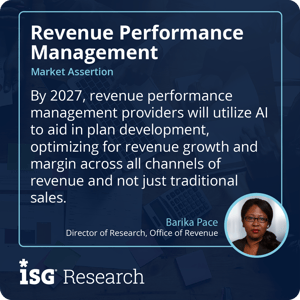 sustainable growth. Tools have proliferated faster than the processes they are meant to support. ISG asserts that by 2027, revenue performance management providers will utilize artificial intelligence (AI) to aid in plan development, optimizing for revenue growth and margin across all channels of revenue and not just traditional sales. But failure to take a strategic approach to your tech stack will result in a revenue engine that is data-rich but insight-poor, full of dashboards but starved for orchestration. Revenue leaders are left asking whether their current stack can predict risk, prescribe action and adapt incentives in real time.
The stakes are high. Without unifying strategy and operations through modern revenue operations (RevOps), companies risk missing their targets and losing credibility with both customers and boards. Organizations that centralize RevOps capabilities by integrating sales performance, forecasting and compensation logic are demonstrably more likely to exceed revenue goals and retain top performers. So, what capabilities should CROs invest in to lead in 2026, and which providers are signaling the future of RevOps?
The first signal is the shift from descriptive to prescriptive intelligence, and CROs cannot afford to ignore it. Legacy platforms like Salesforce and Microsoft Dynamics are embedding AI directly into the core of their systems. Microsoft’s Copilot and Salesforce’s Einstein 1 are evolving beyond automation to become real-time advisors, turning raw data into actionable next steps. These are not cosmetic upgrades; they reflect the growing expectation for systems that drive measurable revenue outcomes. The future winners will be those enterprises that connect predictive insights directly to incentives and account strategies, closing the loop between insight and action.
Newer players like Clari and BoostUp (now Terret) are pushing the envelope further. Built natively for RevOps, they define modern revenue intelligence around how CROs actually operate today. Clari’s deep orchestration capabilities make it ideal for enterprise leaders needing unified forecasting and pipeline accountability, while BoostUp’s agility and precision appeal to growth-stage CROs navigating hybrid or consumption-based models. If your forecast still relies on manual updates or disconnected tools, these platforms are essential. Revenue intelligence is no longer about what happened; it is about knowing what to do next.
Intelligent incentive management is also undergoing a quiet revolution. SAP and Oracle, long dominant in enterprise sales performance management (SPM), are modernizing with flexible rule engines and real-time visibility. SAP Commissions, for example, now integrates scenario modeling to test compensation plan changes against live pipeline data, a leap from months-long configuration cycles.
Much of the momentum comes from newer providers outside traditional ERP. CaptivateIQ, Spiff and QuotaPath simplify compensation plan management, scenario modeling and quota deployment. PaletteHQ extends variable comp design to cross-functional go-to-market roles like customer success and partnerships. As go-to-market structures flatten and hybrid motions grow, RevOps tools must support comp plans that flex with changing teams and strategies.
Orchestration—the connective tissue of RevOps—is becoming the next competitive frontier. Adobe is repositioning Experience Cloud as a cross-functional orchestration layer, while HubSpot is expanding Operations Hub to unify marketing, sales and customer data workflows. Emerging platforms like Syncari, Tray.io and Census tackle the tougher problem of integrating operational systems in ways that drive true automation. In these systems, a change in pipeline stage can trigger forecast adjustments, incentive recalculations and account team alerts automatically. Companies deploying orchestration tools see meaningful reductions in revenue leakage and dramatically shorter planning cycles.
Full RevOps operating systems are also emerging. Platforms like RevOps.io, PavilionIQ and Gtmhub aim to consolidate goal management, enablement, performance and forecasting into a single command center. While in the early stage, these providers point toward a future where CROs and CFOs can see, decide and act within one unified environment.
Legacy platforms are far from obsolete, but they are being redefined by the pressure to perform. Salesforce, Microsoft, SAP and Oracle are pivoting meaningfully, yet they are now measured against the same criteria as younger competitors: speed to value, interoperability and actionability. Emerging providers bring rapid innovation and specialized capabilities that make them indispensable in any forward-leaning RevOps roadmap.
CRO technology strategy in 2026 will be judged not by license cost or seat count but by revenue resilience, seller effectiveness and forecast accuracy. Success will require selecting platforms that act, not just report, and building a RevOps stack that adapts alongside the organization. The smartest leaders will combine the reliability of enterprise systems with the agility of new entrants to create a composable RevOps architecture. In this model, data flows seamlessly, AI augments human judgment and incentives align every seller’s action with company strategy. The revenue organization of the future will learn as fast as its market changes, integrating systems of record, engagement and intelligence into a single adaptive operating model.
CROs who win in 2026 won’t just optimize a quarter—they will architect resilience. The next generation of revenue systems will be judged by how quickly they detect risk, reallocate focus and reinforce behavior through incentives. RevOps transformation is ultimately about rebuilding trust: between forecast and reality, sellers and systems, and revenue promises and performance delivery.
I recommend CROs take these three steps. First, operationalize AI with intent: deploy intelligence that prescribes action and measures its impact on conversion, retention and margin. Second, unify incentive design with forecasting logic so compensation plans flex with changing market dynamics rather than lag. Third, treat data architecture as strategy, not just infrastructure, because the speed and accuracy of your revenue data will determine how quickly your business can adapt. CROs who execute on these imperatives will not only hit their number but will redefine how sustainable growth is built.
Regards,
Barika Pace
Fill out the form to continue reading.