

Revenue leaders entered 2026 under intense pressure to adopt enterprise artificial intelligence (AI), modernize their go-to-market operations and improve forecast accuracy at the same time. Many organizations are responding by adding new sales tools, AI assistants and workflow applications to an already crowded technology stack. The unintended consequence is that revenue teams often end up with more systems, more dashboards, and more activity data, yet less clarity about what is actually driving pipeline and revenue performance. If this pattern continues, the gap between sales activity and predictable revenue will widen even as technology spending increases. The question revenue leaders should be asking is not which new tool promises productivity gains, but whether adding another application will make the business easier or harder to run. The reality is that the next phase of revenue technology strategy is not about buying more sales tools. It is about building a revenue operating environment that enforces consistency, visibility and accountability across the entire revenue lifecycle.
The first step for CROs is to reframe the objective of revenue technology. For much of the past decade, sales technology investments were justified by productivity improvements for individual sellers. Tools promised to help sellers send more emails, automate follow-ups or prioritize accounts. While those capabilities matter, they do not address the central challenge most revenue leaders face today, which is operational confidence. Forecasts must now inform hiring plans, inventory decisions, investor communications and financial guidance. In this environment, the most valuable sales platform is not the one that helps sellers move faster. It is the one that ensures the organization is operating the same way everywhere.
CROs should therefore evaluate their current sales stack through a simple lens: Does the system enforce the company’s revenue process or does it simply document activity? Many organizations discover that their customer relationship management (CRM) and surrounding tools capture large amounts of data but allow different teams to qualify opportunities, manage pipeline stages and forecast deals in inconsistent ways. When that happens, technology amplifies variability rather than reducing it. A pipeline review becomes an exercise in interpretation instead of inspection. The result is a leadership team that spends more time debating the numbers than acting on them.
One practical action CROs can take is to conduct a revenue process audit before evaluating any new technology purchase. Instead of starting with providers, start with operating discipline. Review how opportunities are qualified, how stages are defined and how pipeline health is measured across regions and business units. Many organizations discover that different sales teams are effectively running different playbooks. Once those inconsistencies are visible, technology decisions become easier. The role of the platform is to enforce a shared operating model, not to accommodate every variation of it.
The second step is to rationalize the revenue technology stack around decision-making rather than functionality. Sales stacks have expanded rapidly because each tool solves a specific problem. One tool helps with prospecting. Another helps with call intelligence. A third helps with forecasting analytics. Over time, these tools accumulate into an ecosystem that appears sophisticated but actually fragments decision-making. Revenue data lives in multiple systems, each with its own definitions and workflows. As enterprise AI initiatives accelerate, this fragmentation becomes even more problematic because AI systems depend on consistent and trustworthy data.
CROs should work with their CIO or head of revenue operations to identify which systems truly function as systems of record for revenue execution. In most organizations this will include CRM, pipeline management and contract management platforms. These core systems should contain the authoritative version of revenue data and processes. Other applications should extend those systems rather than duplicate their logic. If a new tool requires a separate data model, a separate forecasting methodology or a parallel workflow, it is likely increasing complexity rather than solving it.
Another practical move is to establish a governance model for revenue technology purchases. In many companies, sales tools are acquired by individual teams or functions based on local needs. Marketing may adopt one engagement platform, sales development another and field sales a different analytics tool. Each purchase appears justified on its own. Over time, the organization ends up with overlapping capabilities and conflicting data structures. CROs should treat revenue technology as shared infrastructure rather than departmental tooling. New purchases should be evaluated based on how they strengthen the overall revenue operating system.
The third step is to align AI initiatives with revenue process maturity. Enterprise AI will undoubtedly influence how sales organizations operate. Automated account prioritization, conversational intelligence, and AI-generated insights are already appearing across the sales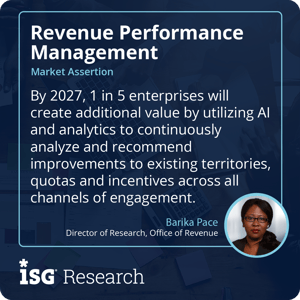 technology landscape. However, AI does not compensate for fragmented processes or inconsistent data. In fact, it often exposes those weaknesses. If the underlying pipeline data is inconsistent, AI-driven forecasting will produce inconsistent results. If opportunity qualification varies across teams, AI recommendations will reinforce those variations rather than correct them. ISG Research asserts by 2027, 1 in 5 enterprises will create additional value by utilizing AI and analytics to continuously analyze and recommend improvements to existing territories, quotas and incentives across all channels of engagement.
This is why many enterprise AI projects struggle to move from experimentation to operational impact. AI systems require a stable operating context in order to deliver reliable outcomes. CROs should therefore treat AI readiness as a process maturity problem rather than a feature adoption problem. Before deploying AI-driven selling tools, ensure that pipeline stages are consistently applied, forecasting definitions are standardized and customer data is governed across systems. When those foundations are in place, AI can accelerate execution. Without them, it will simply automate confusion.
Finally, revenue leaders should rethink how they measure the success of their sales technology investments. Traditional metrics such as seller adoption, activity volume or time saved only capture part of the picture. The more meaningful indicators are organizational outcomes. Is the forecast becoming more reliable quarter over quarter? Are pipeline reviews shorter and more decisive? Are cross-functional teams using the same data to make decisions? These signals indicate whether the technology is strengthening the company’s revenue operating model.
The next generation of revenue platforms will be judged less by how many features they offer and more by how effectively they support disciplined execution. In an environment defined by enterprise AI experimentation and rising expectations for predictable growth, CROs cannot afford a fragmented technology stack that obscures the truth about revenue performance. The most effective strategy is not to keep adding tools in search of productivity gains. It is to build a coherent revenue operating system that allows leadership to see the business clearly and run it with confidence.
Regards,
Barika Pace
Fill out the form to continue reading.