

The shift roster has always been a place where strategy becomes personal. It decides who works, when they work and how predictable their lives can be from one week to the next. When scheduling becomes more automated, the consequences show up immediately in worker sentiment, manager workload, overtime spend and service levels. That is why the rise of artificial intelligence (AI)-driven scheduling feels different than other HR technology shifts. It is not just another feature in the stack, because it touches time, fairness and trust all at once.
The market opportunity is easy to understand. Many organizations still build schedules with a mix of rules, tribal knowledge and last-minute fixes, even when demand is volatile and labor is expensive. AI-driven scheduling and planning promise better coverage, less labor waste, faster responses to call-outs and a more consistent way to handle constraints that managers juggle every day. In the best cases, the system can learn patterns in demand and availability, then propose schedules that reduce chaos rather than amplify it. That is a meaningful win for operations, and it is increasingly a baseline expectation in frontline-heavy industries.
The market issue is that a schedule is not only an optimization problem. It is also a fairness problem, and that is where many AI conversations get uncomfortable quickly. A model can produce an efficient roster that still feels unfair to the people living under it, especially when preferences are ignored, stability is low or undesirable shifts concentrate in the same pockets of the workforce. Even when outcomes are defensible, employees often have no visibility into why decisions were made, which makes every “optimized” schedule feel arbitrary. If the algorithm is running the roster, then the organization must decide what fairness means, how it is measured and what control mechanisms exist when the system gets it wrong.
One reason this is accelerating is that scheduling is being reframed from an operational chore into a frontline experience. In a prior analyst perspective, I explored the argument that it is not simply that smarter tools improve coverage, but that scheduling influences autonomy, trust, retention and worker expectations in ways many enterprises underplay. That framing matters because it shifts ownership from “the person who posts the schedule” to leadership teams who influence culture, engagement and workforce sustainability. It also makes clear that scheduling technology is never neutral because it encodes the organization’s priorities into the most tangible artifact employees receive each week.
As AI becomes embedded in workforce management (WFM), the algorithm starts to behave like a new layer of management. It decides which constraints matter most, which trade-offs are acceptable and what counts as a reasonable outcome when coverage conflicts with worker preference. That is a lot of power to grant a system without a shared set of guardrails and an operating model that supports oversight. HR has a direct role here, not because HR should own scheduling, but because HR is often the only function practiced in policy, governance and employee relations at scale. If the schedule is a daily expression of values, then HR should help define how those values are protected when decisions become automated.
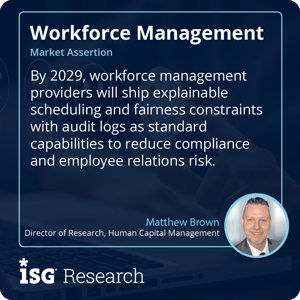 I assert that by 2029, WFM providers will ship explainable scheduling and fairness constraints with audit logs as standard capabilities to reduce compliance and employee-relations risk.
This reflects where the market is headed and why the buyer conversation is changing. Explainability is not a “nice-to-have” when the schedule impacts pay, overtime eligibility, fatigue, protected classes, union terms and perceptions of favoritism. Fairness constraints will not be meaningful if they are vague, so the organization will need to translate fairness into concrete rules and measurable outcomes that a system can follow. Audit logs will matter because the organization will need to show what happened, when it happened and why it happened, especially when exceptions and grievances occur. In practice, the schedule will start to look less like a weekly file and more like a governed decision workflow.
The hard part is that fairness is contextual, and it cannot be outsourced to the provider. One organization might define fairness around predictability and stability because irregular schedules drive attrition and absenteeism. Another might prioritize equitable distribution of premium shifts and undesirable shifts because perceived favoritism erodes trust faster than almost any other factor. Another might weigh compliance and fatigue constraints above everything else because the risk profile is high and the labor rules are complex. AI can support those goals, but it cannot choose between them, and a model trained only on historical patterns can easily repeat yesterday’s inequities with greater consistency.
Workforce planning raises the stakes even further because the schedule is where forecasts become reality. When planning remains siloed, the schedule becomes a constant patch job and managers absorb the gap through overtime, understaffing or burnout. When planning is integrated, scheduling can become the execution layer of a more proactive workforce strategy, not a weekly scramble. In a prior analyst perspective, I made the case that planning must move beyond rigid, reactive methods and become a shared business responsibility informed by multiple inputs across the enterprise. That matters here because algorithmic scheduling will only be as strong as the demand signals, skills signals and staffing assumptions it consumes.
Control is the other dimension HR must take seriously because “automation” is not one decision. Some organizations will use AI to recommend schedules while managers retain final control. Others will allow the system to auto-fill shifts inside guardrails, then route only exceptions to a human. Others will use AI to simulate scenarios that inform staffing and hiring, without touching weekly scheduling decisions at all. The right answer depends on risk tolerance, labor relations and the maturity of governance and data quality, not the sophistication of the demo. If the organization cannot explain outcomes and resolve disputes consistently, then more automation will produce more friction, not more value.
This shift matters to software providers because the differentiators will move beyond optimization into governance-ready capabilities. Buyers will look for systems that can express policy clearly, support worker input, explain trade-offs and make overrides visible and auditable. It matters to customers because scheduling outcomes are felt immediately, and that makes AI adoption a leadership issue rather than a back-office decision. If a model improves efficiency but harms trust, the organization will pay the price in churn, absenteeism and employee relations costs that do not show up neatly in the implementation business case. It matters to partners because success will hinge on change management, integration and ongoing tuning, not simply configuration and go-live.
The path forward is to treat AI scheduling as a governed workforce decision process, not a feature you toggle on. Define what fairness means in your environment and make it explicit enough that it can be configured, measured and explained. Start where the risk is manageable and the value is clear and insist on transparency in how decisions are made and how people can challenge outcomes when something feels wrong. Build the operating rhythm to monitor results, tune rules and keep policy aligned with business changes, because schedules break when the organization changes, but the logic does not. When AI runs the roster, the organization does not get to avoid responsibility for the schedule, it simply shifts responsibility from individual managers to the system designers and the leaders who govern it.
Regards,
Matthew Brown
Fill out the form to continue reading.