

Your application tracking system (ATS) may not be broken. It may be doing exactly what your hiring process told it to do. In a market buzzing with AI, agentic workflows and automation, that should make recruiting leaders pause before they blame the platform, replace the system or automate the next step in a process nobody has challenged in years.
Software does not get a free pass, and neither do the providers building it. Plenty of recruiting platforms still make common tasks harder than they should be. But many organizations have trained themselves to see hiring friction as a platform problem when the deeper issue is the flow of work behind it. The software becomes the visible target because it is where every slow approval, unclear intake question, duplicate step, awkward handoff and inconsistent decision eventually shows up.
An ATS is rarely just a database anymore. It is the workflow engine for requisitions, approvals, candidate movement, communications, interviews, compliance capture, dispositioning and reporting. When those workflows are built around old habits, local exceptions and unclear ownership, the system reflects that reality and preserves it with impressive discipline.
Many buyers get stuck in the same loop. They believe implementation froze a bad process into the system, and sometimes they are right. Then they move to another tool without fully examining what should change about the hiring flow itself. The new system gets a cleaner interface, a refreshed provider relationship and many of the same underlying behaviors.
I am an avid practitioner of the idea that process and tools should live in a continuous state of implementation and reimplementation. In a prior analyst perspective, I argued that go-live is not the end of HR technology work. It is the beginning of the work that determines whether the investment keeps delivering value. The same logic applies directly to recruiting. Hiring flows should be revisited when business priorities shift, candidate expectations change, manager behavior breaks down, new automation becomes available or system data no longer reflects how work is getting done.
The software should be the center of gravity, but not the only thing in the room. Recruiting teams cannot run a better process without using technology strategically, and they cannot use technology well without redesigning the process around it. Intake is a good example. If the role definition is weak, the approval chain is unclear and the hiring manager has not aligned on skills, expectations or decision criteria, the ATS can only move the confusion forward. Automating that intake does not make it better. It gives the confusion a faster ride.
AI makes this harder to ignore because recruiting leaders are being told it can write job descriptions, screen candidates, summarize interviews, recommend matches, generate outreach and help managers make faster decisions. Those capabilities can be valuable, but only when the hiring flow has enough structure to make them trustworthy. If the process has vague job criteria, inconsistent screening logic, weak interview discipline and poor disposition practices, AI will not create hiring maturity.
Providers have ownership in this problem because unlocking value from existing platforms requires more than shipping additional features. Customers need help seeing where workflows are breaking, which means better diagnostics, clearer configuration guidance, embedded adoption support, outcome visibility and governance tooling that helps teams understand how work is moving through the system. Buyers own the hiring design, but providers should make poor design harder to ignore.
In an earlier analyst perspective, I argued that recruiting technology is moving from requisitions as isolated transactions toward relationships that carry context across time.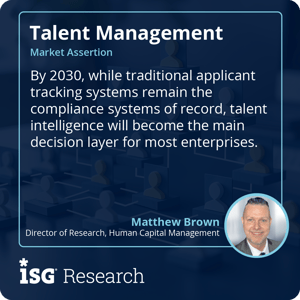 That shift does not make the ATS less important. It makes its workflow, data and governance foundations more important because the relationship layer and talent intelligence layer both depend on the quality of what sits underneath them.
By 2030, while traditional applicant tracking systems remain the compliance systems of record, talent intelligence will become the main decision layer for most enterprises. The ATS is not becoming irrelevant. Its role is changing, and that change raises the cost of weak workflows, poor data capture and inconsistent decision documentation. If the system of record is filled with poor decisions, inconsistent steps and weak evidence, the decision layer above it will inherit those weaknesses.
As more decision support moves outside the traditional ATS experience, the workflow underneath needs to become more coherent, not less important. Skills inference, candidate matching, structured interview guides, assessment signals, internal mobility recommendations and workforce planning data will increasingly influence who gets considered and how decisions are made. A talent intelligence layer cannot compensate for bad intake, unclear approvals, inconsistent interview feedback or weak governance over decision rights.
In another recent analyst perspective, my colleague Jeff Orr wrote about AI as governed autonomous work, with value tied to workflows, identity, controls and measurable outcomes rather than disconnected assistants or unmanaged agent experiments. Recruiting leaders should take that point seriously. The future of hiring automation is not a chatbot sprinkled over the ATS. It is governed workflow execution, with clear rules, human accountability, audit trails, bias controls, exception handling and measurable business impact.
Enterprise buyers should respond based on where they are in the journey. If renewal or replacement is on the table, audit the hiring flow before turning vendor evaluation into the main event. If the ATS is already in place but users are frustrated, treat the platform as something still being implemented, not something that finished implementation at go-live. If AI is being added, do not automate a step until the organization can explain what decision is being made, what evidence supports it, who owns it and how exceptions will be handled.
Software providers should see the same moment as an opportunity to move beyond feature expansion. Customers need help translating capability into disciplined hiring execution. Providers that expose workflow friction, guide better configuration, support continuous adoption and make AI governance practical will be better positioned than those adding automation to a process customers already distrust.
The ATS is not the villain. It is often the mirror. Before replacing it, blaming it or asking AI to work around it, recruiting leaders should look closely at what it is reflecting. The organizations that get the most value from recruiting technology will not be the ones chasing the cleanest interface or the newest automation claim. They will be the ones willing to redesign the hiring flow, keep reimplementing it as the business changes and use the software as the operating system for better decisions.
Regards,
Matthew Brown
Fill out the form to continue reading.