

I recently wrote about the evolving requirements for operational data platforms to support artificial intelligence (AI) workloads. Operational data platforms providers are rapidly updating their products, driven by the development of intelligent applications infused with contextually relevant recommendations, predictions and forecasting that are in turn driven by machine learning (ML), generative AI (GenAI) and agentic AI. Key requirements for operational data platforms now include vector storage and retrieval, advanced vector indexing, and support for agentic frameworks and standards, as well as instant provisioning, automated scaling and cloning, and branching of data and schema to optimize continuous integration and delivery (CI/CD). Although many operational data platform providers are adding these capabilities, maintaining and enhancing support for core database functionality remains paramount. Yugabyte is a prime example of a provider balancing the rapid introduction of innovative new features with enhanced support for more traditional database functionality.
Yugabyte was founded in 2016 by former Facebook software engineers with the goal of  creating a database that would deliver the scalability, reliability and developer-friendliness required to support the social media giant yet still be accessible to enterprises of all sizes. The company was one of the first providers to deliver what is now known as a distributed SQL database, combining the benefits of the relational database model and native support for distributed cloud architecture. YugabyteDB was designed to provide advanced horizontal scalability, resiliency, geo-distributed data replication and availability across multiple clouds as well as on-premises data centers. The company does not provide commercial support for the open-source YugabyteDB OSS, but commercial options are available in the form of its database-as-a-service offerings, which include the YugabyteDB Aeon managed cloud service and the self-managed YugabyteDB Anywhere. Yugabyte was classified as Exemplary in the 2025 ISG Buyers Guide for Operational Data Platforms.
The company also offers YugabyteDB Voyager to assist with the migration of existing applications from other data platforms to YugabyteDB. The product delivers functionality for assessing migration readiness and schema complexity as well as planning, optimizing and conducting data and schema migration.
YugabyteDB’s distributed SQL database is enabled by a layered architecture that splits operations between an extensible query layer that is responsible for handling and directing requests and a distributed storage layer that is responsible for storing data on disk as well as managing replication, load balancing and consistency. The YugabyteDB Query Layer enables interaction with operational applications via multiple APIs. These include the YSQL API for relational workloads, which offers compatibility with the PostgreSQL database, as well as the YCQL API for non-relational workloads, which is based on the Cassandra Query Language as used by the Apache Cassandra NoSQL database. In May, Yugabyte announced the beta availability of its MongoDB API to enable storing and operating on document-based data stored natively in the BSON format. The MongoDB API is powered by the DocumentDB open-source PostgreSQL extension, which was launched in January by Microsoft and is designed to provide compatibility with MongoDB’s document database.
The DocumentDB project should not be confused with Yugabyte’s DocDB distributed storage layer, which is responsible for transactions, sharding, replication and persistence. YugabyteDB supports a combination of synchronous and asynchronous replication that can be configured to fit performance and availability requirements. Synchronous replication in YugabyteDB is based on the Raft consensus-based replication protocol and is used to replicate data within a YugabyteDB “universe” spread across three or more data centers. YugabyteDB’s asynchronous xCluster replication can be used for disaster recovery replication between two independent universes and to provide fault tolerance between two data centers, as well as replication use cases between data centers that require low write latency.
Yugabyte delivered a significant update to YugabyteDB in January with the launch of compatibility with PostgreSQL 15, as well as support for uninterrupted PostgreSQL version upgrades and enhanced backup and disaster recovery. In addition to updating these core database features, the company has also delivered new features designed to support emerging requirements for AI workloads. In April, the company expanded its vector indexing capabilities in addition to its existing support for the open-source pgvector extension. As I previously explained regarding the evolving requirements for operational data platforms, while support for storage and processing of vectors has quickly become a table-stakes requirement for data platforms, vector indexing is becoming a key focus for differentiation as a means of improving the performance and accuracy of similarity search results. In July, the company announced support for Model Context Protocol with the launch of the YugabyteDB MCP Server as well as support for AI frameworks and models, including LangChain, OLLama, LlamaIndex, AWS Bedrock and Google Vertex AI. The April announcement also included a new Performance Advisor agentic app designed to help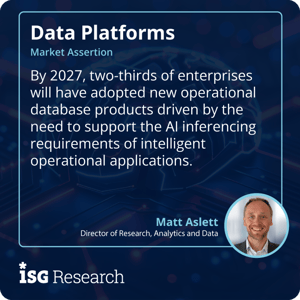 YugabyteDB Aeon users identify, analyze and understand the impact of performance issues. YugabyteDB Aeon is available on AWS, Azure or Google Cloud, managed by Yugabyte, or in a customer’s own cloud environment using a shared responsibility management model. Customers are also able to self-manage YugabyteDB in their own private data center or cloud environment with YugabyteDB Anywhere.
The requirement for emerging functionality to support intelligent applications has the potential to reshape the operational data platforms market. I assert that by 2027, two-thirds of enterprises will have adopted new operational database products driven by the need to support the AI inferencing requirements of intelligent operational applications. Yugabyte is well-placed to take advantage of this trend with its combination of core database functionality, capabilities to address AI workloads, and application and data migration tooling. Of course, it is not alone in positioning itself to support intelligent operational applications, and the company still has work to do to raise its profile given the ongoing dominance of the operational database market by established data management giants. Given the rapidly changing requirements, I recommend that enterprises assessing options for operational data platforms should include Yugabyte in their evaluations.
Regards,
Matt Aslett
Fill out the form to continue reading.