

There are many reasons why the contact center market is in flux, but chief among them is the drive towards convergence: traditional telephony, digital channels, customer relationship management (CRM), workforce tools and analytics are expected to operate as a unified system, rather than as a set of disconnected point solutions. This creates a problem for enterprises: how to modernize their customer experience (CX) processes without raising costs or sacrificing productivity, all on a coherent and integrated tech stack.
Zoho’s role in this landscape is not as a pure-play Contact Center as a Service (CCaaS) provider, but as a horizontally integrated business platform that embeds contact center tools within a broader CRM and CX ecosystem. Broadly speaking, Zoho’s role as a CX provider is to reduce friction in processes by consolidating customer data, automating routine work and augmenting human decision-making across sales, service and support environments, including contact centers.
Among the array of apps that make up the Zoho platform are several directly focused on support operations. Zoho Desk is its core customer service platform, and it links closely to Zoho CRM for customer context, Zoho Analytics for reporting, Zoho SalesIQ for digital engagement and chat, Zoho Voice for cloud telephony, and Zia AI for automation and agent assistance. In other words, there are apps tied into the back-office platform for most of the key functions contact centers need, minus the enterprise-grade CCaaS engine. Zoho is assuming that there are two types of apps needed now: the traditional, commoditized pieces for carrier-grade telephony and advanced workforce management on one side, and on the other, the higher-value apps that manage cases, perform analysis, deliver digital interactions and create automations. While not a CCaaS provider, Zoho is clearly a key part of the contact center provider landscape and is emblematic of how quickly and thoroughly the market dynamics in this area have shifted. The extent of Zoho’s role in contact centers is described in the recent ISG Research Buyers Guides for Contact Centers.
From Zoho’s point of view, it’s more important to approach contact center operations through the framework of CRM and process automation than to compete with legacy CCaaS companies on core infrastructure and telephony features. And this makes sense if you buy into the idea that the contact center isn’t supposed to operate in a bubble. Rather, it should be treated as just one operational node embedded within a larger tech stack focused on managing customer data and automating business workflows. Zoho appears to be prioritizing app simplicity, cost control and unified data over best-of-breed specialization.
For organizations already standardized on Zoho applications, this creates a compelling “good enough” contact center environment with lower integration overhead. For enterprises that still lean into carrier-grade voice or highly complex routing as their fundamental tool, Zoho’s approach is more complementary.
But what makes the CRM-inflected Zoho approach valuable for modern centers is how well it natively injects back-office functions into service operations. If you believe that the value of the contact center lies in how well it executes on enterprise CX strategies (and I do), then you have to marvel at how well Zoho can link rep activity directly to behind-the-scenes business processes. Customer interactions handled in the contact center are natively linked to CRM records, sales opportunities, marketing journeys, billing data, and analytics, without extensive middleware or custom integration.
So, centers get to act less as isolated cost centers and more as hubs that influence revenue, retention and service outcomes. In practice, Zoho’s value proposition is strongest for organizations that have a more CX-centric view of their contact centers. Those teams are perhaps more willing to trade depth in CCaaS specialization for coherence across back, mid and front offices.
For CX leaders and heads of customer service, Zoho represents a way to bring contact center operations into closer alignment with customer data, service processes and business outcomes without introducing another isolated platform. For CIOs and enterprise architects, Zoho’s approach reduces integration complexity and long-term platform sprawl by embedding service interactions directly into an existing application ecosystem. Zoho’s contact center capabilities can function in a limited standalone configuration (most commonly Zoho Desk paired with Zoho Voice or digital channels for inbound service), but the platform is clearly designed to be used in conjunction with Zoho CRM and other related CX applications.
Zoho’s contact center products can serve as an entry or expansion point into a much larger application suite. You may start with Zoho Desk for immediate support needs, then progressively layer in CRM, analytics, automation, marketing or potentially finance and project management applications. Along the way, you don’t have to sacrifice unified data models, reporting or automation as your Zoho footprint grows. Zoho argues that this model can lower TCO and governance overhead compared to managing multiple specialized providers. In the longer run, the contact center becomes a practical on-ramp to broader CX modernization rather than a one-off platform investment.
If Zoho can make this model work for customers at scale, it can reinforce the company’s position as a viable alternative to heavyweight CCaaS stacks. While Zoho may not aim to dominate the high-end CCaaS market, its app portfolio breadth does help it compete more effectively for enterprise-wide CX and operations buyers.
Zoho’s next moves in the contact center market are likely to focus on tighter orchestration across Zoho Desk, CRM, Voice, and Analytics, with incremental expansion of artificial intelligence (AI)-driven automation, agent assistance and cross-channel intelligence. This is sensible because the company isn’t ready to try to outbuild pure-play CCaaS providers on telephony depth, and why would they? They gain no distinctive advantage by following those competitors along that road.
Because of that, buyers should be evaluating Zoho more as part of a broader CX or business application strategy, rather than as a full-bore CCaaS replacement. This makes the most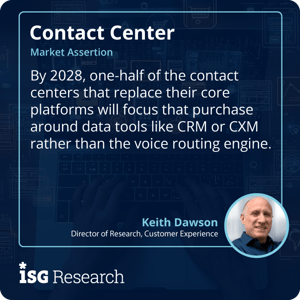 sense for mid-market enterprises that are looking for a bit more simplicity and cost control than they get with traditional CCaaS or complex CRM implementations. We predict that by 2028, one-half of the contact centers that replace their core platforms will focus that purchase around data tools like CRM or customer experience management (CXM) rather than the voice routing engine.
The perception of Zoho as a collection of SMB-focused niche applications is somewhat unfair. Based on the continued evolution of the underlying platform, and the emphasis on tying the disparate components together through AI and data management, I believe the Zoho CX portfolio is well-suited to the needs of many mid-market to large enterprises, especially those that are just now taking steps to rationalize and harmonize tools and processes that span CX departments.
Regards,
Keith Dawson
Fill out the form to continue reading.