

Genesys is an enterprise customer experience (CX) operating platform anchored in contact center execution. Over time, it has evolved beyond conventional interaction routing, with its strategic value increasingly centered on orchestrating how customer issues move between artificial intelligence (AI) and human agents. This positions Genesys as a platform for service transformation rather than simply an infrastructure or telephony replacement. To realize that value, enterprises must be prepared to redesign their service operating model around the platform, rather than deploy it as a technology upgrade within existing processes.
ISG Research asserts that by 2028, contact center software providers will allocate more
development resources to AI and tools for managing customer data than to voice routing or  workforce management. This shift changes the basis of Contact Center as a Service (CCaaS) competition. Genesys can no longer depend on routing scale or workforce optimization as durable differentiators. Its enterprise value will increasingly rest on applying AI and customer context to improve resolution while maintaining operational control. Customer-data ownership is not a Genesys advantage. Its strength is turning information held across enterprise systems into coordinated service action.
Genesys is strongest in large, complex service operations where fragmented decision-making can undermine consistency and customer outcomes. Its advantage lies in governing how work moves between automated and human-assisted service without turning the contact center into a patchwork of disconnected tools. This depth gives Genesys an edge over lighter-weight platforms, particularly when customer service has a direct impact on retention, revenue or business risk. Enterprises realize the greatest value 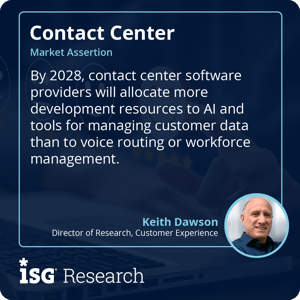 when Genesys
serves as the operating core for service rather than as an additional layer on top of legacy processes. Genesys’ position in the market is reaffirmed in ISG’s Contact Center Buyers Guide, where it was rated as Exemplary.
The platform is weaker when simplicity or system-of-record ownership drives the purchase. Smaller organizations can struggle to justify its scope, while customer relationship management (CRM)-native alternatives retain an advantage when the customer record matters more than contact center execution. Genesys therefore competes at the high end of CCaaS, where operational depth matters more than deployment. Its value is exhibited only when enterprises integrate it effectively and align the operating model around it. Weak execution turns the platform into an expensive layer with limited impact on service outcomes.
The ISG Research viewpoint is that enterprises should consider Genesys when the contact center is strategically important and AI-led service requires disciplined control. It is a strong fit for organizations prepared to standardize how service work is resolved across the enterprise. It is a weak fit for a tactical telephony refresh or a cost-reduction program built mainly around headcount removal. The business case should rest on better resolution and lower customer effort because those outcomes determine whether the transformation is real.
Genesys has a credible path from CCaaS provider to enterprise AI execution layer. The opportunity is substantial, but the market will not reward orchestration claims alone. Genesys must prove that governed AI can deliver reliable outcomes at scale to protect its enterprise position. Otherwise, CRM and cloud providers will capture more of the value around the contact center.
Fill out the form to continue reading.