

Play audio
ISG Research is happy to share insights gleaned from our latest Buyers Guide, an assessment of how well software providers’ offerings meet buyers’ requirements. The Data Observability: ISG Research Buyers Guide is the distillation of a year of market and product research by ISG Research.
 Maintaining trust in data remains one of the most persistent challenges in enterprise data management. Even with decades of investment in data quality initiatives, many organizations still struggle to ensure that data used for analytics and operations is accurate, reliable and accessible when needed. As enterprises accelerate automation and adopt artificial intelligence, the importance of trusted, high-quality data has never been greater. Poor-quality or inconsistent data can slow decision-making, introduce risk and undermine confidence in analytics and AI outcomes. To operate at the speed of business, enterprises must monitor not only the movement of data through pipelines but also its ongoing quality, freshness and reliability.
ISG Research defines data observability as providing the capabilities for monitoring the quality and reliability of data used for analytics and governance projects as well as the reliability and health of the overall data environment. The category builds on long-established data quality practices while introducing new methods to monitor and maintain the integrity of data pipelines. Inspired by application and infrastructure observability, data observability provides continuous visibility into data metrics, dependencies and interactions to ensure that data remains available, consistent and accurate.
Data observability emerged in response to the growing complexity of enterprise data ecosystems. Traditional data quality tools help identify and remediate issues, but they do so reactively and often focus on data already in use. By contrast, data observability platforms instrument the data environment itself, continuously collecting metrics and metadata from data warehouses, data lakes and pipelines. This instrumentation provides insight into lineage (the relationships between data sets), metadata (the descriptive attributes of data, such as format, schema and age) and logs of human or machine interactions. These metrics create a comprehensive picture of data health, enabling the proactive detection of anomalies before they affect downstream systems or business decisions.
Some data observability software extends this functionality further, applying machine learning and statistical modeling to automate anomaly detection and root cause analysis. Alerts, explanations and recommendations are generated to help data engineers and architects address issues quickly or prevent them from recurring. The ability to detect, resolve and prevent reliability issues across large and distributed data environments has made data observability an increasingly critical component of enterprise data strategy. It provides the real-time assurance needed to support analytics, governance and operational processes.
The importance of trust in data has never been greater, particularly as enterprises scale artificial intelligence. Data quality has long been a priority for business intelligence, but the stakes have increased as data now feeds automated, real-time decision systems. These systems are responsible for critical functions such as fraud detection, customer engagement and operational efficiency. As AI initiatives expand to the boardroom level, executives demand reliable data to support efficiency, innovation and growth. Data usability for AI applications is cited by more than one-half (54%) of participants in ISG’s Data and AI Programs Study as one of their biggest data challenges for 2025/6. Without trusted data, AI models can make poor or even harmful decisions that reduce confidence and slow adoption.
Assessing and maintaining the reliability of data used in analytics and AI is increasingly difficult due to the scale, diversity and velocity of modern data sources. Poor data processes can create security and privacy risks, increase storage and processing costs and erode the integrity of analytics and machine learning. Data observability software mitigates these challenges by automating the monitoring of data freshness, schema, distribution, lineage and volume. It complements traditional data quality tools by focusing on the reliability and overall health of the data environment rather than just the suitability of data for a specific task.
While both categories are interrelated, their focus differs. Data quality software evaluates whether data is accurate, complete, consistent and valid for a particular purpose. Data observability software, by contrast, monitors the operational health of data pipelines to ensure that data remains available and accurate before issues propagate. A failed data pipeline might not immediately affect data quality but could result in outdated or missing data later. Data observability detects the problem early, reducing downtime and avoiding costly remediation. Conversely, data quality tools may detect incorrect data values that pass schema validation but do not meet business rules. In practice, the two categories are complementary, often coexisting within the same enterprise.
This overlap is reflected in the vendor landscape. Some providers now offer functionality that spans both data observability and data quality. Others that historically focused on data quality have adopted the term data observability but may lack the breadth of pipeline monitoring and anomaly detection capabilities expected of mature observability platforms. Enterprises evaluating these tools should carefully assess the scope and depth of each product’s functionality to ensure it aligns with business needs. The strongest offerings integrate automated error detection, root cause analysis and remediation workflows, giving data teams the visibility and agility required to manage increasingly complex data environments.
The rise of Data Operations, or DataOps, has further driven the adoption of observability practices. DataOps applies agile and DevOps methodologies 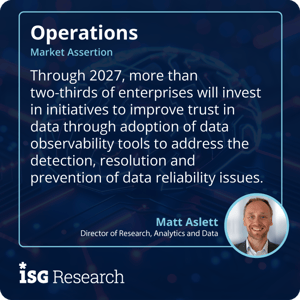 to data engineering, promoting continuous delivery and automated monitoring of data in motion. Data observability plays a foundational role in this framework, enabling teams to maintain consistent, trusted data pipelines that support both operational and analytical processes. In addition to specialized data observability software vendors, many DataOps platforms are incorporating observability capabilities to create unified environments for data development, orchestration and monitoring. This trend reflects the growing recognition that observability is essential to achieving end-to-end data reliability.
As data complexity and dependency increase, enterprises are focusing on proactive monitoring, automation and transparency to improve trust in data. ISG asserts that through 2027, more than two-thirds of enterprises will invest in initiatives to improve trust in data through adoption of data observability tools to address the detection, resolution and prevention of data reliability issues. Organizations seeking to strengthen their data foundations should explore how observability can be integrated into broader people, process and technology improvements. When combined with strong data governance and quality management, data observability provides a real-time, automated framework for ensuring that data remains accurate, reliable and ready for use across analytics and AI applications.
The 2025 ISG Buyers Guide™ for Data Observability evaluates software providers and products in key areas, including the detection, resolution and prevention of data reliability issues. This research evaluates the following software providers: Acceldata, Actian, Anomalo, Astronomer, Ataccama, Bigeye, Collibra, Datadog, DataKitchen, DataOps.live, Hitachi Vantara, IBM, Informatica, Monte Carlo, Precisely, Qlik, RightData, Sifflet, Snowflake, Tencent Cloud and Y42.
This research-based index evaluates the full business and information technology value of data observability software offerings. We encourage you to learn more about our Buyers Guide and its effectiveness as a provider selection and RFI/RFP tool.
We urge organizations to do a thorough job of evaluating data observability offerings in this Buyers Guide as both the results of our in-depth analysis of these software providers and as an evaluation methodology. The Buyers Guide can be used to evaluate existing suppliers, plus provides evaluation criteria for new projects. Using it can shorten the cycle time for an RFP and the definition of an RFI.
The Buyers Guide for Data Observability in 2025 finds Monte Carlo atop the list, followed by Pentaho and Acceldata.
Software providers that rated in the top three of any category ﹘ including the product and customer experience dimensions ﹘ earn the designation of Leader.
The Leaders in Product Experience are:
- Monte Carlo.
- Pentaho.
- Acceldata.
The Leaders in Customer Experience are:
- Informatica.
- Monte Carlo.
- Collibra.
The Leaders across any of the seven categories are:
- Monte Carlo which has achieved this rating in five out of the five categories.
- Acceldata and Pentaho in three categories.
- Informatica in two.
- Collibra, Datadog and IBM in one category.
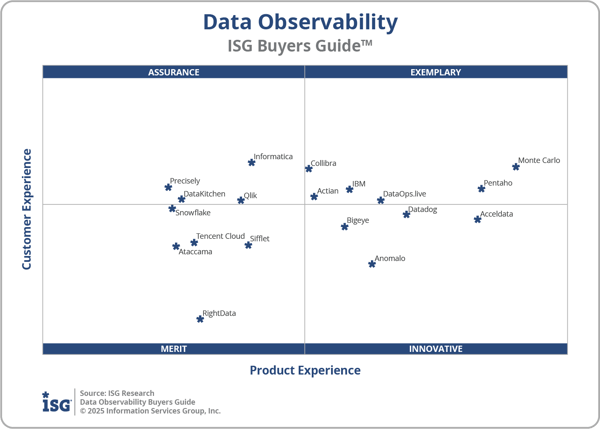
The overall performance chart provides a visual representation of how providers rate across product and customer experience. Software providers with products scoring higher in a weighted rating of the five product experience categories place farther to the right. The combination of ratings for the two customer experience categories determines their placement on the vertical axis. As a result, providers that place closer to the upper-right are “exemplary” and rated higher than those closer to the lower-left and identified as providers of “merit.” Software providers that excelled at customer experience over product experience have an “assurance” rating, and those excelling instead in product experience have an “innovative” rating.
Note that close provider scores should not be taken to imply that the packages evaluated are functionally identical or equally well-suited for use by every enterprise or process. Although there is a high degree of commonality in how organizations handle data observability, there are many idiosyncrasies and differences that can make one provider’s offering a better fit than another.
ISG Research has made every effort to encompass in this Buyers Guide the overall product and customer experience from our data observability blueprint, which we believe reflects what a well-crafted RFP should contain. Even so, there may be additional areas that affect which software provider and products best fit an enterprise’s particular requirements. Therefore, while this research is complete as it stands, utilizing it in your own organizational context is critical to ensure that products deliver the highest level of support for your projects.
You can find more details on our community as well as on our expertise in the research for this Buyers Guide.
Fill out the form to continue reading.