

Play audio
ISG Research is happy to share insights gleaned from our latest Buyers Guide, an assessment of how well software providers’ offerings meet buyers’ requirements. The Data Products: ISG Research Buyers Guide is the distillation of a year of market and product research by ISG Research.
 The rise of natural language analytics and generative artificial intelligence has accelerated enterprise initiatives aimed at data democratization—making data accessible to business decision makers without requiring them to master complex business intelligence tools. These advances have also underscored the need for shared semantic models, standardized business metrics and technologies that support the creation, sharing and consumption of reusable data products. As enterprises embrace data democratization, they increasingly recognize that information must be packaged, maintained and governed with the same discipline applied to any other enterprise asset.
ISG Research defines data products as the outcome of data initiatives developed with product thinking and delivered as reusable assets that can be discovered and consumed on a self-service basis. Each data product includes its associated data contracts and feedback mechanisms to ensure continuous quality improvement and transparency. Many enterprises first encountered this concept through data mesh, an organizational and cultural framework built on four principles: domain-oriented ownership, self-serve data infrastructure, federated governance and data as a product. While these principles reinforce one another, data as a product has emerged as a stand-alone discipline, emphasizing the need to design, deliver and maintain data outputs that can be shared and reused across the business.
The concept evolved in response to long-standing limitations in how enterprises traditionally delivered analytics. Historically, data assets such as reports, data marts or algorithms were built in isolated projects led by centralized IT teams. Each project created a silo of data optimized for a single purpose, often with duplication and limited reuse. Applying product thinking changes this model. It ensures that data is treated as a 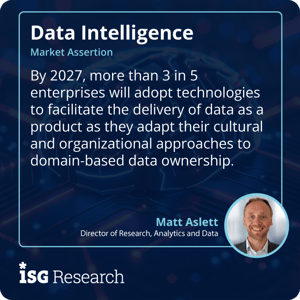 continuously maintained product designed for discoverability, usability and reusability. A data product can be a domain-specific data set, an algorithm, a machine learning model or even an operational application. The format is less important than the principle that guides its creation: the outcome must serve multiple use cases and be designed for ongoing improvement through feedback.
Product thinking also reinforces accountability. With domain-oriented ownership, business functions are responsible for managing and sharing the data they generate through standard interfaces and interoperable formats. This alignment between ownership and expertise improves data quality and timeliness. ISG asserts that by 2027, more than 3 in 5 enterprises will adopt technologies to facilitate the delivery of data as a product as they adapt their cultural and organizational approaches to domain-based data ownership. The result is a cultural shift in which data becomes both a shared enterprise asset and a business capability that fuels agility, analytics and innovation.
To achieve this transformation, data owners must behave like product managers. They must understand how data will be used across the enterprise and anticipate consumer needs. Product thinking requires transparency about the purpose, reliability and service expectations of each data product. This transparency is provided through data contracts, formal agreements between data owners and consumers that outline data structure, meaning, service-level expectations and licensing terms. Data contracts establish confidence that data products are accurate, consistent and up to date, enabling decision makers to rely on them for critical business insights. Complementing these contracts are data observability metrics, which monitor attributes such as validity, timeliness and completeness. Together, contracts and observability foster trust in data and provide clear expectations between data producers and consumers.
As demand for governed, reusable data increases, enterprises are turning to dedicated data product platforms designed to support the full lifecycle of development, publication and consumption. These platforms provide integrated environments for creating and versioning data products, tracking lineage, managing change and maintaining consistent metadata. Built-in templates help standardize data contracts and classification schemes. Self-service portals allow users to browse, discover and request access to data products while offering feedback, ratings and recommendations. Administrators and data owners can monitor usage patterns, manage dependencies and resolve issues, ensuring visibility into how data products are being applied across the business.
A robust data product platform must go beyond publishing and discovery to include native or integrated data operations capabilities. These include pipeline development and orchestration, testing environments and observability tools that track quality and lineage from source to consumer. Advanced solutions embed artificial intelligence to automate classification, tag relationships between data products and detect anomalies or duplication across domains. They also apply AI to assist in the development of new data products, recommend relevant assets to users and identify areas where data quality issues affect business outcomes.
As enterprises broaden their approach to data sharing, some platforms extend functionality to external audiences, supporting data monetization and partnerships. These capabilities include portals for licensing and pricing, compliance management for data sharing and APIs for controlled external access. While most data product initiatives today focus on internal sharing, extending to data-as-a-service represents a natural progression for organizations seeking to commercialize their high-value datasets while maintaining strict data governance and usage transparency.
The adoption of data as a product elevates the importance of foundational capabilities such as governance, cataloging and data quality. Making data available on a self-service basis depends on a shared understanding of data definitions, consistent entity resolution and interoperability across tools and domains. Many providers of data catalog software have expanded into this area, integrating features for data product development, discovery and management. These enhancements position catalog vendors as early leaders in enabling data product strategies. In parallel, providers of data observability software such as Monte Carlo and Sifflet are adapting their tools to group related data assets into domain-specific use cases. While they offer visibility into performance and quality, they generally do not support the full cycle of data product discovery, access and consumption required for inclusion in the ISG Data Products Buyers Guide.
Enterprises adopting data as a product can expect to accelerate the delivery of analytics and AI initiatives, reduce duplication of effort and enhance trust in the data used for strategic decision-making. To succeed, they should evaluate both cultural readiness and technology maturity. ISG recommends that enterprises begin by identifying domains best suited to own and maintain data products, then implement platforms that align to governance and self-service priorities. Buyers should assess the scalability, automation and interoperability of available solutions while considering vendor maturity and roadmap transparency.
The 2025 ISG Buyers Guide™ for Data Products evaluates software providers and products in key areas, including the development, classification, consumption, discovery and management of data products. This research evaluates the following software providers: Actian, Alation, Alteryx, Astronomer, Ataccama, Atlan, Collibra, Confluent, Databricks, DataGalaxy, DataOps.live, Denodo, Domo, Dremio, Google Cloud, Harbr Data, IBM, Informatica, K2view, Microsoft, One Data, Palantir, Qlik, SAP, Snowflake and Starburst.
This research-based index evaluates the full business and information technology value of data products software offerings. We encourage you to learn more about our Buyers Guide and its effectiveness as a provider selection and RFI/RFP tool.
We urge organizations to do a thorough job of evaluating data products offerings in this Buyers Guide as both the results of our in-depth analysis of these software providers and as an evaluation methodology. The Buyers Guide can be used to evaluate existing suppliers, plus provides evaluation criteria for new projects. Using it can shorten the cycle time for an RFP and the definition of an RFI.
The Buyers Guide for Data Products in 2025 finds Databricks atop the list, followed by Domo and Pentaho.
Software providers that rated in the top three of any category ﹘ including the product and customer experience dimensions ﹘ earn the designation of Leader.
The Leaders in Product Experience are:
- Databricks.
- Domo.
- Pentaho.
The Leaders in Customer Experience are:
- Databricks.
- Informatica.
- Alteryx.
The Leaders across any of the seven categories are:
- Databricks, which has achieved this rating in five of the five categories.
- Domo and Pentaho in three categories.
- Informatica in two categories.
- Alteryx and Microsoft in one category.
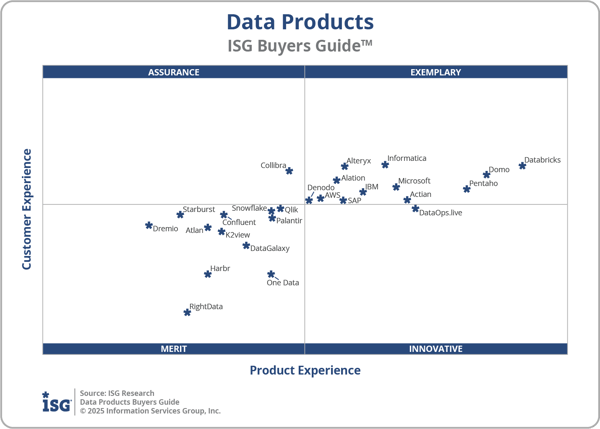
The overall performance chart provides a visual representation of how providers rate across product and customer experience. Software providers with products scoring higher in a weighted rating of the five product experience categories place farther to the right. The combination of ratings for the two customer experience categories determines their placement on the vertical axis. As a result, providers that place closer to the upper-right are “exemplary” and rated higher than those closer to the lower-left and identified as providers of “merit.” Software providers that excelled at customer experience over product experience have an “assurance” rating, and those excelling instead in product experience have an “innovative” rating.
Note that close provider scores should not be taken to imply that the packages evaluated are functionally identical or equally well-suited for use by every enterprise or process. Although there is a high degree of commonality in how organizations handle data products, there are many idiosyncrasies and differences that can make one provider’s offering a better fit than another.
ISG Research has made every effort to encompass in this Buyers Guide the overall product and customer experience from our data products blueprint, which we believe reflects what a well-crafted RFP should contain. Even so, there may be additional areas that affect which software provider and products best fit an enterprise’s particular requirements. Therefore, while this research is complete as it stands, utilizing it in your own organizational context is critical to ensure that products deliver the highest level of support for your projects.
You can find more details on our community as well as on our expertise in the research for this Buyers Guide.
Fill out the form to continue reading.