
I recently wrote about the development, testing and deployment of data pipelines as a fundamental accelerator of data-driven strategies as well as the importance of data orchestration to accelerate analytics and artificial intelligence. As I explained in the recent Data Observability Buyers Guide, data observability software is also a critical aspect of data-driven decision-making. Data observability addresses one of the most significant impediments to generating value from data by providing an environment for monitoring the quality and reliability of data. Maintaining data quality and trust is a perennial data management challenge, often preventing enterprises from operating at the speed of business.
The importance of trust in data has arguably never been greater. As enterprises aspire to be more data-driven, having confidence in the data used to make those decisions is critical. However, only 1 in 5 (20%) of participants 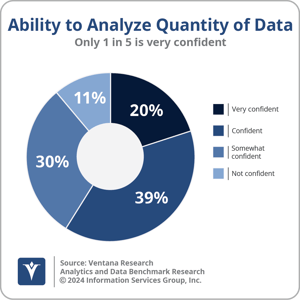 in Ventana Research’s Analytics and Data Benchmark Research are very confident in their ability to analyze the quantity of data needed to make informed business decisions. Without data quality processes and tools, organizations may make decisions based on old, incomplete, incorrect or poorly organized data. Assessing the quality of data used to make business decisions is not only more important than ever but also increasingly difficult, given the growing range of data sources and the volume of data to be evaluated. Poor data quality processes can result in security and privacy risks as well as unnecessary data storage and processing costs due to data duplication.
Enterprises have previously sought to improve trust in data using data quality tools and platforms to ensure that data used in decision-making processes is accurate, complete, consistent, timely and valid. Data observability complements the use of data quality products by automating the monitoring of data freshness, distribution, volume, schema and lineage as well as the reliability and health of the overall data environment. While data quality software helps users identify and resolve data quality problems, data observability software automates the detection and identification of the causes of data quality problems, such as avoiding downtime caused by lost or inaccurate data due to schema changes, system failures or broken data pipelines, potentially enabling users to prevent data quality issues before they occur.
Data observability is an important aspect of Data Operations, which provides an overall approach to automate data monitoring and the continuous delivery of data into operational and analytical processes through the application of agile development, DevOps and lean manufacturing by data engineering professionals in support of data production. Agile and collaborative practices were a core component of the Capabilities criteria we used to assess data pipeline tools in the Data Observability Buyers Guide, alongside the functionality required to support the detection, resolution and prevention of data reliability issues.
To monitor and measure anything, it must first be instrumented, so a baseline requirement for data observability software is that it collects and measures metrics from data pipelines, data warehouses, data lakes and other data-processing platforms. Data observability software also collects, monitors and measures information on data lineage, metadata and logs of human- or machine-based interaction with the data. In addition to collecting and monitoring this information, some data observability software also enables the creation of models that can be applied to the various metrics, logs, dependencies and attributes to automate the detection of anomalies.
Data observability software may also offer root-cause analysis and the provision of alerts, explanations and recommendations to enable data engineers and data architects to accelerate the correction of issues. I assert that 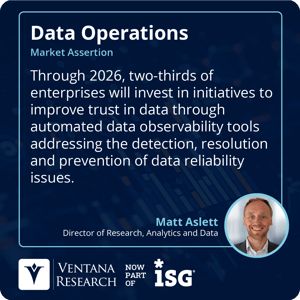 through 2026, two-thirds of enterprises will invest in initiatives to improve trust in data through automated data observability tools addressing the detection, resolution and prevention of data reliability issues.
Data observability is just one aspect of improving the use of data within an enterprise, alongside the development, testing and deployment of data pipelines and data orchestration. Nevertheless, I recommend that all enterprises explore how data observability can help increase trust in data as part of a broader evaluation of the people, processes, information and technology improvements required to deliver data-driven decision-making.
Regards,
Matt Aslett
About the author