

I recently attended ADP’s 2026 Rethink event and had the chance to hear the company’s latest thinking for its international clients and analyst community. The HCM market is shifting quickly. AI is accelerating across the enterprise, labor markets are reshaping themselves, and buyers increasingly expect unified platforms that connect HR, payroll, workforce management, data, and intelligence. ADP is clearly trying to reposition itself in this context. The company wants to be seen not only as the most trusted payroll provider on the planet, but also as a full-suite HCM platform with the scale and credibility to serve global enterprises. Rethink 2026 showed real progress in that direction, especially in AI governance and the expansion of value-add services. At the same time, it left notable gaps—particularly around the visibility and momentum of the Lyric HCM suite. The result was a mix of strong vision, uneven emphasis, and emerging signals worth watching.
ADP’s leadership highlighted three major areas this year: responsible AI, expanded services around transformation support, and continued global investment. The AI story was the clearest and most polished of the three. ADP’s governance model is disciplined, transparent, and considerably more mature than most competitors. Its commitment to human oversight, clear reasoning paths, and continuous bias testing reflects a practical understanding of what global enterprises increasingly expect: trustworthy automation, not experimental hype.
The second area—value-add services—received more attention than in prior years. ADP is leaning into advisory, readiness assessments, and transformation guidance that help large buyers manage complexity before the technology is even switched on. This is practical support that reduces risk during pre-sales, implementation, and early adoption. It aligns neatly with one of my assertions: that by 2028, HCM providers will shift generative AI differentiation from feature counts to adoption enablement, with packaged use-case playbooks, governance templates, change assets, and value tracking becoming standard. ADP appears to be moving in this direction, even if the messaging is still early.
The third theme was global scale. ADP reinforced what has always been its strongest differentiator: payroll accuracy, in-country expertise, regulatory depth, and security. The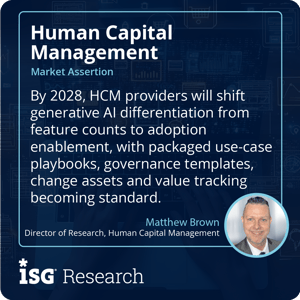 message was clear. Whatever else ADP becomes as a platform provider, it intends to stay the safest and most resilient payroll backbone in the world.
What was noticeably missing was a sustained focus on Lyric HCM. After a high-profile launch at HR Tech 2024, Rethink included little on global readiness, customer references, deployment scale, or roadmap clarity. For a vendor trying to shift market perception, this was an opportunity left unused.
ADP sits at an interesting crossroads. The company has all the raw ingredients of a modern, global HCM platform, but the market still largely identifies it with payroll. That perception persists, in part, because ADP has not consistently messaged the evolution of its broader suite. Many buyers still don’t know what Lyric can actually do, where it works today, and how quickly it is scaling.
However, beneath the surface, ADP is doing important work that could meaningfully reshape its position. The ADP Research Institute continues to produce some of the most compelling workforce analytics in the market—from labor market modeling to AI task analysis. These insights could become a powerful differentiator if more directly linked to product strategy. Enterprises don’t just want automation; they want guidance, context, and intelligence built into the tools they use daily. ADP is positioned to do that more credibly than most, but the connection needs to be tighter and more explicit.
For buyers, the implications break down by persona:
- CHROs should pay attention to how ADP is integrating insights into talent, pay, scheduling, and workforce planning. The company’s research foundation could eventually give HR leaders a more strategic line of sight into workforce dynamics than typical HCM platforms provide.
- Payroll and compliance leaders will find ADP difficult to beat. Accuracy, local expertise, and governance are areas where ADP remains in a category of its own.
- CFOs and CIOs will care about the security posture, audit readiness, and process standardization ADP brings to global operations.
But persistent questions remain. How global is Lyric today? How mature is it in enterprise-scale environments? And how aggressively will ADP promote it? Until ADP becomes louder and more visible with real customer stories, the broader suite will lag behind its payroll reputation.
Still, the direction is clear. ADP is evolving into a holistic HCM provider that brings together an enterprise platform, responsible AI, and unparalleled payroll capability. For companies that value resilience and long-term stability, this trajectory merits attention.
Organizations evaluating ADP should recognize the strengths that remain unmatched: scale, compliance depth, product security, and a responsible approach to AI. These foundations alone make ADP a compelling option in any global HCM or payroll transformation. At the same time, buyers should push for more detail on the Lyric HCM suite, including global rollout plans, regional capabilities, customer references, and future roadmap commitments.
ADP has the potential to mature into a full enterprise HCM player, not just a payroll giant. The company’s value-add services, research insights, and disciplined product philosophy signal a provider moving in the right direction. With the right due diligence from buyers, ADP can be a strategic partner that delivers both operational confidence and long-term growth. For organizations conducting that due diligence, our latest HCM Buyers Guide provides a structured view of the market, critical evaluation criteria, and emerging provider trends.
Regards,
Matthew Brown
Fill out the form to continue reading.