

Payroll is no longer a back-office function. It has become a frontline trust engine that touches every worker, every pay cycle and the moments that matter most. When pay is right, confidence grows quietly and people focus on the work in front of them. When it is wrong, trust fractures instantly and the damage is disproportionate to the size of the mistake. Frontline employees feel this most because payroll is inseparable from their daily lives and financial realities. One error can linger as a signal that the organization did not show up when it mattered. That is why payroll should be viewed not as a process but as a platform for confidence.
The urgency of this shift is being driven by changes in business models, technology maturity and employee expectations. Organizations are blending worker types, expanding locations and entities and transforming scheduling and time capture. It is no longer enough for payroll to compute totals at the end of a cycle. Payroll must participate in the flow of work, anticipate issues upstream and help managers and employees make informed decisions in real time.
Trust in payroll rests on a few fundamentals that sound simple and are difficult to achieve at scale. Accuracy is the foundation. Timeliness is the expectation. Transparency is the differentiator. Employees do not only want a number; they want to understand what changed between pay periods, why a deduction appeared and how premium rules were applied. Clear explanations in plain language and accessible records turn pay from a black box into a system that respects the worker’s need for clarity. When those elements are missing, even a small variance can feel like a breach.
Seeing payroll as a platform forces a design choice. The system has to orchestrate inputs across human capital management (HCM), workforce management, time, scheduling and finance, with governance that prevents errors rather than cleaning them up after the run. Most pay issues originate upstream in messy data, missed approvals, late schedule changes or misapplied rates. A trust-centric payroll platform detects those paths early and guides the right person to the right fix before the run is blocked. That approach reduces defects, shortens resolution times and gives employees confidence that the organization is attentive to the moments that matter most.
Features that signal trust are becoming mainstream, and they matter because workers feel them in real time. Real-time pay and earned wage access give employees agency when cash flow is tight. Transparent pay dashboards show what changed, when it changed and the reason behind it. These are today’s markers of respect and reliability in the pay experience.
Operational foundations give those signals durability. Data quality must be treated as an operational risk, not a project task. Localization should be comprehensive and tested in real scenarios, including multi-entity payroll with different calendars and rules. Audit trails must be clear enough to reconstruct the path of a defect without a forensic expedition. Manager nudging is valuable only when it is timely and specific. The most trusted payroll platforms make the path from detection to resolution simple, and they do it in language that is readable and direct.
Providers are beginning to embrace the trust narrative, especially those targeting frontline worker segments where payroll errors have immediate impact. The danger is turning trust into a marketing theme without the operational evidence behind it. Providers that lead will prove trust with measured reductions in defects, faster cycle times, clear pay explanations and strong adoption of transparency features. They will treat orchestration as a product capability rather than a services promise, and bring forward hardened integrations that show how governance prevents errors at the seams. For providers looking to benchmark capabilities and competitive positioning, our Payroll Buyers Guides offer detailed evaluation criteria and market insights.
Buyers have a role in making trust measurable and actionable. Each workforce has its own realities, and trust should be defined accordingly. A frontline retail operation will value same-day corrections and clear premium rules for split shifts. Buyers should ask for prevention proofs in pilots and demos, require human-readable explanations and test stress scenarios that mirror organizational operations. Trust is not a one-size-fits-all score. It is a set of outcomes that can be observed and improved. For deeper evaluation frameworks and provider comparisons, check out our most recent Payroll Buyers Guides.
The market consequences of treating payroll as a trust platform are already visible. Win rates shift toward providers who demonstrate prevention and clarity. Renewal conversations change when defect trends move in the right direction. Buyers are rewriting RFPs to include scenarios that expose orchestration weakness and governance gaps. Trust is becoming a competitive differentiator, not a slogan.
By 2028, one-half of all payroll systems will improve the accuracy of—and minimize the need for—manual adjustments by adopting AI-infused platforms that predict and guide for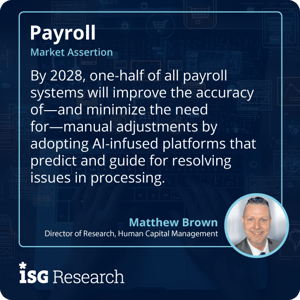 resolving issues in processing. That forecast captures the direction of travel for the category and emphasizes a practical point. The value of AI in payroll is not the label on a feature; it is the reduction of defects and the increase in confidence employees feel when problems are prevented and explanations are delivered before anxiety sets in. The center of gravity is shifting from calculation to communication and prevention. Payroll that computes quickly but fails to explain will not earn trust. Payroll that explains clearly but does not prevent defects will not keep trust. The platforms that win will do both and will align product roadmaps, integration strategies and customer success practices to that dual mandate. When payroll shows up in this way, employees believe the organization is paying attention to their lives, not just their hours. That belief is the essence of trust, and it is earned one clean, well-explained pay at a time.
Regards,
Matthew Brown
Fill out the form to continue reading.